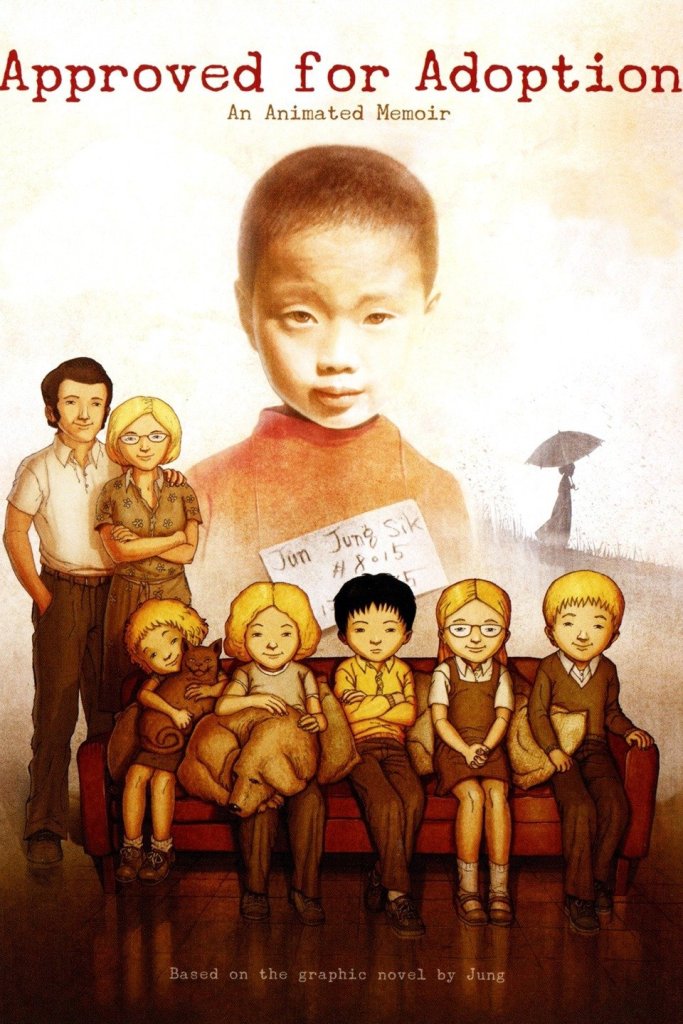
Jung was 5 years old and wandering a South Korean street by himself when he was found by a policeman. The Western world awaited; the boy would be among more than 200,000 Korean children adopted in the aftermath of the Korean War. In May 1971, a Belgian family brought Jung Henin home. “It was like getting a new car,” recalls Jung, describing how his adoptive parents might have considered the addition, “but it needed more looking after.”
Known professionally simply as Jung, the illustrator and graphic novelist recounts his childhood in the lovely, low-key Approved for Adoption. Blending hand-drawn and computer-generated animation, Jung and co-director Laurent Boileau utilize Super 8 home movies, newsreels and modern-day live-action footage for a mosaic of vignettes about identity and the need to belong.

William Coryn provides the voiceover narration (the movie is French language) of adult Jung reminiscing about his youth while searching through contemporary Korea for information about his past. Our point of view never strays from Jung.
Because the Henins already have four kids when they adopted him, Jung’s childhood acclimation often proves chaotic. He undergoes the requisite rites of passage, from mild mischief to young crushes (including one on the Henins’ oldest daughter), while his memory of Korean culture gradually fades.

Yet he still feels like a tourist in his home. Even Jung’s new grandmother tends to discount him. “I keep forgetting about your little Asian,” she tells the Henins (voiced by Jean-Luc Couchard and Christelle Cornil). Jung’s mother gives mixed signals. She is nurturing but also not above exploiting her adopted son’s “otherness” when she is angry. Jung’s own free-floating hostility ekes out in various ways. He steals, defies his parents and seeks refuge in his innate artistic gifts.
Jung’s relationship to Korea is equally ambivalent. He is both drawn to and embarrassed by other Koreans. And he recognizes that there are advantages to knowing nothing about his biological parents – especially for someone with an imagination as fertile as Jung – since “they can be just the way you like.”
Split identities abound in Approved for Adoption, from the 38th Parallel that separates North and South Koreas to Jung’s internalized divisions between East and West. The film is melancholy and leisurely paced, and it manages to capture the experience of being an adopted child while tapping into more universal themes. It’s a small but absorbing movie, and more proof that the rewards of animation go far beyond talking dogs and hawking merch.
 Cutting to the Chase with Phil Bacharach