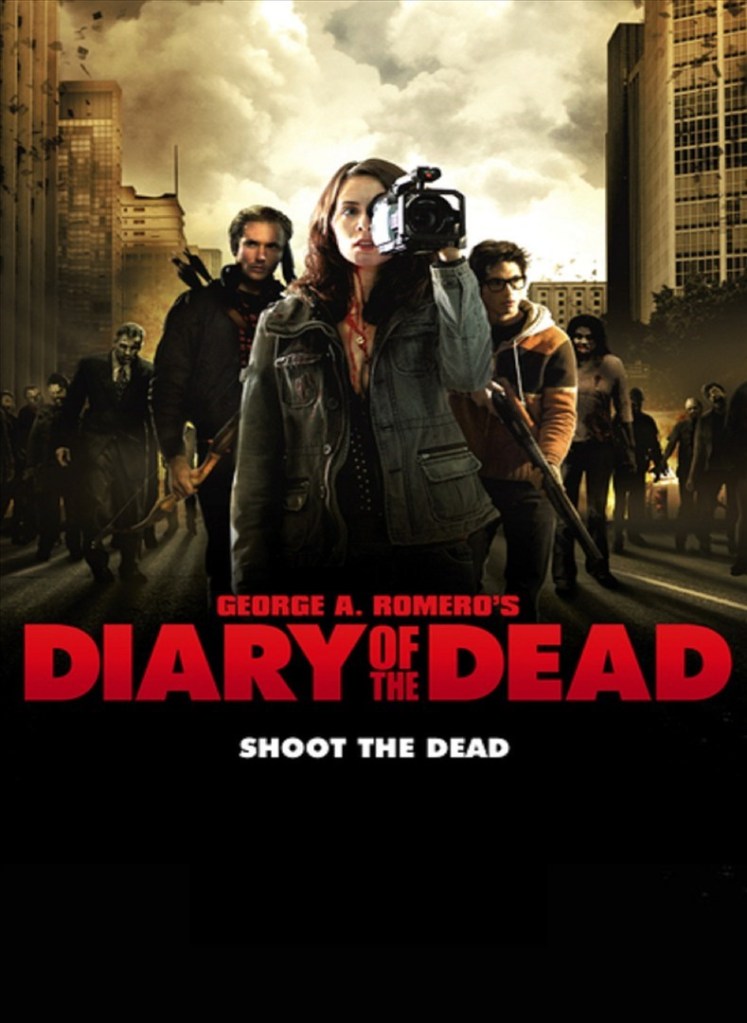
As the granddaddy of the modern-day zombie flick, George A. Romero understood that the undead are much more than simply people who have a good reason for smelling bad. He recognized that zombies make for potent metaphors with (considering the constraints of rigor mortis) surprising malleability. One minute, they’re fearsome monsters with an insatiable need to feed on the living; the next, they’re mindless cretins suitable for target practice.
In the first (and best) of Romeo’s zombie pictures, 1968’s Night of the Living Dead, he used the flesh-eating stiffs as a launching pad for tweaking race relations in America and the dissolution of the nuclear family. Later, Romero unearthed the undead to satirize consumerism (Dawn of the Dead, 1978), militarism (Day of the Dead, 1985) and income inequality (Land of the Dead, 2005).
The medium is the message being skewered in Diary of the Dead, when the 68-year-old writer-director turned his attention to a generation cocooned by information technology. The resulting film is both provocative and overstuffed with ideas. Where Romero once made horror interspersed by social commentary, here he has made social commentary interrupted by occasional horror. It’s the least scary of his zombie films, but gorehounds willing to entertain more than entrails will find this to be a revealing Diary.
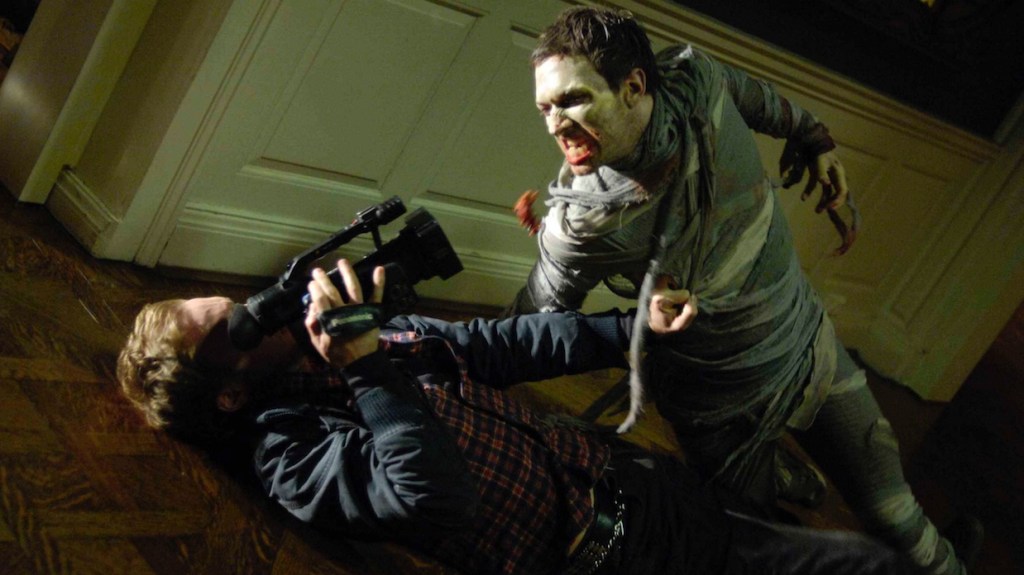
Borrowing the “found footage” structuring device popularized by The Blair Witch Project and Cloverfield, Diary of the Dead is sort of a movie within a movie. The conceit is that a group of college students are shooting a mummy movie in rural Pennsylvania when the world is overrun by bloodthirsty dead folks. The student-director, a wannabe documentarian named Jason (Joshua Close), quickly nixes the mummy flick, herds the small cast and crew into a Winnebago and sets out for a safe area.
Jason vows to record every minute of their nightmare journey across the zombie-strewn countryside. “The camera is the whole thing,” he says with voyeuristic fervor, determined to capture the apocalyptic truth for the benefit of future generations. His zealousness doesn’t sit well with his colleagues, including his girlfriend (Michelle Morgan), a film-school rival (Shawn Roberts), a feisty leading lady (Amy Ciupak Lalonde) and a booze-addled professor (Scott Wentworth), Jason wants cinema verité, but the others just want to get home for loved ones who may (or may not) still be alive.
Diary of the Dead is carpeted in the sights and sounds of digital-age media – a miasma of Internet grabs, surveillance camera, streaming video and the insistent chatter of news anchors (featuring cameos by such paragons of fright as Stephen King, Quentin Tarantino and Guillermo del Toro).
Jason is eager for his documentary, ominously titled The Death of Death, to join the chorus of cyberspace. He is overcome with emotion after uploading a portion of his footage on YouTube, marveling, “72,000 hits in eight minutes!” As Diary suggests, Jason is emblematic of a tech-savvy generation that has let technology short-circuit its capacity to feel and react. Who are the real zombies?
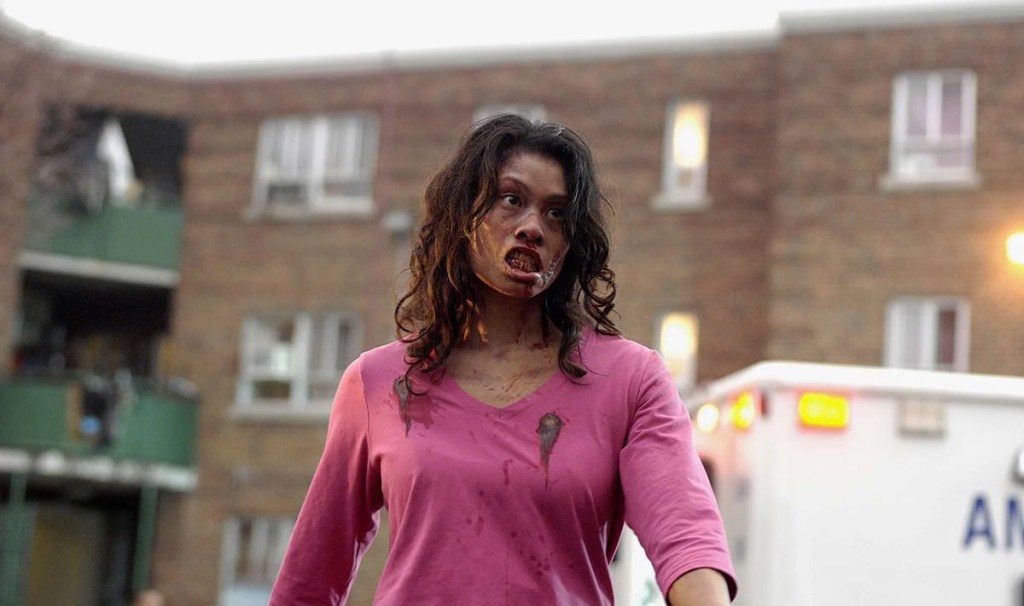
While Romero has plenty to say about the numbing properties of mass media, and some of it none too subtle, this is no dry sociological tome. Diary might not send shivers up the spine, but it is his darkest, most claustrophobic zombie saga since Night. There is enough chomped flesh, spattered blood and creative impalings to satisfy a viewer’s gore tooth. And Romero’s twisted humor ranges from the badass fears of a deaf Amish farmer to a particularly unpleasant clown at a child’s birthday party.
Moreover, in a sly rebuke to how movie zombies picked up considerable speed in the wake of 28 Days Later and other post-Romero horror, the old master reminds us that real zombies don’t sprint. “Dead things done move fast!” Jason barks at his actor playing the mummy in the student film. “You’re a corpse, for Christ’s sake! The script says the mummy shambles!” Like any self-respecting zombie, Diary of the Dead moves at a measured pace, but its final resting place is worth paying your respects.
 Cutting to the Chase with Phil Bacharach