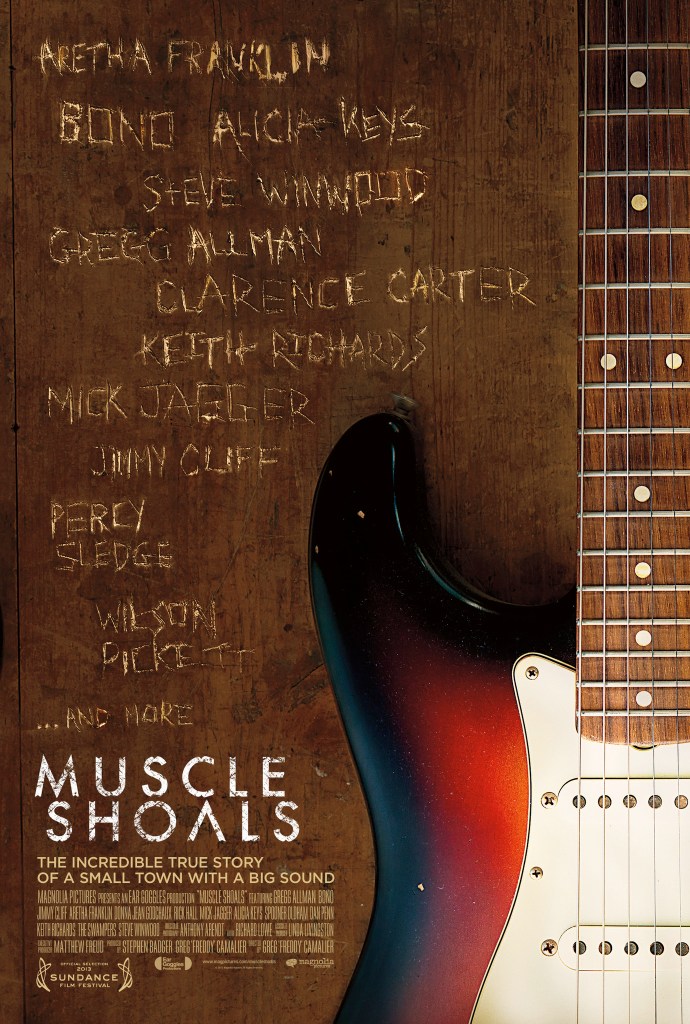
The documentary Muscle Shoals chronicles the oddity of Muscle Shoals, Ala., a tiny town near the Tennessee River that became an improbable birthplace for some of the most soulful music of the 20th century.
At the center of the Muscle Shoals miracle is Rick Hall, a stone-faced guy with a hardscrabble past, who in the late 1950s opened the FAME recording studio in the town. Among the first singers he recorded was a local bellhop, Arthur Alexander, whose “You Better Move On” became a hit. It was the launch of an astonishing run that would include the likes of Wilson Pickett, Aretha Franklin and Etta James, all of whom are interviewed here.

Hall was a gifted producer and shrewd businessman, but arguably his greatest attribute was FAME’s in-house band, the Muscle Shoals Rhythm Section. Dubbed “The Swampers” by Oklahoma’s own Leon Russell, the motley group of southern good ol’ boys was so soulful and funky that newcomers to the studio were shocked to learn that the musicians were white. “These cats are really greasy. You’re gonna love it,” Aretha Franklin recalls being told by Atlantic Records impresario Jerry Wexler before her inaugural trip to FAME.
But that session, which produced the immortal “I Never Loved a Man (The Way I Love You),” also began a chain of events that would culminate in a new direction for Hall. A dispute between Franklin’s then-husband and a FAME trumpeter led to a falling out between Hall and Wexler. Members of The Swampers later formed a rival studio in Muscle Shoals and recorded Traffic, Lynyrd Skynyrd and The Rolling Stones. Hall remained an in-demand producer, but his musical pursuits eventually steered toward the likes of the Osmond Family and Paul Anka.

The filmmakers are fortunate to have reams of archival footage at their disposal; Muscle Shoals is best when it lets its interviewees mosey down memory lane. Percy Sledge was a local hospital orderly when he cut “When a Man Loves a Woman” at FAME; the singer approximated the vocal styling of cotton pickers he had heard in the region. Clarence Carter remembers being skeptical when Hall insisted he record “Patches,” a grim tale that the producer had penned as a tribute to his own late father. The track hit No. 2 on the charts in 1970.
The movie is less successful when director Greg “Freddy” Camalier reaches for deeper meaning. Why did such remarkable music come from this flyspeck of a place? Answers surely don’t come from the doc’s scenic shots of Muscle Shoals and pontificating from Bono. Thankfully, Muscle Shoals has too much soul for that.
 Cutting to the Chase with Phil Bacharach