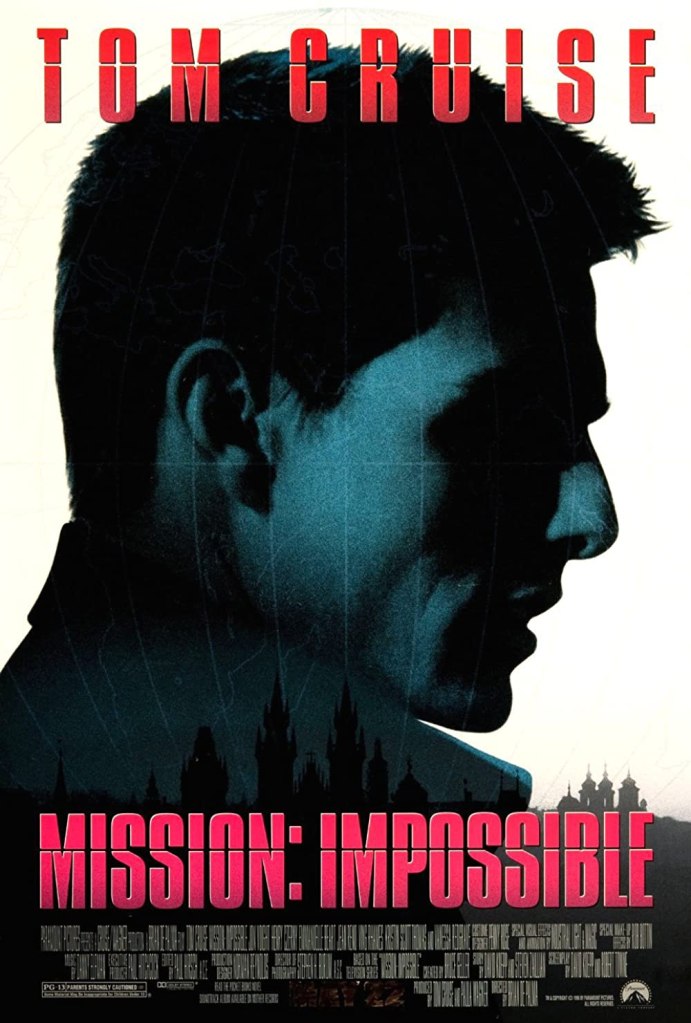
Loosely based on the espionage TV series of the late 1960s, Mission: Impossible finds Tom Cruise as secret agent Ethan Hunt, the point man for a team of IMF spies headed by Jim Phelps (Jon Voight reprising the only character originally from the TV show). Trouble ensues when Phelps’ team is assigned to keep a list of U.S. spies’ covert identities from falling into the hands of a mysterious baddie named Max (Vanessa Redgrave). Ethan and his colleagues try intercepting the sale at a cocktail party at the U.S. embassy in Prague, but all the agents are slain in an ambush.
All except Ethan, that is. Being the sole survivor doesn’t sit too well with IMF chief spook Kittredge (Henry Czerny), who informs Ethan that the mission had been a subterfuge to ferret out a traitor on Phelps’ team. And since Ethan is the last guy left standing …Well, you get the picture. Now suspected by his own agency of being a traitor, Ethan must clear his name and track down the real mole.
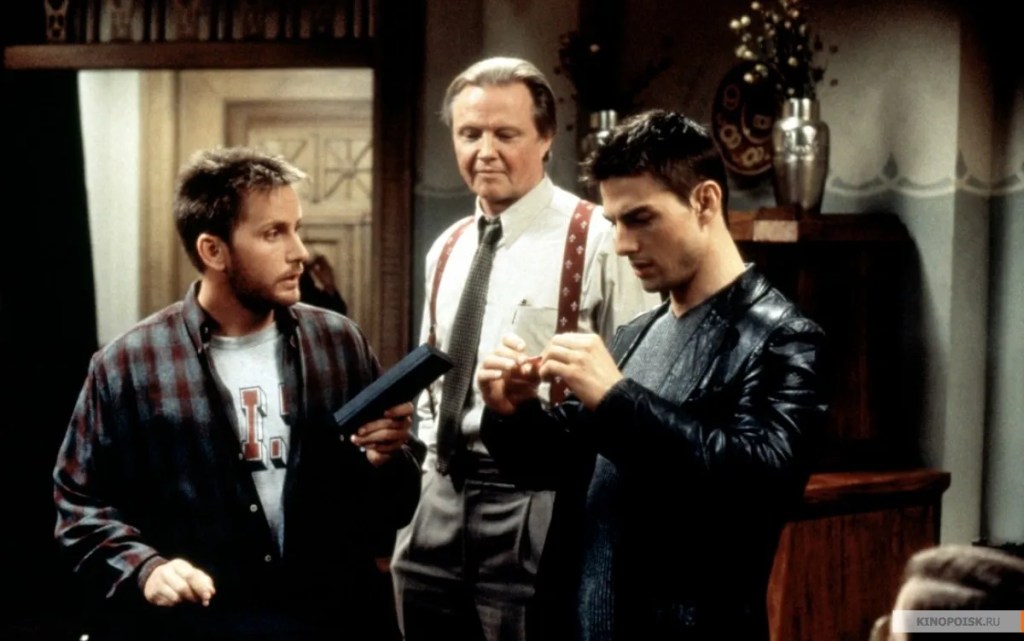
But the plot isn’t too important – which is a good thing, too, since chunks of Mission: Impossible are too convoluted to follow. Despite a screenplay by first-rate writers David Koepp and Robert Towne, the movie’s chief reason for existing is to let the great Brian De Palma flex his directorial gifts for suspenseful set pieces.
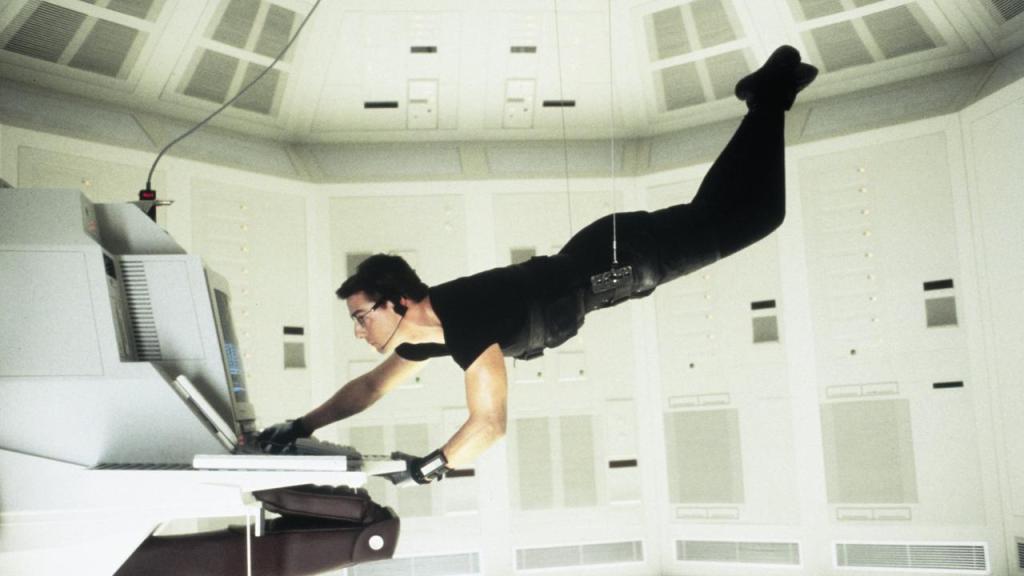
And there are three such set pieces in Mission: Impossible, each one beautifully constructed. The best of them also happens to be the leanest, in which Cruise and a makeshift team of “disavowed” spies (Jean Reno, Ving Rhames and Emmanuelle Beart) break into CIA headquarters to steal some super-secret files. With Cruise dangling by cable from a hole in the ceiling, he must hack into a computer in a room where the slightest temperature change or pressure on the floor will sound alarms. It is vintage De Palma, with the scene’s deafening silence reminiscent of the famed heist sequence in Jules Dassin‘s Rififi.
Alas, three set pieces are not the entire film. Too much of Mission: Impossible is impossibly dull. De Palma’s pacing is surprisingly limp. One can’t help thinking that, somewhere along the way, the proceedings shifted into a Cruise vanity project. This is one movie franchise that actually improved with each successive installment.
 Cutting to the Chase with Phil Bacharach