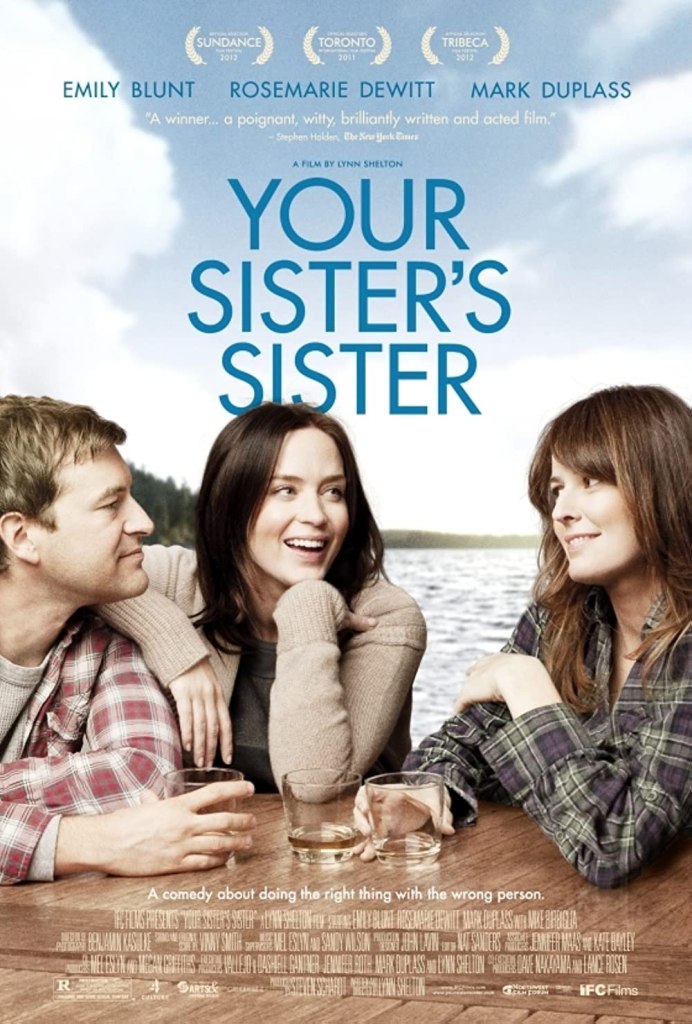
Your Sister’s Sister is a revelation in which low-budget indie meets comedy of the masses. Written and directed by Lynn Shelton, the 2011 picture marked another milestone in what was then the ongoing mainstreaming of “mumblecore,” a quasi-film movement characterized by improvisation, modest production values and, all too often, undisciplined notions of storytelling.
But Shelton, who died far too young in 2020 at age 54, was no navel-gazer. Your Sister’s Sister is smart, funny and absorbing, and it benefits from a terrific acting turn by another mumblecore alum, Mark Duplass, who has also directed several nifty movies (The Puffy Chair, Baghead, Cyrus) himself.
Duplass gives one of three strong performances, joined by Emily Blunt and Rosemarie DeWitt, for what essentially could be a three-character stage play. What it lacks in a dynamic visual style — despite its setting in the scenic Pacific Northwest — is made up for with keen observance and emotional honesty. There is hardly a false note here.
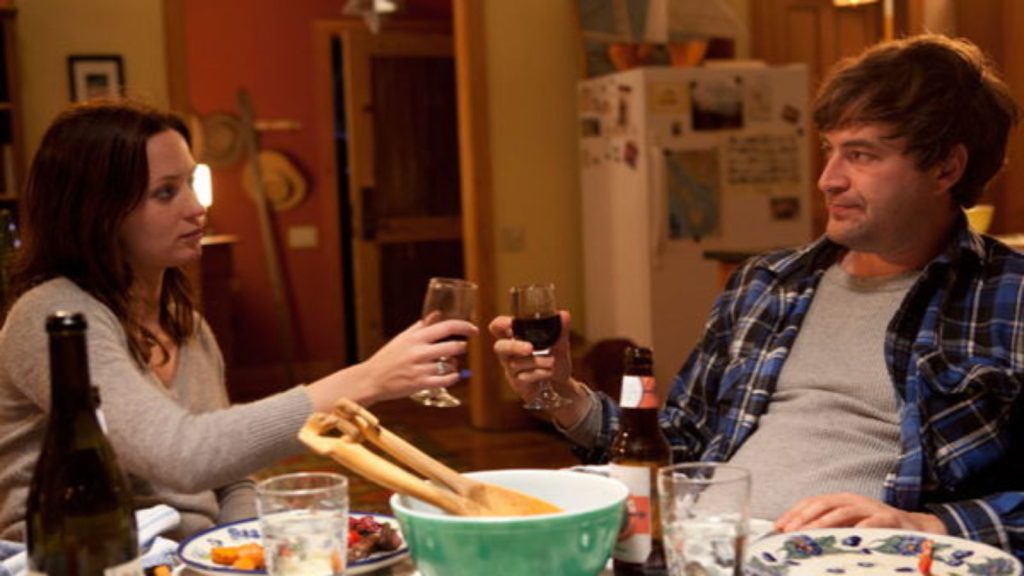
At the center is Jack (Duplass), an underachieving 30-something filled with rage, self-absorption and grief over the untimely death of his brother. Iris (Blunt), Jack’s best friend and the ex-girlfriend of the deceased brother, urges Jack to seclude himself for a couple of days at a cabin her family owns on a nearby island. He accepts the offer, bicycling to a ferry and heading to the island for “some head space.”
But the place is already occupied by Iris’ lesbian half-sister, Hannah (DeWitt), who is seeking alone time after the end of a seven-year relationship.
“I apologize if I’m barging through the doors of your privacy,” Jack tells her shortly before the thrust-together roommates share a bottle of tequila, some drunken conversation and — in a funny and awkward why-the-hell-not moment — a bed. Clearer heads emerge the next morning, and Jack realizes he really doesn’t want Iris to know about the one-night fling.
And then Iris shows up for a surprise visit.

Some twists you see coming, some you don’t, but it all feels seamless and urgent. The three principals are outstanding. Duplass gives Jack a sharpness and wit that make even the character’s obnoxiousness endearing. Just as good is DeWitt, whose humor and screen presence are commanding; I’ll never understand why she hasn’t had a stronger career. Blunt, the only marquee name here, fares less well, but she is also saddled with the most passive role.
Shelton wisely keeps directorial intrusions to a minimum and lets her cast do their thing. The result is a first-rate dramedy that observes, and ultimately celebrates, the flawed heart.
“I’m emotionally, at best, precarious,” Jack tells Iris and Hannah, “at worst, a cripple.”
In other words, he is human.
 Cutting to the Chase with Phil Bacharach