
In its tale of death and loyalty along the U.S.-Mexico border, The Three Burials of Melquiades Estrada bears similarities to the great westerns of John Ford. Like that masterful storyteller, director Tommy Lee Jones (in his big-screen directorial debut) and screenwriter Guillermo Arriaga revel in the splendor of nature and the small, lyrical moments of how people connect. But the movie is also morbidly funny. Moreover, its central journey, that of lugging a decomposing corpse across the countryside for a proper burial, has a post-modernist bent reminiscent of Sam Peckinpah‘s Bring Me the Head of Alfredo Garcia. In short, The Three Burials of Melquiades Estrada is difficult to categorize, but easy to fall for.
Much of the credit goes to Arriaga and his gift for inventive structure and multilayered narratives. Like his work in Amores Perros and 21 Grams, Three Burials is defiantly nonlinear, particularly its first half’s zigzag between flashbacks and present day.

Jones stars as Pete Perkins, a laconic Texas ranch foreman mourning the mysterious shooting death of his ranch-hand and close friend, Melquiades Estrada (Julio Cesar Cedillo). Despite Pete’s doggedness, the ill-tempered local sheriff (Dwight Yoakam) refuses to investigate the death of the Mexican immigrant. Pete, left to do his own digging, is led to a sullen border patrolman, Mike Norton (Barry Pepper), who has recently moved to the dust-choked town with his pretty – and pretty bored – wife, Lou Ann (January Jones).
Through fragmented scenes, we learn that Norton’s shooting of Melquiades stemmed from misunderstanding. Pete does not know that, however — nor would he particularly care. In a final act of loyalty to his deceased friend, Pete kidnaps the patrolman and forces him at gunpoint to help return Melquiades’ body to the dead man’s wife and children back in Mexico.
Three Burials is a marvel on several levels. With a deliberate pace and occasionally elliptical narrative, it proceeds with the sensibility of a European art film. Dialogue is sparse, always economical. Cinematographer Chris Menges captures the exquisite beauty of the surroundings, while Marco Beltrami‘s evocative music score is used to brilliant effect.
These disparate elements come together to create an environment as bleak as it is realistic. This is a world in which casual sex is tapped as an alternative to boredom, whether it’s Pete and the sheriff sharing the same mistress or Norton taking his wife from behind as she keeps her eyes glued on a God-awful TV soap opera.
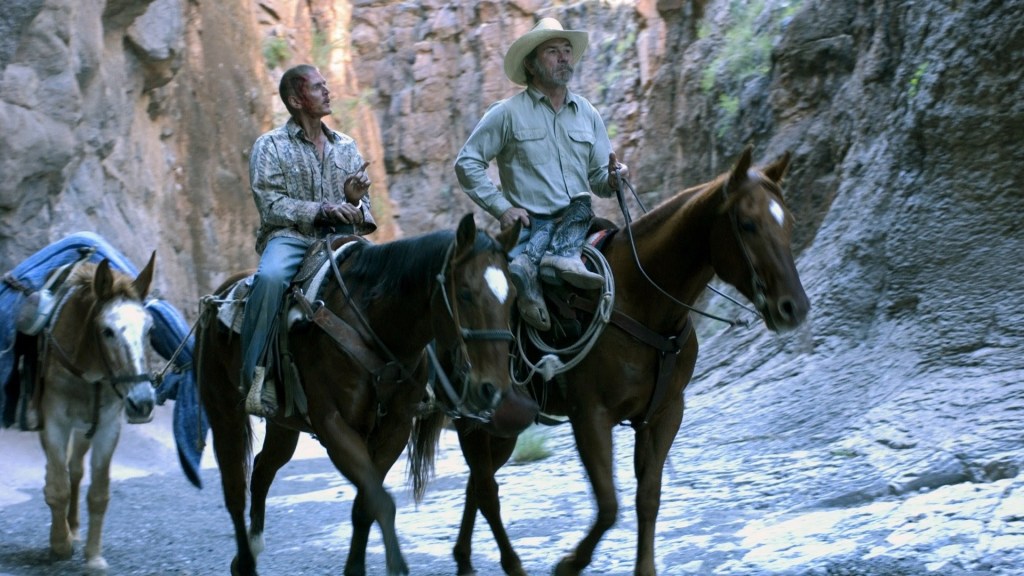
The performances are remarkable. Jones’ baleful eyes convey the stoic loneliness of a man who has lost the only friend he ever had. But the actor-director is equally generous with his talented cast, all of whom have moments to shine. Yoakam and Melissa Leo (as the town floozy) are memorable in supporting roles, and Levon Helm (he of The Band fame) makes a lasting impression as a blind hermit.
But Barry Pepper is in a class by himself. With his sunken eyes and the expression of a guy enduring the world’s worst toothache, he is a complicated villain. Pepper has a herculean task. He is both the heavy and an object of sympathy, especially when Pete subjects him to a litany of humiliations — grimly funny humiliations, incidentally — as they head toward Melquiades’ final resting place.
It is a testament to Jones’ direction, Arriaga’s script and Pepper’s tremendous range that Three Burials successfully weaves together such ostensible paradoxes.
 Cutting to the Chase with Phil Bacharach