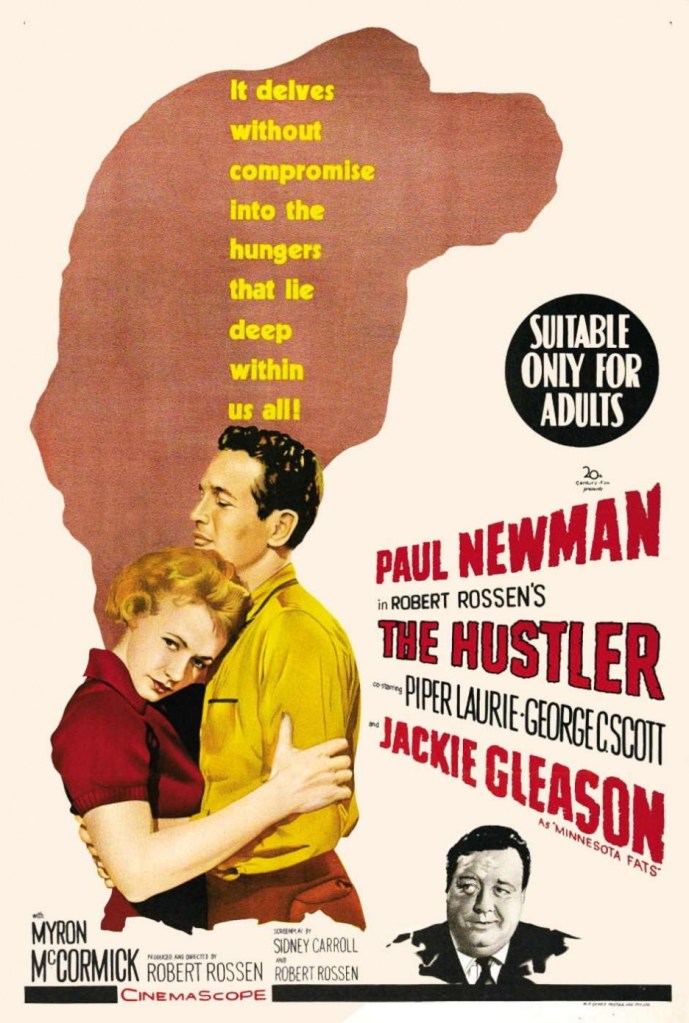
The Hustler is a straightforward morality play, but told with a lean intensity that pushes it into the realm of classic cinema. It helped that the 1961 picture featured a slew of great acting performances, particularly a superstar-making turn by Paul Newman.
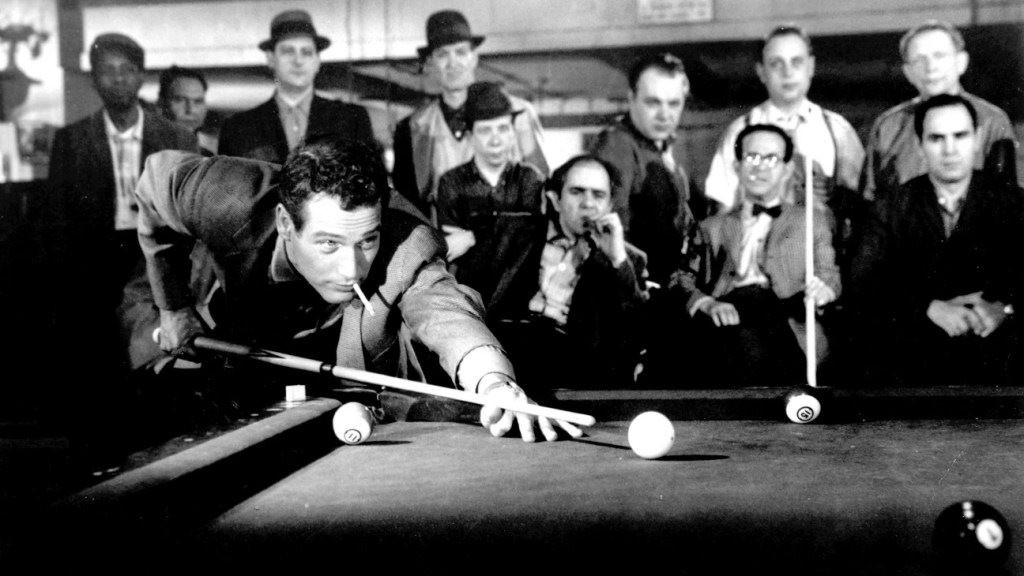
Based on a 1959 novel by Walter Tevis, The Hustler follows Fast Eddie Felson (Newman), a mouthy, brash poolroom hustler with the talent to back up his braggadocio. He and his older partner, Charlie (Myron McCormick), arrive at New York’s Ames Pool Hall to challenge the most legendary pool ace of them all, Minnesota Fats (Jackie Gleason). As the match-up stretches through the night and into the following morning, Eddie’s cockiness fades into drunken desperation; he doesn’t know when to walk away with his winnings.
Eddie is up by $18,000 at one point, but Fats is unflappable. The champ washes up, powders his hands and proceeds to decimate his young opponent. A local gambler, Bert Gordon (George C. Scott), sums up Eddie tersely: “a born loser.”
Broke and broken, Eddie skips out on Charlie and transfers everything he owns to a rented locker at the bus station. There he meets Sarah Packard (Piper Laurie), who drinks too much, walks with a limp and hints at a checkered past. The two, kindred spirits in loneliness, strike up a loving relationship.
But Eddie can’t stay away from plying his craft. After a hustle in a seedy pool hall results in his receiving a beating, he winds up under the tutelage of Bert Gordon. Although the pitiless gambler labels Eddie a loser, Bert also recognizes there is money to be made from the kid’s raw talent, and so he takes Eddie — and, grudgingly, Sarah — to Louisville, Ky, to hustle a rich ne’er do well played by the dependable Murray Hamilton.
Influenced by film noir and neorealism, The Hustler is a clear-eyed critique of winning and losing, and the psychological toll that both can take. Bert is the unequivocal villain of the piece, but he is an astute student of human behavior. Eddie will always pale beside Minnesota Fats, Bert observes, because Eddie mistakenly thinks talent can trump character. In fact, Bert exploits that very absence of character, squeezing every semblance of humanity out of Eddie in an effort to make him a ruthless — and soulless — pool champ. “You can’t live unless you make everything else dead around you,” Eddie observes of Bert.
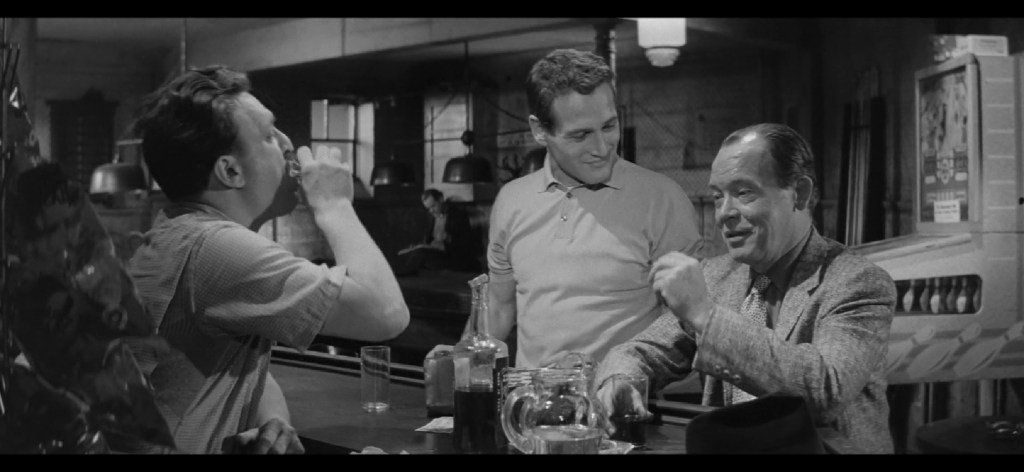
Sarah offers Eddie an opportunity for salvation. She loves him and tries to make him see the folly behind the success he craves. She warns that cutthroats such as Bert and his cronies mask “perverted, twisted, crippled” realities. Alas, Eddie must learn it the hard way.
Some movie scholars have suggested that The Hustler’s solemn themes were informed by the experience of director Robert Rossen, a onetime communist, during the McCarthy era. In 1951, only two years after Rossen’s All the King’s Men had won the Oscar for Best Picture, he was blacklisted in Hollywood after refusing to name names before the U.S. House Un-American Activities Committee (HUAC). The inability to work took its toll. Two years later, Rossen recanted his silence and gave HUAC the names of nearly 60 alleged communists.
Regardless of whether Rossen used The Hustler to exorcise sundry demons, there is no disputing that the movie pulsates with energy. His screenplay with Sidney Carroll is punctuated by sharp, searing dialogue. The film is at its sooty best in the dingy pool halls, particularly the Eddie-Fats contests that bookend it. For those scenes, 20th Century Fox enlisted Willie Mosconi, arguably the greatest pool player of all time, to serve as an off-screen consultant (he also appears in a blink-or-you’ll-miss-it cameo).
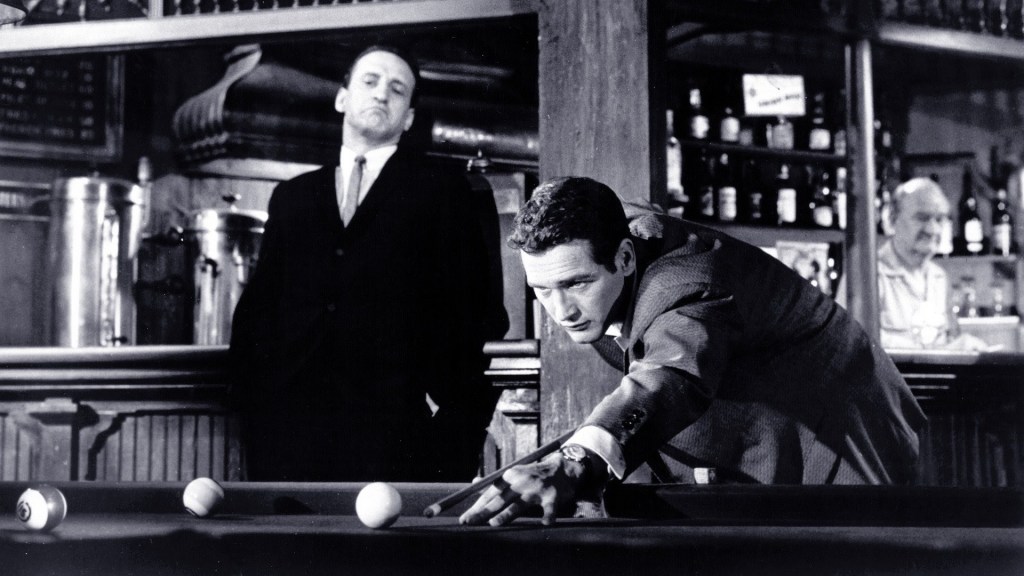
The cast is excellent, but The Hustler is Newman’s movie. The method actor pours all his considerable charm into Fast Eddie (a role he would reprise in Martin Scorsese’s 1986 sequel, The Color of Money), and the result is the blueprint of what would become Newman’s distinctive brand of antihero, a guy who elicits a sort of seductive sympathy despite being utterly selfish.
Although the weight of the film rests on Newman’s shoulders, The Hustler boasts a number of stellar performances. Laurie is heartbreaking as the conscience of the story, while Scott, in only his third movie, showed early on why he made such a great heavy. Newman, Laurie, Gleason and Scott all earned Oscar nominations.
The four contribute mightily to the picture’s gritty atmospherics. And it’s all captured in glorious black and white Cinemascope by director of photography Eugen Schüfftan, who won an Academy Award for his work here.
 Cutting to the Chase with Phil Bacharach