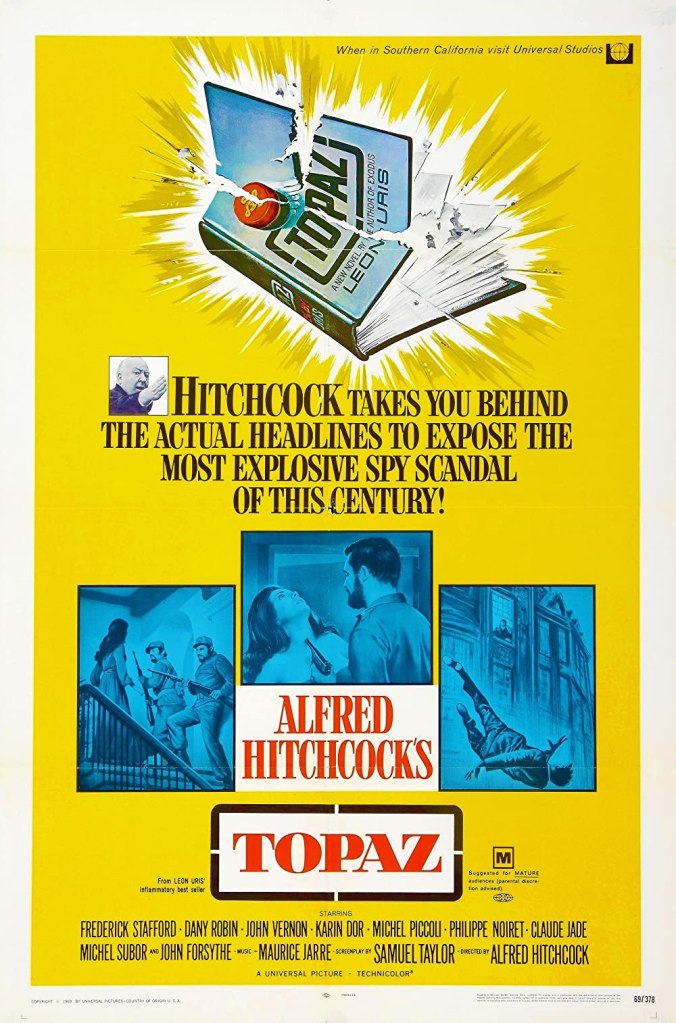
The late 1960s marked something of a downslide for Alfred Hitchcock. There is speculation about what prompted his string of disappointments. Perhaps the slow demise of the studio system left the master of suspense rudderless. Hitchcock scholar Donald Spoto contended in his 1983 biography, The Dark Side of Genius: The Life of Alfred Hitchcock, that the director grew despondent and sloppy in his work after his sexual advances were spurned by Tippi Hedren. Whatever the reason, the trio of films that followed 1963’s The Birds — Marnie in 1964, Torn Curtain in 1966, and Topaz in 1969— were critical and commercial flops.
Of the three, Topaz is understandably the most derided. While even substandard Hitchcock is better than a lot of what passed for thrillers at the time, the movie can be a bit of a chore. It is long and muddled. And yet, for all its clunkiness, Topaz carries the unmistakable imprint of Hitchcock.
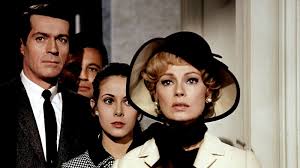
Based on the bestseller by Leon Uris, the tale of international intrigue unfolds in the weeks preceding the 1962 Cuban Missile Crisis. Andre Devereaux (Frederick Stafford) is a French intelligence agent stationed in Washington, D.C., and cozier with American intelligence operatives than his supervisors would like. At the urging of CIA agent and friend Mike Nordstram (John Forsythe), Andre sets out to learn more about Russian missiles being strategically positioned around Cuba.
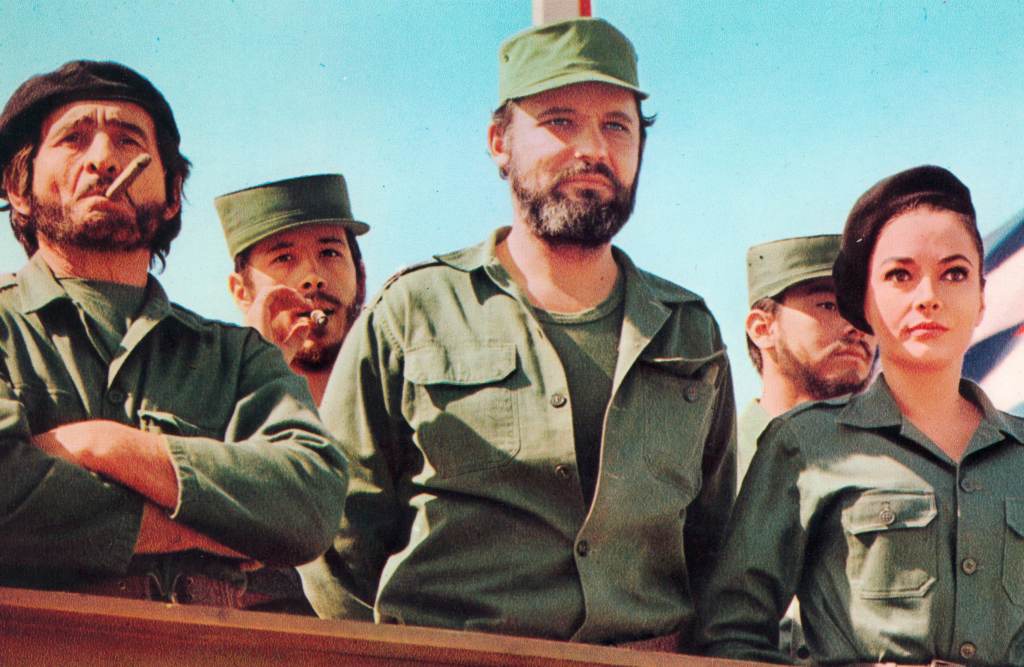
Andre’s mission takes him to Harlem’s Hotel Theresa, where he conspires to view top-secret files in the possession of Cuban revolutionary Rico Parra (John Vernon, sporting a Castro beard). After one of Andre’s associates (Roscoe Lee Browne) successfully snaps photos of the documents, Andre travels to Cuba for a firsthand look. There, he hooks up with his extramarital squeeze, Juanita de Cordoba (Karen Dor), an underground resistance leader who also happens to be Rico’s occasional concubine. Girl gets around.
Complications arise for Andre. He learns that an unnamed French intelligence officer known only as “Topaz” is funneling NATO secrets back to Moscow. While giving the Americans vital information on Cuban missiles, Andre must also contend with a leak within his own ranks.
Hitchcock accepted the movie project but soon discovered it beset with challenges, not the least of them being that Uris’ dense screenplay proved too unwieldy for the big screen. The director brought in a longtime collaborator, screenwriter Samuel A. Taylor, to rework the script, albeit with mixed results. Topaz remains lumbering and slow-paced. Despite what should have been a tantalizing slew of globetrotting locations — New York, Paris, Copenhagen, Cuba, etc. — the film is actually saddled with too many ideas for its own good.
Stafford is another problem. He gives a competent but bloodless performance in a role that desperately needed an actor with some charisma (Hitch originally wanted Sean Connery to play Devereaux). Only John Vernon seems to have fun with his part — but who wouldn’t with a Castro beard?
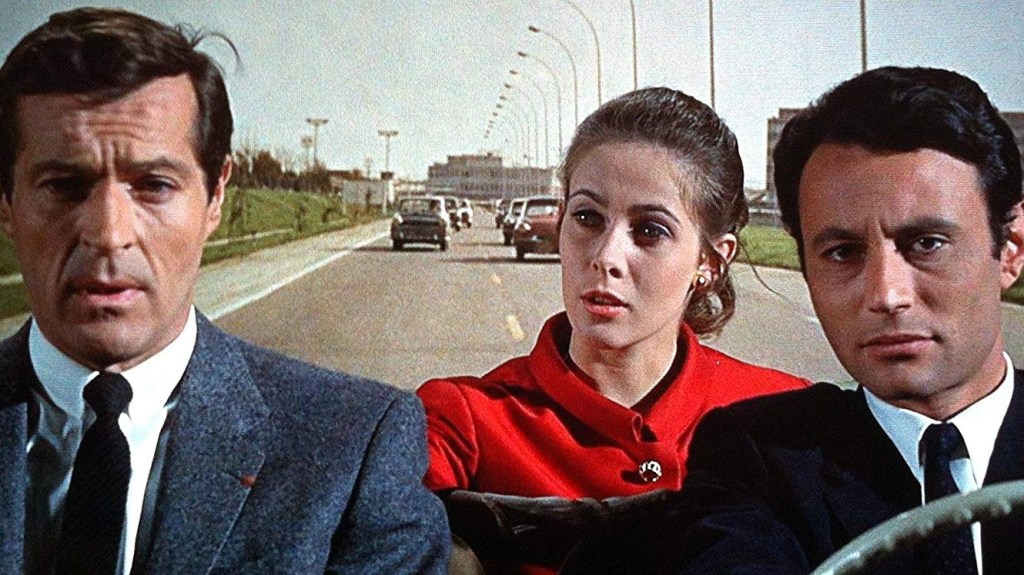
Even hamstrung with a difficult script, lackluster cast and some dicey production values (the rear-screen projection is particularly risible), Hitchcock still manages to sink his choppers into a few tasty set pieces. The opening sequence, in which a defecting Russian agent and his family are trailed by KGB agents in Copenhagen, boasts the director’s artful skills.
But Hitchcock is at the top of his game once Topaz settles in Cuba for a spell. In one of the most startling images in Hitchcock’s canon, a woman collapses on a white tiled floor after being shot. Her violet dress billows out from under like a swelling pool of blood. The shot is pure genius. If only the rest of Topaz had been so inspired.
 Cutting to the Chase with Phil Bacharach