
Rope is intriguing, if not altogether successful. The picture marked a kind of paradox for Alfred Hitchcock, a master of cinematic storytelling who presented himself with a challenge that appeared almost antithetical to the possibilities of film. In adapting a 1929 play by Patrick Hamilton, the director wanted the story to be experienced in the same way it would if the audience were seeing it on stage — albeit with a fluid camera to direct the viewer’s attention.
Hitchcock never shied away from testing himself, but Rope — his first color picture and his first to produce — remains one of his most daring works. The movie unfolds in real time, composed to give the impression of being only a handful of moving, uninterrupted shots.
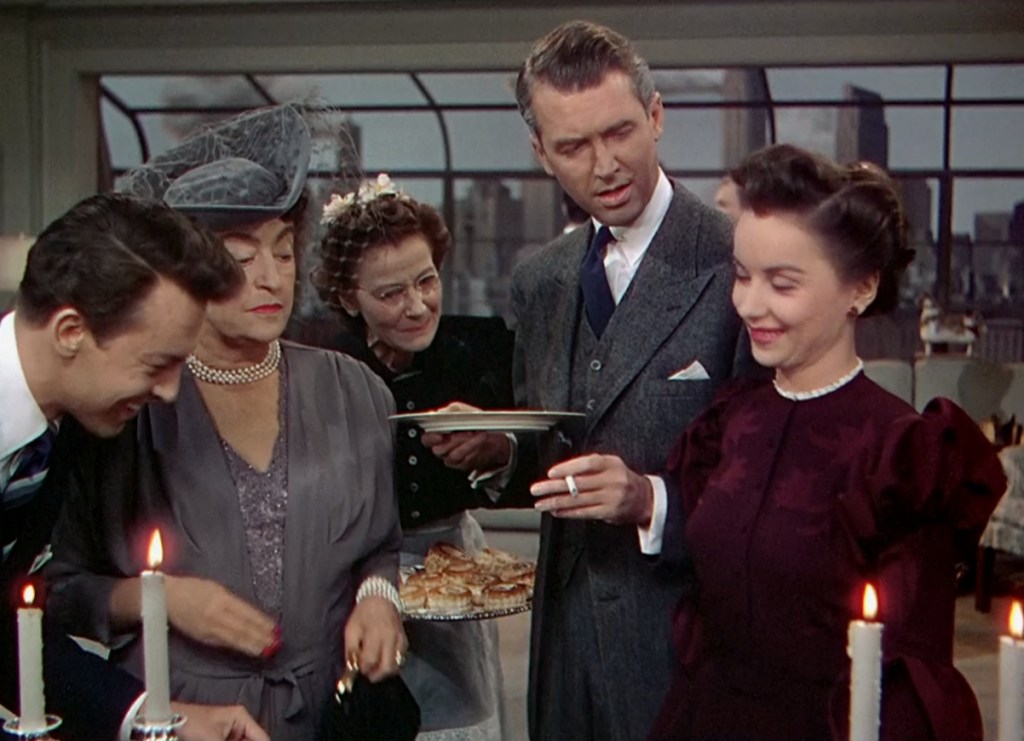
Of course, some sleight of hand was involved. As a reel of film at that time translated into about 10 minutes of screen time, the cameraman was forced at the end of each reel to pause on a darkened image, such as the back of a man’s suit jacket, before changing reels. The following shot would start from where the previous one had ended, and on it went. Rope does have several unmasked edits, but the overall sense is of only a few camera shots.
The demands of real time spurred other concerns, too. As Rope takes place in a New York City high-rise, the windows of the apartment looked out on to a large cyclorama of the skyline with a gradually darkening sky and clouds that glided on invisible wires. The set was equally accommodating, complete with walls that could open, cable-strewn floors, and furniture on wheels.
Rope‘s technical artistry is what put it on the proverbial map, but the storyline itself was quintessentially Hitchcock, too. We begin with murder. In a spacious Manhattan apartment, young sophisticates Brandon Shaw (John Dall) and Phillip Morgan (Farley Granger) strangle to death an old college chum, David Kentley (Dick Hogan). The killers, we soon learn, have murdered simply for the thrill of it, believing themselves intellectually superior beings whose greatness gives them a sort of moral carte blanche.
Phillip is shaken and guilt-ridden, but Brandon is elated by the experience. They barely have time to stuff David’s body in a trunk, however, before turning their attention to a dinner party that they are about to host. Brandon even directs their maid, Mrs. Wilson (Edith Evanson), to serve dinner, buffet style, on the trunk that conceals the freshly made corpse.

Brandon and Phillip hold the event just so they can privately gloat over the sheer audacity of the stunt. The guests arrive: David’s father (Sir Cedric Hardwicke); a Kenley family friend, Mrs. Atwater (Constance Collier); David’s fiancée Janet (Joan Chandler); and David’s ex-pal/Janet’s ex-boyfriend, Ken (Douglas Dick). Perhaps the riskiest guest, however, is Rupert Cadell (James Stewart). A former schoolmaster of Brandon and Phillip’s, Rupert is an intellectual misanthrope whose Nietzchean teachings apparently fed Brandon’s warped worldviews about murder and the like.
By kicking off the film with David’s murder, Hitchcock coaxes thrills by encouraging the audience to identify with the effete killers. Unlike the stage play on which Rope is based, the film does not tantalize viewers with questions about whether Brandon and Phillips have actually committed a murder or are simply delusional. The suspense evolves because we know their actions from the outset. When Rupert grow suspicious by his ex-pupils’ behavior, we are apt to feel a bit conflicted, squirming along with Brandon and Phillip even while wanting justice to be done.
If Hitchcock saw the innovative film production as a special challenge, he also must have enjoyed the mischief of making a movie about gay characters amid Hollywood’s Hays Code. Rope clearly drew inspiration from the 1924 case of Nathan Leopold and Richard Loeb, two wealthy young men in Chicago who murdered a 13-year-old boy for the thrill of it. Like the real-life Leopold and Loeb, Brandon and Phillip are lovers. Although their relationship is never explicitly stated, it doesn’t take much reading between the lines.
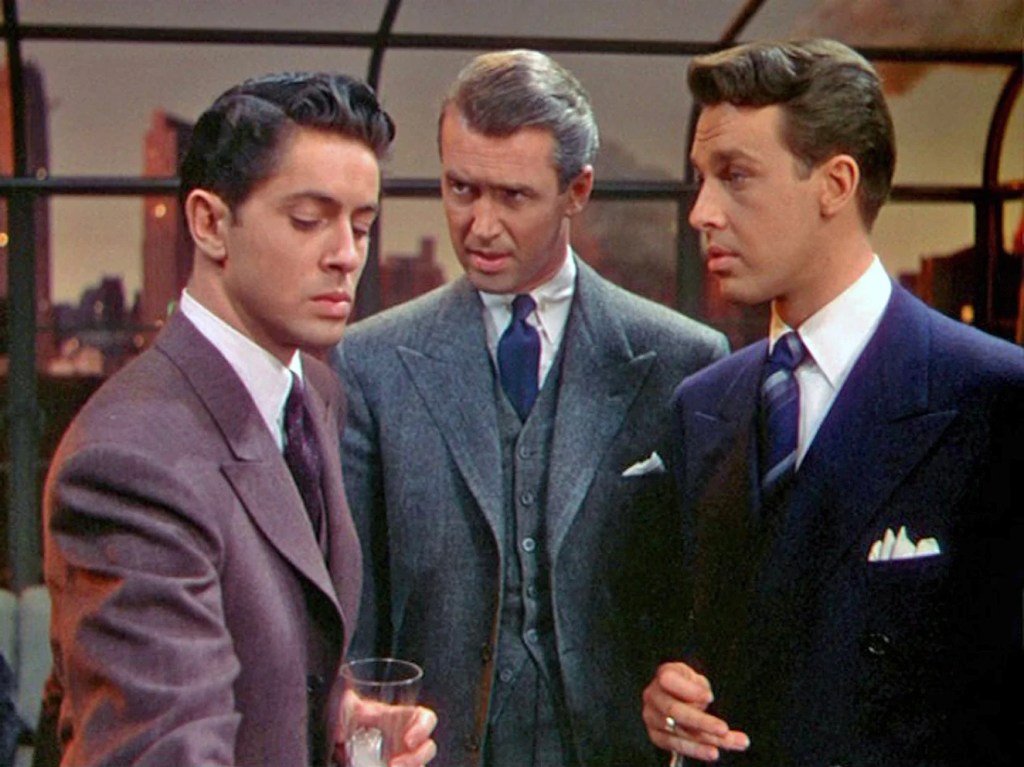
While Rope ultimately is weighted down by its experimental nature, high marks go to Dall and Granger for solid performances. Stewart, however, is another matter. The actor’s folksy, congenial persona makes it a little tough to accept him as an elitist intellectual who would have inspired Brandon and Phillip to such horrific heights. In the play, Rupert is also gay and an ex-lover of one of the men. Presumably, Stewart declined to lend such shadings to the character. Instead, he turns Rupert Cadell into a quasi-detective and adds to imbuing Rope with a disappointingly conventional final act.
 Cutting to the Chase with Phil Bacharach