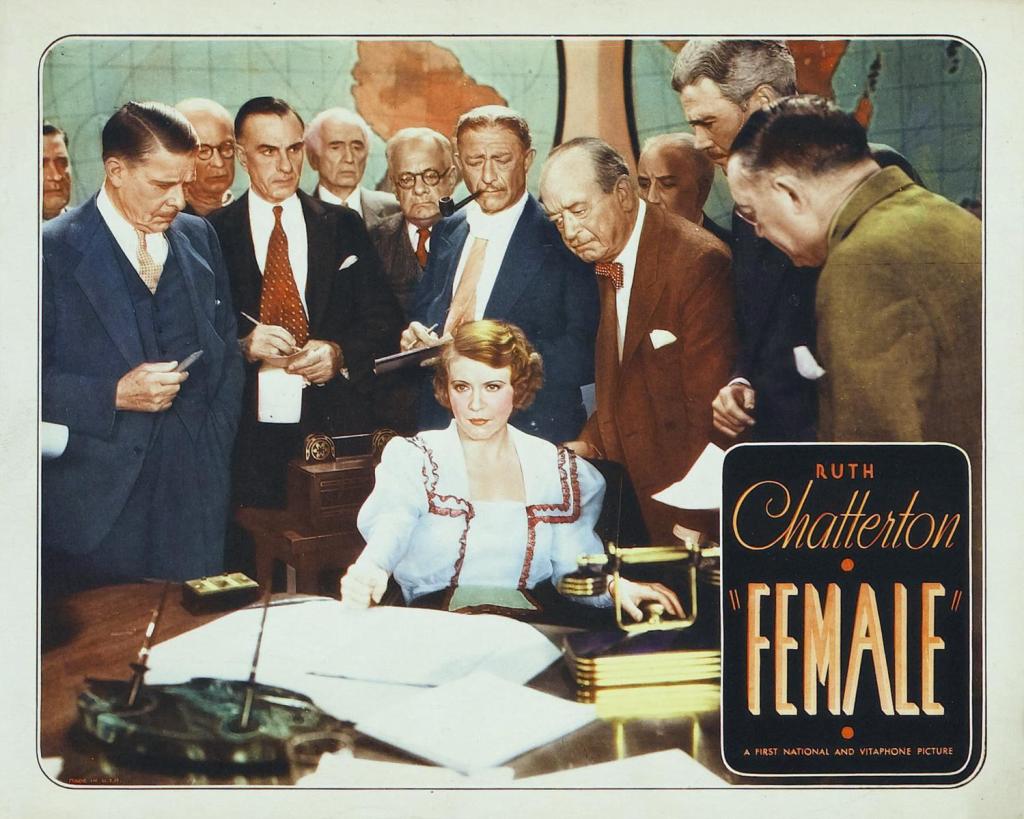
The car-manufacturing magnate at the center of Female is one tough cookie, a take-no-prisoners mogul by day and take-no-guff seductress by night. That, in a nutshell, sums up the vitals of this 1933 comic gem. The movie is funny, the dialogue whip-smart, and dependable director Michael Curtiz doesn’t outwear things, with the picture clocking in at a lean 60 minutes.
It also boasts a terrific, quasi-feminist lead performance by Ruth Chatterton. Having inherited the Drake Motor Car Company from her father, her Alison Drake is a strong-willed businesswoman who commands the boardroom. She proves equally in control in the bedroom.

Come evening, Alison lures handsome male employees to her mansion under the auspices of discussing business, only to turn them into her playthings with the help of her feminine wiles and copious amounts of vodka. Alison’s butler/enabler compares Alison to Catherine the Great, whom he notes also plied her soldiers with vodka “to fortify their courage.”
Alison’s conquests are short-lived. The boy toys invariably profess their love to her at work the following morning, but she will have none of it. “To me, a woman in love is a pathetic spectacle,” Alison confides to a friend. “She’s either so miserable that she wants to die or so happy that you want to die.”

Alas, this is 1933 and a woman’s independence cannot last. Alison’s impenetrable exterior melts when she falls for George Brent (Chatterton’s offscreen husband at the time) as a self-assured engineer newly hired by the company. He resists the boss lady’s aggressiveness, a rejection that only causes Alison to crater and resolve to be a “real” woman.
OK, so the would-be feminism has been thoroughly snuffed out by the film’s end, but most of Female has chutzpah and charm to spare. Screenwriter Gene Markey, who also penned the celebrated Pre-Code potboiler Baby Face, weds sophistication with bawdy humor, and Chatterton does a bold, sexy turn in the lead. What’s not to like?
 Cutting to the Chase with Phil Bacharach