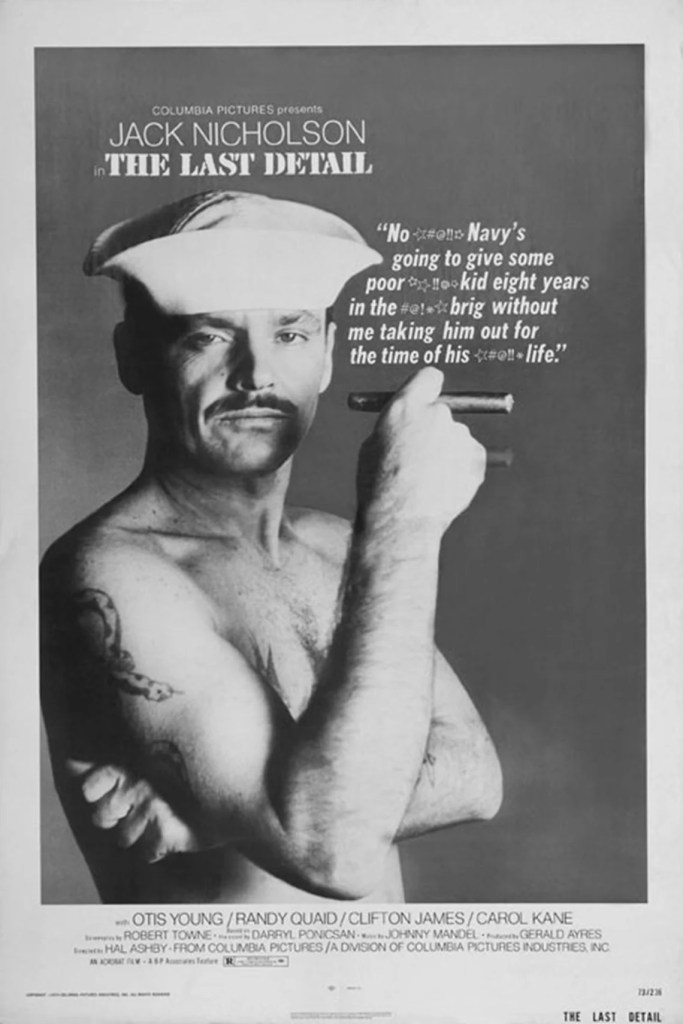
There is no doubt that screenwriter extraordinaire Robert Towne wrote The Last Detail with his friend Jack Nicholson in mind. As 1st Class Signalman Billy “Badass” Buddosky, one of two Navy lifers tasked with escorting a young midshipman to the brig, Nicholson was gifted with a meaty role that enabled him to demonstrate his full comic chops.
We get devilish Jack. We get enraged Jack. We get melancholy Jack.
Nicholson’s brilliance is evident in an otherwise throwaway scene where the three men are on a city bus. The prisoner, an 18-year-old gentle giant named Larry Meadows (Randy Quaid), tells his fellow sailors about his childhood growing up with an alcoholic mother. Buddosky is seated behind Meadows, listening; his weary expression registers the realization of the shitty future awaiting this prison-bound innocent. Nicholson, who turned down The Sting in order to do The Last Detail, gives a tour de force performance, to dust off a phrase I don’t see much anymore, but one which pretty much defined most of his work throughout the 1970s.
A collaboration of Nicholson, Towne and director Hal Ashby, The Last Detail is one of the more emblematic exemplars of New Hollywood in 1970s’ American cinema. Ashby’s film – his first since the commercial disappointment of 1971’s Harold and Maude – is leisurely paced, shaggily plotted and resolutely anti-authority, and yet beneath its scruffy exterior beats the heart of a sentimentalist.
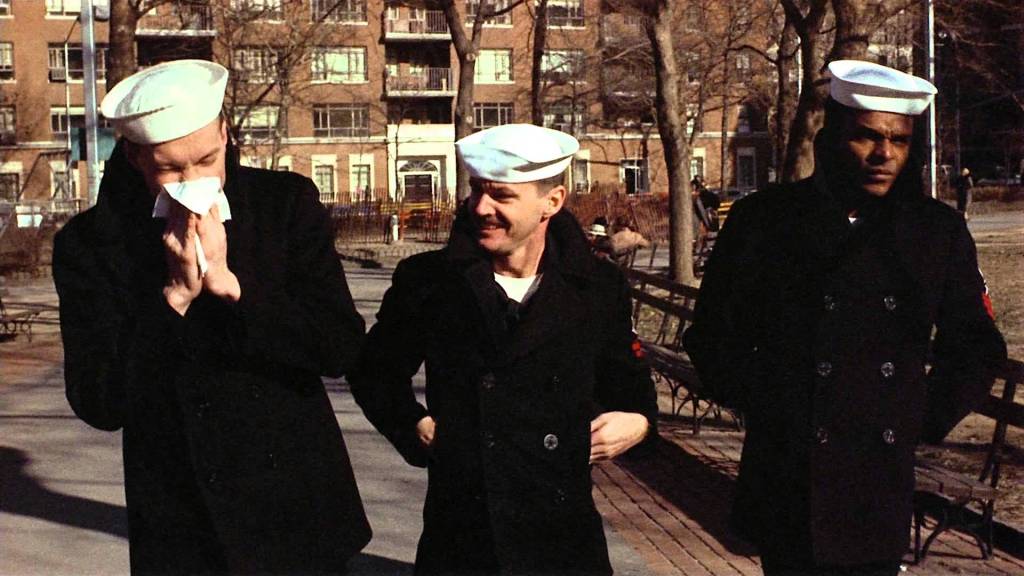
Adapted from a novel by Darryl Ponicsan, the story is half road-trip picture, half coming-of-age movie. Buddosky and petty officer Richard “Mule” Mulhall (Otis Young) are directed to deliver Meadows from Norfolk, Va., to the naval prison near Portsmouth, N.H. Meadows has received a dishonorable discharge and an eight-year prison sentence for stealing a paltry $40 from a donation box. The box, it turns out, was for polio, which happens to be a pet charity of the admiral’s wife. The severity of the punishment is absurd, but Buddosky and Mulhall are hardly fazed.
The pair see this as an easy assignment. Their plan is to hustle Meadows to New Hampshire and spend the remainder of their week getting drunk and getting laid. In short order, however, Buddosky and Mulhall develop an affection for the prisoner and resolve to show him a good time before his looming incarceration. The three pound beers in a Washington D.C. hotel room, pick a fight with Marines in New York, and eventually take the virginal Meadows to a brothel in Boston (Carol Kane has a nice bit as an insouciant hooker).
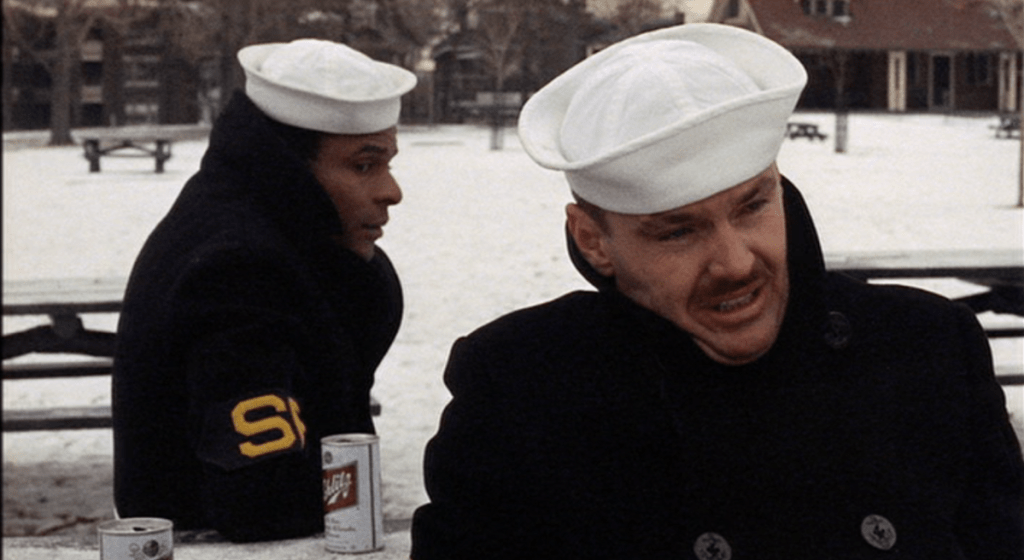
Along the way, the Navy lifers prod Meadows into being more assertive. “Don’t you ever get mad at nobody?” Buddosky asks Meadows with bewilderment. Buddosky’s own temperament tends to run from angry to furious. When a bartender refuses to serve the three and threatens to call the shore patrol if they don’t leave, Buddosky loses it. “I am the motherfucking shore patrol, motherfucker!” he erupts, slamming his gun on the bar top.
The moment is vintage Jack, who gets to say “motherfucker” a lot here. In 1973, Towne’s screenplay was so notoriously profanity-laced, the Navy declined to cooperate with the production. Viewed today, it seems hard to imagine how The Last Detail and its accurate reflection of the salty language of sailors were ever deemed controversial. Also notable is a peppy score by Johnny Mandel that lends an ironic juxtaposition to the shambling narrative.
While Nicholson’s performance rightly earned an Oscar nomination, The Last Detail also features fine jobs from the other principals. Quaid, doughy faced and light of touch, is affecting as Meadows; he also scored an Academy nomination for best supporting actor. Young deftly captures the ambivalence of Mulhall, a role that had been crafted for a Nicholson friend, Rupert Crouse, but the actor was diagnosed with terminal cancer shortly before production began. Eagle-eyed cinephiles should be on the lookout for brief turns by Gilda Radner, Nancy Allen and Michael Moriarty.
 Cutting to the Chase with Phil Bacharach