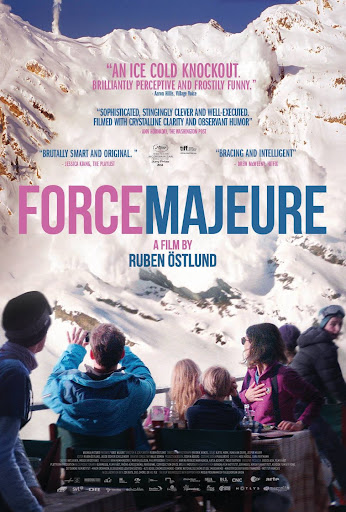
Early in Force Majeure, a young, good-looking family – father, mother, son and daughter – is enjoying a leisurely outdoor lunch at a ski resort in the French Alps. The vista, a gleaming and snow-packed mountain, is spectacular. A controlled explosion in the distance triggers an avalanche that commands the attention of the restaurant patrons, including the family we have been observing. Diners pull out their iPhones and record the wall of snow as it barrels down the mountain.
But the avalanche rumbles ever closer. Will it reach the restaurant? Suddenly there is panic. Patrons scramble. Some of them scream; others run for their lives as a ginormous cloud of snow envelopes the patio.
The mother and father react differently to the chaos. Ebba (Lisa Loven Kongsli) grabs their children (real-life siblings Clara and Vincent Wettergren) and seeks cover. Tomas (Johannes Bah Kuhnke), the family’s husband-father, is not so instinctively protective.
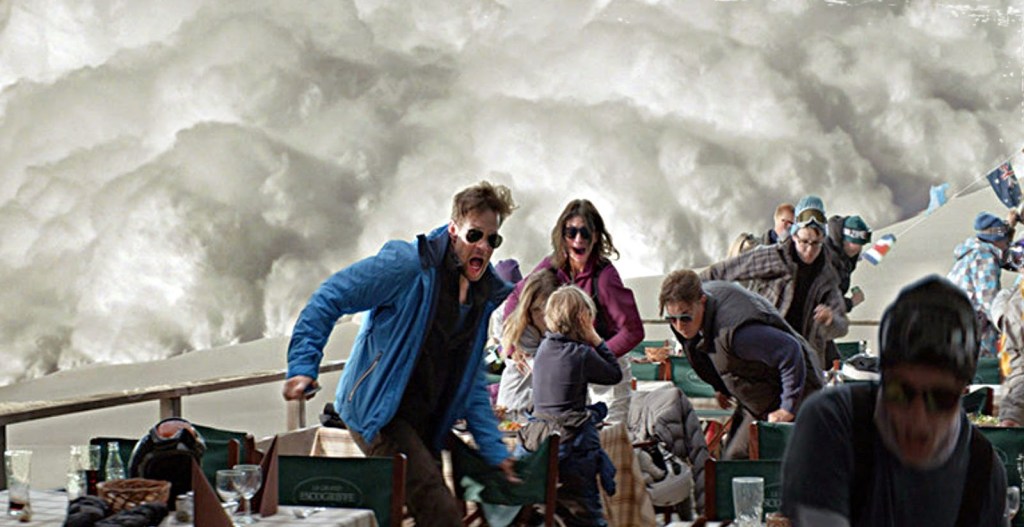
But the avalanche, which turns out to be part of the resort’s regular maintenance on the slopes, quickly fizzles as a would-be disaster. The brief whiteout at the restaurant is essentially snow dust. Normalcy resumes, but shame and hurt are palpable in the awkward silence that consumes the family as they regroup at the table.
The lives of these four will never be the same.
Like Force Majeure’s high altitudes and frosty climes, the instantly changed reality that emerges from the scene is enough to induce vertigo. But it is that sense of being off stride – the potential danger that arises from leaving a comfort zone — that makes this Swedish-language film so riveting.
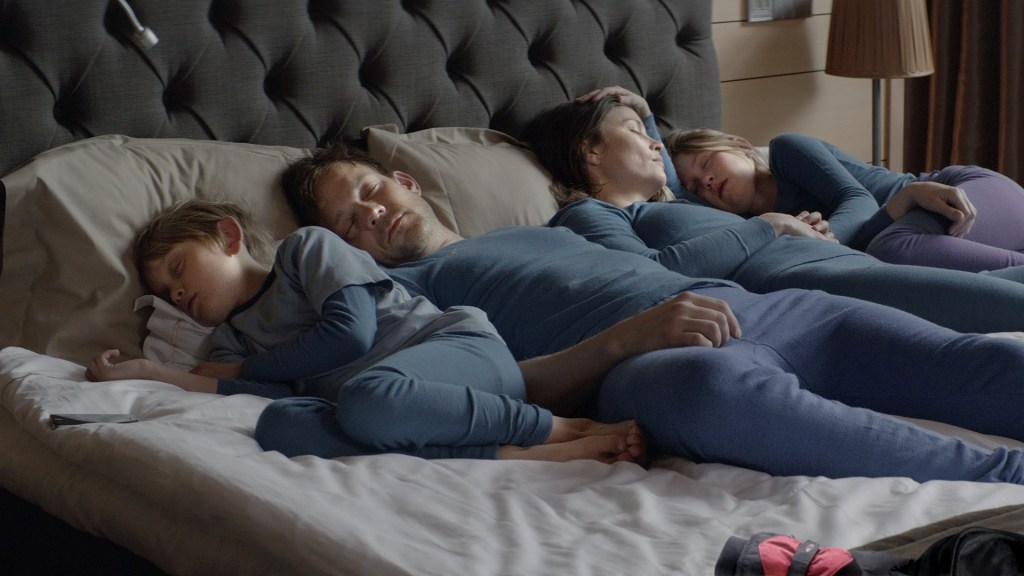
The almost-natural disaster spurs a disaster of the marital kind. Writer-director Ruben Östlund is less interested in standard melodrama than he is in more squirm-inducing possibilities. He slaps this picture-perfect family onto a glass slide and places it under a microscope for further inspection. Ebba is godsmacked by her husband’s action at the restaurant, but her bewilderment morphs into anger once it is clear that Tomas would rather revise history and downplay the matter altogether. Her fury spills out over dinner with another couple she and Tomas have only just met.
Östlund lets every excruciating moment unfold. Anyone familiar with his later works, namely The Square or Triangle of Sadness, knows the filmmaker’s sensibility weds Curb Your Enthusiasm with the enfant terrible of filmmakers, Michael Haneke (Amour, The White Ribbon). In other words, the dry laughs elicited by Force Majeure – and there actually are some –come with a chaser of existential dread.
Caustic but insightful, the movie explores perceptions of sacrifice, bravery and responsibility, tweaking them through the filter of gender expectations. Östlund is particularly merciless on what might quaitly be termed “manliness.” Tomas’ ostensible sin stings all the more because Ebba uses it to emasculate him. The self-doubts and recriminations they dredge up even infect another couple (Kristofer Hivju and Fanni Metelius) with whom they are friends.
This dark comedy plays out amidst a landscape of snowcapped beauty. Set at the tony resort of Les Arcs and lovingly lensed by Fredrik Wenzel, Force Majeure boasts a crisp, uncluttered look unsurprising for filmmakers who hail from the land of IKEA. But the similarities end there. The surface look might be sleek and orderly, but emotional implications are anything but neat.
 Cutting to the Chase with Phil Bacharach