Hollywood has long found the innate drama of baseball to be irresistible. It’s that rare team sport to have the additional draw of being a showdown of individuals: pitcher and hitter. Baseball fans love to argue over which movie best captures the glory of the game, and I’m no exception. With apologies to 1942’s much-beloved The Pride of the Yankees, about legendary New York Yankees first baseman Lou Gehrig, who died of amyotrophic lateral sclerosis at age 37, the picture is just too schmaltzy for my taste, and star Gary Cooper doesn’t pretend to be anyone but Gary Cooper.
These, then, are my picks:
10. 42 (2013 dir: Brian Helgeland)
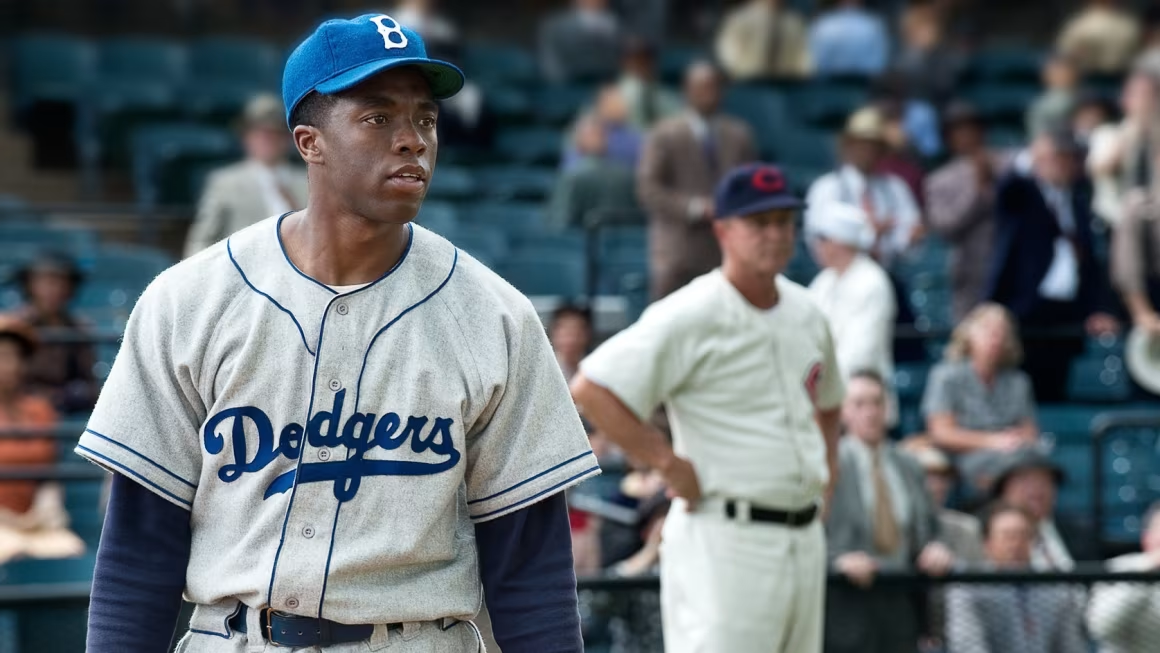
In chronicling the story of Jackie Robinson, who broke Major League Baseball’s color barrier in 1947 with the Brooklyn Dodgers, 42 is often shamelessly sentimental. Writer-director Brian Helgeland is content to let his hero worship fly, and I am content with his contentment. 42, the number Robinson wore on his Dodger jersey, tells an important history that inconceivably eluded serious big-screen treatment after Robinson portrayed himself in 1950’s (surprisingly good) The Jackie Robinson Story. Chadwick Boseman gives a stirring, star-making performance as the supremely gifted ballplayer who was in the Negro Leagues when Brooklyn general manager Branch Rickey (Harrison Ford) plucked him for the “great experiment” of integrating MLB. Ford lapses into caricature as the craggy Rickey, but it seems appropriate for such an endearingly old-fashioned movie.
9. The Natural (1984, dir: Barry Levinson)

Bernard Malamud’s debut novel, 1952’s The Natural, is considerably darker than this adaptation, but Hollywood in the Reaganite 1980s wasn’t eager to shell out $20 million for a downer in the multiplex. Softening the edges of Malamud’s source material, director Barry Levinson and screenwriters Roger Towne and Phil Dusenberry elevate the game’s mythologizing in this tale of preternaturally gifted ballplayer Roy Hobbs (Robert Redford) armed with his own Excalibur: a bat named “Wonderboy” carved from an oak tree struck by lightning. I’ve never really been taken by Redford’s one-note performance, but the supporting cast – including Robert Duvall as a crafty sportswriter, Wilfred Brimley and Richard Farnsworth as manager and coach, Glenn Close as Roy’s unwaveringly good and decent childhood sweetheart – is rock solid. The movie’s production bona fides are undeniable, from Randy Newman’s sumptuous score to the exquisite cinematography of Caleb Deschanel.
8. Major League (1989, dir: David S. Ward)
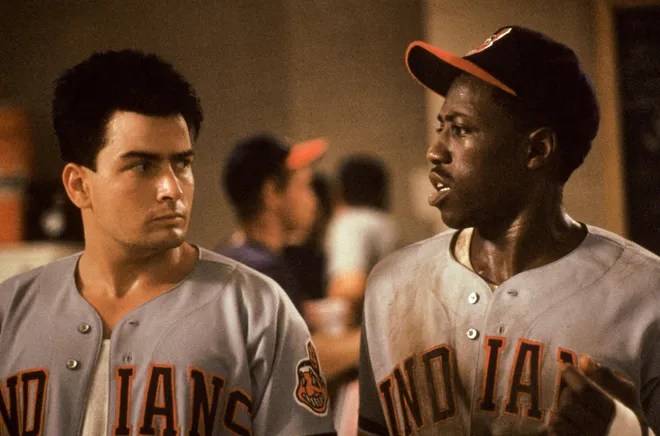
Major League is as broad as Babe Ruth’s gut after a hot dog bender, but funnier. Writer-director David S. Ward’s comedy features the beleaguered Cleveland Indians (long before they became the Cleveland Guardians) and a scheming new owner (Margaret Whitton) intent on making the team so crummy, they wind up in the American League cellar and thereby expedite relocation to Miami. Or some such nonsense. The plot is an excuse for the comic possibilities posed by familiar archetypes. Tom Berenger is a burned-out veteran catcher who never made good, Charlie Sheen is an ex-con fastballer with control issues both on and off the field, Dennis Haysbert is a voodoo-practicing power hitter, Corbin Bernsen is a washed-up former star player, etc. You get the idea. Many of the gags work—including the inimitable Bob Uecker as the Indians’ broadcaster—but some have not aged well. There is a casual racism, and a romantic subplot involving Berenger and Rene Russo (in her movie debut!) as a former flame is strictly rote. Still, sometimes all you need are peanuts and Crackerjack to hit the spot.
7. Field of Dreams (1989, dir: Phil Alden Robinson)
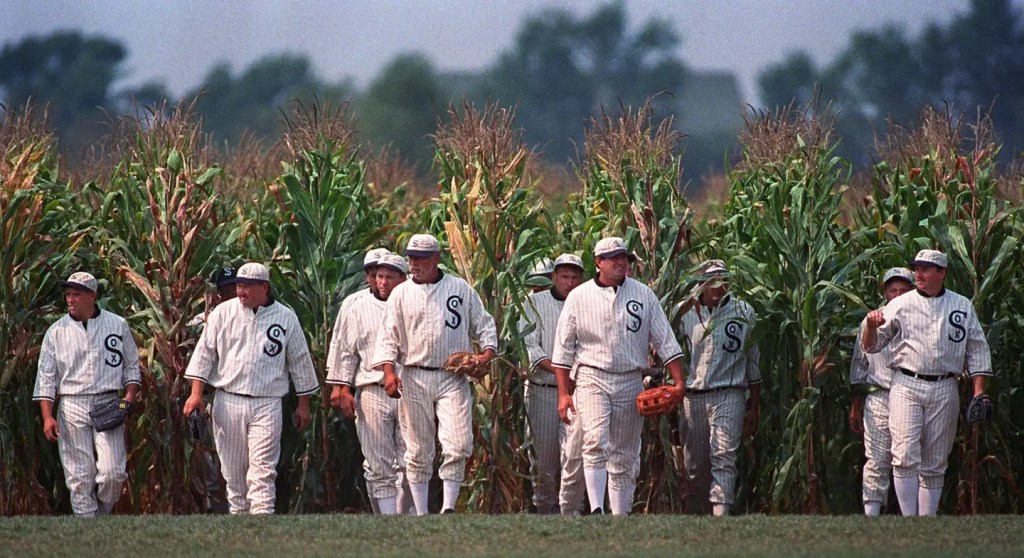
How can a film this treacly be so gosh-darned effective? Just as something magical compels Field of Dreams’ Ray Kinsella (Kevin Costner) to construct a ballpark in the middle of his Iowa farm, so, too, does there appear to be a benevolent spirit guiding this picture. “If you build it, he will come,” a mysterious, disembodied voice tells Ray, a happily married former 1960s’ love child still harboring some unresolved issues with his late father. Baseball connected father and son, and it connects Ray to dad’s childhood hero when the Chicago White Sox’s long-dead Shoeless Joe Jackson (Ray Liotta, miscast) miraculously turns up on the newly created ballfield. Writer-director Phil Alden Robinson has a lot of moving parts — the disgraced 1919 White Sox team that threw the World Series, James Earl Jones as a reclusive writer once a leading voice of the ‘60s, Burt Lancaster as a kindly smalltown doctor -– that by all rights should have made Field of Dreams insufferable. And yet…
6. Eephus (2025, dir: Carson Lund)
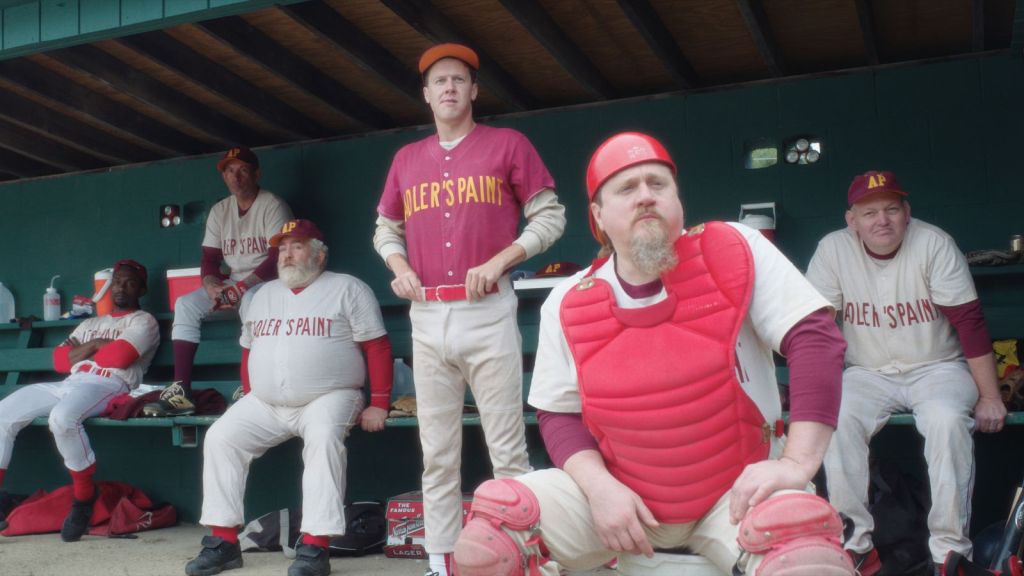
First-time filmmaker Carson Lund summons the spirit of Robert Altman in this wry ode to male bonding and baseball. The title references a rare variation of the curveball; the eephus is a pitch so slow, it lulls batters into forgetting to swing until it’s too late. That can also be a nifty metaphor for life, and Eephus is about life — midlife, to be exact — in all its ragged, oh-my-aching-back glory. In smalltown Massachusetts in the 1990s, two recreation-league ballclubs square off on a diamond soon to be demolished for commercial development. These men — some physically fit, some not, some young, some old — drink cheap beer, trash talk and wax rhapsodically about herniated discs and whatever else is on their minds. “Is there anything more beautiful,” one character opines as the game creeps into evening, “than the sun setting on a fat man stealing second base?” Short answer: no, there is not. The screenplay by Lund, Michael Basta and Nate Fisher is endlessly quotable.
5. Bull Durham (1988, dir: Ron Shelton)
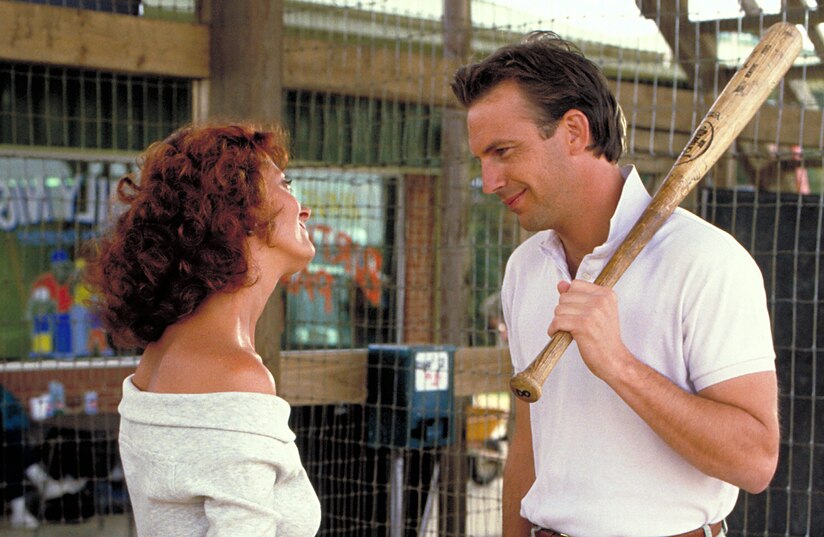
Writer-director Ron Shelton had long wanted to make a film drawing upon his experiences playing minor-league ball in the Baltimore Orioles’ organization, but it wasn’t until the project attracted the interest of then-rising star Kevin Costner that Orion Pictures was willing to proceed. The baseball groupies, the locker room sexual escapades, the cheesy promotional stunts — Bull Durham comes from a knowing place. Front and center, however, this is a very sexy romcom about a love triangle involving veteran catcher “Crash” Davis (Costner), poetry-reading Annie Savoy (Susan Sarandon) and up-and-coming pitching phenom “Nuke” Laloosh (Tim Robbins) as much as it is about what Annie calls “the church of baseball.”
4. Eight Men Out (1988, dir: John Sayles)
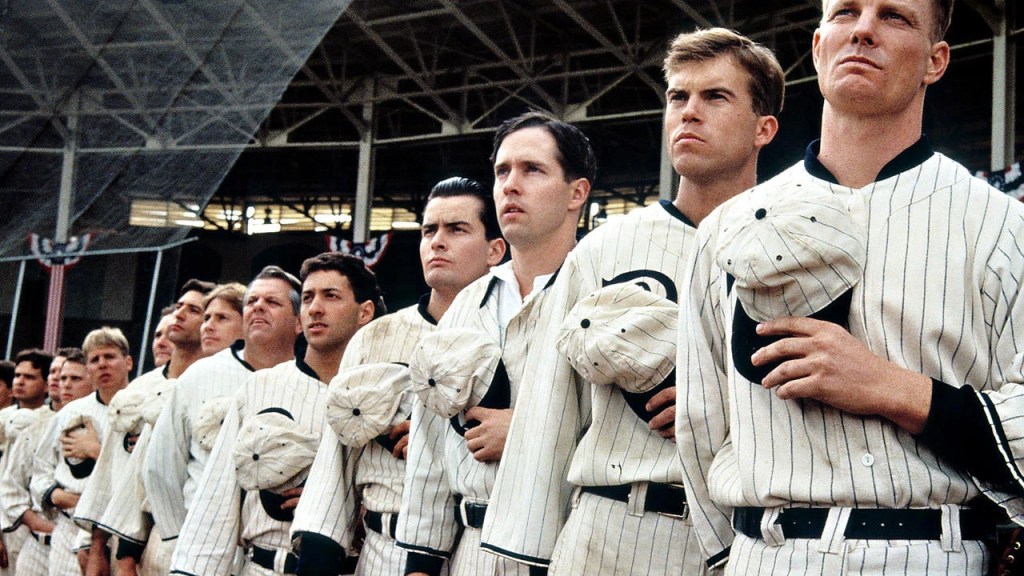
The 1919 “Black Sox” scandal is the stuff of infamy, when a cabal of gamblers bribed eight players of the American League champion Chicago White Sox into throwing the World Series. Writer-director John Sayles’ Eight Men Out is a handsomely crafted depiction of Major League Baseball’s most notorious shame, but at its heart is a story about athletes exploited by one group while corrupted by another. More so than the players, Eight Men Out’s villain is White Sox owner Charles Comiskey (Clifton James), whose miserliness presumably pushed his ballplayers, including stars Shoeless Joe Jackson (see #7’s Field of Dreams) and pitcher Eddie Cicotte, into the clutches of gamblers. If not a fully accurate portrait of the events, the film is nevertheless engrossing and powerful. Sayles, who has some fun playing real-life sportswriter Ring Lardner, assembled a treasure trove of character actors -– Christopher Lloyd, Bill Irwin and Michael Rooker, to name a few — but it is David Stratharin and John Cusack who lend a melancholy soulfulness.
3. Sugar (2008, dir: Anna Boden and Ryan Fleck)
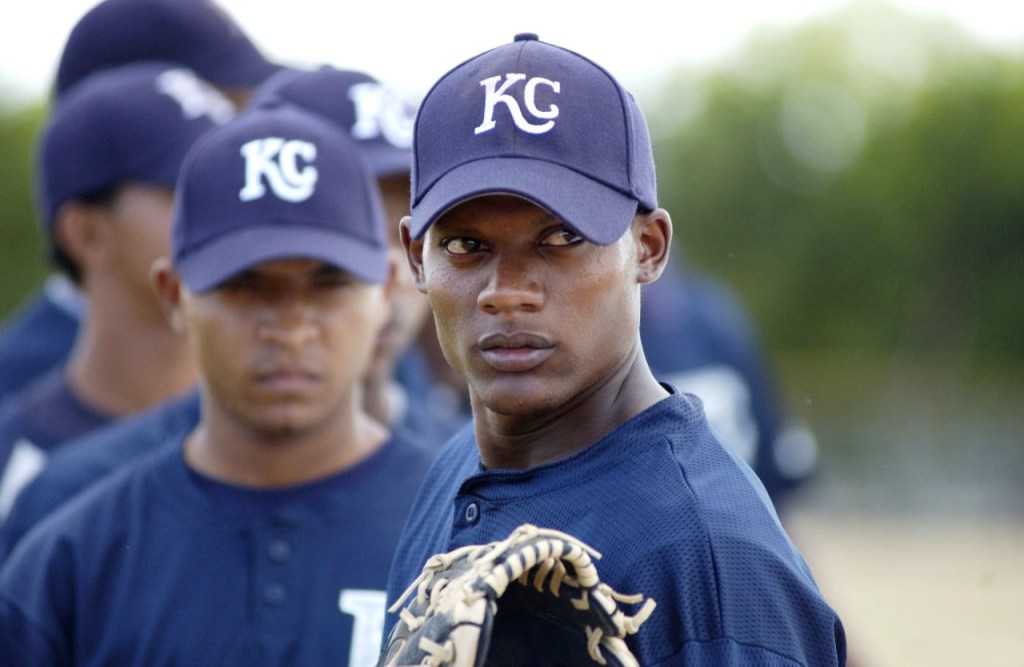
Part of what makes this a remarkable sports flick is that it isn’t a sports flick in the conventional sense. Written and directed by the team of Anna Boden and Ryan Fleck, Sugar is the story of a baseball phenomenon. But that’s where the familiarity ends, since this is the more common tale (albeit not on screen) of a phenom who wasn’t. The filmmakers auditioned hundreds of nonactors in the Dominican Republic before discovering Algenis Perez Soto. He is extraordinary as Miguel “Sugar” Santos, a prospective pitcher who lands a spot with a farm club for the fictitious Kansas City Knights. Boden and Fleck’s unsentimental, naturalistic style offers a window on the immigrant experience, a man alienated within a system that hopes to monetize his talents while keeping him at arm’s length.
2. The Bad News Bears (1976, dir: Michael Ritchie)
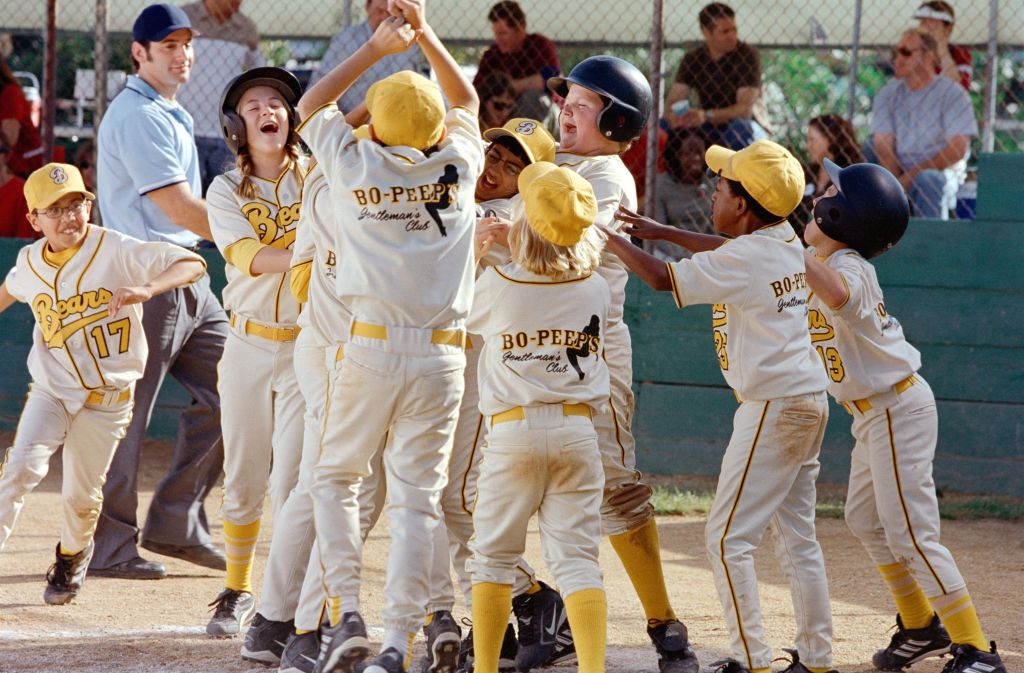
The first movie to obsess me as a kid was The Bad News Bears and its monumentally inept Little League team that perseveres under the dubious coaching of Walter Matthau as a broken-down alcoholic. Part of my affection for it was due to my love of baseball, and maybe my childhood crush on co-star Tatum O’Neal had something to do with it. The movie was so honest about adolescence as to be revelatory – the bullying, the racist taunts, the simultaneous yearning to fit in and be invisible. Screenwriter Bill Lancaster (son of Burt, from #7’s Field of Dreams) had its pint-sized characters talk like real kids, copious F-bombs and all. Now, many moons later, I can appreciate elements that sailed over the head of preteen me, particularly its razor-sharp satire of competition and how it can both inspire and corrupt. It’s a theme that director Michael Ritchie also explored in The Candidate, Smile and Downhill Racer. Matthau is pitch-perfect as the gloriously named Morris Buttermaker, but the true stars are the child actors.
1. Moneyball (2011, dir: Bennett Miller)
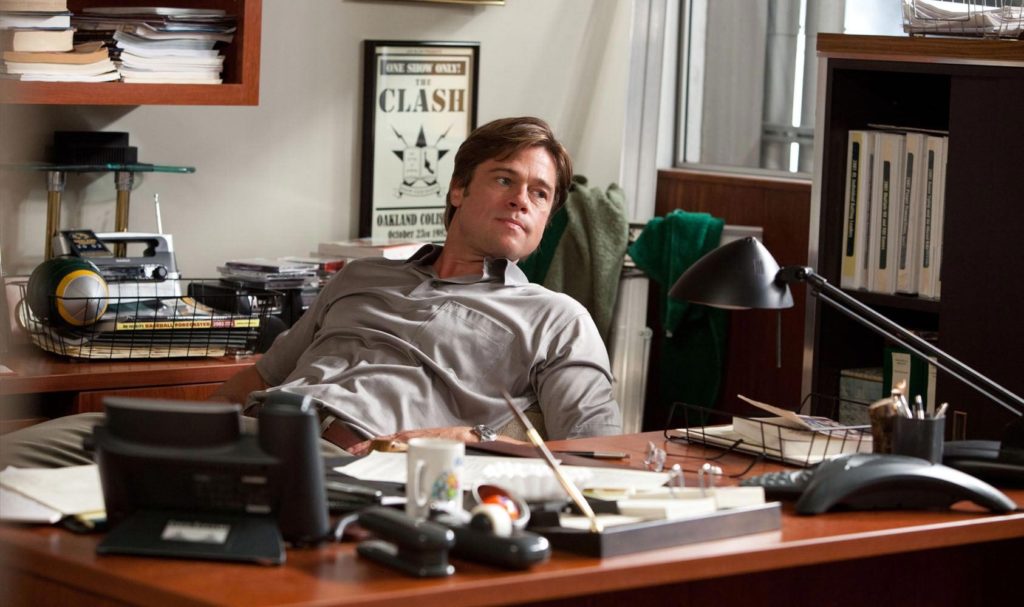
This fictionalized chronicling of the Oakland Athletics’ 2002 season, when the team’s 20-game winning streak set an AL record, brings clear eyes and an analytical mind to Major League Baseball. Consider it a companion piece of sorts to #3’s Sugar. Moneyball, like the Michael Lewis nonfiction bestseller on which it is based, details how A’s general manager Billy Beane (Brad Pitt) and a mild-mannered Ivy League numbers-cruncher (Jonah Hill) compensated for the club’s limited budget and resources by focusing on a statistics-laden theory known as “sabermetrics” advanced by baseball writer-scholar Bill James. Director Bennett Miller was not interested in making a traditional baseball movie. Steven Zailian and Aaron Sorkin’s incisive script explores the dichotomy between baseball as sport versus business, intuition versus analysis. In so doing, Moneyball demystifies the game while still romanticizing it, albeit in a grownup way. Pitt and Hill are tremendous, and the music score by Mychael Danna is perfectly understated but stirring.
Honorable mention: The Sandlot
 Cutting to the Chase with Phil Bacharach