It can always be worse. At least, that’s what moviegoers have long told themselves, and so there is a weird comfort that comes from losing yourself in big-screen dystopias.

Fritz Lang likely jumpstarted the genre in 1927 with Metropolis’ tale of haves and have-nots, but speculative pessimism quickly caught on in cinema. Like the best science-fiction, stories of futuristic hellholes offer artists a clever and safe way to comment on the problems of today. What follows are my picks for 10 wonderfully wretched film dystopias. Distilling such abundance to a list of 10 is admittedly something of a fool’s errand. As such, I have limited myself to films in which the dystopian milieu plays as central a role as the plot.
10. Dredd (2012, dir: Pete Travis)
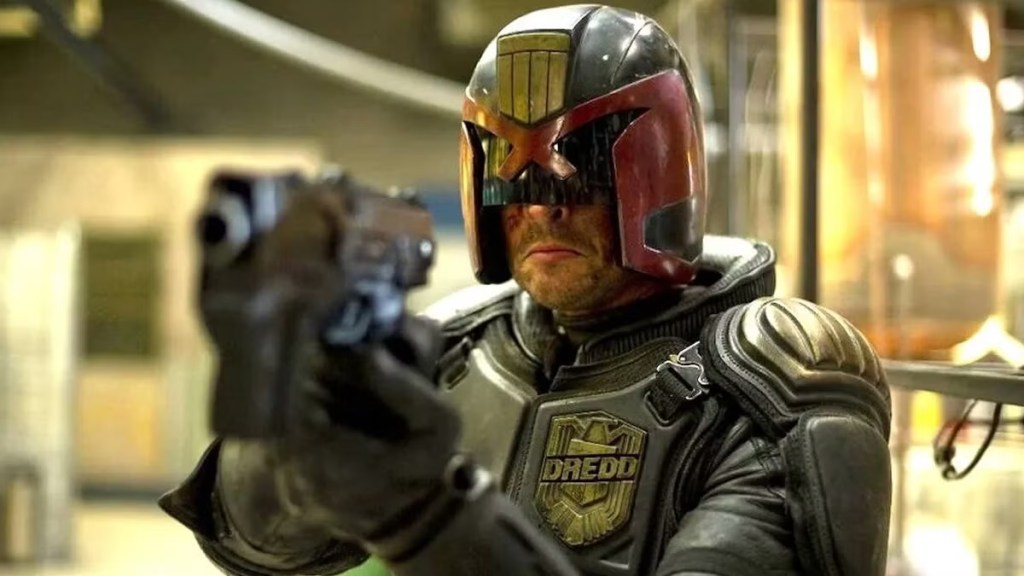
Rampant crime and authoritarianism are dystopian catnip, and Dredd feasts on our collective fears of both. It’s a mystery to me how this nonstop actioner, ostensibly directed by Pete Travis but reportedly steered in large part by its accomplished screenwriter, Alex Garland, wound up a box-office disappointment. Based on the Judge Dredd comics, the movie stars Karl Urban as Dredd, among the one-man jury-judge-executioners tasked with ensuring justice in the dangerously overcrowded Mega-City One. That Urban even registers much of a presence, and he does, is especially impressive when you consider that Dredd’s helmet obscures all but the actor’s mouth and jaw.
9. Idiocracy (2006, dir: Mike Judge)
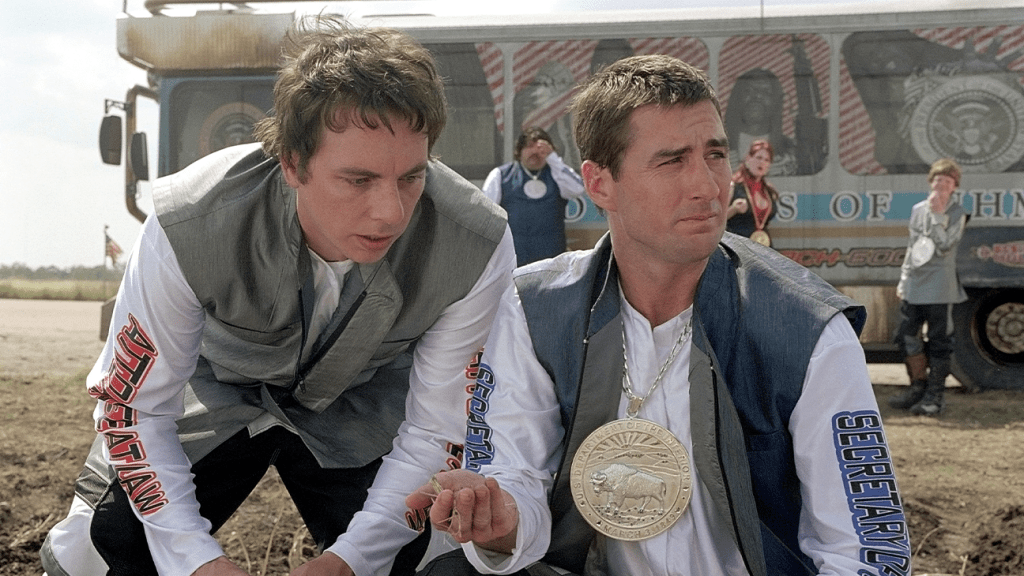
Idiocracy posits a future America overrun with stupidity, presumably because dummies breed more than smarties. Writer-director Mike Judge’s cult comedy is often hilarious but also a bit blind to its own issues with racism and sexism. Example: Luke Wilson and Maya Rudolph play modern-day test subjects selected by the military for their average intelligence; tellingly, average male Wilson is a passive Army clerk, while average female Rudolph is a sex worker. The pair are cryogenically frozen, then awaken 500 years later in a nation where people think Gatorade is water, slavishly watch a TV show called Ow! My Balls! and are governed by a former pro wrestler and porn star. Back in 2006, this all seemed far-fetched…
8. Soylent Green (1973, dir: Richard Fleischer)
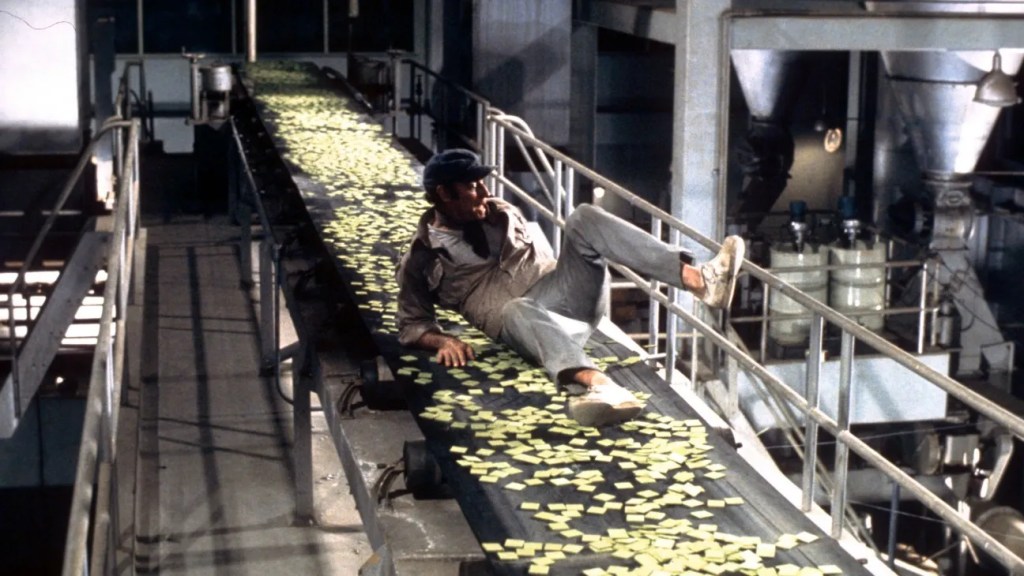
The year is 2022 (!) and the world has gone to shit. The earth is unsuitable for vegetation, the oceans are polluted and dying, and humanity subsists on a diet of something called soylent (if you know, you know). Charlton Heston is a hard-nosed cop investigating the murder of an executive with the corporation that makes soylent. Director Richard Fleischer and screenwriter Stanley R. Greenberg concoct a scuzzed-out conspiracy involving soylent, female sex workers (called “furniture” in this uber-sexist dystopia) and a past-their-prime cast that includes Chuck Connors, Joseph Cotten and Edward G. Robinson. Soylent Green was the final film for Robinson, who was dying of cancer throughout production. In the movie’s most exquisite scene, Robinson’s Solomon Roth dies via assisted suicide, going out while surrounded by screened images of the Earth of yesteryear––flowers, trees, rivers, etc.––and rousing classical music. “People were always rotten,” pines the old man, “but the world was beautiful.” Mic drop.
7. Children of Men (2006, dir: Alfonso Cuarón)
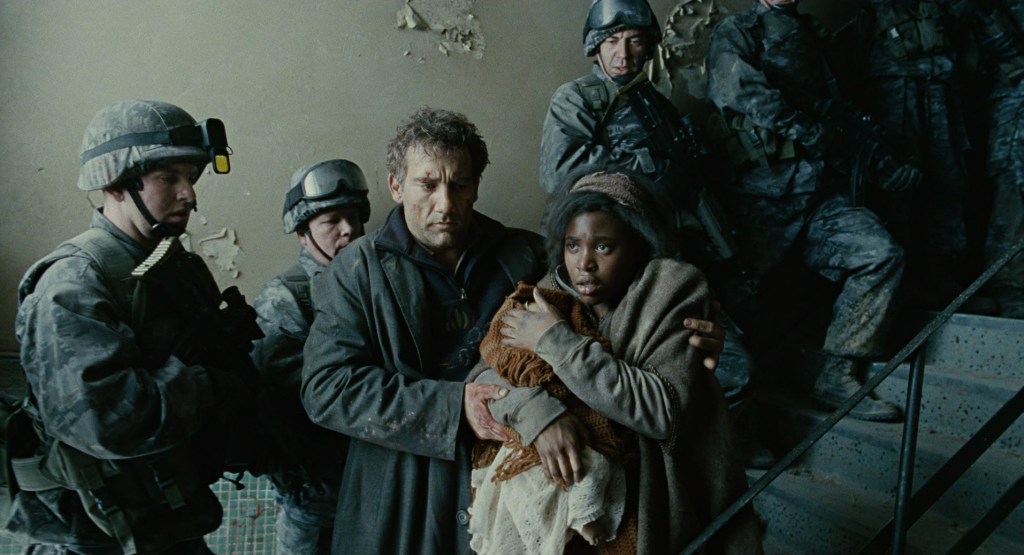
By 2027, the global population has ground to a halt in the wake of no one being able to produce children. In an authoritarian United Kingdom where immigration is outlawed, Clive Owen plays Theo, a former activist now an embittered mope who skulks around in a rumpled overcoat and indulges “pull my finger” jokes from his old hippie friend Jaspar (a terrific Michael Caine). Theo’s ennui is disrupted when an ex-flame from his activism days (Julianne Moore) enlists his help to protect Kee, a young refugee who is––wait for it––pregnant and being sought by government forces. Loosely based on a P.D. James novel, Children of Men is conceptually spare but a fully realized dystopia. As a work of visceral excitement, it is phenomenal. Director Alfonso Cuarón and cinematographer Emmanuel Lubezki choreograph a handful of spellbinding action sequences, one of which is among the most jaw-dropping oners you will ever see.
6. Mad Max 2: The Road Warrior (1981, dir: George Miller)
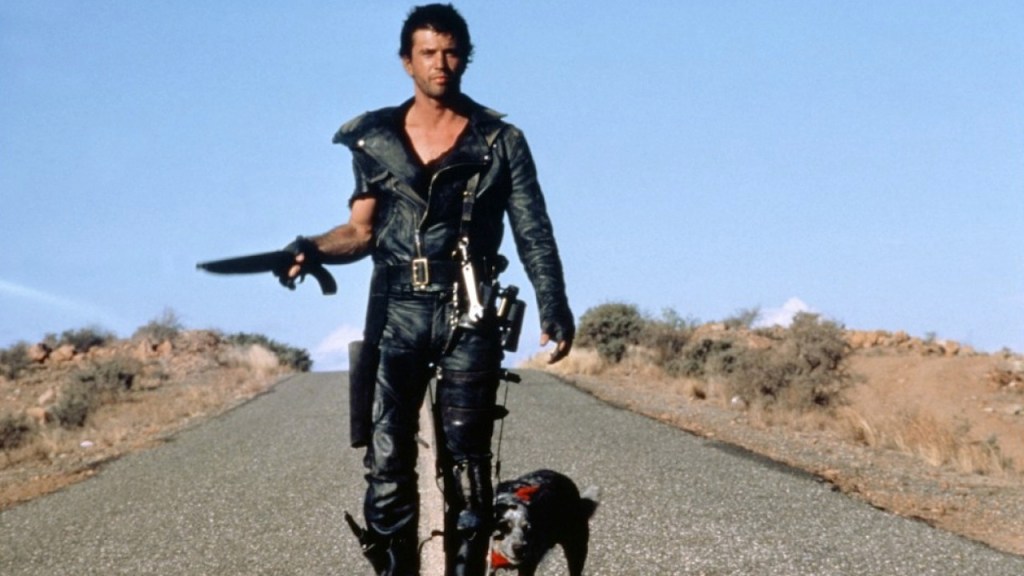
For world-building, few directors can touch George Miller, the Australian impresario behind the Mad Max franchise. For edge-of-your-seat action, there is no contest; 2015’s reimagined Mad Max Fury Road is an unequivocal masterpiece of the genre. For dystopian goodness, however, my money is on this second installment in the series. Long before Mel Gibson revealed himself to be a dumpster fire with legs, he was the perfect embodiment of Max, the stoic antihero roaming a post-apocalyptic landscape. Featuring a handful of excellent set pieces that gave lots of stuntmen lots of work, Mad Max 2: The Road Warrior is essentially a western, albeit with cool-looking vehicles in place of horses and costumes that make one suspect Miller’s crew raided all the punk boutiques and sex stores there were in Sydney.
5. Battle Royale (2000, dir: Kinji Fukasaku)
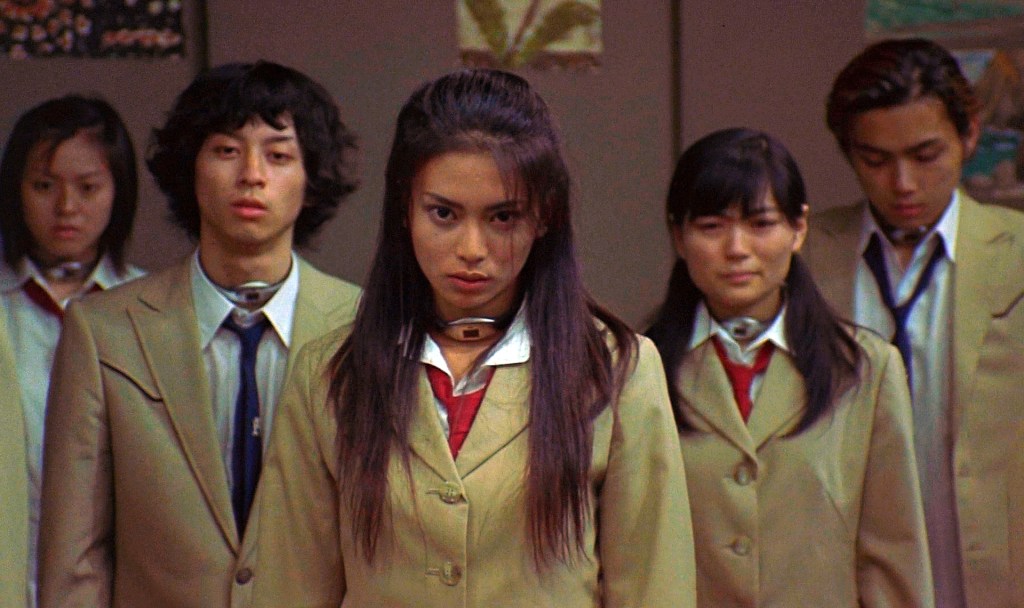
The Hunger Games and its many imitators have this Japanese import to thank for their brutal take on humanity’s future. In the wake of economic and societal collapse, 40 Japanese ninth-graders leave for what they think is a school field trip, only to be drugged and awakened on a remote island. A teacher of theirs (Takeshi Kitano) dutifully explains to the kiddos, “Today’s lesson is you get to kill each other off … until there’s only one of you left.” The sundry dramas of high school, which range from crushes to cliques, become literally weaponized. Battle Royale director Kinji Fukasaku captures a remarkable tone that teeters between darkly humorous and emotionally gripping––occasionally simultaneously.
4. RoboCop (1987, dir: Paul Verhoeven)
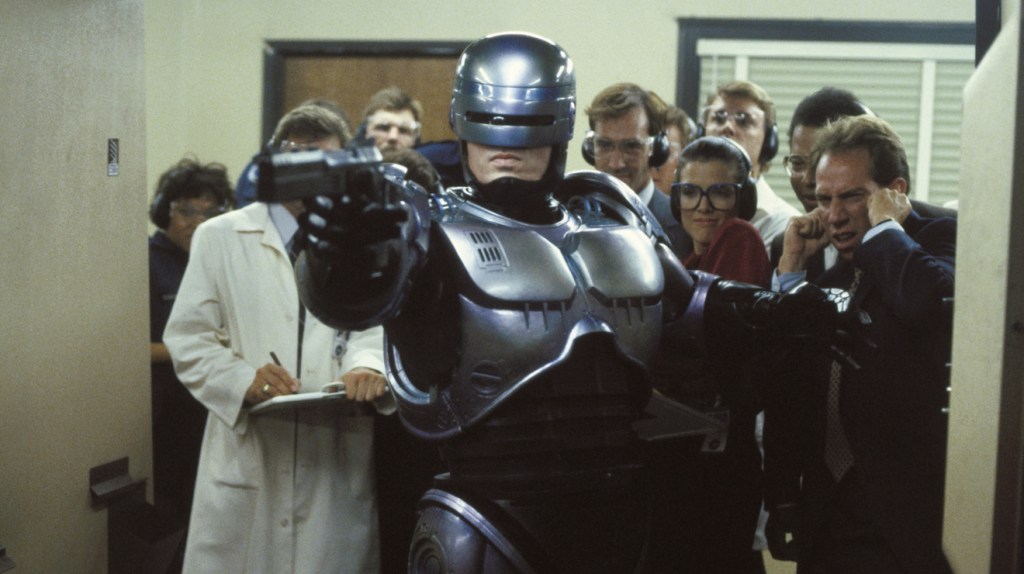
While Detroit has long been caricatured as a crime-infested hellhole, at least Dutch director Paul Verhoeven made it wickedly fun. Set in the futuristic year of 1991 (!), RoboCop plops us into a city plagued by criminal gangs, one of which mows down squeaky-clean cop Murphy (Peter Weller, whom Verhoeven later admitted he cast in large part because of his awesome chin). Thanks to corporate behemoth Omni Consumer Products, the left-for-dead officer is transformed into a nearly indestructible crimefighting quasi-robot. RoboCop delivers some boffo action while skewering corporate greed via wonderfully broad comic performances from Ronny Cox and Miguel Ferrer as rival Omni executives. Some of the picture’s satirical bite has faded with time, but the narrative still packs a bionic wallop.
3. WALL-E (2008, dir: Andrew Stanton)
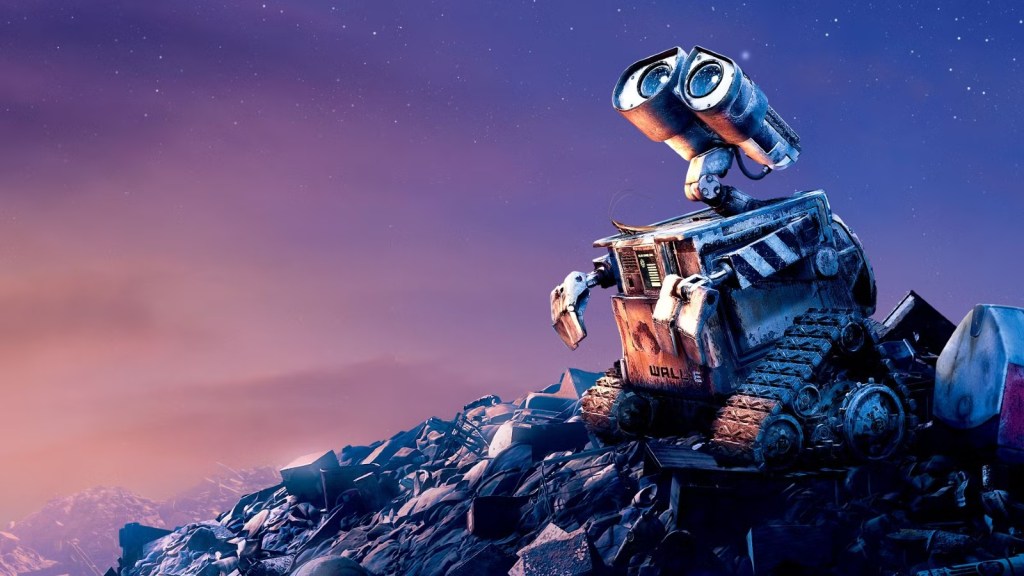
Despite WALL-E taking place in the 29th century, Pixar’s dystopian outlook feels perilously close to where we are headed. An uninhabitable Earth long ago forced the evacuation of humanity aboard spaceships provided by a huge corporation. The morbidly obese humans are confined to multifunctioning chairs and other technological gizmos that can meet their every need. Back on our abandoned planet, a lone working robot, the titular WALL-E, dutifully organizes seemingly endless tons of garbage left behind. And yet … amid this despairing scenario, writer-director Andrew Stanton and co-writer Jim Reardon offer a poignant tale of love and hope. An Oscar winner for Best Animated Feature, the movie is a visual and tonal masterpiece, arguably the greatest of Pixar’s impressive canon.
2. Minority Report (2002, dir: Steven Spielberg)

It’s Washington, D.C., in the year 2054, and three psychic beings called precogs marinate in a pool of water and occasionally predict future murders. Tom Cruise portrays John Anderton, the head of the precrime law enforcement agency that takes its cues from the precogs. When Anderton winds up on the losing end of a precog prognostication, he goes on the run to clear his name for something he has not yet done. Screenwriters Scott Frank and Jon Cohen worked for two years in adapting Philip K. Dick’s novella. The painstaking care is apparent. Minority Report is intricately plotted but cleanly told, propulsive and exciting. It is also an insightful examination of the tradeoff between freedom and security. In the opinion of your humble writer, Minority Report is Steven Spielberg’s best film of the 2000s.
1. A Clockwork Orange (1971, dir: Stanley Kubrick)
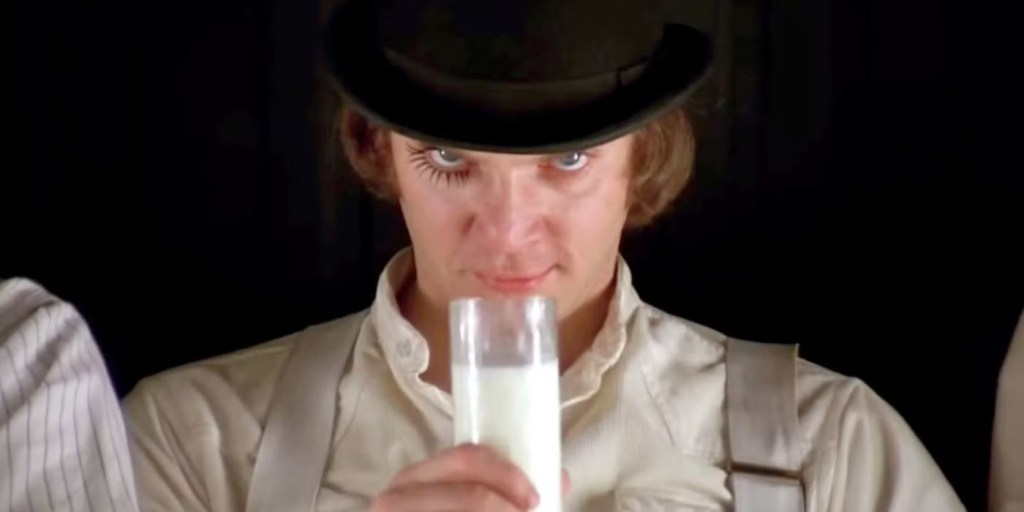
This elegant but chilling adaptation of Anthony Burgess’ 1962 novel had a profound impact on me when I first saw it while in high school, on a VHS cassette rented from Blockbuster. The film was my entry point to Stanley Kubrick. Set in a slightly futuristic London, A Clockwork Orange stars a frightening—and frighteningly charismatic—Malcolm McDowell as Alex, leader of three hooligans clad in white suspenders, black bowlers and heavy-duty codpieces. The impact of the film’s brutal opening sequences, in which Alex and his fellow “droogs” embark on a sadistic night of the “ultra violent,” has not dimmed with time. In a particularly horrifying home invasion, Alex rapes a woman while crooning “Singin’ in the Rain,” the victim’s husband forced to watch helplessly. A Clockwork Orange has much more on its mind than shock. Kubrick challenges our notions of free will when it comes to good and evil; the maestro does so with generous dollops of darkly funny satire. Wendy Carlos’ score, a strange blend of synthesizers and classical (Alex is a psychopath who appreciates Beethoven), adds to the sinister vibe. Shortly after A Clockwork Orange’s release, a Dutch woman was sexually assaulted by attackers who sang “Singin’ in the Rain” throughout the ordeal. Kubrick himself pulled the movie from screens in Great Britain.
Honorable mention: Akira (1988, dir: Katsuhiro Otomo), Blade Runner (1982, dir: Ridley Scott), Brazil (1985, dir: Terry Gilliam), District 9 (2009, dir: Neil Blomkamp), Escape from New York (1981, dir: John Carpenter), The Long Walk (2025, dir: Francis Lawrence), Metropolis (1927, dir: Fritz Lang), Rollerball (1975, dir: Norman Jewison), Stalker (1979, dir: Andrei Tarkovsky), Total Recall (1990, dir: Paul Verhoeven)
 Cutting to the Chase with Phil Bacharach