
Time travel movies aren’t really about time. Yes, the idea of moving through time is fantastical, but such stories are conduits to explore themes as diverse as nostalgia, regret, fate and free will. These are my picks for the 10 best movies about time travel.
10. My Old Ass (2024, dir: Megan Park)
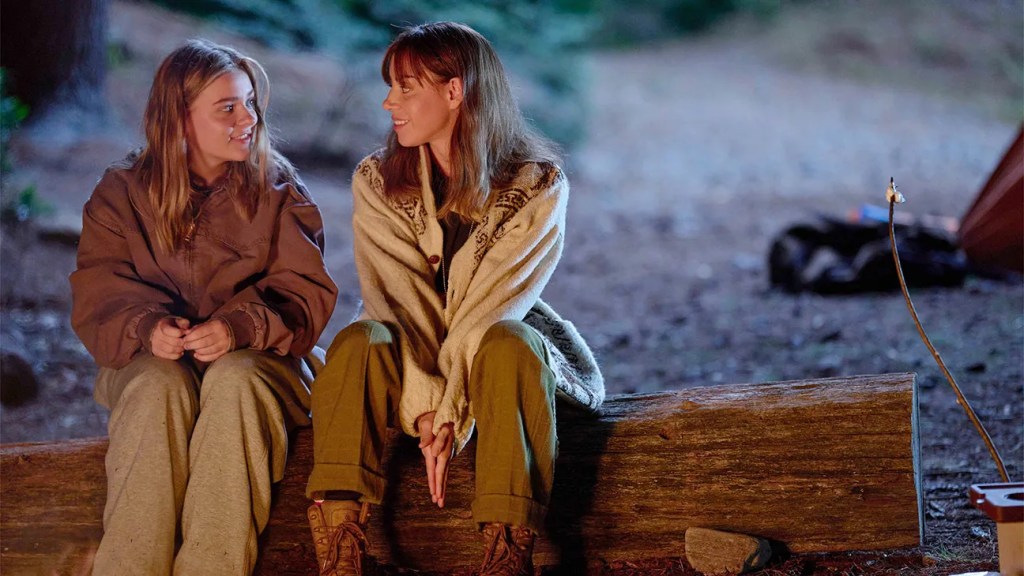
10. My Old Ass (2024, dir. Megan Park)
“If I knew then what I know now, I’d have been better off.” That’s the premise behind My Old Ass, which, despite an arguably unfortunate title, is a comedy-drama of surprising depth and humanity. Maisy Stella is terrific as Elliott, an 18-year-old in her last summer before college. She is tripping on mushrooms with friends when she is visited by her 39-year-old future self (Aubrey Plaza). Writer-director Megan Park takes a gamble on her high-wire concept. Instead of struggling to explain the fantastical situation, she explores the emotional possibilities it offers. This is one comedy where it pays to bring tissues.
9. Palm Springs (2020, dir: Max Barbakow)

If you’ve seen Groundhog Day (see #1), the premise is familiar: our protagonist is condemned to repeat the same day over and over, or as Palm Springs’ Nyles puts it, “one of those infinite time-loop continuums you’ve heard about.” Palm Springs is obviously inspired by Groundhog Day, but it is no knockoff. Nyles (Andy Samberg) is spending a literal eternity as the plus-one at a Palm Springs wedding where his girlfriend (Meredith Hagner) is a bridesmaid. That monotony is shattered when he inadvertently pulls the bride’s cynical sister (Cristin Milioti) into the continuum. Andy Siara’s screenplay is clever and endearingly silly, and first-time feature director Max Barbakow keeps things snappy. The picture’s secret weapons are Samberg and Milioti. Their rapport makes Palm Springs downright lovable.
8. La Jetée (1962, dir: Chris Marker)
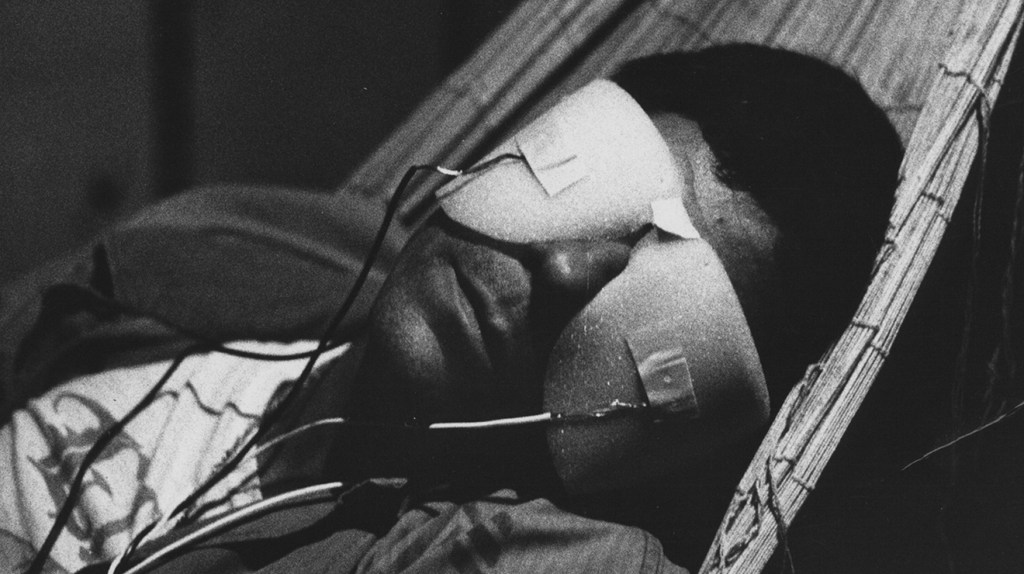
It took Chris Marker only about 28 minutes––flawless minutes, mind you––to tell a haunting story of premonition, apocalypse, time travel and fate. He makes some bold choices in La Jetée, purportedly due to not having a camera, but limitation fosters brilliance. Relying on grainy black and white still photographs, voiceover narration and an interesting sound design, the French writer-director devises a startlingly creative work. The protagonist, known only as the man (Davos Hanich), is sent back in time by futuristic scientists as part of a time-travel experiment. He has been selected, a voiceover narrator explains, “only because he was glued to an image of his past.” The guts of La Jetée get a makeover in Terry Gilliam’s Twelve Monkeys (see #5), but both films are knockouts in their own right.
7. Looper (2012, dir: Rian Johnson)
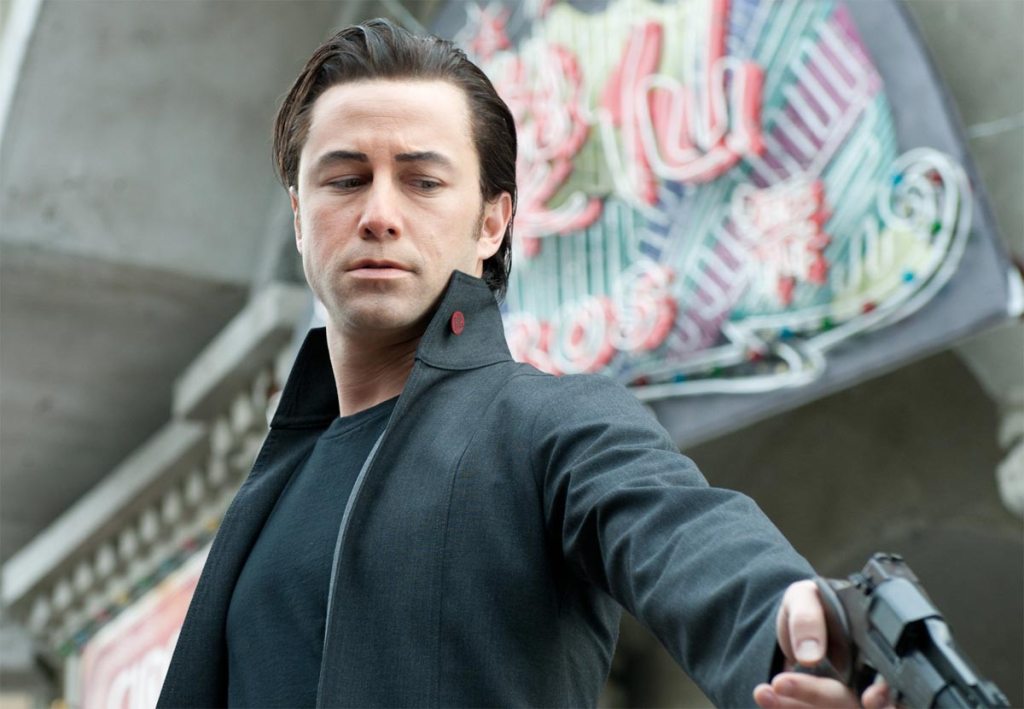
Looper has so many ideas, at first you fear that the movie will collapse under its own weight. Dystopia, time travel, telekinesis, gangland killings––there are a lot of ground rules to keep straight in this science-fiction actioner. But writer-director Rian Johnson plays fair with his complicated construct. We start in 2044, where time travel is about 30 years away, but still figures prominently in the lives of “loopers,” killers hired by a futuristic crime syndicate to assassinate and dispose of targeted baddies who are transported from the future. In this insidiously efficient system: a looper waits in the middle of nowhere for a hooded victim to materialize from thin air. He then blasts that poor bastard to smithereens. And when it’s time to clean up loose ends, the looper is directed to dispatch his future self. Joseph Gordon-Levitt is Joe, a looper who makes the costly mistake of failing to off his older self (Bruce Willis). But old Joe arrives in 2044 with his own agenda to stop a certain future from taking shape.
6. The Terminator (1984, dir: James Cameron)

James Cameron directed and co-wrote (with Gale Anne Hurd) this crackerjack science-fiction film that put him on the map and gave Arnold Schwarzenegger his most iconic role. Schwarzenegger plays a cyborg assassin who arrives in Los Angeles circa 1984 from the year 2029, when artificial intelligence systems have nearly extinguished the human race. Humanity’s salvation is a guy named John Connor, and those evil machines have dispatched the Terminator to eliminate Sarah Connor before her yet-to-be-conceived son can lead a resistance. There’s another time traveler, too: Kyle Reese (Michael Biehn), a resistance fighter tasked with protecting John’s mother. Don’t think too hard about holes in the mind-bending plot. Cameron’s first box-office hit and second directorial feature demonstrates his penchant for spectacular action sequences. He even sprinkles in some dry humor, thanks to the taciturn Terminator’s way with a catchphrase.
5. Twelve Monkeys (1995, dir: Terry Gilliam)
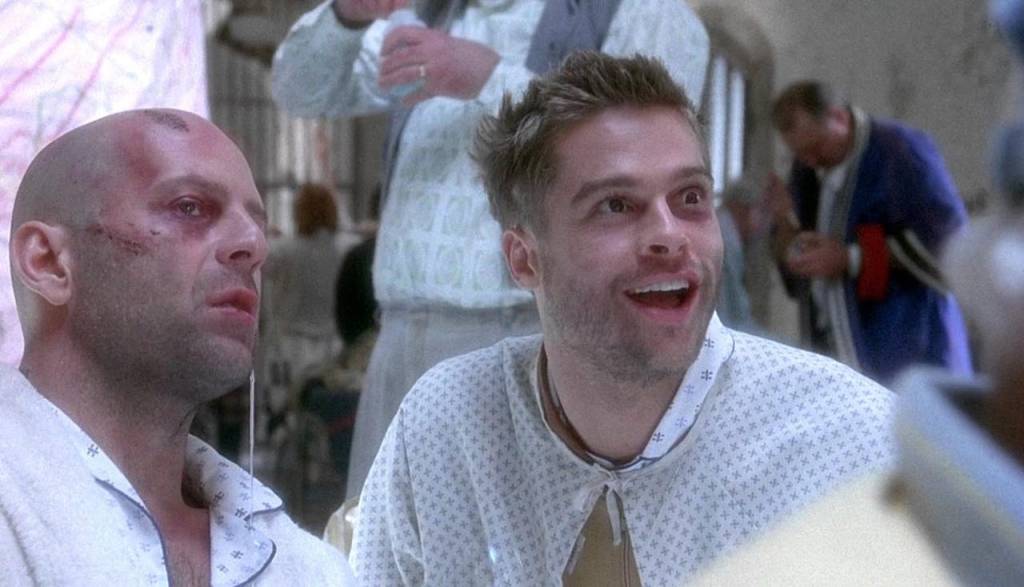
This reimagining of the 1962 short La Jetée (see #8) conjures a future devastated by a global pandemic that has killed billions and forced humanity to burrow underground. Bruce Willis is James Cole, a violent prisoner in 2035 sent by scientists back to 1996 to collect information about the moment that Earth went to hell (remember when civilization-ending viruses were the stuff of fiction?). He and Madeleine Stowe deliver strong performances, but best of all is a bonkers Brad Pitt as a mentally unstable rich kid who might just be responsible for the end of the world. Scripted by the husband-wife team of David and Janet Peoples and directed by Terry Gilliam with his customary visual aplomb, Twelve Monkeys luxuriates in its melancholy––even down to Willis’ baleful eyes––as it careens toward its inexorable, haunting, achingly beautiful conclusion.
4. Interstellar (2014, dir: Christopher Nolan)
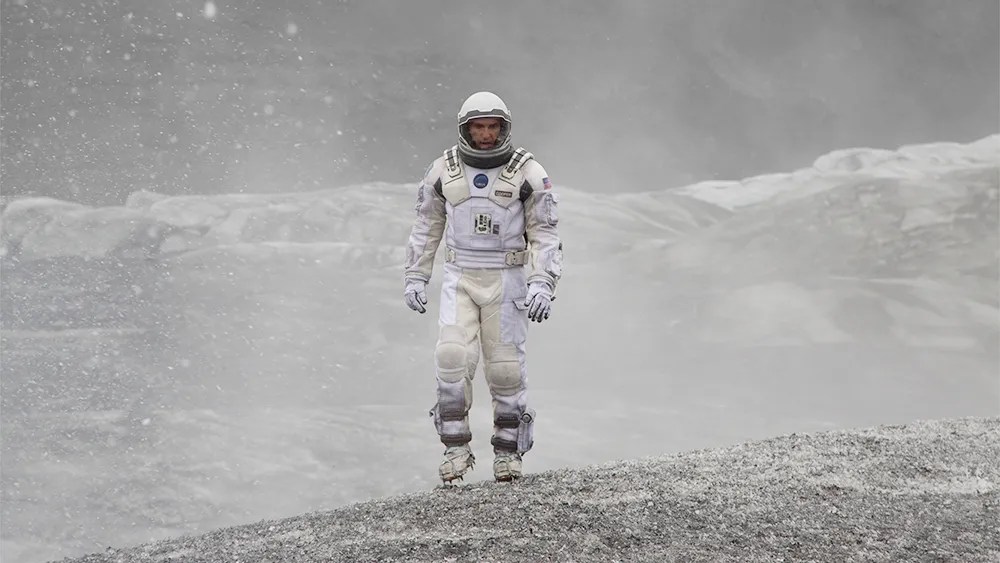
Like the best Christopher Nolan films, Interstellar swings for the fences. Earth is dying in a not-too-distant future, with massive dust storms ravaging American farmlands. Among those impacted is Cooper (Matthew McConaughey), a widower and former NASA engineer now raising two children. Eventually, he and another astronaut played by Anne Hathaway are recruited to helm a space mission to a wormhole near Saturn. On the other side of the universe, the astronauts learn, are three planets possibly suitable to serve as humankind’s next home. In that wormhole, Cooper and crew slingshot through distortions of time and space. A particularly stirring sequence finds him influencing his own future by jumping back in time, a narrative twist that would make M.C. Escher woozy. Nolan and his brother Jonathan penned the screenplay in close consultation with acclaimed astrophysicist Kip Thorne. While I cannot attest to the science of Interstellar, I couldn’t care less when the storytelling is this extraordinary.
3. Slaughterhouse-Five (1972, dir: George Roy Hill)
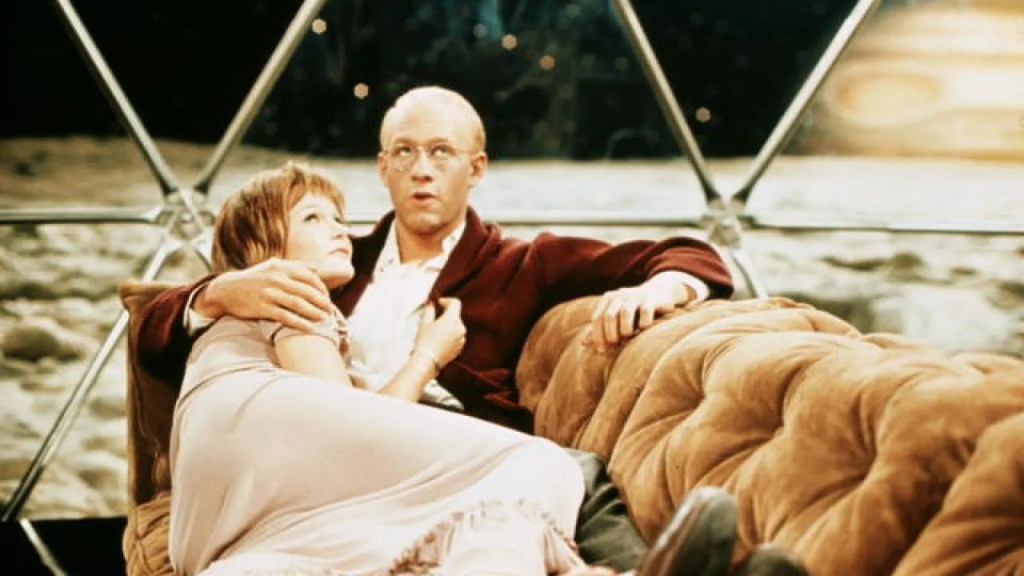
George Roy Hill’s audacious adaptation of Kurt Vonnegut’s 1969 classic inexplicably failed to register with movie audiences of the time despite it having made a splash at 1972’s Cannes Film Festival. The film’s lack of stature today is baffling. Slaughterhouse-Five more than delivers on the novel’s absurd science-fiction and comic existentialism in the life of Billy Pilgrim (Michael Sacks), who trips through time as if skimming stones. The middle-aged husband and father shuttles from World War II––where he is a prisoner of war during the Allied firebombing of Dresden, Germany––to a planet called Tralfamadore where he and skin-flick star Montana Wildhack (Valerie Perrine) are encouraged to mate. Sacks is a bit more of a blank slate than necessary, but the supporting cast is excellent, particularly Eugene Roche as a kindly POW, Ron Leibman as an unhinged GI and Sharon Gans as Billy’s insecure wife. Armed with Stephen Geller’s clever nonlinear script and brilliantly edited by Dede Allen, Slaughterhouse-Five is an underseen masterpiece.
2. Back to the Future (1985, dir: Robert Zemeckis)
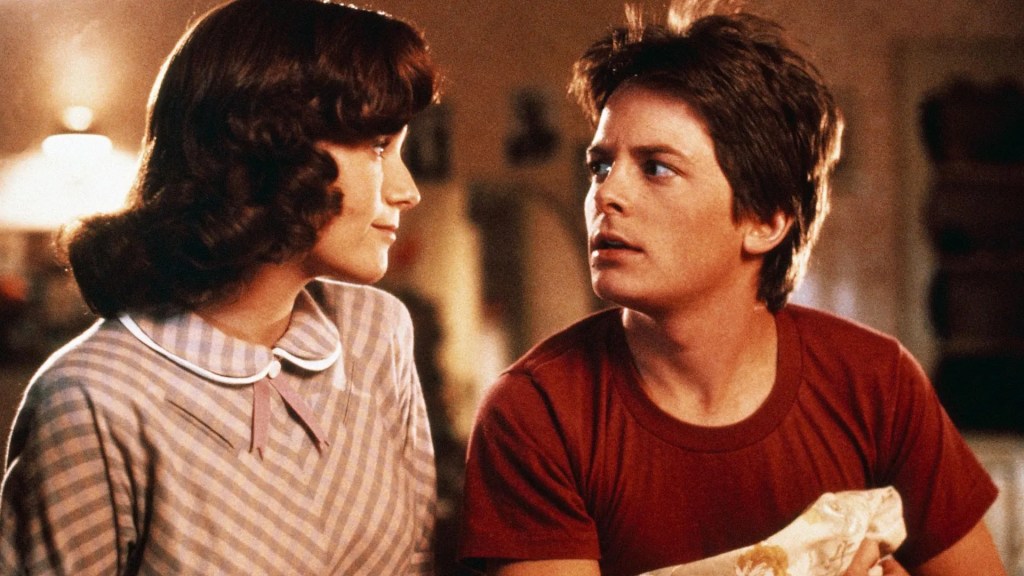
For such a monster hit, Back to the Future flirts with genuine weirdness. A teenage boy travels back in time, bumps into his parents as high schoolers, and finds that his future mom is hot for him. It isn’t the standard formula for a summer blockbuster, but writer-director Robert Zemeckis and co-screenwriter Bob Gale craft a fine-tuned blend of comedy, action and flights of fancy. As the kid who accidentally travels back to 1955 courtesy of a DeLorean, Michael J. Fox is a wonderfully likable Marty McFly. He shot the picture on nights and weekends, whenever he wasn’t at work on TV’s Family Ties. The experience proved nearly as exhausting as time travel. “The character of Marty McFly––a skateboarding, girl-chasing high school rock ‘n’ roll musician––seemed like the kind of guy I could play in my sleep,” wrote Fox in his memoir Lucky Man. “That very nearly turned out to be the case.”
1. Groundhog Day (1993, dir: Harold Ramis)
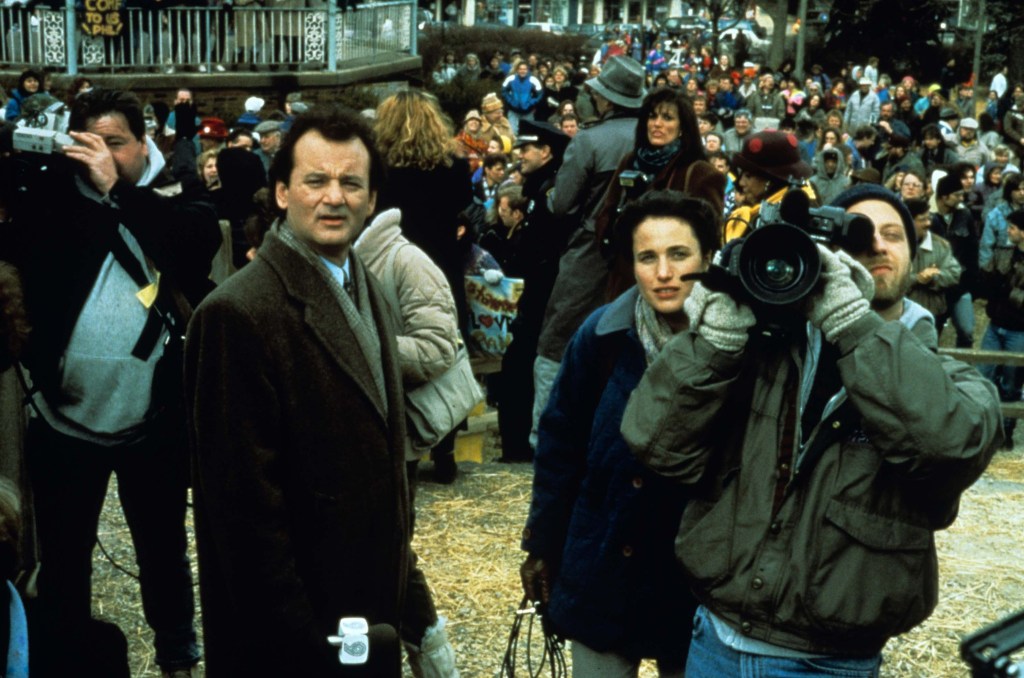
A clever concept executed with consummate skill, Groundhog Day involves a time loop in which a TV weatherman is forced to experience February 2 over and over again. That date, of course, corresponds to the annual event when the world’s most famous groundhog, Punxsutawney Phil, supposedly predicts whether there will be six more weeks of winter. As the smug weather man, Bill Murray portrays Phil Connors as an insufferable jerk none too pleased about being stuck with a TV producer (Andie MacDowell) and cameraman (Chris Elliott) in snowy Punxsutawney, Pennsylvania, for the big day. Danny Rubin, who co-wrote the screenplay with director Harold Ramis, originally envisioned Phil Connors as repeating the day over the course of thousands of years. While the duration of the time loop isn’t clear, the stages of repetition in Groundhog Day forces our antihero to face some uncomfortable, if hilarious, truths about existence––all in the crowd-pleasing guise of a romantic comedy.
Honorable mention: Back to the Future Part II (1989, dir. Robert Zemeckis), Bill & Ted’s Excellent Adventure (1989, dir. Stephen Herek), The Butterfly Effect (2004, dir. Eric Bress and J. Mackye Gruber), Il Mare (2000, dir. Lee Hyun-seung), Peggy Sue Got Married (1986, dir. Francis Ford Coppola), Planet of the Apes (1968, dir. Franklin J. Schaffner), Primer (2004, dir. Shane Carruth), Source Code (2011, dir. Duncan Jones), Star Trek IV: The Voyage Home (1986, dir. Leonard Nimoy), Time After Time (1979, dir. Nicholas Meyer)
 Cutting to the Chase with Phil Bacharach