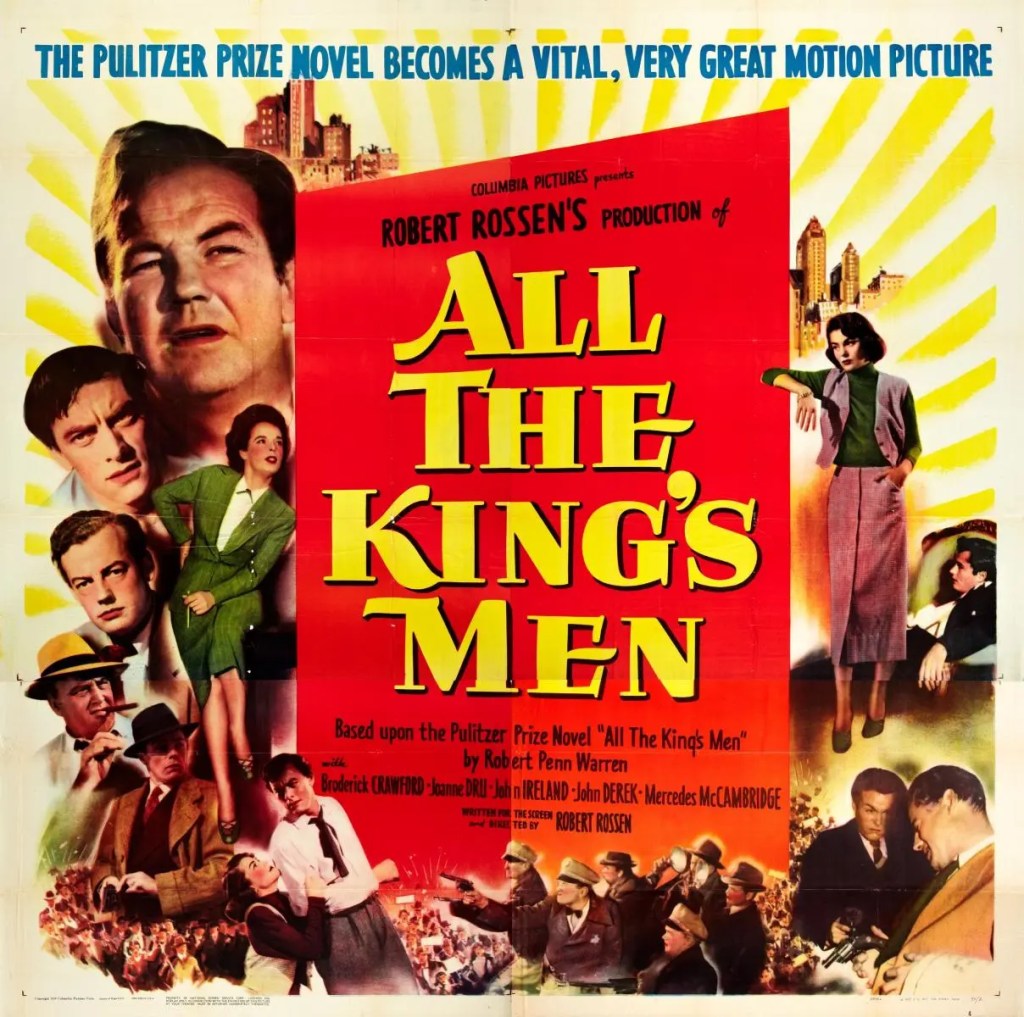
All the King’s Men catapulted Broderick Crawford from character actor to movie stardom, and rightly so. As fire-breathing demagogue Willie Stark, the indelible performance earned him an Academy Award for Best Actor.
His portrayal dominates the film. Adapted from Robert Penn Warren‘s Pulitzer Prize-winning 1947 novel and loosely based on the life of legendarily corrupt Louisiana political boss Huey Long, All the King’s Men still reverberates with ferocity. In today’s age of hyper-polarized political rhetoric, the film’s relevance is obvious; cautionary tales of populist hero-turned-demagogue never go out of style (which might explain why writer-director Steve Zaillian revisited the story for a 2006 remake starring Sean Penn).

Our view of Willie Stark in All the King’s Men comes chiefly through the eyes of Jack Burden (John Ireland), a newspaper reporter in an unnamed Southern state, presumably Louisiana, who is assigned to cover a county treasurer election. Willie, the challenger, is a tenacious and principled bear of a man determined to take on the corrupt good-ol’-boy network. Jack interviews Willie and his soft-spoken wife, Lucy (Anne Seymour), and grows fond of the couple. Willie loses the race, but his ambitions remain intact. He earns a law degree and becomes a country lawyer with a reputation for helping the little guy.
Willie’s political ascent begins a few years later. Political operatives for a gubernatorial candidate named Harrison, concerned about the down-home appeal of their opponent, look for a decoy candidate who will split the “hick” vote and subsequently hand the election to Harrison.
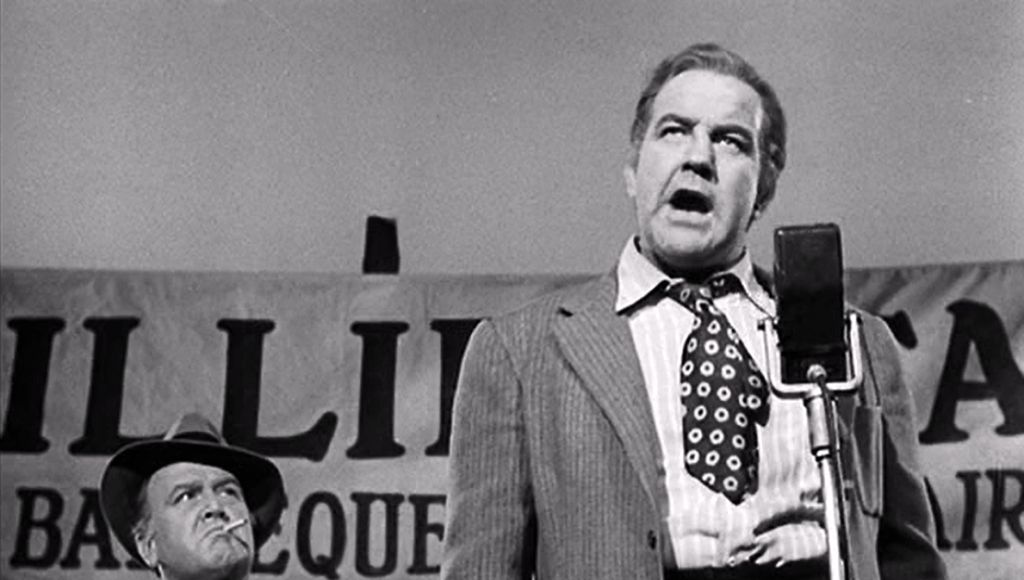
In Willie Stark, the political hacks find their unwitting dupe. Or so they think. Once Willie discovers the scheme, his rage awakens the charismatic beast lurking inside. After a night of boozing, Willie appears before a crowd of voters and whips them up with a torrent of snarling demagoguery, vowing to battle the power elite on behalf of his fellow “redneck hicks.” Willie loses the battle but wins the war. A few years later he is elected governor in a campaign slaughter that Jack likens to “Saturday night in a mining town.”

As governor, Willie surrounds himself with loyal sycophants such as Jack and Sadie (Mercedes McCambridge), Stark’s campaign manager. Tall, burly and thoroughly imposing, Willie is as vilified as he is glorified, a thoroughly corrupt politico who also happens to be a tireless champion of the have-nots. A newsreel muses whether he is a messiah or dictator, but as the story progresses, the messianic side of Willie Stark grows ever more remote.
Writer-director Robert Rossen infuses All the King’s Men with the same unvarnished power he brought to 1947’s Body and Soul and 1961’s The Hustler. This is butcher-block filmmaking, simply told and not exactly spillimg over with subtlety.
While there are good performances all the around (McCambridge won Best Supporting Actress), Crawford is a force of nature. In his best scenes – such as the populist-fueled speech that jumpstarts Willie’s political career – the actor personifies the voraciousness of a man with an unquenchable appetite for power. None of the supporting players can hold their own against Crawford. No matter. All the King’s Men is All Crawford, All the Time.
 Cutting to the Chase with Phil Bacharach
One response to “All the King’s Men (1949)”
[…] Rossen, a onetime communist, during the McCarthy era. In 1951, only two years after Rossen’s All the King’s Men had won the Oscar for Best Picture, he was blacklisted in Hollywood after refusing to name names […]
LikeLike