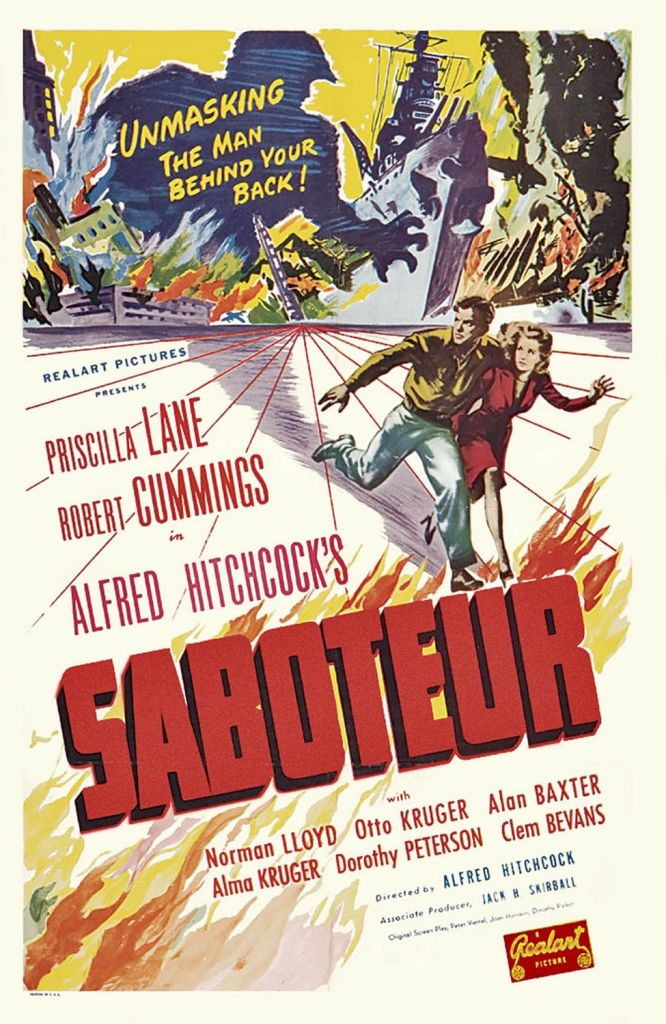
Saboteur is hardly top-tier Alfred Hitchcock, but even below-par Hitch is damned entertaining. And this wartime suspense yarn certainly holds your interest. It relies on a familiar theme of the director’s — an innocent man wrongly accused of a crime embarks on a cross-country chase to clear his good name — that he had used in his 1935 British masterpiece, The 39 Steps, and would tap again in 1959’s North by Northwest. In fact, Saboteur‘s imaginative set pieces and loopy humor can be seen as a sort of blueprint for North by Northwest, even down to the literal cliffhanger high atop a national monument.
Saboteur‘s Barry Kane (Bob Cummings) is an average Joe doing his part for the war effort by working at a Glendale, Calif., munitions plant. During a work break, he literally bumps into an abrasive stranger, Frank Fry (Norman Lloyd), who drops a few envelopes and sneers when Barry and his pal, Ken, offer an apology.
Shortly afterward, a fire spreads through the plant. Fry shows up to hand a fire extinguisher to Barry, who in turn gives it to his friend. Whoops. The extinguisher is filled with gasoline, and Barry watches helplessly as Ken goes up in flames.
Police pin Barry as the arsonist, and so begins our hero’s odyssey to exonerate himself by tracking down Fry. Remembering an address on one of Fry’s letters, Barry hitchhikes to a place called Deep Springs Ranch, where he meets dastardly Charles Tobin (Otto Kruger), a rich geezer with a creepy laugh and a soft spot for his baby granddaughter.
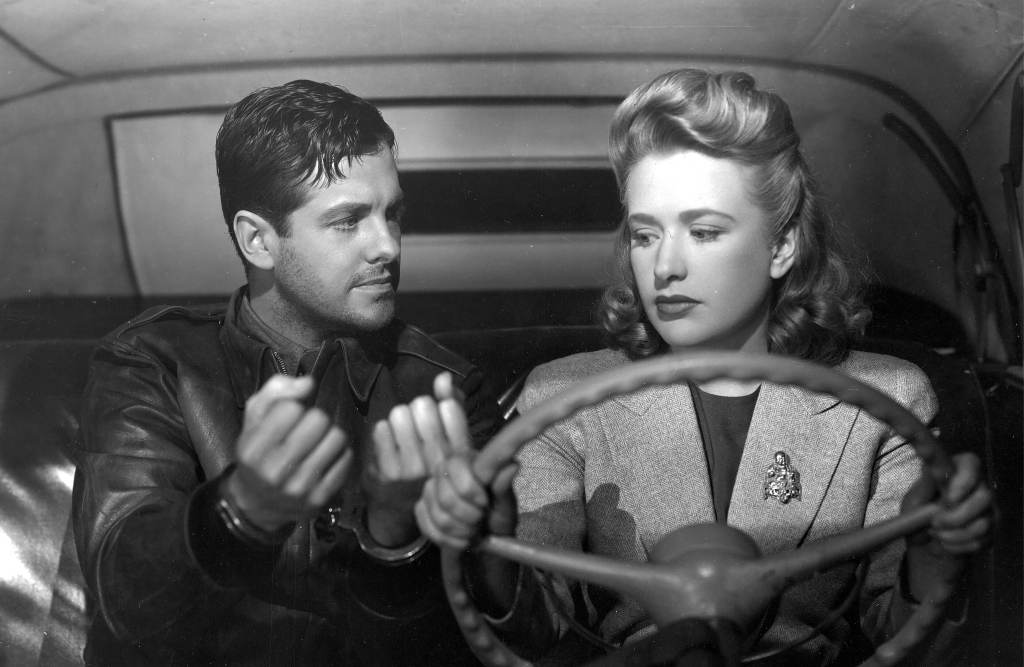
Tobin, a ringleader of pro-fascist saboteurs out to thwart the Allies, turns Barry over to police. But our intrepid protagonist escapes, seeks refuge from a solicitous, effete blind man (think The Bride of Frankenstein meets Noël Coward) and winds up enlisting the help of the man’s pretty niece, Pat Martin (Priscilla Lane).
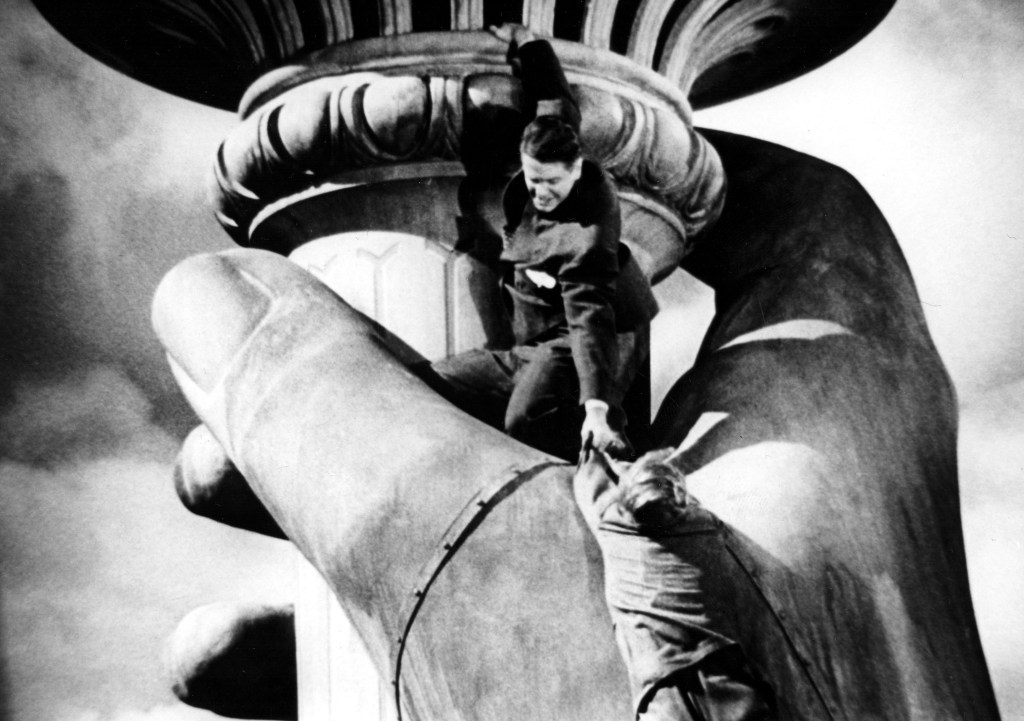
As is typical with Hitchcock’s shaggy-dog adventures, Saboteur‘s plotline is essentially a canvas to justify a succession of nifty set pieces. The movie reveals a dry wit, owed in part to the screenplay by Peter Viertel, Joan Harrison and the great Dorothy Parker. Barry and Pat stumble across a train car of circus sideshow folks, complete with conjoined sisters who aren’t speaking to one another and a bearded lady with her beard in curlers for the night. In a sly burst of post-modernism, Barry later finds himself at Radio City Music Hall during a movie, dodging bullets while a very similar scenario is unfolding at the same time on the big screen. Most impressive of all is the film’s justly celebrated climax atop the Statue of Liberty.
Unfortunately, Hitchcock’s moments of inspiration are hampered by a casting decision that had been foisted upon him. Cummings is a serviceable hero, but he can’t shake a lightweight, comedy-friendly persona. Lane also fails to register much presence.
Moreover, Saboteur‘s ham-fisted jingoism is certainly understandable, but its flag-waving is more likely to leave you chortling instead of choked up. An over-the-top speech that Barry delivers toward the film’s conclusion has everything but the rocket’s red glare.
 Cutting to the Chase with Phil Bacharach
2 responses to “Saboteur (1942)”
[…] legendary filmmaker employed the “wrong man” theme in many of his films (The 39 Steps, Saboteur, North by Northwest, etc.) but few Hitchcock protagonists can match Dick Blaney for sheer […]
LikeLike
[…] The Glass Key, director: Stuart Heisler9. The Palm Beach Story, director: Preston Sturges8. Saboteur, director: Alfred Hitchcock7. Desperate Journey, director: Raoul Walsh6. I Married a Witch, René […]
LikeLike