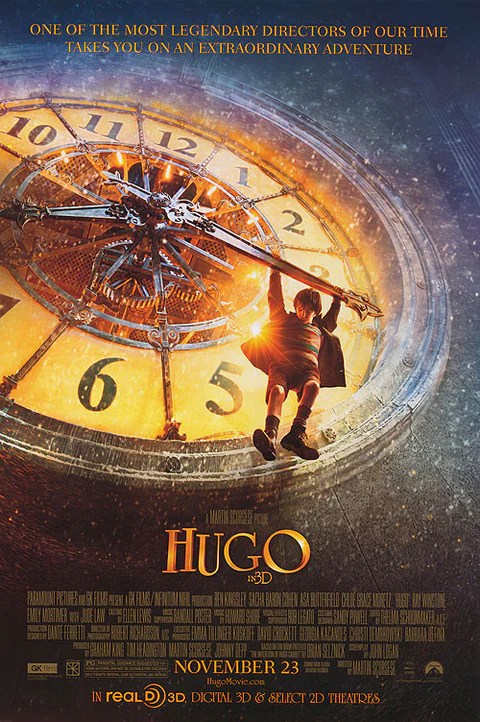
Given Martin Scorsese’s prodigious love of film, it is hardly surprising that he made a mash note to the medium that has so dominated his life. To some extent, Scorsese’s entire catalog has been a love letter to movies, immersed as he is in the singular possibilities of cinema. What is unexpected, however, is that this mash note comes in a rare outing for him: a family-friendly film based on a popular children’s book.
Set in 1930s Paris, Hugo concerns Hugo Cabret (Asa Butterfield), a young boy who keeps the clocks running in a sprawling train station. Orphaned and living on his own, Hugo hopes to make a connection with his late father (Jude Law) by repairing an automaton that Mr. Cabret had rescued from a museum.

That automaton is one of the film’s wonderful creations, a steampunk-friendly metal man with impassive eyes and the look of something that escaped from Fritz Lang’s Metropolis. Hugo is determined to make the mystery figure move again, hoping it contains a secret message from dearly deceased old Dad.
Along the way, Hugo swipes mechanical parts from a cranky toyshop owner (Ben Kingsley) who turns out to have his own intriguing connection to the automaton. The shop owner is none other than Georges Méliès, among the earliest masters of French film. In silents such as A Trip to the Moon, Méliès pioneered special effects and was among the first to explore how moving pictures could create waking dreams.
Hugo shares Méliès’ unbridled enthusiasm for movies. In his first 3-D endeavor, Scorsese successfully employs the gimmick to illustrate how early cinema astounded audiences. It is a bounty of visual richness, from the dizzying camerawork of cinematographer Robert Richardson to Dante Ferretti’s exquisite production design. Nearly every shot belies painterly detail.

The story doesn’t quite rise to the invention of its magnificent look. Based on Brian Selznick’s novel, Hugo is about 20 minutes too long and populated by archetypes — Dickensian orphan, starchy law-enforcement officer, plucky girl hungering for adventure, etc. — instead of fleshed-out characters. But even their shopworn familiarity seems fitting in the context of this tribute to reel life.
The cast is mostly game. Butterfield is fine, if underwhelming, as our hero, but receives able help from the dependable Kingsley and a radiant Chloë Grace Moretz as Méliès’ goddaughter. Other standouts include Michael Stuhlbarg as an early film scholar and Sacha Baron Cohen as that cold-hearted train inspector who just needs a good hug. Lucky for him, Hugo is Scorsese’s most (only?) huggable movie.
 Cutting to the Chase with Phil Bacharach
One response to “Hugo (2011)”
Meh. Love me some Scorsese but HUGO disappointed immensely
LikeLike