
Who am I? Questions surrounding one’s sense of self have long preoccupied the arts, but the theme is especially piquant in the movies. Characters are played by actors who are projected on screens that we then watch and interpret. With film itself built on layers of performance and illusion, it only follows that cinema is the perfect sandbox to shape and reshape identity. What follows are 10 of the best movies to explore identities in crisis. But a word of caution: there are spoilers ahead, so if you haven’t seen some of the titles mentioned and want to check them out cold––always the best way to see a film––read on at your peril.
10. Shutter Island (2010, dir. Martin Scorsese)
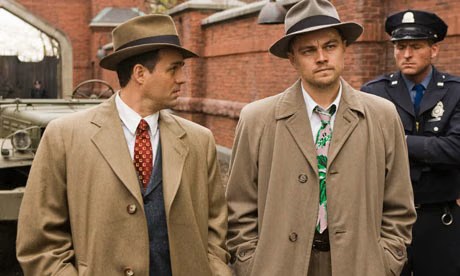
Set in the 1950s, Shutter Island casts Leonardo DiCaprio as Teddy Daniels, a hard-nosed U.S. marshal looking into the disappearance of a mental patient. The case leads him and his partner (Mark Ruffalo) to a secluded island near Boston that houses a prison for the criminally insane. But the search grows increasingly confused. Discordant memories and visions intrude on Teddy’s investigation. Director Martin Scorsese’s adaptation of Dennis Lehane’s 2003 potboiler leans into genre tropes––a thunderstorm, darkened hallways, a mad doctor—and for good reason. At its blackened heart, Shutter Island is a horror movie. Teddy doesn’t seem to realize it, but then again, he’s a rather unreliable narrator of his own life.
9. Performance (1970, dir. Donald Cammell and Nicolas Roeg)
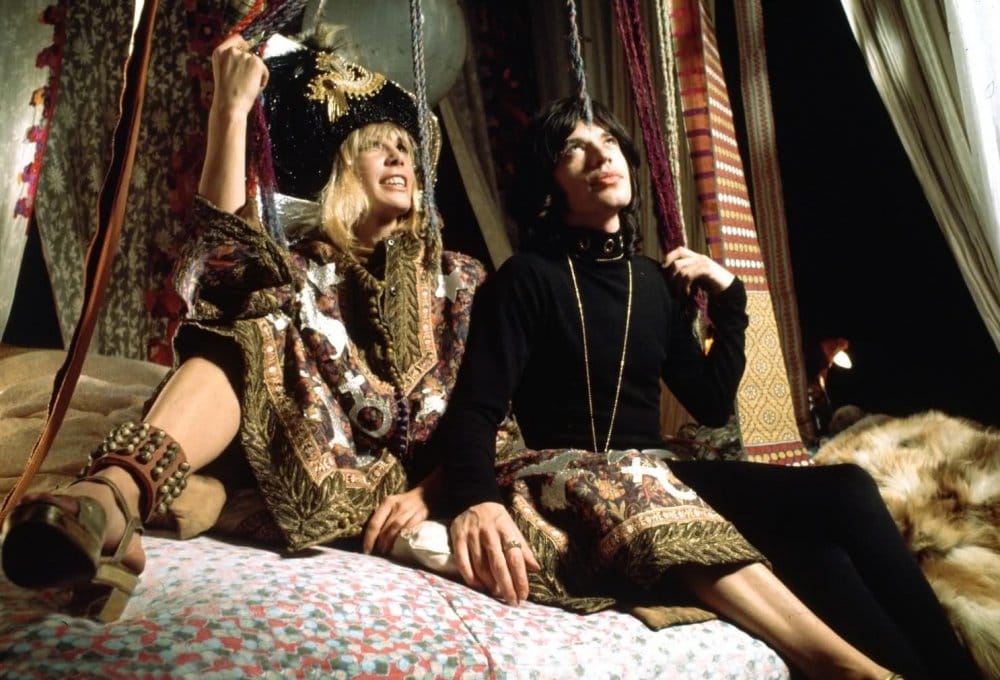
Warner Bros. execs didn’t know what to do with Performance when they saw the finished cut in 1968. Hoping to cash in on the popularity of the Rolling Stones, the studio had paid directors Donald Cammell and Nicolas Roeg for a flick starring Stones frontman Mick Jagger. The picture delivers sex, drugs, and rock ‘n’ roll, all right, albeit packaged as a transgressive head-trip about a London hoodlum named Chas (James Fox), a reclusive rocker called Turner (Jagger), and Turner’s alluring girlfriend (Anita Pallenberg). Performance initially appears to be a conventional gangster film until an on-the-lam Chas rents a room in Turner’s Notting Hill flat. Generous ingestion of hallucinogens and sexual adventurism follows. The brutal Chas dresses up in women’s clothing while a feminized Turner dabbles in Chas’ testosterone-addled universe. It soon becomes difficult to tell where one man ends and the other begins. Befuddled Warner execs shelved Performance for two years until the unexpected success of Easy Rider prompted them to release it—though they still didn’t quite know what to make of it.
8. Black Swan (2010, dir. Darren Aronofsky)

Black Swan is so engrossing, you might be tempted to read more into it than it warrants. With its creepy shock effects, swirling camerawork and Oscar-caliber performance by Natalie Portman, the psychological thriller from Darren Aronofsky is a ballet/showbiz picture on LSD. Aronofsky pushes the audience into the discomfiting point of view of Nina Sayers (Portman), a gifted New York City ballerina whose grip on who she is begins to splinter. An ambitious perfectionist, she is cast as the Swan Queen in a cutting-edge version of “Swan Lake.” But between Nina’s overbearing mother (Barbara Hershey) and the threat posed by a newly arrived dancer (Mila Kunis), Black Swan becomes an is-it-real-or-is-it-madness pirouette that finds Nina whirling toward the abyss. Portman charts Nina’s descent with conviction, but the most fine-tuned performance is Aronofsky’s direction. He seduces the audience into identifying closely with Nina, even as she loses that ability herself.
7. The Tenant (1976, dir. Roman Polanski)
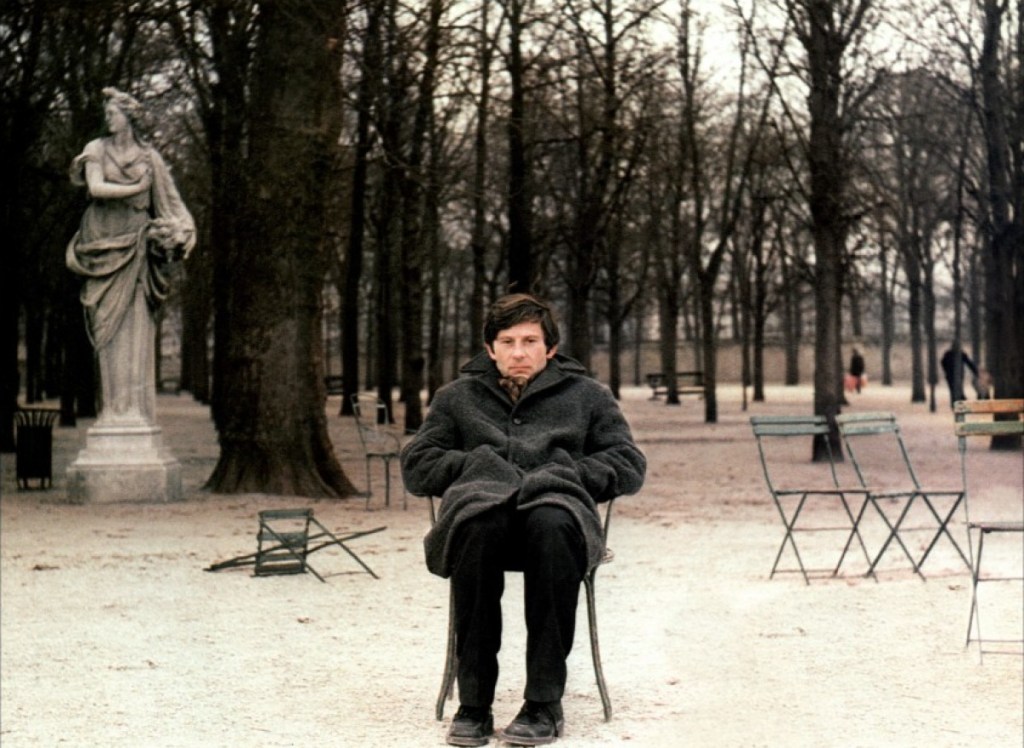
A diminutive, mild-mannered bureaucrat named Trelkovsky moves into a Paris flat after learning that its previous tenant, a single woman named Simone Choule, tried to kill herself by jumping off her balcony. He visits Simone in the hospital as she lies on her deathbed. Wrapped in bandages like a mummy, Simone takes one look at Trelkovsky and emits a blood-curdling scream from a mouth missing a front tooth. Writer-director Roman Polanski, who also stars, draws us into a Kafkaesque mindscape of alienation, paranoia, hallucinations––and a steady erosion of self. The tenuous state of self undoubtedly resonated for Polanski, a Jewish Pole whose family was trapped by occupying Germans and shipped to Nazi death camps. Trelkovsky, drinking with friends one evening, wonders what constitutes the self. “If you cut off my head, what would I say? ‘Me and my head,’ or ‘me and my body?’” he muses. “What right has my head to call itself me?” Soon, he will find it hard enough to call himself Trelkovsky. The neighborhood café keeps serving him what Simone used to order. Her friends become his friends. He begins wearing some of Simone’s dresses that he finds in a closet. The new tenant is becoming the previous tenant.
6. 3 Women (1977, dir. Robert Altman)

Writer-director Robert Altman credited a dream with inspiring 3 Women, which seems appropriate for a movie with such a dreamlike atmosphere. Shelley Duvall and Sissy Spacek play, respectively, Millie and Pinky, co-workers at a spa for elderly patients. Millie is a self-absorbed motormouth who is ridiculed and avoided by almost anyone who encounters her. The sole exception is Pinky, a painfully shy young woman seemingly devoid of personality. The unlikely friends become roommates. Tensions between the two inevitably mount––and then things get really weird. Consider this Altman’s Persona (see #5). “I don’t think I ever knew what the film was about,” Spacek told Altman: The Oral Biography writer Mitchell Zuckoff. “Bob (Altman) would say, ‘Well, if you confuse people enough in the first twenty minutes they’ll give up trying to figure out what it’s about and they’ll just go with it.’”
5. Persona (1966, dir. Ingmar Bergman)

There is a lot to chew on in Ingmar Bergman’s surreal meditation on the fluidity of identity. Nurse Alma (Bibi Andersson) is assigned to care for Elisabeth Vogler (Liv Ullman), a celebrated actress who inexplicably has chosen to stop speaking. In the absence of conversation, Alma fills the air with her talk. “Is it possible to be one and the same person at the same time—I mean, two people?” she muses. In a more confessional moment, the nurse confides that she once engaged in group sex. Later, Alma discovers that Elisabeth has disclosed the secret in a letter in which the actress adds that “it’s very interesting studying her.” Is Elisabeth studying Alma for a role? The nurse’s sense of betrayal triggers a porous exchange of selves reflected by masterful compositions that merge the two women’s faces. Meanwhile, Elisabeth’s blind husband mistakes Alma for his wife. Repeated images of movie projectors, screens and cameras point to the artifice of perception. Maybe? For his part, Bergman said that the screenplay he crafted with Ullman and Andersson stemmed from chaos and anger. Persona is purposefully enigmatic, its mystery part of its enduring fascination.
4. Your Name. (2016, dir. Makoto Shinkai)

Taki (voiced by Ryunosuke Kamiki) is a teenage boy living in Tokyo. Mitsuha (voiced by Mone Kamishiraishi) is a teenage girl living in rural Japan. For reasons the film wisely leaves unexplained, the two change bodies intermittently but revert to their actual selves when asleep. The experience forces each to inhabit the other’s life––family, friends, expectations––so completely that the boundaries between them begin to dissolve. The gender-bending premise doesn’t venture as far as it could, but writer-director Makoto Shinkai still gives viewers plenty to think about. The metaphysical trappings don’t overwhelm the central romance, but they enhance the connection between Taki and Mitsuha. How better to empathize with another than to be another? In this equation, empathy deepens a love unfettered by constraints of time and space. No wonder Your Name., which also boasts gorgeous animation, quickly became Japan’s second highest-grossing film of all time.
3. Vertigo (1958, dir. Alfred Hitchcock)
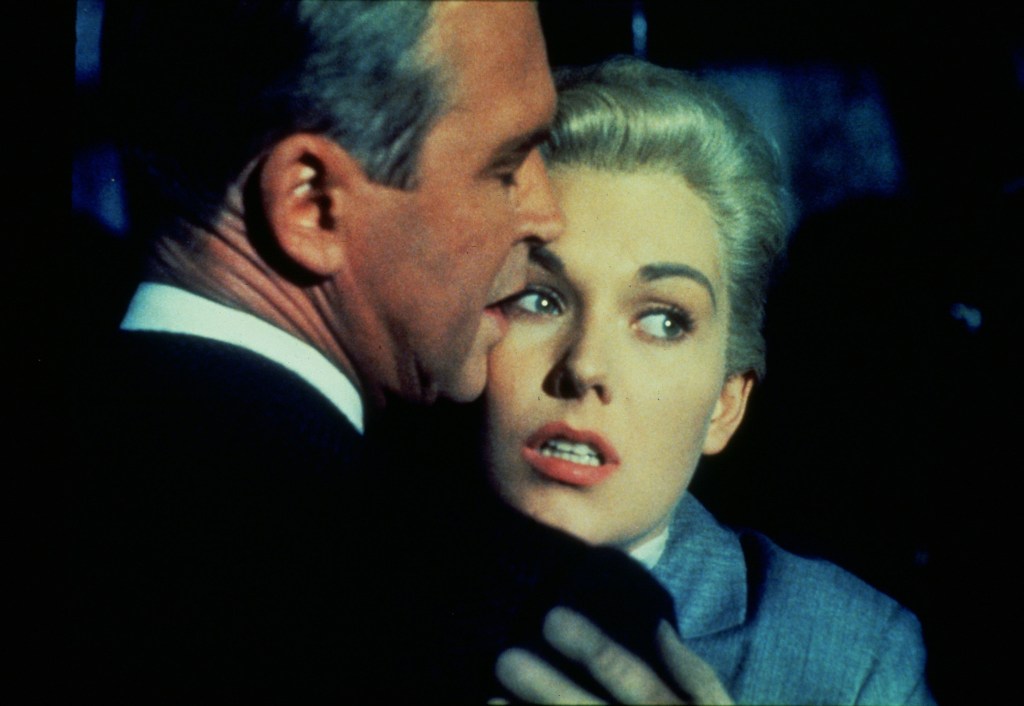
Scotty Ferguson (James Stewart), the detective in this dreamlike trance of a movie, becomes obsessed with recreating an illusion. But then again, Vertigo itself is fascinated by how easily a person can be remade into the image of another. He is hired to trail a client’s wife, Madeleine Elster (Kim Novak), a beautiful blonde obsessed with the belief she is possessed by a ghost. And yet Madeleine is herself a ruse manufactured by the client as part of a scheme to lure Scotty. It works. Scotty falls for faux Madeleine, only to watch helplessly as she hurls herself from the top of a tower. Months later, a grieving Scotty comes across a shopgirl, Judy (also Novak), who bears a striking resemblance to the deceased woman. Scotty courts the red-haired Judy, albeit with some unsettling demands. Put on this blonde wig, wear this gray dress, change your posture: erase yourself and become someone else. The situation is particularly knotty for Judy, who actually had pretended to be Madeleine, but she submits to Scotty’s creepy makeover in a desperate effort to make him like her. For Alfred Hitchcock, who created the icy-blonde archetype in movie after movie, this narrative had special resonance. In Vertigo, the self is alarmingly pliable—the putty of obsession.
(See more in The 20 best kiss scenes in film and The 10 best films about voyeurism.)
2. Fight Club (1999, dir. David Fincher)

Being a David Fincher film, Fight Club is sleek, visually stunning and darkly funny. But it also poses a question: Who is Tyler Durden? That query is at the core of this bare-knuckled adaptation of the Chuck Palahniuk novel. Edward Norton is a nameless insurance adjuster trapped in a somnambulist existence. But then he meets Tyler Durden (Brad Pitt), whose fearlessness and roguish charisma represent everything Norton’s character craves. The two men become…inseparable. Tyler proposes they start “fight clubs,” secret venues for alienated, frustrated, lost men to pummel and be pummeled, a literal gut punch aimed at restoring a battered sense of masculinity in a hyper-consumerist culture. Just don’t talk about it (the first and second rules of fight club). As Adam Nayman puts it in David Fincher: Mind Games, the movie embraces the fallacy that “inside every pasty, alienated, white-collar laborer bemoaning a consumerist carousel of pointless purchases … lurks a chiselled, two-fisted, righteously sloganeering Che Guevara manqué yearning to break free from it all.”
1. Being John Malkovich (1999, dir. Spike Jonze)

Literally entering the headspace of another person lends itself to questions of selfhood. That’s the brilliant concept behind Being John Malkovich, a surreal comedy from screenwriter Charlie Kaufman and director Spike Jonze. John Cusack is Craig Schwartz, a self-absorbed puppeteer slumming it as an office drone on the seventh-and-a-half floor of New York City’s Martin Flemmer Building. Between his chaotic home life with wife Lotte (Cameron Diaz) and his attempts to get into the pants of co-worker Maxine (Catherine Keener)––Craig is not a particularly good husband––he stumbles across a hidden tunnel. As happens with such things, anyone who crawls inside is transported into the mind of actor John Malkovich before being belched out on the side of the New Jersey Turnpike. Craig and Maxine monetize the portal by charging curiosity-seekers eager to escape their own humdrum existence. Things get even stranger when Malkovich surreptitiously visits his own portal, prompting a sort of solipsistic orgasm in which his world is populated by other Malkoviches who repeatedly squawk their surname. It all leads to a mind-scrambling coda. And yet this narrative, weird as it is, barely captures its inexhaustible inventiveness.
(See more in The 10 best mindfuck films and The 10 best films about voyeurism.)
Honorable mention: The Face of Another (1966, dir. Hiroshi Teshigahara), A History of Violence (2005, dir. David Cronenberg), Invasion of the Body Snatchers (1978, dir. Philip Kaufman), It’s What’s Inside (2024, dir. Greg Jardin), Lost Highway (1997, dir. David Lynch), Monsieur Klein (1976, dir. Joseph Losey), The Passenger (1975, dir. Michelangelo Antonioni), Psycho (1960, dir. Alfred Hitchcock), Seconds (1966, dir. John Frankenheimer), Sisters (1972, dir. Brian De Palma)
 Cutting to the Chase with Phil Bacharach
5 responses to “The 10 best films about identity crises”
[…] Arguably the most famous bathroom scene in movie history, Norman Bates’ (Anthony Perkins) knife attack on Marion Crane (Janet Leigh) in a motel shower took Alfred Hitchcock more than a week to shoot and consisted of 78 shots. The result is 45 seconds of terror that absolutely freaked out movie audiences. It is a masterclass of cinematic sleight-of-hand, of course. Despite what moviegoers think they saw, the knife never makes contact with Marion, nor do we see any nudity. The director was customarily painstaking in determining the right sound for a knife penetrating flesh. In Alfred Hitchcock and the Making of Psycho, Stephen Rebello notes how the director listened intently with closed eyes as a propman stabbed various types of melons. “When the demonstration table was littered with shredded fruit, Hitchcock opened his eyes, and intoned simply: ‘Casaba,’” writes Rebello. Chocolate syrup serves as Marion’s blood winding down the drain. Curiously, the sudden violence wasn’t the only thing that troubled censors, who were none too thrilled that Marion flushes a toilet to dispose of some incriminating papers. The Production Code frowned on showing toilets. (See more in The 15 best slasher movies, 10 memorable movie mothers and The 10 best films about identity crises.) […]
LikeLike
[…] In one of the more dubious instructions ever given to prepare for a performance of Swan Lake, Black Swan’s innocent, introverted Nina Sayers (Natalie Portman) is told by her lecherous artistic director (Vincent Cassel) to go home and touch herself. “Live a little,” he suggests. Nina does as she is told, tentatively at first. The moment turns into something far less liberating and far darker—especially after her domineering mother (Barbara Hershey) barges in. (See more in The 10 best films about identity crises.) […]
LikeLike
[…] Persona proclaims its mindfuckery early on. Its infamous prologue begins inside a movie projector where a strip of celluloid races through the gate while the carbon-arc lamp flickers behind it. The artifice of what we are about to see is clear: this is a film. But then Ingmar Bergman intercuts with fleeting images—a silent-movie demon, a razor slicing through an eye, a spider on a white background, an erect penis, nails hammered into a human hand. A boy awakens in a stark white room and stretches his hand out to us. But then the angle changes and we see it is not us at all. The boy reaches for a movie screen showing the blurred images of Persona’s two main characters, played by Liv Ullmann and Bibi Andersson. The former plays Elisabeth Vogler, a celebrated stage actress who is no longer able to speak, much to the bafflement of her doctors. Alma (Andersson) is the nurse sent to care for the mute woman. There is a transference of memories and identities, a merging underscored by the famed composite face framed by Bergman’s longtime cinematographer Sven Nykvist. Bergman later said Persona was the product of feelings of rage. “Since he was not sure himself what the film meant, he left his audience free to make of it what they would,” Barbara Young writes in The Persona of Ingmar Bergman. “Perhaps more than any other of his films, Persona poured forth from an amalgam of unconscious and semiconscious issues in Bergman’s past and present life.”(See more in The 10 best films about identity crises.) […]
LikeLike
[…] For The Tenant, his Kafkaesque tale of alienation and madness, Roman Polanski (Chinatown, Rosemary’s Baby) cast himself as the increasingly unhinged Trelkovsky. The role came naturally enough. Like Trelkovsky, Polanski was a Polish émigré living in Paris. Reviews were mixed upon its release (“‘The Tenant’s’ not merely bad—it’s an embarrassment,” wrote Roger Ebert in The Chicago Sun-Times), but history has been kinder to this resolutely weird psychological thriller. Polanski himself, however, has not benefited from a similar rehabilitation. After pleading guilty the following year to unlawful sexual intercourse with a 13-year-old girl, he fled the United States before sentencing and has remained a fugitive from American justice ever since.(See more in The 10 best films about identity crises.) […]
LikeLike
[…] This Ingmar Bergman masterpiece offers one of the most fascinating, if puzzling, film openings ever. Persona begins inside a movie projector, where a strip of celluloid races through the gate as the carbon-arc light flickers behind it. The artifice is announced before anything else: this is a film. Then Bergman intercuts a barrage of unrelated images—a silent-movie devil, a razor slicing through an eye, a spider on a white background, an erect penis, nails hammered into a human hand. A young boy awakens in a stark white room and stretches his hand toward us. But the angle shifts, and we see it wasn’t us at all—the boy is reaching for a movie screen, where the blurred faces of actress Elisabet Vogler (Liv Ullmann) and nurse Alma (Bibi Andersson) slowly come into focus. The sequence erases the distance between projector, screen, film, and movie audience. Before the story even begins, Bergman reminds us that movies are illusions—and then uses that illusion to probe truths that realism cannot reach. What follows is a hypnotic inquiry into identity, perception, and the porous boundary between one consciousness and another, as Elisabet and Alma gradually exchange emotional, psychological, and perhaps even spiritual identities. Or maybe they don’t. Bergman famously refuses to settle the question.(See more in The 10 best mindfuck films and The 10 best films about identity crises.) […]
LikeLike