Film noir didn’t know it was film noir. French critics coined the term after World War II to describe a cycle of American crime pictures steeped in shadows and cynicism, but the filmmakers themselves were simply reflecting a changed world. Inspired by the starkness of German Expressionism—many noir directors were German émigrés who had fled the Nazi regime—film noir traded in hard contrasts: light and dark, law and lawlessness, desire and consequence.
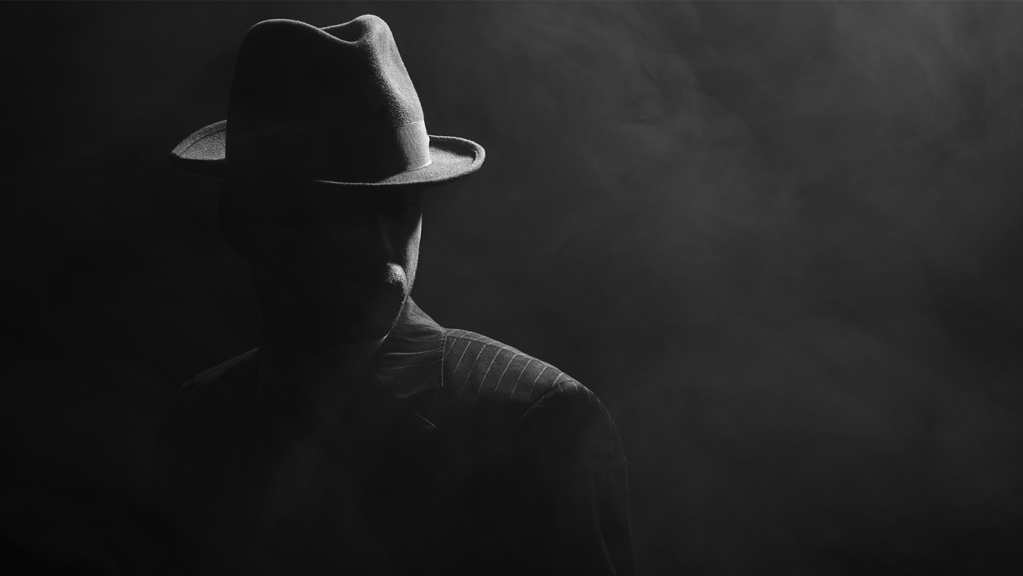
Noir is less a genre than a perspective. It smells corruption everywhere, and it knows that convictions of right and wrong can evaporate more quickly than cigarette smoke. The protagonists of noir are compromised men undone as often by their own weaknesses as by external forces. Waiting in the wings is the femme fatale, whose sexual allure is matched only by her capacity for destruction. Such elements form a body of work stretching roughly from 1941 to 1958, capturing a postwar hangover of disillusionment, fatalism, and moral ambiguity.
These are my 15 favorites in film noir. While Laura and Out of the Past are certainly canonical, they fell just shy of the list.
15. Detour (1945, dir. Edgar Ulmer)
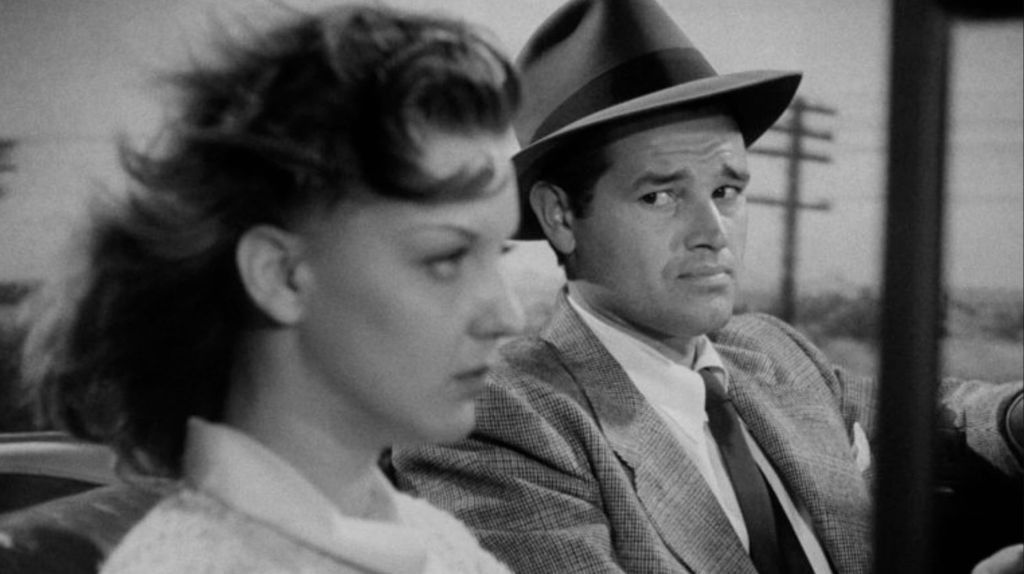
A Poverty Row treasure from B-movie legend Edgar Ulmer, Detour is noir at its cheapest (reportedly shot in six days), grittiest, and most cynical. Tom Neal is Al Roberts, a piano player hitchhiking from New York to California in hopes of reconciling with a girlfriend pursuing stardom in Hollywood. Roberts might be noir’s all-time stupidest protagonist (and that’s saying something), accidentally leaving a trail of dead bodies in his wake. “Detour is a nightmare, one in which the unconscious overwhelms rational thought and takes off on mesmerizing and implausible leaps of logic,” writes Eddie Muller in Dark City: The Lost World of Film Noir. “That’s why it works best viewed at 2:30 a.m., through half-closed eyes, with Neal’s self-pitying soliloquies snaking around your defenseless mind.” Detour’s antihero makes one boneheaded choice after another, but his biggest misstep is falling in with Vera, a femme fatale played with malevolent gusto by Ann Savage. Dumb plus evil never turns out well.
14. The Big Heat (1953, dir. Fritz Lang)
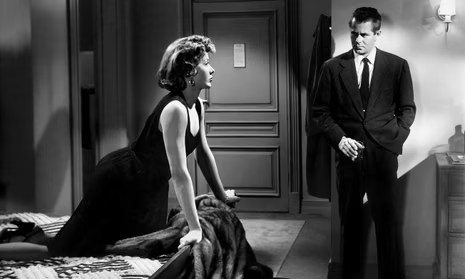
It’s not easy being an honest cop in a corrupt city. Homicide detective Dave Bannion (Glenn Ford) is looking into an open-and-shut suicide of a fellow officer when he is told to stop questioning the widow. The dead man’s mistress tells Bannion there’s more to the case just before she winds up in the city morgue. He presses on. Then Bannion’s wife (Jocelyn Brando, sister of Marlon) is killed in a car bomb intended for him. Her death sends Bannion on an obsessive, furious quest—even after he’s forced to turn in his badge—to take down Mike Lagana (Alexander Scourby), the crime boss who has infested the city. Bannion’s one-man vengeance tour endangers the only person willing to help him; Gloria Grahame is heartbreaking as the girlfriend to Lagana’s brutal enforcer (Lee Marvin). The Big Heat is aptly named, with Bannion, a once-decent cop, willing to torch everything in his path.
13. The Killing (1956, dir. Stanley Kubrick)
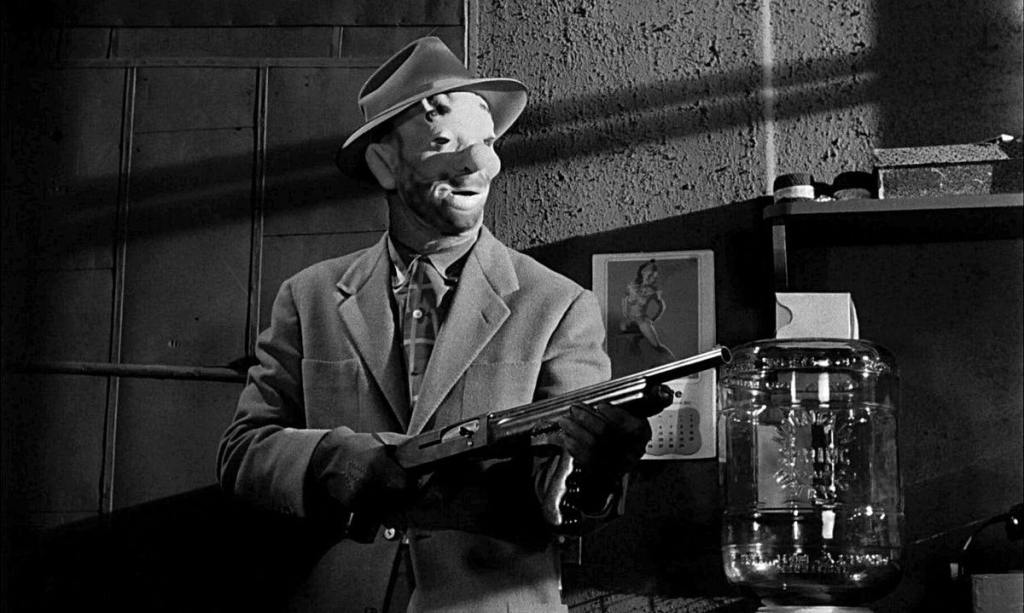
Stanley Kubrick’s critical breakthrough is a muscular, hard-nosed account of a racetrack robbery—but with a twist. The script by Kubrick and pulp novelist Jim Thompson adheres to the conventions of the genre, but takes a hard left with a nonlinear narrative that attracted the filmmaker to the source material, Lionel White’s Clean Break, in the first place. United Artists execs were baffled by the structure and urged Kubrick to recut the picture in chronological order. Kubrick held firm, but was less successful keeping UA from inserting a Dragnet-ish voiceover narrator. Even that compromise, however, adds to the film’s staccato rhythm. Sterling Hayden is exceptional as ringleader Johnny Clay, supported by a lineup of character actors including Elisha Cook Jr., Timothy Carey, and Jay C. Flippen. Then there’s Marie Windsor, who puts the fatale in femme fatale. One of Hollywood’s best-ever heist films, The Killing’s influence is evident in Quentin Tarantino’s Reservoir Dogs (1992) and Michael Mann’s Heat (1995), among others.
12. Gun Crazy (1950, dir. Joseph H. Lewis)
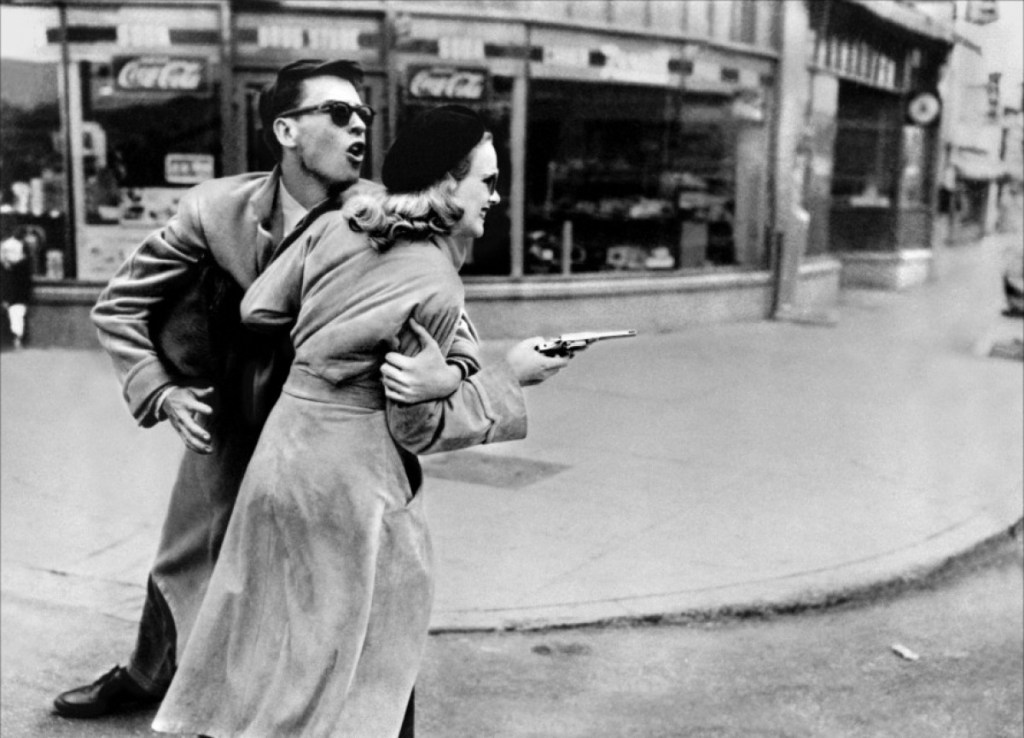
Bart Tare (John Dall) and Laurie Starr (Peggy Cummins) meet at a carnival shooting contest, take one lusty look at each other and all but throw down then and there. Penned by MacKinlay Cantor and blacklisted Hollywood screenwriter Dalton Trumbo (writing under a pseudonym), Gun Crazy’s tale of lovers bonded by a shared passion for guns and crime is raw, lurid, and propulsive. Dall and Cummins, relative unknowns when they were cast, have a sizzling chemistry, and they are well-served by the go-for-broke visual style of B-movie director Joseph H. Lewis. In one showy but undeniably effective scene, Lewis positions the camera directly behind Bart and Laurie as they drive into a small town, rob a bank, are confronted by a police officer, and speed away—all in one uninterrupted shot. The movie’s blurring of eroticism and violence courses through everything from Jean-Luc Godard’s Breathless (1960) and Arthur Penn’s Bonnie and Clyde (1967) to Terrence Malick’s Badlands (1973) and Oliver Stone’s Natural Born Killers (1994).
11. The Asphalt Jungle (1950, dir. John Huston)
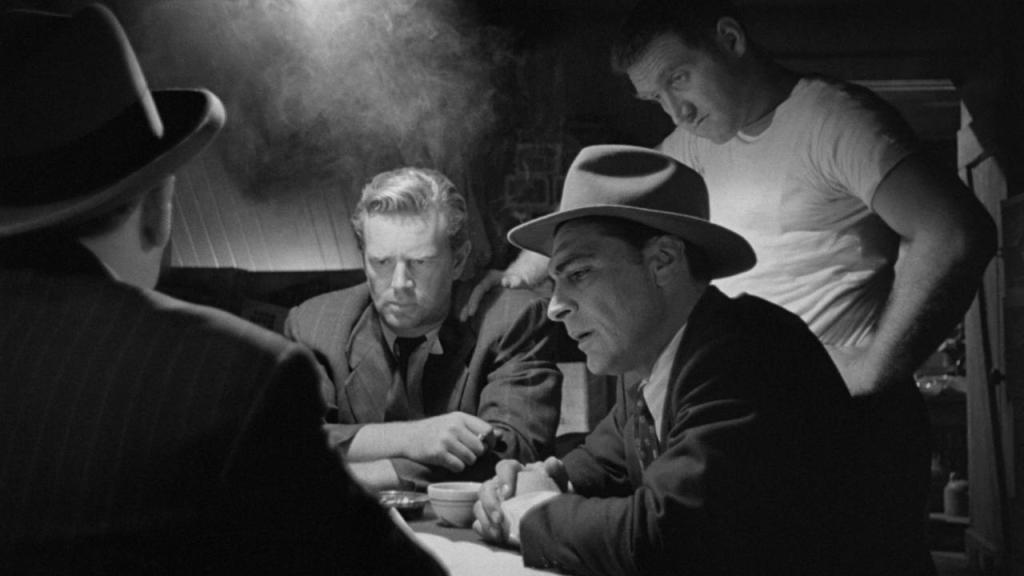
For noir gloomier than a roomful of morticians but photographed with grim elegance, few movies can match this adaptation of W.R. Burnett’s 1949 novel of the same name. Desperate, small-time crooks come together for a jewel theft, but double-crosses invariably ensue. The Asphalt Jungle helped establish a template for heist flicks ranging from Stanley Kubrick’s The Killing to Jules Dassin’s Rififi (1955). It teems with first-rate character actors Sterling Hayden, Louis Calhern, Sam Jaffe, Jean Hagen, and Marc Lawrence; and it features one of Marilyn Monroe’s first appearances, in a brief but memorable turn as the mistress to Calhern’s shady attorney, Alonzo Emmerich. John Huston and co-writer Ben Maddow make it clear that their sympathies, and ours, are with the thieves, a fact that Production Code censors tried to soften, but to little avail. And why should they have? “What is crime,” muses Emmerich, “but just a left-handed form of human endeavor?”
10. Nightmare Alley (1947, dir. Edmund Goulding)
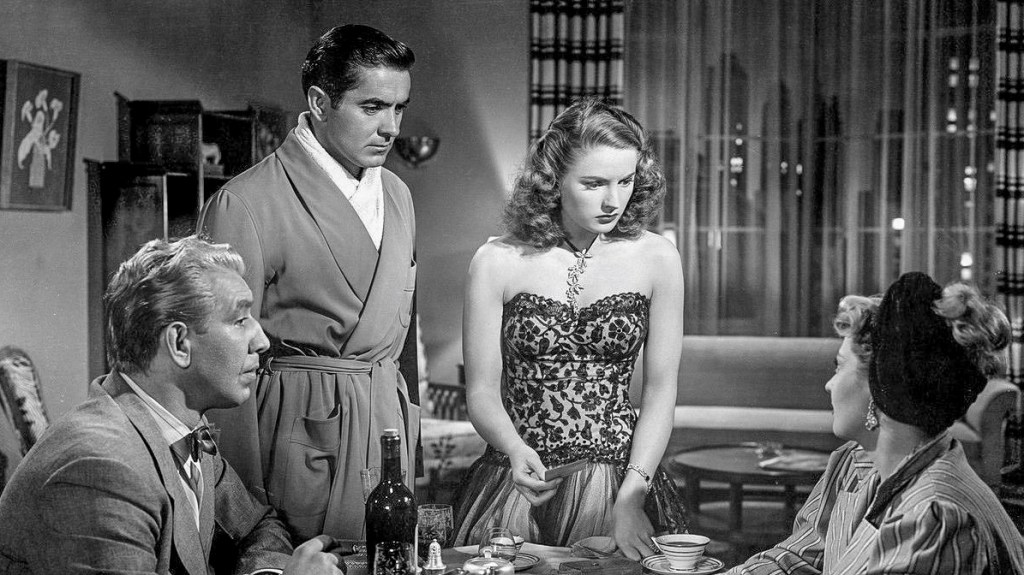
Tyrone Power got to show 20th Century Fox chief Darryl Zanuck that he was more than just a pretty face with Nightmare Alley, a role for which the matinee idol had lobbied hard. In adapting William Lindsay Gresham’s bestseller, director Edmund Goulding and screenwriter Jules Furthman concocted perhaps the bleakest of all noirs. Power is Stan Carlisle, a charming carnival huckster who gets rich with a mind-reading scam he learns from carny psychic Mademoiselle Zeena (Joan Blondell). Stan’s ambitions are matched by his gift for seduction, and so he woos and runs off with a sexy coworker (Coleen Gray) to tour the country reading minds and conning suckers as “the Great Stanton.” Stan meets someone more unscrupulous than himself with psychiatrist Lilith Ritter (Helen Walker); together they work to fleece her wealthy patients. The picture is unusual among noirs in locating its corruption not in a crime but in a con: Stan isn’t undone by a femme fatale or a heist gone wrong, but by his own belief that manipulating people’s need for meaning is a viable way to live. Guillermo del Toro directed a respectable remake in 2021, but not even the cynicism of modern cinema can make a dent in the misanthropy of the original.
9. Kiss Me Deadly (1955, dir. Robert Aldrich)

This unapologetically mean-spirited adaptation of Mickey Spillane’s pulp bestseller is a fistful of nasty. The opening scene alone underscores that this is no typical crime picture. The credits roll backward over an over-the-shoulder, uninterrupted shot of private eye Mike Hammer (Ralph Meeker) and a distraught hitchhiker (Cloris Leachman) racing along the highway in Hammer’s convertible Jaguar. They are forced off the road shortly after arriving in Los Angeles. The woman is kidnapped, tortured, and murdered, and Hammer is suddenly caught up in Cold War intrigue. Meeker snarls, smirks, and slugs his way through a performance that demonstrates why Spillane’s private dick is, to be blunt, a prick. Robert Aldrich’s direction mirrors the brutishness of his antihero. Kiss Me Deadly ain’t pretty. It’s fast, punchy, and occasionally disorienting. Its legion of admirers included French critic and future filmmaker François Truffaut. “Watching a film like this is such an intense experience that we want it to last for hours,” he wrote at the time of its theatrical release. The mysteriously glowing box at the center of the film—a MacGuffin later commemorated in Repo Man (1984) and Pulp Fiction (1994)—is a sharp, if unsubtle, manifestation of 1950s nuclear anxiety, and a fitting image for a movie so explosive.
8. The Maltese Falcon (1941, dir. John Huston)
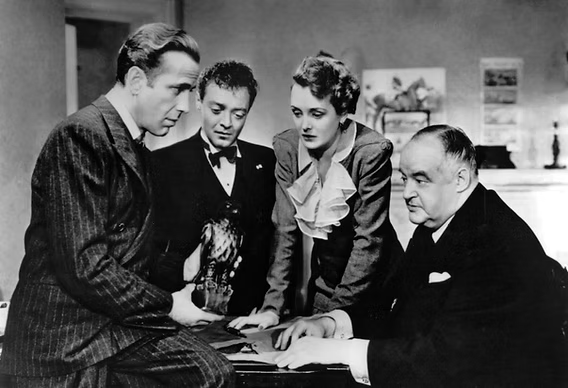
Hollywood had adapted Dashiell Hammett’s 1930 detective novel twice before but, as the saying goes, three’s a charm. The Maltese Falcon is a noir joyride. It moves with the nimbleness of a master thief, sliding into scenes, executing the job with crack precision, and moving on to the next before anyone is the wiser. The film is an astonishingly self-assured debut for writer-director John Huston, who completed the production under budget and in 34 days. Humphrey Bogart shot to movie-star status as hardboiled San Francisco private eye Sam Spade, drawn into the shadowy shenanigans of the most colorful criminals this side of a Dick Tracy comic. Their aim: to swipe a priceless statuette of the titular black bird. The cast of Warner Bros. regulars—including Mary Astor, Peter Lorre, Sydney Greenstreet, and Elisha Cook Jr.—is, to borrow the film’s closing line, the stuff that dreams are made of. “The picture was a completely new conception of the ‘gangster movie,’” gushed Astor in her memoir. “It was the story not of hoodlums, but of a group of evil though intelligent people playing for very high stakes.” Astor might have been biased, since she and Huston had an affair during the filming. But she happens to be right. Huston preserves Hammett’s snappy dialogue, delivered at a fast clip by some of the most watchable character actors of their day.
7. Sunset Boulevard (1950, dir. Billy Wilder)
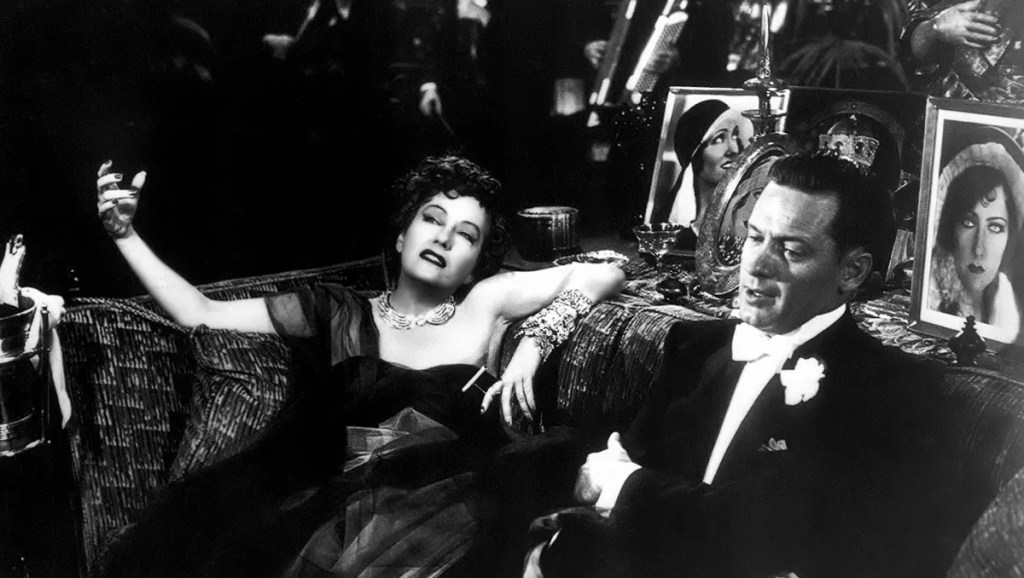
When Billy Wilder and writing partner Charles Brackett first drafted what became Sunset Boulevard, among the first images they wanted was that of a dead body floating in a pool: death in paradise. But they took the concept further, making that corpse the narrator as well as the audience’s point of entry. The story of Hollywood narcissism and cruelty features former silent-screen star Gloria Swanson as—in a feat of meta casting—an aging silent-film queen. The similarities between the actress and her character ended there, although Swanson, whose performance earned an Oscar nomination, lamented afterward that audiences confused the two. As Norma Desmond, Swanson is a wild-eyed, nostril-flaring force of nature; her reclusive star is lost in a reverie of past glories that are kept alive by her faithful butler and ex-husband, Max von Mayerling (Erich von Stroheim). That hermetically sealed universe is upended when down-on-his-luck screenwriter Joe Gillis (William Holden) stumbles onto Norma’s decaying mansion while outrunning creditors. Wilder, Brackett, and co-writer D.M. Marshman Jr. give the movie business itself the most withering of close-ups in this darkly comic tale. Hollywood is Sunset Boulevard’s ultimate femme fatale.
(See more in The 10 best films about filmmaking, The 20 best opening scenes in film, and The 10 best performances by film directors not typically known for acting.)
6. Sweet Smell of Success (1957, dir. Alexander Mackendrick)
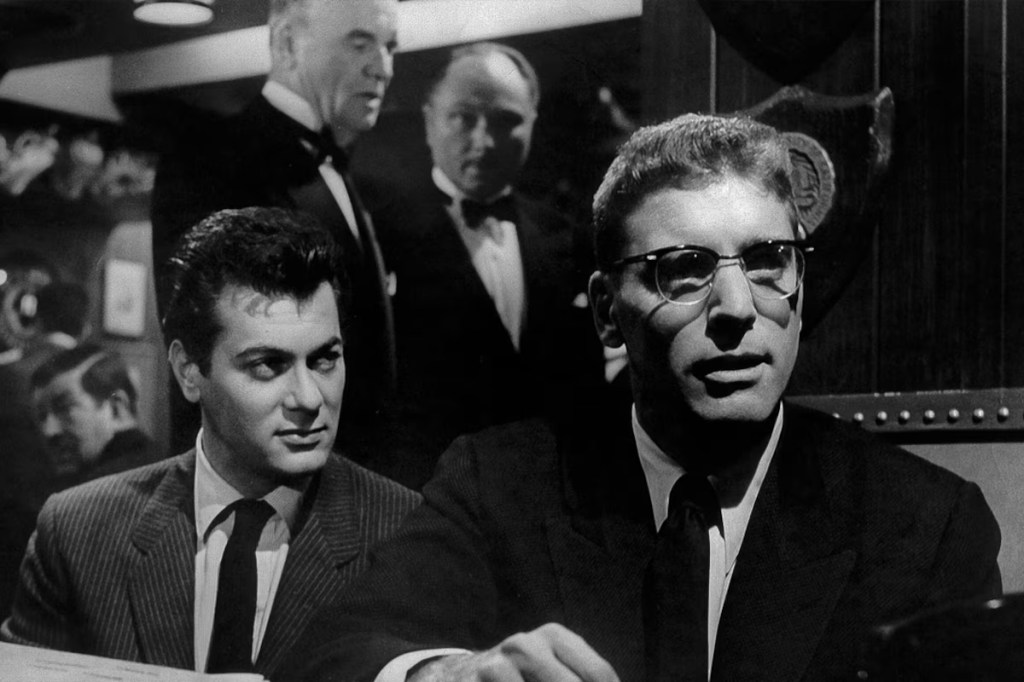
Gossip columnist J.J. Hunsecker (Burt Lancaster) finds the perfect metaphor to sum up Sidney Falco (Tony Curtis), an obsequious press agent willing to do anything to land a client’s name in Hunsecker’s syndicated column: “You’re a cookie full of arsenic.” That line also describes Sweet Smell of Success. A thinly disguised takedown of Walter Winchell—a leading media demagogue of his time—the picture savages a particularly sociopathic strain of American success. The script by Ernest Lehman and Clifford Odets is sharp enough to sever the jugular, while director Alexander Mackendrick is nimble enough to catch the blood before it hits the pavement. This is a feast of quotable dialogue, while cinematographer James Wong Howe showcases New York City’s seamy side in black and white. Lancaster, here sporting thick glasses and a drop-dead glare, is the embodiment of icy rage. He’s also a wee bit too protective of kid sister Susie (Susan Harrison), who is being romanced by Martin Milner as the world’s whitest, most clean-cut jazz player. Lancaster’s coldness is juxtaposed by Curtis’ volatility as Falco. Up to this point, Curtis had chiefly been a Hollywood pretty boy, but Sweet Smell of Success proved his acting chops. Falco says of his scheme to break up the Susie Hunsecker romance and thereby demonstrate his allegiance to J.J.: “The cat’s in the bag and the bag’s in the river.”
5. The Big Sleep (1946, dir. Howard Hawks)
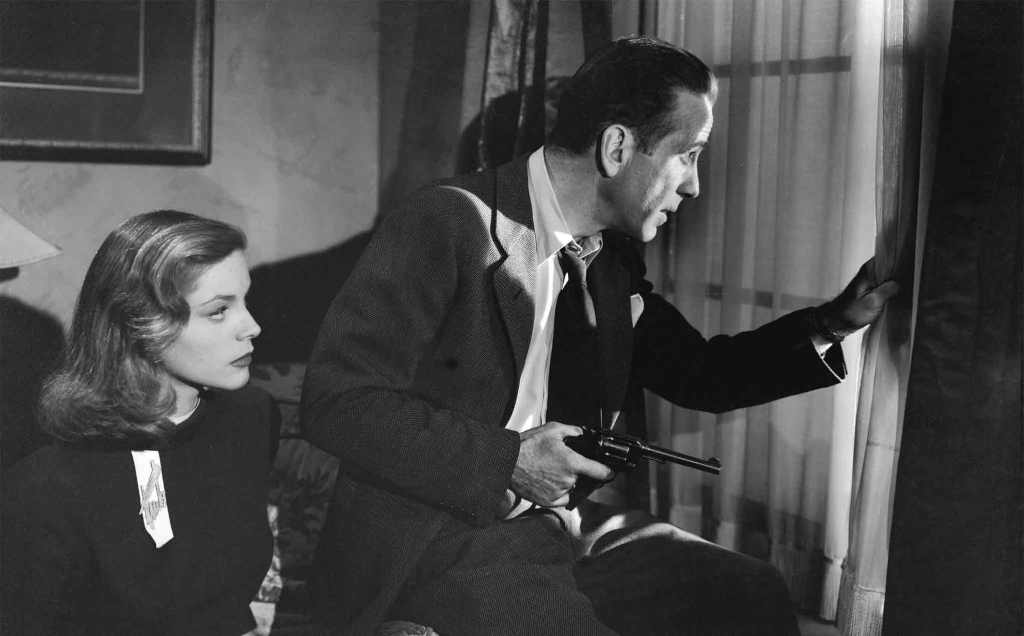
The Big Sleep punches all the noir sweet spots: the stench of danger and corruption, a smoky-eyed femme fatale, a protagonist hanging on to a moral code in an otherwise immoral universe, and stunning black-and-white interplay of shadows. A supremely entertaining adaptation of the 1939 Raymond Chandler novel, it stars Humphrey Bogart as Los Angeles private eye Philip Marlowe, hired by the wealthy, aging Colonel Sternwood (Charles Waldron) to deal with a blackmailer. The Big Sleep’s big draw is its scintillating dialogue—the screenwriting dream team included William Faulkner, Jules Furthman, and Leigh Brackett—particularly the sexually charged banter between Bogie and Lauren Bacall as the colonel’s oldest daughter. The onscreen chemistry mirrored what was happening off screen, as the pair continued a love affair that had begun with 1944’s To Have and Have Not. Their spicy rapport, however, is only part of the appeal. The trenchcoat-clad Bogart exudes noir cool. No wonder the L.A. depicted here is populated by beautiful women eager to throw themselves at the gumshoe. The vibe of The Big Sleep is easy to understand. The storyline, less so. Its byzantine plot even tripped up Hawks and the writers; they reportedly lost track of who committed one of the murders, that of the Sternwood chauffeur. Hawks even telegrammed Chandler to find out, but, as the director told film scholar Joseph McBride, even the author didn’t know. “Actually, we didn’t care,” said Hawks. “It was the first time I made a picture and just decided I wasn’t going to explain things. I was just going to try and make good scenes.” Mission accomplished.
4. In a Lonely Place (1950, dir. Nicholas Ray
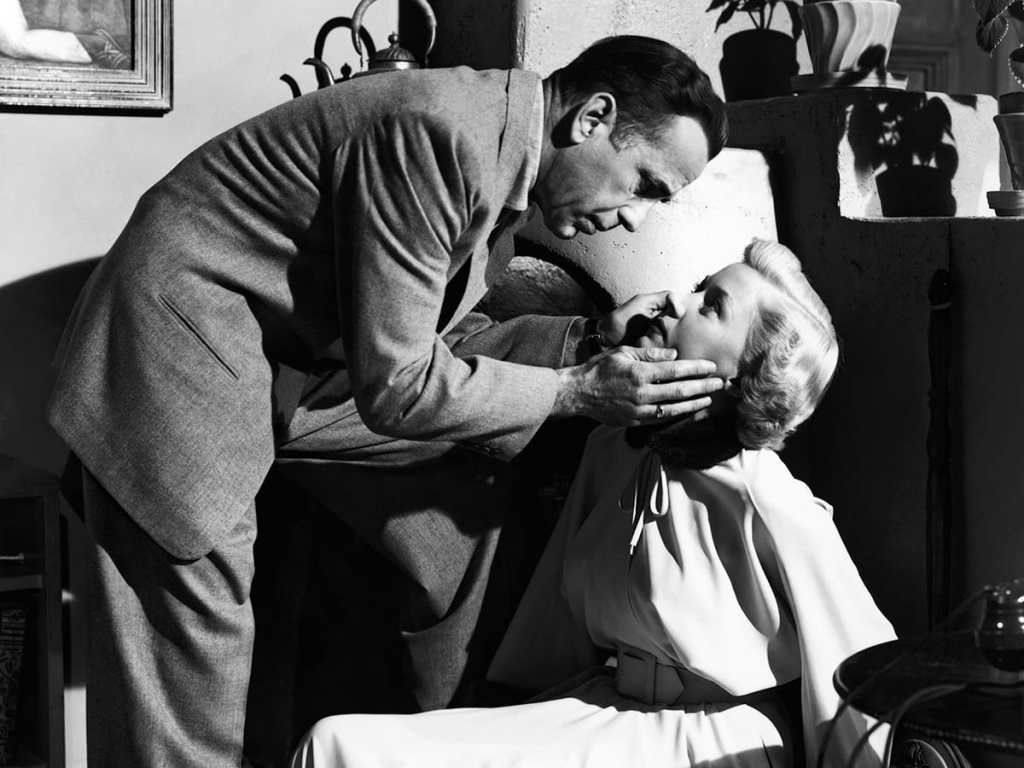
Dixon “Dix” Steele is one of noir’s most fascinating antiheroes. A gifted screenwriter, he is smart, charming, and a loyal friend. But Dix is also prone to bouts of blind, uncontrollable rage. Seemingly anything can set him off, from a pang of jealousy to piqued pride. Nicholas Ray and screenwriter Andrew P. Solt navigate the psychology of self-destruction that fuels In a Lonely Place. Humphrey Bogart was arguably never better than as Dix, who Los Angeles police suspect of strangling a hat-check girl (Martha Stewart) who was last seen at his apartment. His only alibi is a neighbor, Laurel Gray (Gloria Grahame). The pair quickly strike up a passionate romance, even while Dix remains LAPD’s prime murder suspect and Laurel catches frightening glimpses of his temper. Dix’s long-suffering manager (Art Smith) makes excuses for the behavior. “You knew he was dynamite,” he tells Laurel. “He has to explode sometimes.” For Ray, In a Lonely Place came from a personal place. His marriage to actress Grahame was falling apart, and he wondered (incorrectly, it turned out) if casting her could salvage their relationship. They separated during production, prompting Ray to consider changing the movie’s ending. “Ray fought the urge to kill the fictional character his wife was playing,” writes biographer Patrick McGilligan in Nicholas Ray: The Glorious Failure of an American Director. “The idea was all the more unspeakable considering how much he loathed Grahame at the moment.” The marriage dissolved, but the film endures as one of film noir’s all-time greats.
3. The Third Man (1949, dir. Carol Reed)
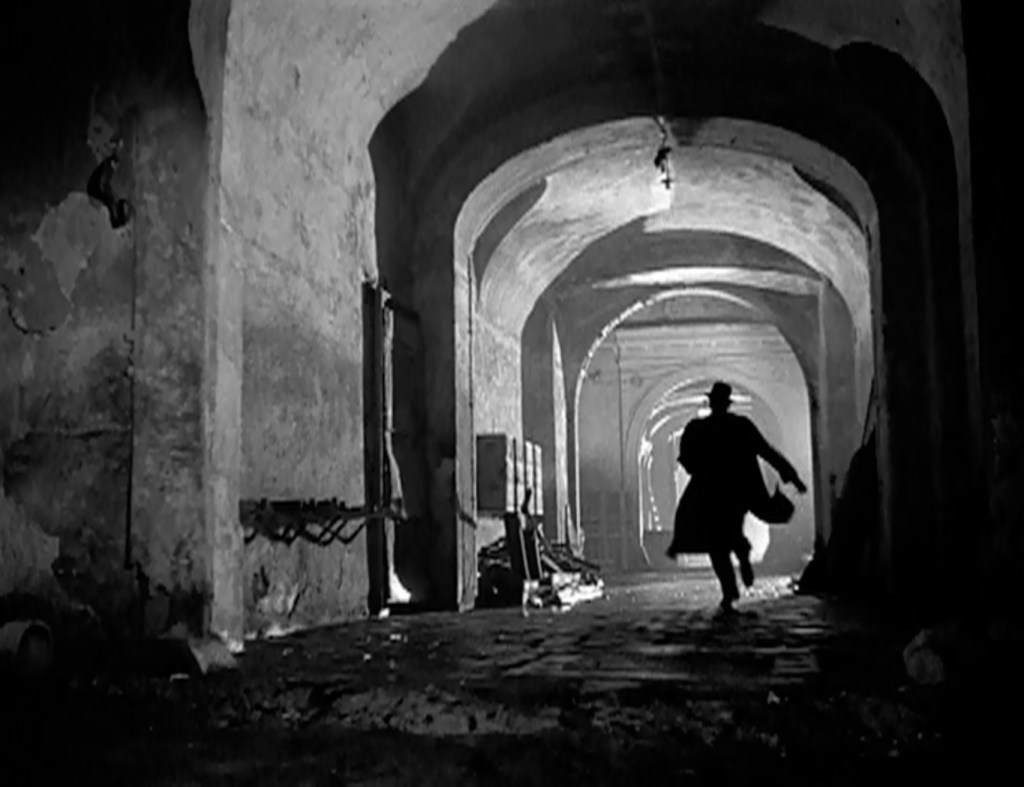
This British noir from director Carol Reed and writer Graham Greene is lean, compact, and smart—in short, great storytelling. Set in postwar Vienna, The Third Man conveys the moral vacuity of a city gripped by black-market profiteers. Every camera movement, shot composition, and edit feels designed to accentuate the locale’s claustrophobia and sense of peril. You can tell this is a movie that has been fussed over, but in a good way. Its biggest gamble, it seems to me, is the zither-centric score by Anton Karas, whom the filmmakers discovered performing in a Vienna café during production. The music is strangely evocative and, somehow, perfect. Joseph Cotten stars as Holly Martins, who comes to Vienna for a job promised by his childhood friend, Harry Lime (Orson Welles). Damn the luck—Holly arrives just in time to learn that Harry was struck down by a motorist and is about to be buried. But Holly can tell something doesn’t add up, and his suspicions are only heightened at Harry’s funeral by mourners who practically have the word “disreputable” flashing in neon signs above their heads. Sure enough, Harry is very much alive. Holly spies his friend standing in a darkened doorway that is suddenly illuminated by a shaft of light from a nearby window. It is one of cinema’s most remarkable entrances. But cinematographer Robert Krasker makes every black-and-white frame of The Third Man a work of art. Cotten is excellent, but Trevor Howard nearly steals the picture as a flinty British lawman determined to nab Harry for stealing penicillin from military hospitals. The scam has killed children, but Harry is untroubled. “The dead are happy dead,” he tells Holly. “They don’t miss much, poor devils.” The sentiment encapsulates the Vienna of The Third Man.
(See more in The 10 best uses of manmade landmarks in film.)
2. Double Indemnity (1944, dir. Billy Wilder)
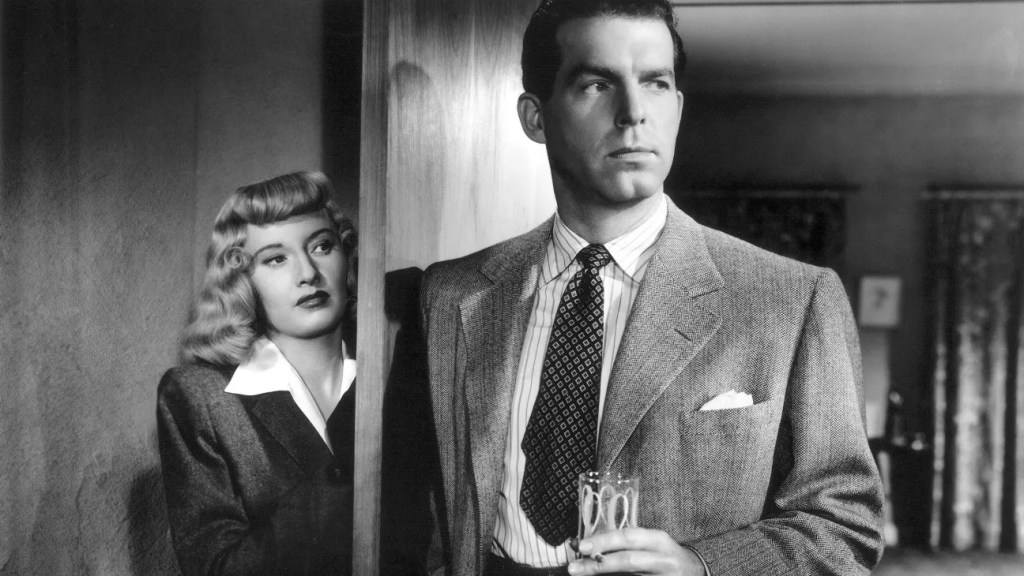
An adaptation of a James M. Cain potboiler, Double Indemnity is the definitive film noir that helped codify the genre and its postwar interest in obsession, cynicism, fatalism, and sex. Cinematographer John Seitz’s shadow-laden lighting, informed by German Expressionism, proved hugely influential. As horny-but-dumb insurance salesman Walter Neff, Fred MacMurray all but salivates on his suitcoat once he gets a good look at Phyllis Dietrichson (Barbara Stanwyck, pitch-perfect), a blonde femme fatale whose wedding ring interests Walter less than her “honey of an anklet.” Within minutes of his insurance sales pitch, the two are engaged in some of moviedom’s all-time tastiest sexual innuendo. In short order, they become lovers and kill Phyllis’ husband (Tom Powers) so she can pocket his life insurance policy. But something about his death doesn’t add up for insurance claims manager—and Walter’s friend—Barton Keyes (Edward G. Robinson). In an effort to strengthen the dialogue, Billy Wilder brought in hardboiled crime novelist Raymond Chandler, creator of detective Philip Marlowe. The partnership was an unhappy one. The two did not get along, and Chandler’s productivity often gave way to him drinking himself unconscious. Wilder reportedly drew upon that experience for his next picture, The Lost Weekend, about an alcoholic writer. Chandler was equally unimpressed by Wilder. Shortly after the production, Chandler told his British publisher that the collaboration “was an agonizing experience and has probably shortened my life.” As sometimes happens, offscreen antipathy translated onscreen as a potent work of cynicism and desire.
(See more in The 10 best films about infidelity.)
1. Touch of Evil (1958, dir. Orson Welles)
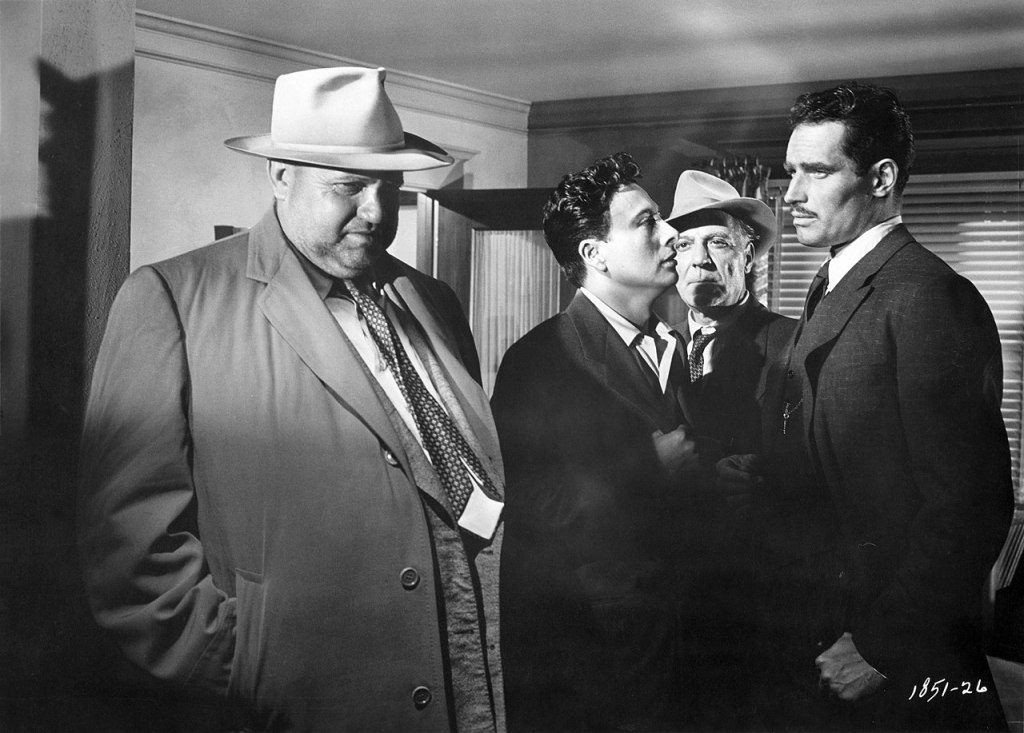
Behold noir at its most deliriously sordid. Orson Welles demonstrates his mastery of cinema’s language—camera movement, composition, lighting, music, performance—all in the service of rolling around in B-movie muck. The genius behind Citizen Kane, the guy who was staging Shakespeare at age 18, evidently also enjoyed a good walk on the wild side. Touch of Evil stars Welles—obese, jowly, constantly chewing on candy bars—as Hank Quinlan, a thoroughly crooked police captain on the U.S. side of the U.S.-Mexican border. His nemesis is Mike Vargas, played by Charlton Heston, who is quite possibly Hollywood’s least-convincing actor to play a Mexican narcotics official. The plot concerns Quinlan’s investigation of a car bombing shortly after the vehicle crosses into his jurisdiction. Vargas is suspicious of Quinlan’s zeal to pin the crime on a Mexican. Touch of Evil positively revels in its own depravity. The cast is an embarrassment of riches. Akim Tamiroff is a toupee-sporting worm of a villain; Dennis Weaver takes nervous jitters to near-operatic heights; Janet Leigh can fill out a bra like no one’s business; Joseph Calleia is Quinlan’s disillusioned number two man; and Mercedes McCambridge is terrifically over the top as a dope-smoking, lesbian biker. But the greatest performance comes from Welles in the director’s chair. From oblique camera angles and intricate sound design to at least three virtuoso scenes in single traveling shots—including a justly famous opening—Touch of Evil is the work of someone who wants to dazzle you. And he succeeds.
(See more in The 20 best opening scenes in film.)
Honorable mention: Act of Violence (1949, dir. Fred Zinnemann), The Breaking Point (1950, dir. Michael Curtiz), Crime Wave (1953, dir. André de Toth), Criss Cross (1949, dir. Robert Siodmak), D.O.A. (1949, dir. Rudolph Maté), Elevator to the Gallows (1958, dir. Louis Malle), Gilda (1946, dir. Charles Vidor), The Hitch-Hiker (1953, dir. Ida Lupino), The Lady from Shanghai (1947, dir. Orson Welles), Laura (1944, dir. Otto Preminger), Leave Her to Heaven (1945, dir. John M. Stahl), Mildred Pierce (1945, dir. Michael Curtiz), Night and the City (1950, dir. Jules Dassin), Out of the Past (1947, dir. Jacques Tourneur), Pickup on South Street (1953, dir. Samuel Fuller), The Postman Always Rings Twice (1946, dir. Tay Garnett), Scarlet Street (1945, dir. Fritz Lang), The Set-Up (1949, dir. Robert Wise), Thieves’ Highway (1949, dir. Jules Dassin), White Heat (1949, dir. Raoul Walsh)
 Cutting to the Chase with Phil Bacharach
6 responses to “The 15 best film noir”
[…] film noir that emerged from Hollywood in the years after World War II did not know it was film noir. […]
LikeLike
[…] guttural howls that reportedly shocked the room crowded with extras posing as inmates.(See more in The 15 best film noir and 10 memorable movie […]
LikeLike
[…] Billy Wilder’s idea for Sunset Boulevard stemmed from a single image: a dead body floating in a swimming pool. For Wilder and co-screenwriters Charles Brackett and D.M. Marshman Jr., the macabre visual encapsulated the movie business in all its California sun-drenched treachery. Silent-film star Gloria Swanson came out of retirement at age 49 to play Norma Desmond, a silent-film star but, unlike Swanson, one long forgotten by Hollywood. William Holden is Joe Gillis, a struggling young screenwriter who latches on to Norma shortly after he pulls onto her once-palatial estate while trying to dodge creditors. Rounding out the principal cast is the great silent-era director Erich von Stroheim, who had directed Swanson in 1929’s Queen Kelly, here playing silent-era filmmaker Max von Mayerling, once Norma’s husband and director, but now her dutiful butler shielding her fragile ego from a harsh reality. The meta-ness of it all is head-spinning—Norma, Joe and Max watch Queen Kelly in Norma’s private screening room—and that doesn’t even include Norma’s routine visits from silent-screen stars like Buster Keaton and Anna Q. Nilsson, whom Joe uncharitably labels “the waxworks.” At an early screening of Sunset Boulevard, MGM boss Louis B. Mayer told Wilder he should be run out of town for biting the hand that fed him. Wilder was unmoved. He reportedly answered with “fuck you” or “go shit in your hat”—accounts vary. The director and co-writer acquitted himself with 11 Oscar nominations, including wins for Screenplay, Art Direction, and Score. “In hindsight,” writes David Thomson in The Big Screen: The Story of the Movies, “Sunset Blvd. looks like the start of a new adulthood, or the peeling away of ‘Hollywood’ nonsense.”(See more in The 15 best film noir.) […]
LikeLike
[…] that unhappy history into one of Hollywood’s most ingenious casting choices.(See more in The 15 best film noir and The 10 best films about […]
LikeLike
[…] out to be a little high.” Few openings announce a film’s fatalism more elegantly.(See more in The 15 best film noir, The 10 best films about filmmaking and The 10 best performances by film […]
LikeLike
[…] If Christina Crawford’s explosive memoir, Mommie Dearest, forever tainted the reputation of her movie-star mom, at least Joan Crawford’s legacy will always include Mildred Pierce. Adapted from a James M. Cain novel, Michael Curtiz’s noir resurrected Crawford’s career after leaving MGM for Warner Bros.—and as the cherry on top, her performance earned the Best Actress Oscar. The eponymous heroine is a tough-as-nails single mother whose business savvy is undercut by her slavish devotion to no-good, nasty daughter Veda (Ann Blyth). Cain loved Crawford’s portrayal, sending the actress a leather-bound copy of the book inscribed with praise for bringing his creation to life. The New York Times was less impressed. Its reviewer found it implausible that someone as smart as Mildred “could be so completely dominated by a selfish and grasping daughter who spells trouble in capital letters.” Hmm. The unnamed critic must have had limited interaction with motherhood. Mildred is a heartbreaking paradox: powerful enough to build a business empire but powerless to stop loving the daughter hellbent on destroying her.(See more in The 15 best film noir.) […]
LikeLike