The movies have come a long way since the days of the “hooker with a heart of gold” archetype that populated westerns and gangster flicks. Sex workers have been a mainstay of film, but their treatment has transformed dramatically over decades. World cinema’s examination of sex workers has been more realistic and ambiguous than that of Hollywood, chiefly because the Production Code instituted in 1934 dictated what could pass muster with the censors.
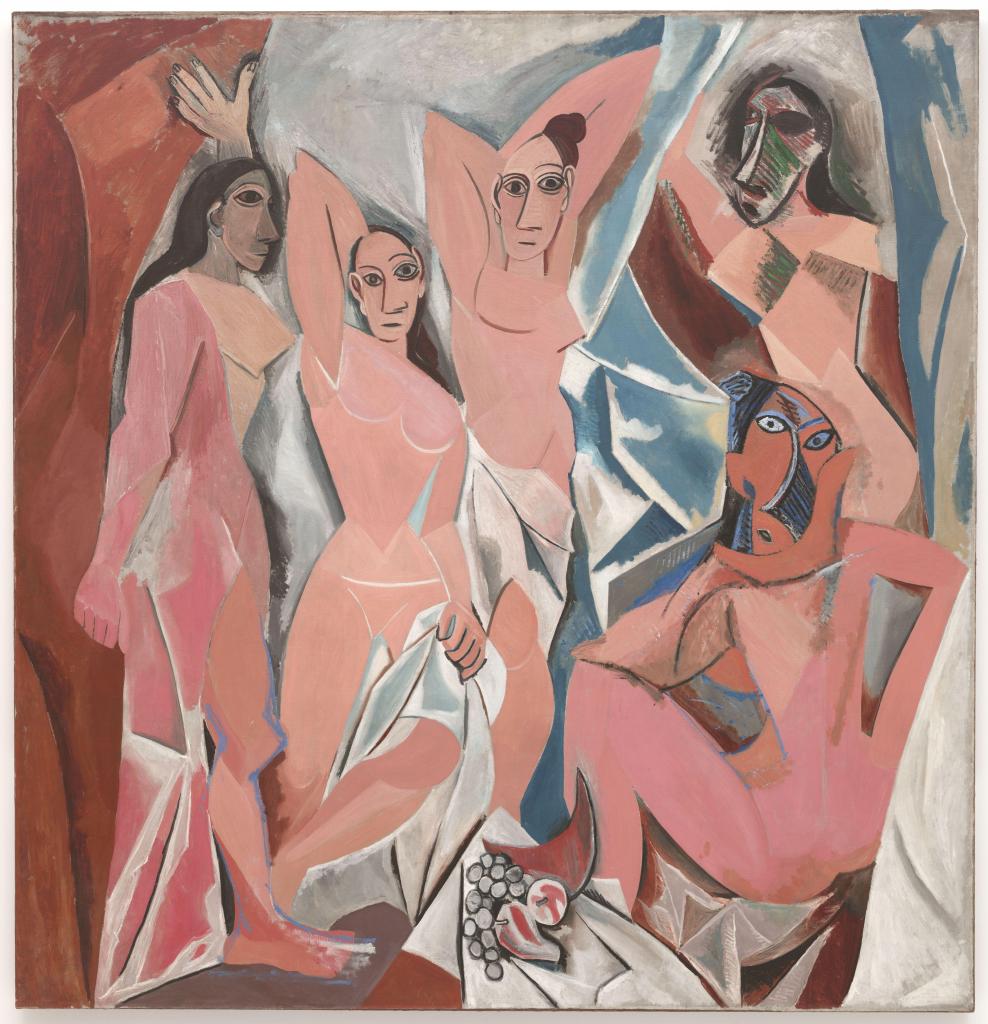
The Code collapsed in 1968. The following year, the Academy Award for Best Picture went to an X-rated film about a male prostitute. Times change. Here are my picks for the 10 best films about sex workers.
10. Pleasure (2021, dir. Ninja Thyberg)
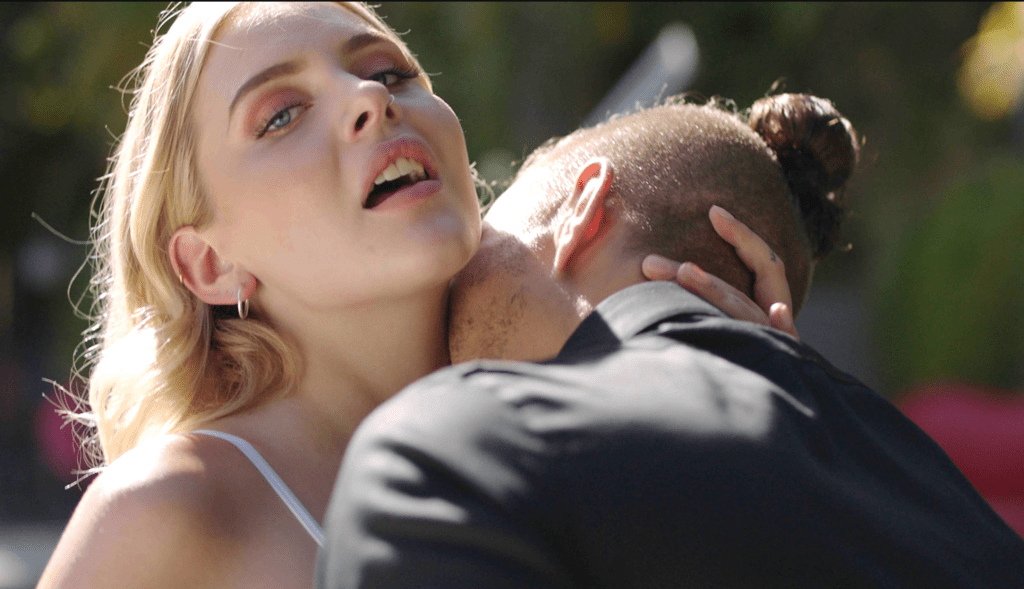
The title is ironic. Swedish filmmaker Ninja Thyberg wades through an industry that presumes to manufacture sexual pleasure, in a film that finds the experience deeply unsettling. Thyberg spent years researching the American porn business before she shot a single frame of her feature debut. Bella Cherry (Sofia Kappel), a young woman fresh from Sweden, arrives in Los Angeles resolved to do whatever it takes to succeed in the industry. Kappel, a nonprofessional actress, is starkly effective as she single-mindedly climbs to the top of the profession. Pleasure hardly condones porn—in a particularly unflinching scene, Bella is coerced into a nonconsensual threesome—but it stops short of condemnation.
9. Anora (2024, dir. Sean Baker)
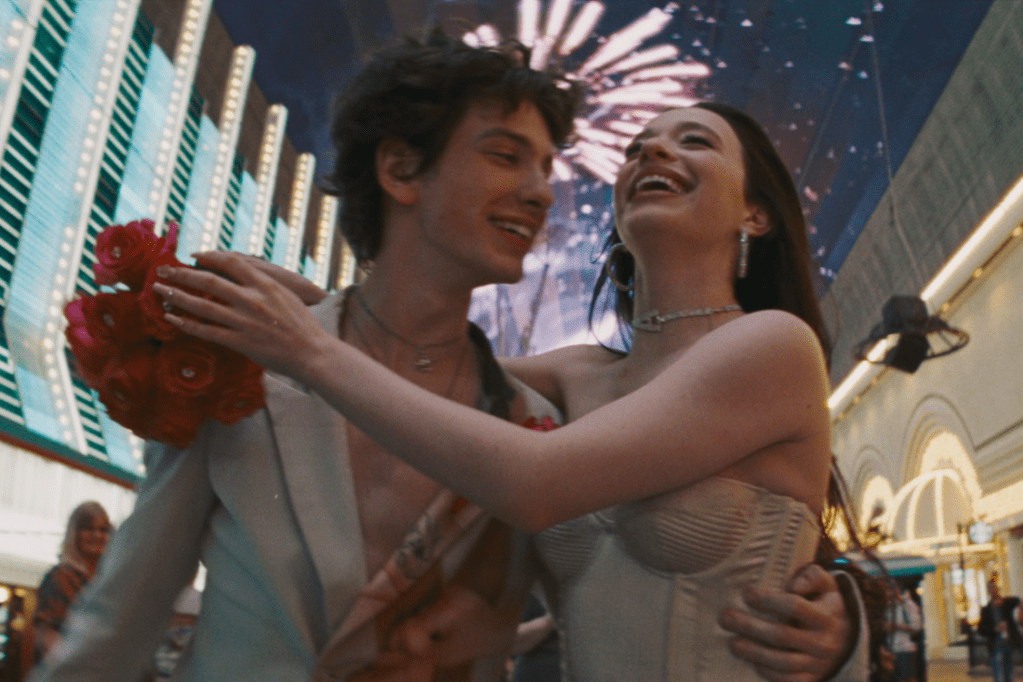
Writer-director Sean Baker is fascinated by people on the margins of society, particularly the lives of sex workers. He scratches that itch in Anora, an indie comedy that took home the Palme d’Or at the Cannes Film Festival and racked up Oscars for Best Picture, Best Actress (for Mikey Madison), Best Director, Best Original Screenplay and Best Editing (also Baker). Madison is Anora “Ani” Mikheeva, an exotic dancer in New York who jumps into a whirlwind courtship with Vanya Zakharov (Mark Eydelshteyn), the flighty 26-year-old son of a Russian oligarch. The couple marry in Las Vegas but the union incurs the wrath of Vanya’s imposing parents (Aleksei Serebryakov and Darya Ekamasova). The Zakharovs learn Ani is no pushover. Baker shifts from screwball comedy to bleak tragedy with seeming ease. Anora’s final scene between Ani and one of the Zakharov thugs, Igor (Yura Borisov), is devastating and hints at darker origins for a rage that Ani (mainly) keeps under wraps.
8. Klute (1971, dir. Alan J. Pakula)
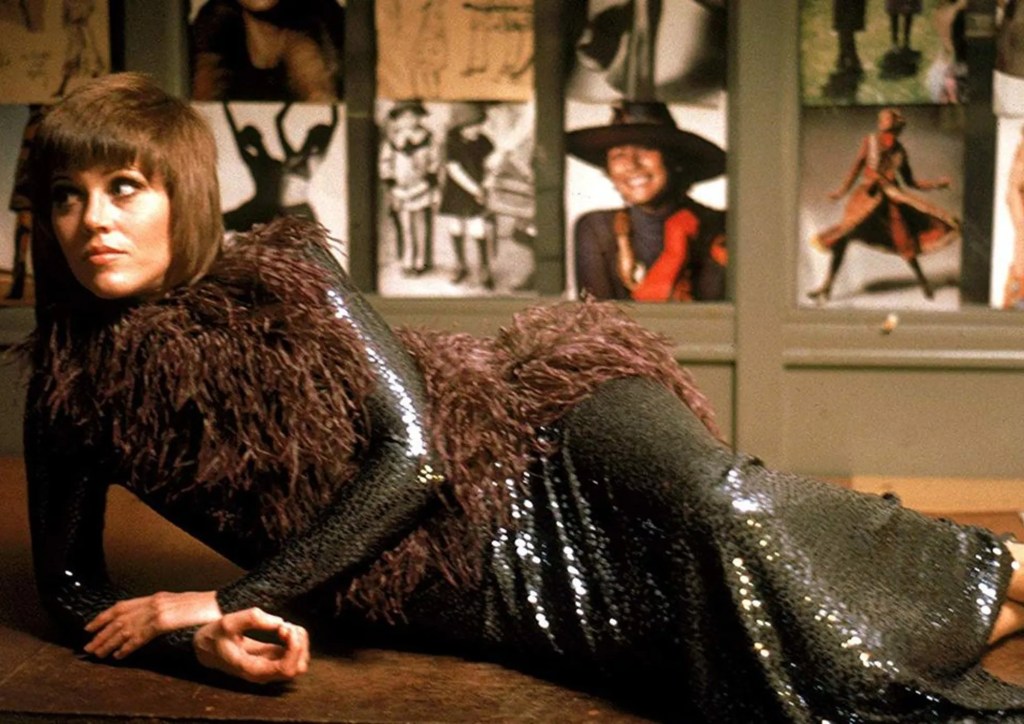
In Alan J. Pakula’s moody, paranoia-soaked Klute, Donald Sutherland is the titular private detective trying to unravel the mystery of a Pennsylvania businessman who has been missing for a year. The trail leads him to New York City and Jane Fonda as high-priced call girl Bree Daniels. Only a few years removed from her controversial trip to North Vietnam and her sex-kitten turn in Barbarella, Fonda rightly earned the Best Actress Oscar. Bree is introspective, canny, insecure and self-destructive—an aspiring actress whose chief theatrical success is feigning pleasure with johns. As she tells her therapist, “And for about an hour, I’m the best actress in the world. I’m the best fuck in the world.” She is also in danger, being stalked by a killer tied to Klute’s investigation. The first of Pakula’s “paranoia” trilogy—the others being The Parallax View and All the President’s Men—Klute is a trenchant character study masquerading as a thriller.
7. My Own Private Idaho (1991, dir. Gus Van Sant)
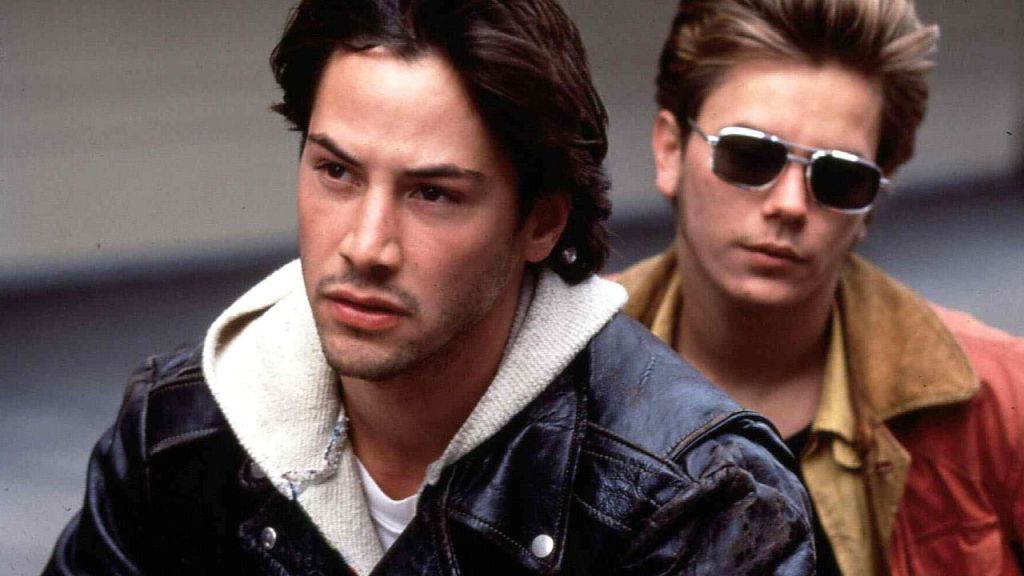
My Own Private Idaho transplants Shakespeare’s Henry IV and Henry V to the world of male hustlers plying their trade on the streets of Portland, Oregon. The mashup shouldn’t work, but it does—largely due to director Gus Van Sant’s gift for poetic naturalism. River Phoenix and Keanu Reeves play, respectively, friends Mike Waters and Scott Favor. Mike suffers from narcolepsy—it tends to hit when faced with situations he cannot handle—and hopes to track down his long-lost mother. Scott, the son of Portland’s mayor, knows he will inherit the family fortune and plans to leave sex work when he turns 21. Searching for Mike’s mother, the pair drifts from Portland to Idaho and, finally, to Rome. Phoenix is extraordinary as the sensitive Mike; he is especially heartbreaking in a campfire scene, largely improvised by the actor, where he confesses to Scott his crush on him. The following year, Phoenix died of a drug overdose at age 23. The film’s melancholy is inseparable from the Pacific Northwest’s overcast skies beautifully captured by cinematographers Eric Alan Edwards and John Campbell.
6. Working Girls (1986, dir. Lizzie Borden)
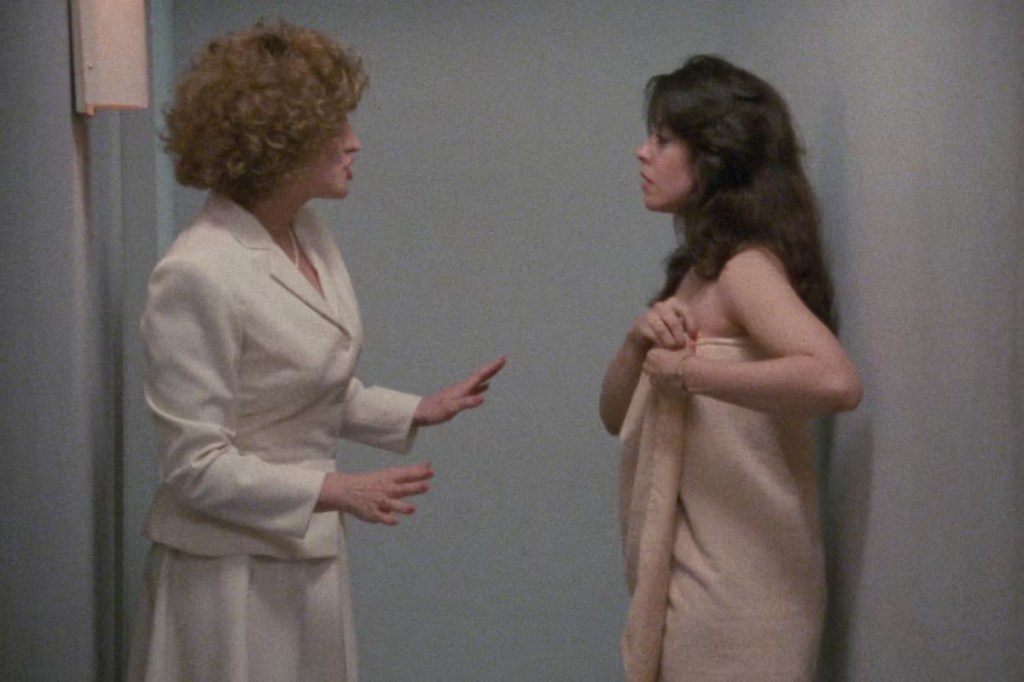
Working Girls’ window into a day in the life of a high-end prostitute is radical in its ordinariness. Molly (Louise Smith) is a Yale graduate and photographer who picks up extra cash working part-time at a Manhattan brothel. It’s a job. Molly has her regulars, one of whom offers her financial advice. The house madam, Lucy (Ellen McElduff), reprimands her staff for their haphazard way of answering the phone. When Lucy is away from the office, Molly and her co-workers pass the time smoking weed, swapping stories about their personal lives and grousing over Lucy’s shoddy treatment. Working Girls doesn’t shy away from showing sex between prostitutes and johns, but it is presented in all its transactional banality, and without a hint of titillation. The film, shot on a shoestring budget over several weekends, has the feel of a docudrama. Writer-director Lizzie Borden and co-writer Sandra Kay eschew questions of morality to reach the quiet revelation that the work of Molly and her co-workers is not far removed from so many jobs in the service sector.
5. Belle de Jour (1967, dir. Luis Buñuel)

Belle de Jour begins with a jolt. A beautiful housewife named Séverine Serizy (Catherine Deneuve) is in a horse-drawn carriage on a country road when the coachman accosts her, dragging her into nearby woods. She is gagged and bound with heavy rope. “Don’t scream or I’ll kill you!” the coachman barks, lashing Séverine with a riding crop before ravishing her. She then awakens from what has been a daydream, where she is again married to Dr. Pierre Serizy (Jean Sorel), a devoted husband who believes his wife to be sexually frigid. The interplay between fantasy and reality pervades Luis Buñuel’s adaptation of Joseph Kessel’s 1928 novel in which a bourgeois Parisian wife satisfies her extreme sexual fantasies by working as a daytime prostitute in a high-end brothel. The director instructed the 22-year-old Deneuve not to act; her preternatural stillness enhances the movie’s dreamlike quality. Film critic Richard Schickel calls Belle de Jour “one of the most beautiful and mysterious movies ever made—elegant, handsome, enigmatic, in some sense inexplicable.”
(See more in The 10 best movies about dreams.)
4. Vivre sa vie (1962, dir. Jean-Luc Godard)
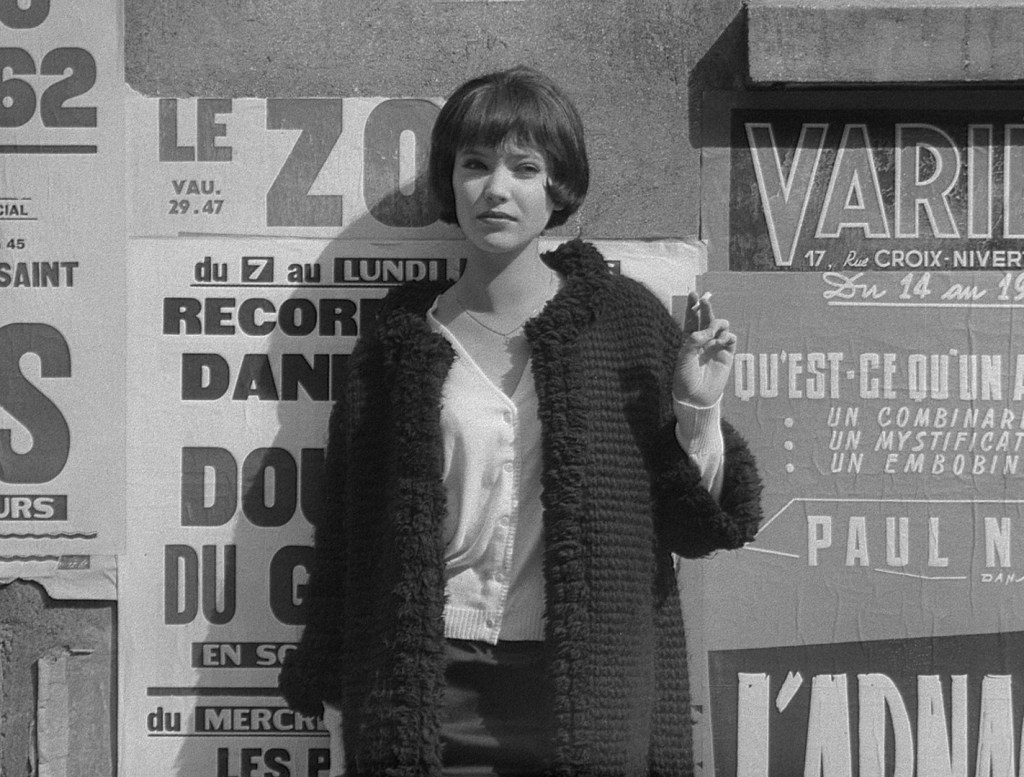
Divided into 12 chapters, Vivre sa vie (or “my life to live”) introduces us to Nana Kleinfrankenheim, a young Parisian woman who casually drifts into prostitution. Played by Anna Karina, Jean-Luc Godard’s then-bride and frequent muse, Nana is beautiful but opaque—as are most of the people around her. Nana initially wants to be an actress, sees that isn’t going anywhere, notices the earning potential of a streetwalker, hooks up with a pimp named Raoul (Sady Rebbot) and voilà. “The prostitute earns all she can by trading on her charms to build up a good clientele and establish the best working condition,” Raoul instructs her. Godard is only tangentially interested in the life of a sex worker. The writer-director is fascinated by a lot. He experiments with noise and silence. He films people from the front, the back and in profile. His camera lingers in Paris’ gleaming coffeehouses, record shops and pool halls. And because it’s Godard, there is a random shootout on the street. The director uses prostitution the way he uses everything else—as a prism through which to examine the alienation of modern life. Through it all there is Karina: luminous, lovely, mysterious.
3. Nights of Cabiria (1957, dir. Federico Fellini)
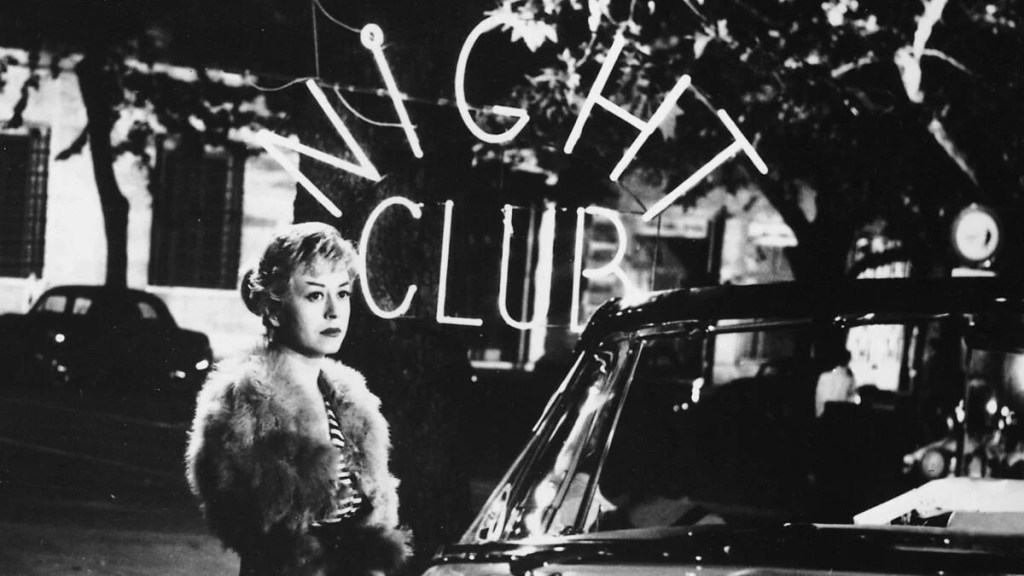
Nights of Cabiria wastes no time showing what life is like for its hapless title character, a street prostitute working the outskirts of Rome’s Via Veneto area. It opens as Cabiria runs joyfully with a man, presumably her lover, to a river in the countryside. They stop by its bank and embrace—when the man suddenly grabs her purse and shoves her into the water, leaving her to drown. Cabiria is later rescued by some passersby, but the indignity is only the first to be heaped upon her. Cabiria, portrayed by Giulietta Masina (the wife of director Federico Fellini), is plucky and resilient, but more than a bit gullible—a particularly dicey trait for a sex worker. Her impish optimism is indefatigable despite a life seemingly stacked against her being happy. Time and again, Cabiria suffers the consequences of laying her heart bare, but she doesn’t break. Bob Fosse captures some of that moxie in his musical adaptation, Sweet Charity (1969). Nights of Cabiria’s justifiably famous final close-up of Masina cycles through defeat and then, almost miraculously, a tentative smile of hope. It is a wondrous encapsulation of this lovely Fellini film.
2. Midnight Cowboy (1969, dir. John Schlesinger)
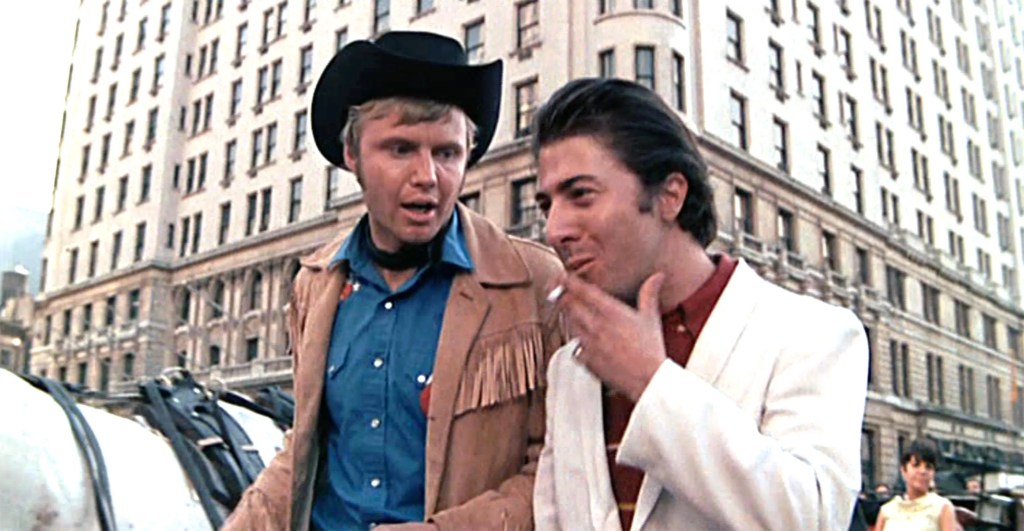
Bob Hope set the discomforting tone of the 1970 Oscars in his opening monologue. “This will go down in history as the cinema season which proved that crime doesn’t pay but there’s a future in adultery, incest and homosexuality. That’s what we’re honoring tonight,” said the comedian. “This is not an Academy Awards. It’s a freakout, ladies and gentlemen.” John Wayne, who won the Best Actor award that year for True Grit, later dismissed Midnight Cowboy as “a story about two fags.” Still, the disdain of Old Hollywood couldn’t keep the movie about a male hustler from winning the Best Picture Oscar—not to mention John Schlesinger for Best Director and Waldo Salt for Best Adapted Screenplay. The story concerns Joe Buck (Jon Voight), a restaurant dishwasher in Texas who takes a Greyhound to New York City, where the naive, would-be stud dreams of making his fortune by servicing rich, sex-starved women. By the time he is fellated by a nervous young man (Bob Balaban) in a Times Square restroom stall, Joe realizes the gigolo life is not as he had imagined. He shares a dingy apartment with Ratso Rizzo (Dustin Hoffman), a tubercular crook with a bum leg who becomes Joe’s sole friend. Midnight Cowboy made Voight a star and made a radio hit of Harry Nilsson’s “Everybody’s Talkin’,” but it also forever changed the trajectory of American cinema. The first and only X-rated film to win Best Picture (a rating that reflected its frank treatment of sexuality rather than anything pornographic), it helped usher in the New Hollywood of the 1970s.
(See more in The 10 best male buddy films.)
1. Boogie Nights (1997, dir. Paul Thomas Anderson)
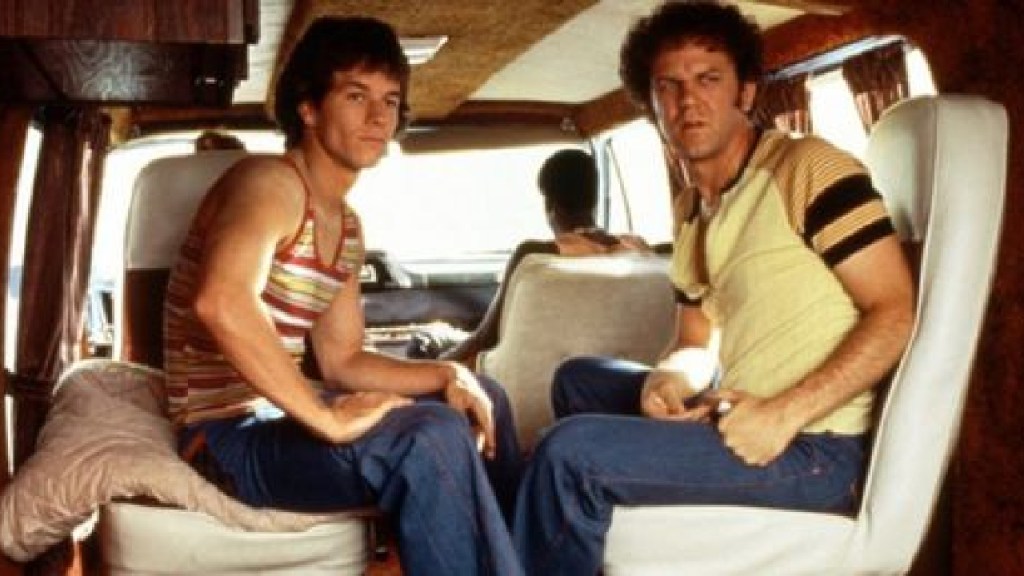
For his second film, Paul Thomas Anderson turned to a topic that had intrigued him ever since he found his father’s secret pornography stash as a kid. Boogie Nights, a sprawling journey through the porn industry of the 1970s and ‘80s, chronicles the rise and fall of Dirk Diggler (Mark Wahlberg), an unusually well-endowed busboy languishing in the San Fernando Valley until his discovery by adult-movie impresario Jack Horner (Burt Reynolds). Loosely based on porn star John Holmes, the character of Diggler had rattled around in Anderson’s head since his teen years. “I love pornography just as much as it completely disgusts and completely depresses me,” the director said shortly after the movie’s release. “The back half of the movie is a sort of punishment for those fun and games. It’s my own guilty feelings about pornography.” Taken in its entirety, however, Boogie Nights is exhilarating: sexy, funny, operatic and drenched in nostalgia (the fashions! the music! the drugs!). The terrific cast includes several actors Anderson would work with again, including Julianne Moore, John C. Reilly, Philip Seymour Hoffman and William H. Macy. Also memorable: real-life porn star Nina Hartley as Macy’s sexually unfettered wife. Reynolds, for his part, hated the picture and fought with Anderson on set, but still wound up earning an Oscar nomination for Best Supporting Actor. From its bravura opening tracking shot onward, Boogie Nights heralds the arrival of a major filmmaker in Anderson. Peel away the virtuosic camerawork and assortment of oddball characters, however, and at the movie’s core are broken people from broken homes creating their own family.
(See more in The 20 best needle drops in film.)
Honorable mention: American Gigolo (1980, dir. Paul Schrader), Diary of a Lost Girl (1929, dir. G.W. Pabst), House of Tolerance (2011, dir. Bertrand Bonello), Jeanne Dielman, 23, quai du Commerce, 1080 Bruxelles (1975, dir. Chantal Akerman), Lilya 4-ever (2002, dir. Lukas Moodysson), Lola (1981, dir. Rainer Werner Fassbinder), McCabe and Mrs. Miller (1971, dir. Robert Altman), Mysterious Skin (2004, dir. Gregg Araki), Streets of Shame (1956, dir. Kenji Mizoguchi), Tangerine (2015, dir. Sean Baker)
 Cutting to the Chase with Phil Bacharach
One response to “The 10 best films about sex workers”
[…] Nothing can stoke anxiety quite like a 1980s power ballad, especially when you happen to be in a strange house trying to sell cocaine to an unhinged, bathrobe-clad dude named Rahad (Alfred Molina) while his houseboy periodically lobs firecrackers just for the hell of it. Music blasts from Rahad’s personal mixtape—Night Ranger’s “Sister Christian” giving way to Rick Springfield’s “Jessie’s Girl”—so that every abrupt cut between tracks ratchets up the tension. Paul Thomas Anderson employs it all for a masterclass in humor-laden suspense. You’ll be motoring.(See more in The 10 best films about sex workers.) […]
LikeLike