There isn’t typically much middle ground when it comes to teachers in the movies. They tend to be inspirational or tyrannical. There’s one trait, however, they share: influence. The classroom is one of the few places where a single person can shape scores of lives at once, which is why cinema has produced some unforgettable teachers.
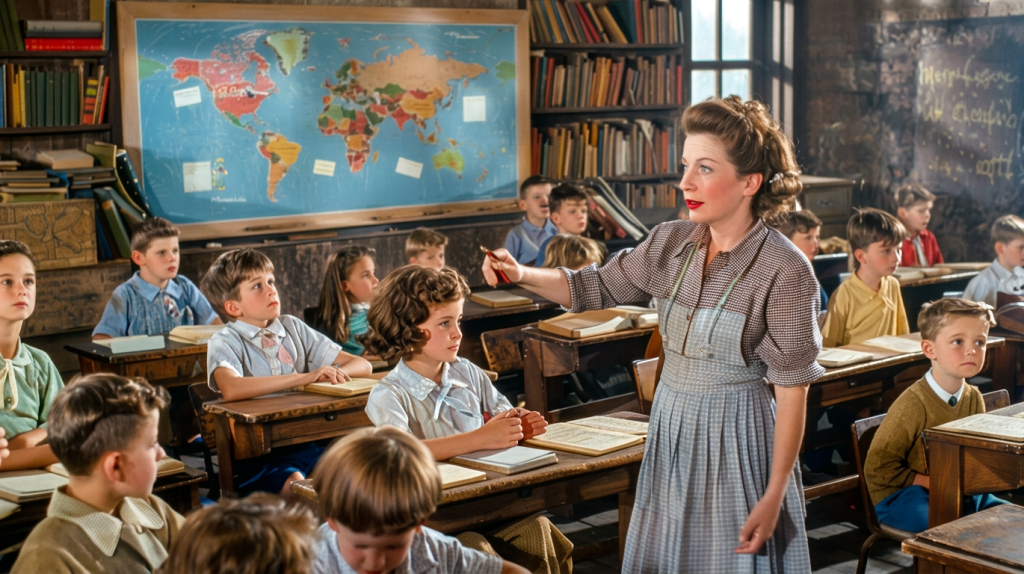
The best of these portraits resist the binary. A teacher’s devotion and a teacher’s cruelty can come from the same source—an unwillingness to accept less than a student’s full potential—and the line between the two can be thinner than either the inspirational or the tyrannical label suggests. Sometimes that line gets crossed in the other direction: a teacher’s need to nurture melts into obsession.
10. Jaime Escalante in Stand and Deliver (1988, dir. Ramón Menéndez)
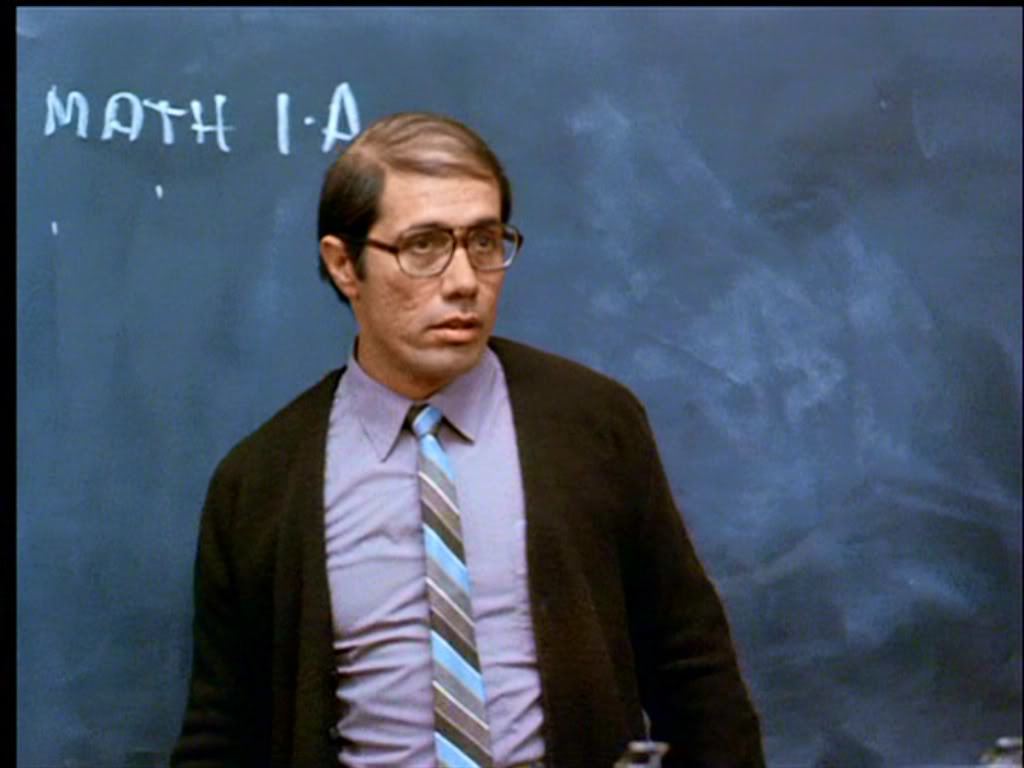
Eighteen students at Garfield High School passed Advanced Placement Calculus in 1982. That feat alone would be impressive, considering that the AP Calculus exam is notoriously difficult. But the Educational Testing Service grew suspicious of the results, and the students later said they suspected it was because they came from a predominantly Hispanic class in a rundown section of East Los Angeles. ETS investigated whether 14 of the students cheated. The kids, however, had only cheated low expectations, thanks largely to a tenacious math teacher who believed in them. Edward James Olmos received an Academy Award nomination for his performance as educator Jaime Escalante. It’s an eccentric portrayal for a story that’s otherwise conventionally told. Wearing an ugly sweater and sporting an unflattering combover, Escalante mumbles, tells bad jokes, and makes awkward, inappropriate comments in the classroom. But he is also confident—correctly, it turns out—that his students can learn calculus. It’s no wonder colleges of education have used Ramón Menéndez’s film as an inspirational tool for teaching.
9. Jean Brodie in The Prime of Miss Jean Brodie (1969, dir. Ronald Neame)
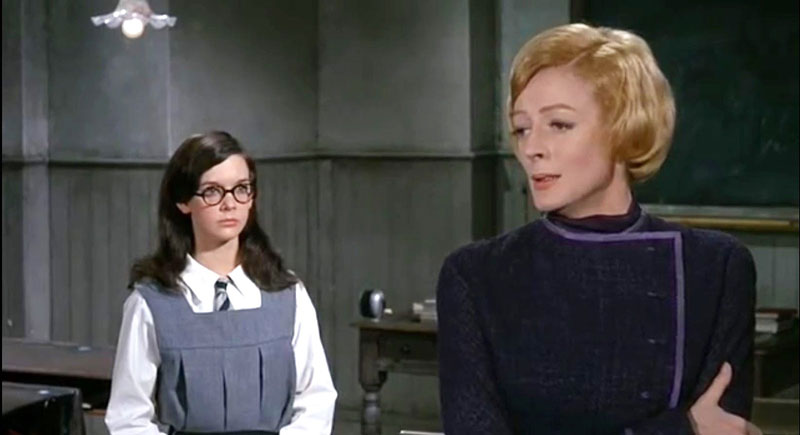
Maggie Smith earned the Academy Award for Best Actress in this odd melodrama of a self-mythologizing teacher at an all-girls school in Edinburgh circa 1932. The Prime of Miss Jean Brodie is an ironic title, given that it’s only Miss Brodie who is insistent that she is in her “prime,” whatever that is. Jean is cultured, charismatic, and profoundly self-deluding—a lover of art and beauty with a soft spot for fascist strongmen like Benito Mussolini and Francisco Franco. She fancies herself a mentor to her students, but her nurturing is selective, favoring a small clique of “Brodie’s girls” whom she dubs “the crème de la crème.” The eventual skeptic in the close-knit cult, Sandy (Pamela Franklin), senses the danger in Miss Brodie’s reckless delusions combined with the hold she exerts over the students. Most disturbing is Jean’s attempt to push one of her students into an affair with the lecherous, married art teacher (Robert Stephens) who had once been her lover. The Prime of Miss Jean Brodie is a disquieting examination of one teacher’s malignant influence.
8. Richard Dadier in The Blackboard Jungle (1955, dir. Richard Brooks)
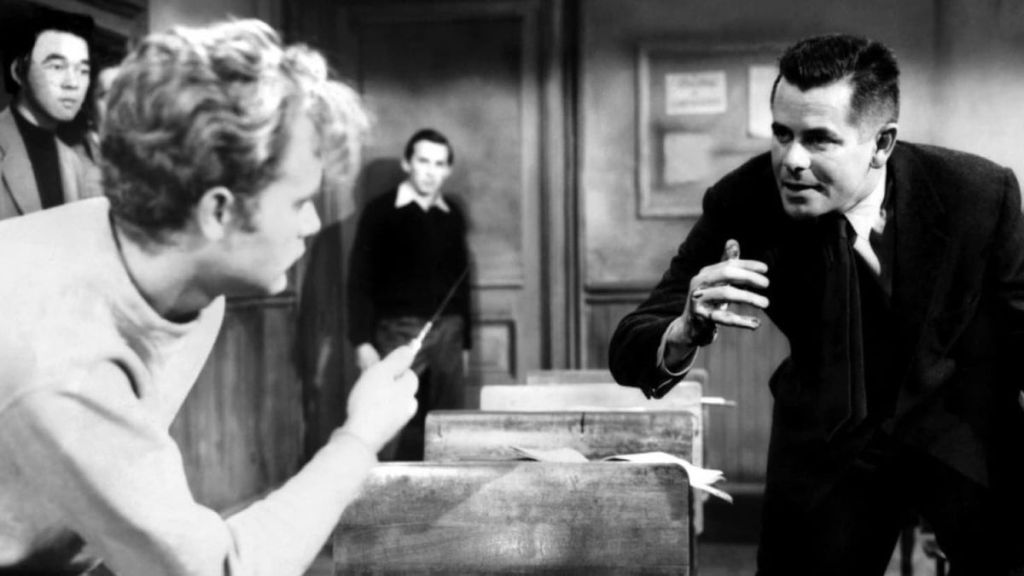
The Blackboard Jungle purports to tackle the social problem of “juvenile delinquency,” but what newbie English teacher Richard Dadier (Glenn Ford) finds at North Manual Trades High School is more flat-out criminal behavior than adolescent rebellion. Richard’s class is leery of him from the git-go, but their hostility erupts into violence when he physically restrains a boy he catches assaulting a female teacher (Margaret Hayes). Shortly thereafter, Richard and another teacher (Richard Kiley) are waylaid by a posse of bad seeds led by the cretinous, dead-eyed Artie (Vic Morrow). The Blackboard Jungle generated controversy at the time, and not just for its early use of rock ‘n’ roll—Bill Haley and the Comets’ “Rock Around the Clock,” which bookends the film—but for its unflinching dramatization of classroom violence. It is bracingly candid about school racism. Sidney Poitier portrays a popular student leader who still has racial epithets lobbed his way, even by Mr. Dadier. Writer-director Richard Brooks paints the institution of school as a prison with students as the hardened cons and the faculty as traumatized guards.
7. Sylvia Barrett in Up the Down Staircase (1967, dir. Robert Mulligan)
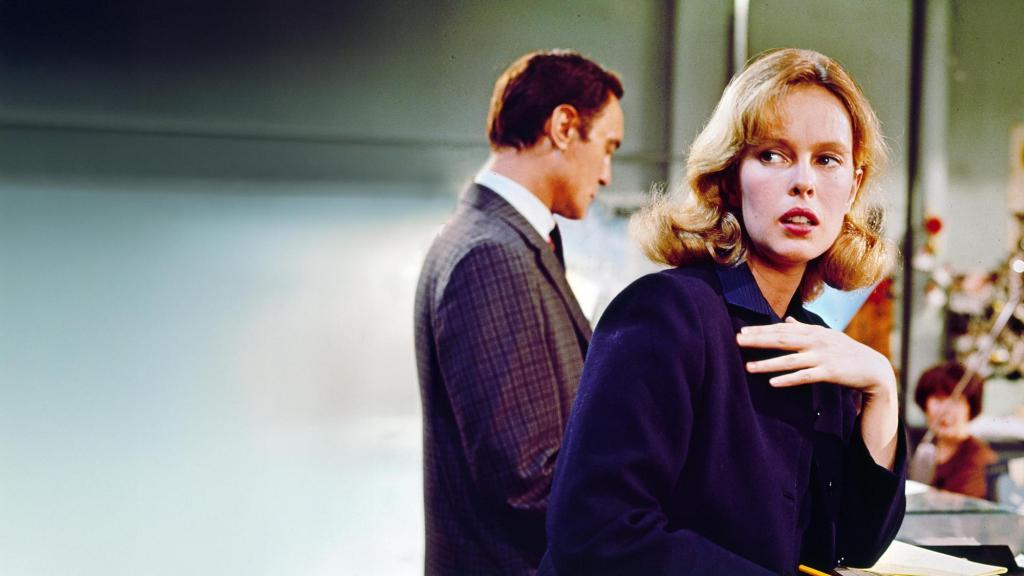
Sandy Dennis is at her best as a first-year teacher feeling her way through a challenging high school in a low-income area of New York. Her Sylvia Barrett is refreshingly unremarkable but immensely appealing—kind and eager to make a difference. Sylvia is not perfect. She’s timid and unsure of herself, but such traits simply make her normal, not flawed. Snappily directed by Robert Mulligan and scripted by Ted Mosel from a Bel Kaufman bestseller, Up the Down Staircase is more about character than plot. It’s also frank about the travails of teaching: crowded classrooms, excessive paperwork, at-risk kids with the odds stacked against them. But there are meaningful rewards, too. “This is where they spend 18 hours a day. We have them for six. Almost insurmountable odds, 18 to six,” a veteran teacher tells Sylvia as they walk through the neighborhood of Calvin Coolidge High. “You’ll notice I said ‘almost’ because you can’t give up. You can’t give them up. They’ve been given up by too many already.” Up the Down Staircase has largely been forgotten, but the world of Sylvia Barrett would undoubtedly ring true for today’s educators.
6. Lisa Spinelli in The Kindergarten Teacher (2018, dir. Sara Colangelo)

Kindergarten teacher Lisa Spinelli (Maggie Gyllenhaal) is a would-be poet frustrated with her poetry-writing class. The instructor (Gael García Bernal) and her classmates are less than encouraging. Then she overhears one of her kindergarten students reciting a poem he made up. Lisa is struck by its evocative imagery. She commits it to paper, submits it to the poetry class as her own, and basks in the resulting praise. From that moment, Lisa resolves to help this child (Parker Sevak) develop his gift. “Talent is so fragile,” she tells the boy’s uncle. “It’s so rare, and our culture does everything to crush it.” Gyllenhaal carries herself with the melancholy of someone whose life has fallen far short of her expectations. What makes Lisa’s obsession so unnerving is that it evolves from an admirable desire to nurture talent and preserve genuine artistry from indifference. An English-language remake of a 2014 Israeli film of the same name, Sara Colangelo’s The Kindergarten Teacher almost imperceptibly transforms nurturer into predator.
5. Paul Hunham in The Holdovers (2023, dir. Alexander Payne)
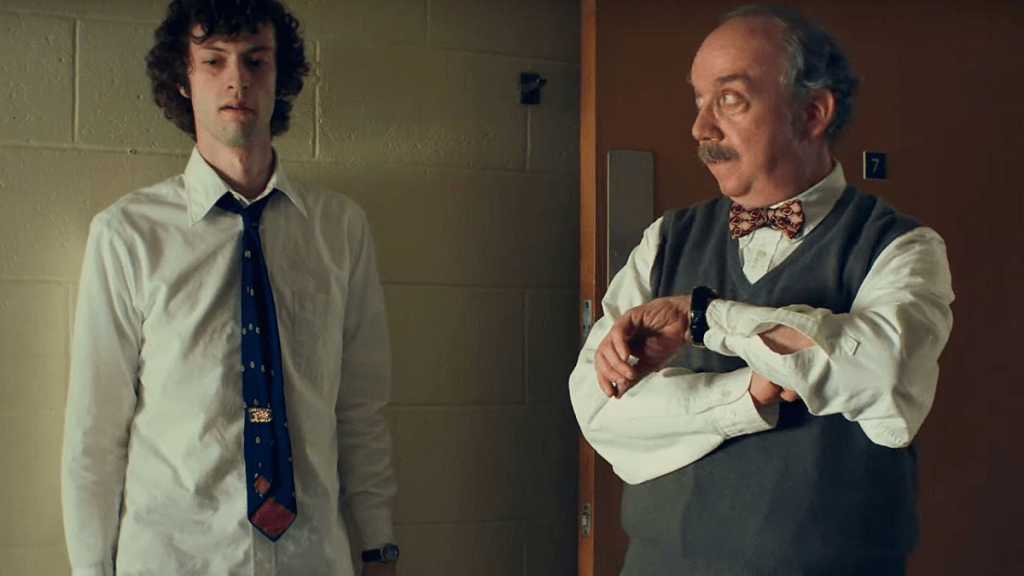
Alexander Payne’s comedy-drama about three broken people making a connection over the Christmas holidays earns its prickly sentiment. A throwback to 1970s American cinema, The Holdovers feels like a long-forgotten Hal Ashby movie (think The Last Detail or Harold and Maude) rescued from the vault. Paul Giamatti is Paul Hunham, a flinty, thoroughly unpleasant teacher disliked by students and faculty alike at a New England all-boys boarding school. The professor hasn’t been dealt a generous hand. He has a distracting eye turn and a rare medical condition called trimethylaminuria that causes him to smell like fish. Left in charge of a few students unable to go home over winter break, Hunham develops a bond with a volatile outcast, Angus Tully (Dominic Sessa), and the school’s head cook (Da’Vine Joy Randolph) who is grieving the recent death of her son in Vietnam. Randolph’s performance won the Best Supporting Actress Oscar. Giamatti, who earned a Best Actor nomination, brilliantly conveys the complexities of a man whose misanthropy is a poor substitute for loneliness.
(See more in The 15 best school-centric films.)
4. Terence Fletcher in Whiplash (2014, dir. Damien Chazelle)

The sophomore feature of Damien Chazelle introduces arguably film’s scariest teacher this side of Breaking Bad’s Walter White. Whiplash stars Miles Teller as Andrew Neiman, a first-year student at a Juilliard-style music college, chasing a dream of becoming jazz’s best drummer since Buddy Rich. That is, if Andrew can survive Terence Fletcher, his demanding mentor—or tormentor, to be accurate—played with vein-popping, Oscar-winning ferocity by J.K. Simmons. He throws a chair at Andrew’s head, routinely humiliates the young man in front of classmates, and belittles him at every turn. Typical pedagogical moment from Fletcher: “You are a worthless, friendless, faggot-lipped little piece of shit whose mommy left daddy when she figured out he wasn’t Eugene O’Neill, and who is now weeping and slobbering all over my drum set like a fucking 9-year-old girl!” Is Fletcher’s behavior really meant to push students to be their best, or is it no more complicated than the guy’s a sadist? Do motives even matter when the educator is sending furniture flying? Considering that Chazelle based Fletcher on his own high school music teacher, it’s a wonder the director lived to tell the tale.
3. Annie Sullivan in The Miracle Worker (1962, dir. Arthur Penn)
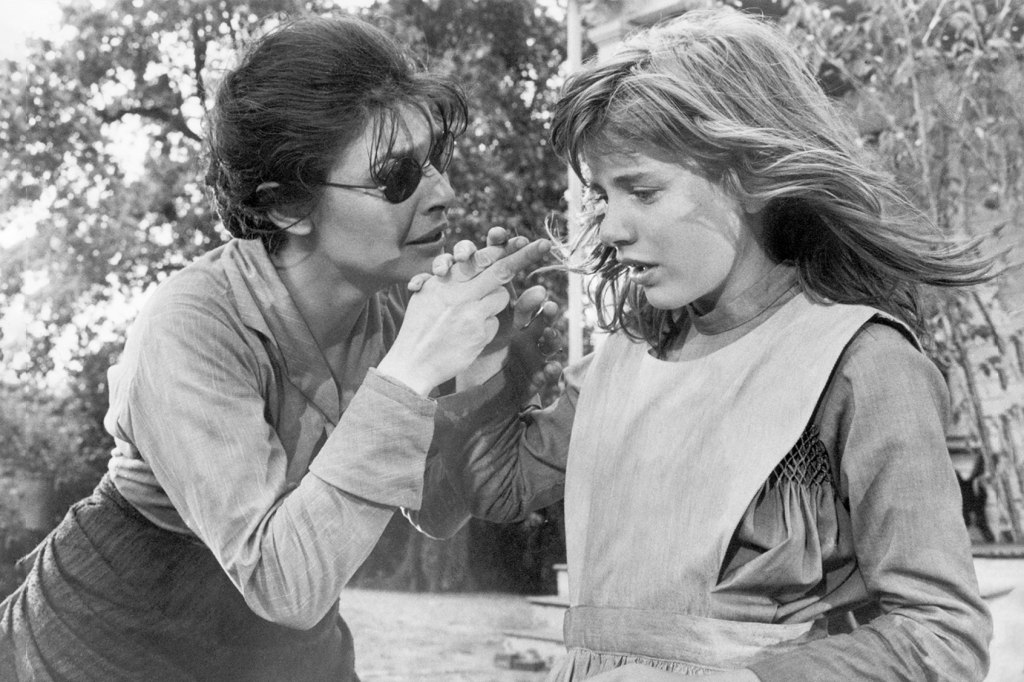
In The Miracle Worker, the Keller family is nonplussed when Annie Sullivan (Anne Bancroft) arrives in Alabama to teach their daughter, Helen (Patty Duke), left blind and deaf from what was likely scarlet fever. The parents are desperate for help, yet Annie, a novice teacher only in her 20s, seems woefully ill-prepared. Nearly blind herself, Annie must wear dark glasses because of sensitivity to any amount of light. As history bore out, however, her zeal and methodology proved miraculous. Helen’s parents agonize seeing their near-feral child driven so hard by her teacher. “I don’t want her just to obey,” Annie tells Helen’s father (Victor Jory). “But let her have her way, then everything is a lie to her.” Director Arthur Penn, who had helmed the William Gibson play on Broadway, maintains a stage sensibility. The Miracle Worker is spare and simple. It understands that its power rests with Bancroft and Duke’s strong, physically demanding performances. Both actresses took home Oscars. The Miracle Worker demystifies the story of Helen Keller, but it also pays tribute to what an incredible teacher can inspire.
2. Erika Kohut in The Piano Teacher (2001, dir. Michael Haneke)
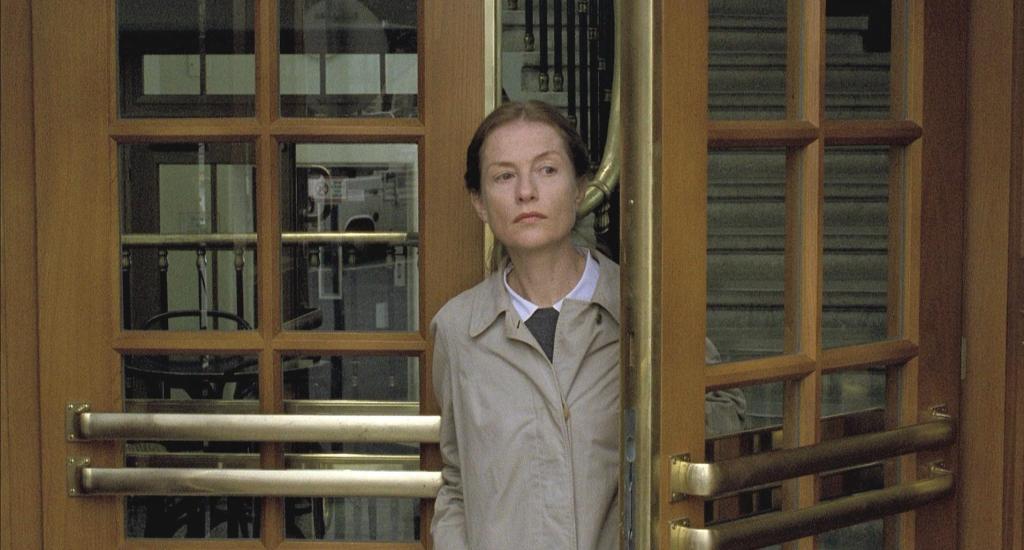
Michael Haneke films scratch at the darker recesses of the human experience. The Piano Teacher is no exception. At the Vienna music conservatory where she teaches, Erika Kohut (Isabelle Huppert) is strict, exacting, and casually cruel to her pupils. That classroom persona lies in stark contrast to her fraught, sometimes violent relationship with the overbearing mother (Annie Girardot) she lives with. Outside the conservatory, Erika harbors darker compulsions. She consumes graphic pornography at peepshows while inhaling the discarded tissues left by male customers. She cuts herself in tender regions of her body. Her carefully controlled desires bubble to the fore when she surrenders to the advances of a cocky, handsome student (Benoît Magimel) and presents him with a written list of demands for her own humiliation. Huppert is mesmerizing, revealing volumes with a simple glance or a subtle shift of her lips. The film dives into the struggle for sexual dominance, even the paradoxical control within sexual submission. What is fantasy? What’s love, for that matter? Is control a false construct? There’s a lot to chew on in The Piano Teacher, but viewers must come with an appetite.
1. John Keating in Dead Poets Society (1989, dir. Peter Weir)
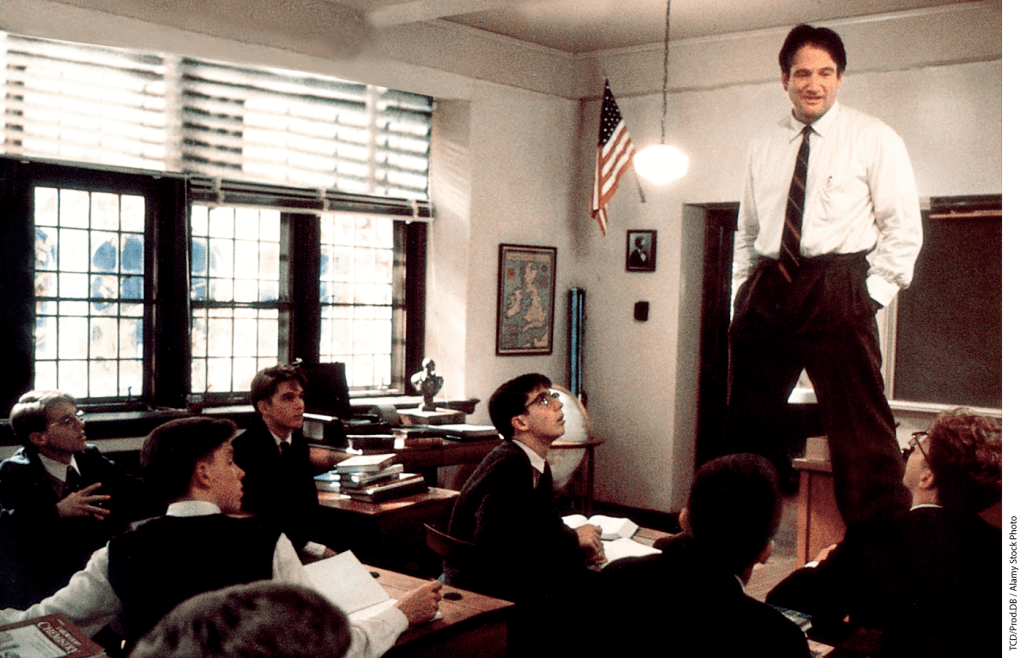
Set in a snooty boarding school circa 1959, Dead Poets Society presents an exceptional teacher in John Keating. Portrayed by a glint-eyed Robin Williams, Mr. Keating begins shaking things up shortly after arriving at Welton Academy. “Carpe diem. Seize the day, boys,” he whispers to his poetry students as they study vintage photographs of previous graduating classes displayed in a trophy case. “Make your lives extraordinary.” Mr. Keating urges his students to challenge conformity and dream big, an ostensibly noble lesson—but a daring one in light of the school’s airless rigidity. What ignites the class’ imagination, however, is when they learn of the Dead Poets Society, a group Mr. Keating had organized back when he was a student at Welton. The kids revive the club. Tragedy waits around the corner, and Mr. Keating the hero becomes Mr. Keating the scapegoat in the repressive 1950s. Screenwriter Tom Schulman modeled the character on a beloved teacher at his own alma mater. Williams’ finely calibrated performance demonstrates what makes the teacher so effective, but it stops short of idealization. Keating’s genius is that he teaches literature not as an academic subject but as permission to imagine a larger life.
Honorable mention: Jim McAllister (Matthew Broderick) in Election (1999, dir. Alexander Payne), Charles Chipping (Robert Donat) in Goodbye Mr. Chips (1939, dir. Sam Wood), Dan Dunne (Ryan Gosling) in Half Nelson (2006, dir. Ryan Fleck), Mademoiselle (Jeanne Moreau) in Mademoiselle (1966, dir. Tony Richardson), Bachir Lazhar (Mohamed Fellag) in Monsieur Lazhar (2011, dir. Philippe Falardeau), Glenn Holland (Richard Dreyfuss) in Mr. Holland’s Opus (1995, dir. Stephen Herek), Charles W. Kingsfield Jr. (John Houseman) in The Paper Chase (1973, dir. James Bridges), Dewey Finn (Jack Black) in School of Rock (2003, dir. Richard Linklater), Carla Nowak (Leonie Benesch) in The Teachers’ Lounge (2023, dir. İlker Çatak), Mark Thackeray (Sidney Poitier) in To Sir, with Love (1967, dir. James Clavell)


2 responses to “The 10 most memorable movie teachers”
[…] Didn’t we all know a Tracy Flick in high school, that gratingly confident and capable overachiever whose hand was always first to shoot up when the teacher asked a question? I’m laying odds that you did. Similarly, I’m betting we all also knew a version of Jim McAllister, a middle-aged teacher who made no effort to hide their disdain for some students and approval of others. In adapting Tom Perrotta’s novel Election for the big screen, Alexander Payne and co-writer Jim Taylor perform a razor-sharp dissection of relationships and rivalries in an Omaha, Nebraska, high school (Payne transplanted the book’s New Jersey setting to the director’s Midwest stomping grounds). The humor is lacerating. Reese Witherspoon gave a breakthrough performance as Tracy Flick, whose campaign for class president incurs the wrath of Matthew Broderick, equally terrific as the progressively unhinged civics teacher who cannot stomach a Flick victory.(See more in 10 memorable movie teachers.) […]
LikeLike
great list, Phil. Several oldies I would definitely watch again.
LikeLike