Few settings are as innately dramatic as prison, where freedom is the only currency that matters and the struggle to maintain humanity amid a dehumanizing system plays out in brutal relief.
The genre has been a movie staple since at least 1930, when MGM’s The Big House essentially set the template, made a star of Wallace Beery, and earned an Academy Award for Frances Marion, arguably the greatest female screenwriter of her time. Overcrowded cells, hardened cons, corrupt guards, the inevitable escape attempt—it all began with The Big House and its shrewd exploitation of the universal fear of confinement. For purposes of the list below, it’s worth noting that prisoner-of-war films, while sharing some DNA with prison flicks, present a distinct set of circumstances to warrant their own conversation entirely.
What follows, then, are the 10 best movies set behind bars.
10. The Big Doll House (1971, dir. Jack Hill)

The feverish male fantasy women-in-prison subgenre thrived in the 1970s, but none were better than this Roger Corman-produced offering. The ad campaign tagline said it all: “Women so hot with desire they melt the chains that enslave them.” In this case, the chain-melting mavens—played by Julie Brown, Roberta Collins, Pam Grier and Pat Woodell—are sexy, mean, and did I mention sexy? OK, so no one saw The Big Doll House for heart-stopping action or snappy dialogue, but it checks off other boxes: body cavity searches, mud wrestling, fetishistic torture, sexually charged whippings, and a sadistic female warden played by Kathryn Loder. Jack Hill shot the movie in the Philippines for $200,000. It grossed $10 million and reunited the director and Grier the following year for a sorta-kinda-sequel, The Big Bird Cage.
9. The Longest Yard (1974, dir. Robert Aldrich)
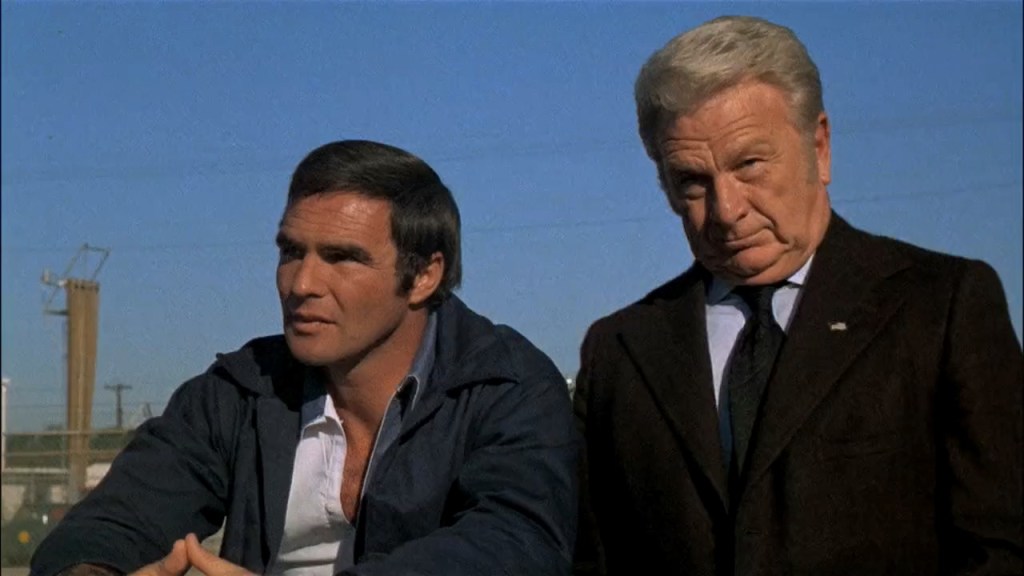
Burt Reynolds is a cocky narcissist—I mean he portrays one—in this rough-and-tumble comedy of an improbable football game. He plays Paul Crewe, a former NFL quarterback whose career ended after he was caught shaving points in games. One drunken evening he steals his girlfriend’s sports car and leads police on a chase before he is caught, convicted and sent to fictional Citrus State Prison. Paul just wants to do his time quietly, but he’s hounded by tyrannical Warden Rudolph Hazen (Eddie Albert), who is crazy proud of his facility’s amateur football team comprised of his guards. “The game embodies what has made this country great!” bellows the warden. In a scenario that strains credulity, Hazen coerces Paul into coordinating a scrimmage between the guards and inmates, albeit under the strict condition that the guards win. The Longest Yard director Robert Aldrich and screenwriter Tracy Keenan Wynn lean hard into the era’s anti-establishment bent for a movie that is violent and undeniably funny.
8. Sing Sing (2024, dir. Greg Kwedar)

At first blush, director Greg Kwedar’s docudrama about an actual theater arts workshop for prison inmates might sound like earnest movie medicine that is supposed to be good for you. Instead, it is a deeply moving account of prisoners trying to preserve scraps of their humanity in the face of an institution designed to dehumanize, and it is all the more impactful since it mostly consists of nonprofessional actors who participated in Rehabilitation Through the Arts (RTA) in upstate New York’s Sing Sing Correctional Facility. Colman Domingo embodies contemplative grace as Divine G, RTA’s biggest champion, but he is matched by Clarence “Divine Eye” Maclin, a former inmate who plays a fictionalized version of himself. Sing Sing, which earned Academy Award nominations for Domingo and screenwriters Kwedar and Clint Bentley, is a testament to the redemptive power of art—and it has the real-life bona fides to back it up.
7. The Shawshank Redemption (1994, dir. Frank Darabont)
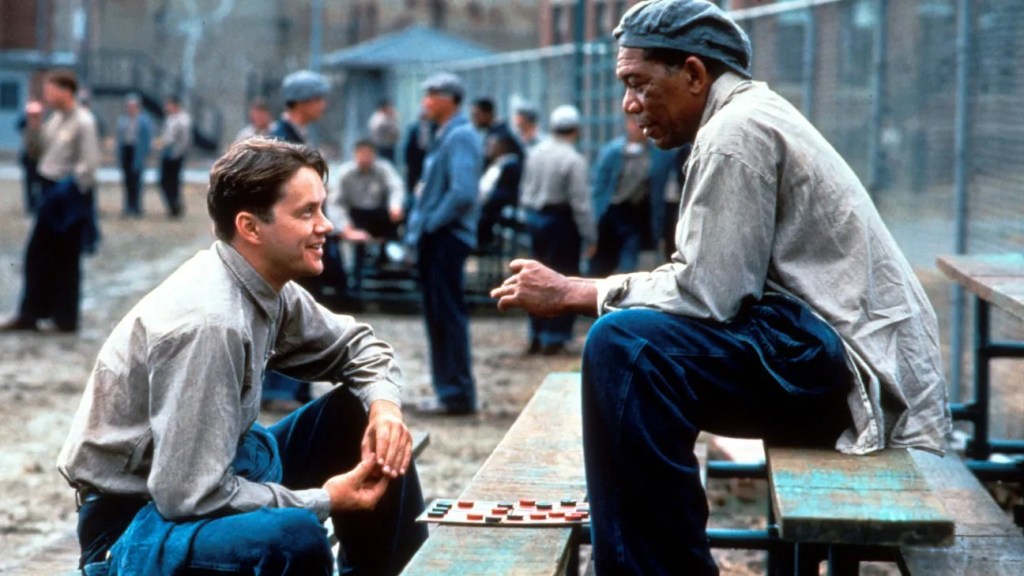
Frank Darabont’s adaptation of a Stephen King novella has a mighty cult following that considers it among the best movies of all time. For years, it sat atop IMDB’s Top 250, and there’s no denying this is a solid, rousing prison flick. The production, however, was an ordeal. On location in the recently shuttered Ohio State Penitentiary, the shoot often dragged on to 18 hours a day of take after take, six days a week. Tim Robbins is Andy Dufresne, a Maine banker who receives two life sentences for the murders of his wife and her lover. He steadfastly proclaims his innocence but, of course, longtime convicts like Red (Morgan Freeman) have heard it all before. Andy and Red form a bond that endures decades in unforgiving Shawshank State Penitentiary. While I don’t find Robbins too convincing as the cagey Andy, the rest of the cast is terrific. Red became a signature role for Freeman, and Bob Gunton nails it as the sanctimonious warden. The Shawshank Redemption is a well-oiled crowd-pleaser.
6. Papillon (1973, dir. Franklin J. Schaffner)
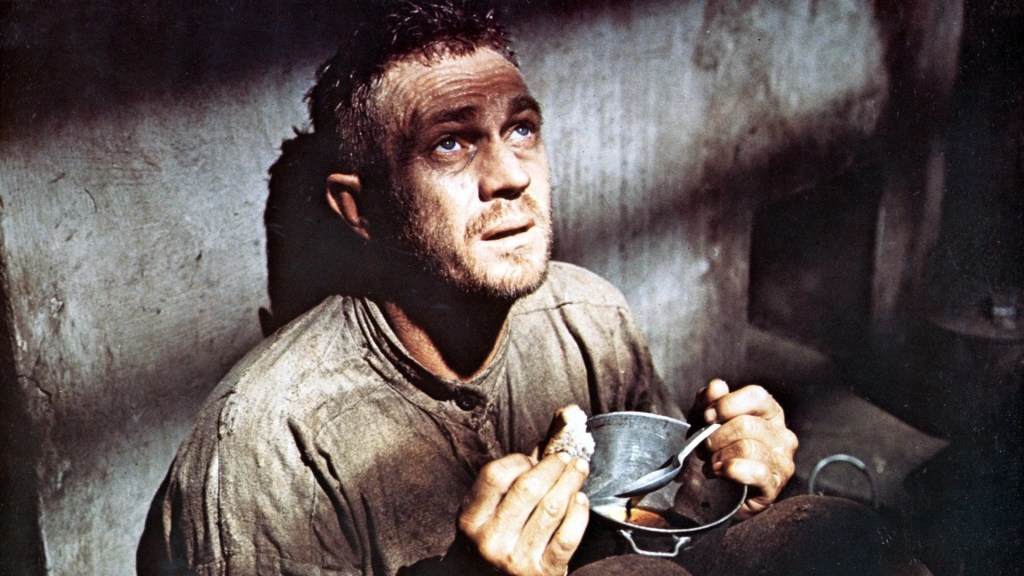
Steve McQueen shows surprising range as the real-life French safecracker who, in the early 1930s, was sentenced to life in prison for the murder of a pimp. Based on the autobiography of Henri Charrière, whose nickname of “Papillon” came from a butterfly tattoo on his chest, the film chronicles Papillon’s tireless attempts to escape from the French Guiana penal colony. Along the way he forms a lasting friendship with fellow prisoner Louis Dega (Dustin Hoffman), a wealthy, physically frail forger who trades financial support for Papillon’s protection. “The rule here is total silence,” a corrections official tells arriving inmates. “A meat processor processes live animals into edible ones. We process dangerous men into harmless ones. This we accomplish by breaking you.” Director Franklin J. Schaffner crafts a sweeping epic that, in spite of a baggy middle section—and a lot of skepticism about Charrière’s claims—illustrates the purgatory of France’s penal system and Papillon’s eventual banishment to Devil’s Island.
5. Escape from Alcatraz (1979, dir. Don Siegel)
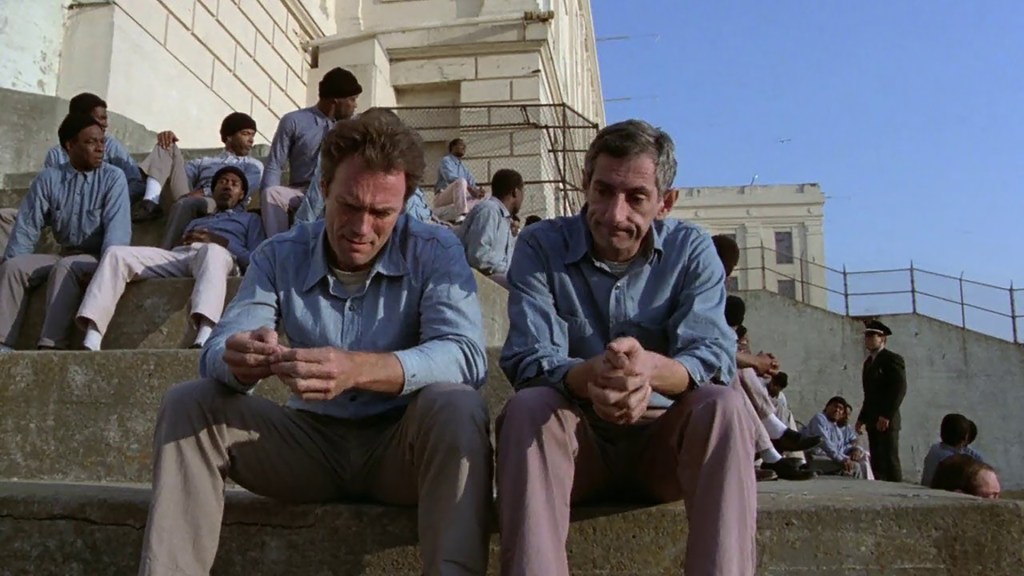
The newest arrival to Alcatraz, a chronic prison escapee named Frank Morris (Clint Eastwood), is processed into the notoriously escape-proof facility on a stormy night in San Francisco Bay. Morris is stripped and marched naked along Alcatraz’s main corridor to his cell. The bar doors slam shut and a guard barks, “Welcome to Alcatraz!”—a disingenuous greeting if ever there was one, nicely underscored by a sudden clap of thunder. “No one has ever escaped from Alcatraz,” the stone-faced warden (Patrick McGoohan) later tells Morris, “and no one ever will.” Of course, that pronouncement is catnip for a badass like Eastwood—er, I mean Frank Morris. Based on a true story, Escape from Alcatraz is lean and tightly coiled, but the titular escape plan is hatched relatively late in the film. Until then, Don Siegel lets tensions percolate as Morris settles into life on the Rock. He gets a job in the library, befriends an older inmate (Roberts Blossom) with an affinity for painting, and makes a dangerous enemy when he rebuffs the advances of a fellow prisoner (Bruce M. Fischer) by beating him to a pulp. Siegel’s fifth collaboration with Eastwood proved a fitting note to close out the director’s career.
4. I Am a Fugitive from a Chain Gang (1932, dir. Mervyn LeRoy)
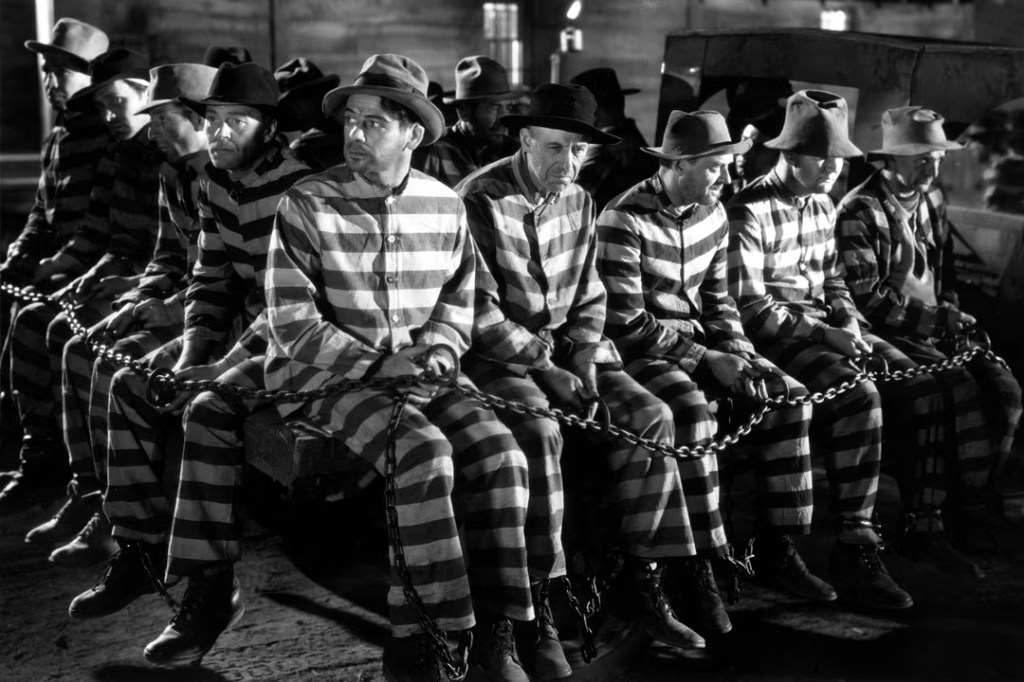
Warner Bros. took considerable chances with this socially conscious melodrama drawn from real life. Robert Elliott Burns had written a bestseller about his escape from a Georgia prison chain gang, but he was still on the lam at the time of the book’s publication. Jack Warner wanted an important picture, and he got one. Paul Muni is Jim Allen, a down-on-his-luck war veteran who is at a diner waiting on a hamburger when he gets swept into an armed robbery. He is unfairly convicted and slapped with a 10-year sentence on a chain gang in the Deep South. After enduring all the vicious guards and backbreaking labor he can, Jim makes a break for it. Warner Bros. execs tracked the real fugitive to New Jersey, where there was no extradition law. The studio hid Burns on the Warner lot, gave him a new name, and paid him as a consultant. The Studio Relations Committee fretted that the film would enrage southern states, particularly Georgia, but its grim brutality impacted policymakers as well as audiences. One of Hollywood’s first major works of social realism, Mervyn LeRoy’s I Am a Fugitive from a Chain Gang proved instrumental in spurring meaningful prison reform.
3. A Man Escaped (1956, dir. Robert Bresson)
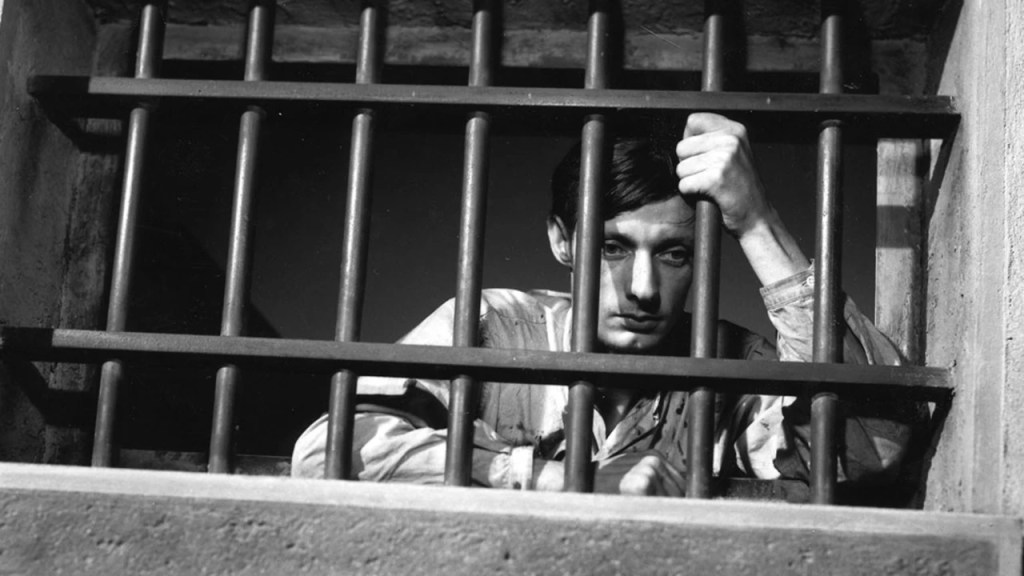
Robert Bresson’s A Man Escaped takes the naturally visceral subject of a prison break and saps it of drama and embellishment—the result is riveting. Based on the escape of French resistance leader André Devigny, it details the breakout of Fontaine from Nazi-occupied Montluc prison. François Leterrier portrays the protagonist with an absence of emotion that defines Bresson films, but his Fontaine is certainly a man of action. He stashes away a spoon that he fashions into a sort of chisel to methodically loosen the panels of his cell door. He collects useful items from other inmates, moving tools with the help of a makeshift pulley made of heavy rope. His drive for escape is simple: “To fight. To fight the walls, to fight myself, to fight the door.” François Truffaut called A Man Escaped “pure music” and “rushes into the night with the same rhythm as a windshield wiper.” Like Fontaine, the film doesn’t concern itself with anything but the job at hand—and approaches it with the same relentless austerity.
2. A Prophet (2009, dir. Jacques Audiard)

Tahar Rahim is phenomenal as Malik El Djebena, a North African immigrant sentenced to six years in a French prison for assaulting police and other offenses. The 19-year-old is illiterate, terrified, and unmoored as he tries acclimating to life behind bars. He is approached by another inmate, Corsican crime boss César Luciani (Niels Arestrup), with a proposition he cannot refuse. Malik must kill an Algerian inmate (Hichem Yacoubi) being targeted by the Corsicans—or face being killed himself. Malik complies after much agonizing, earning the enmity of his fellow Muslim prisoners but the protection of César and his minions. Malik rises in the ranks after most of the Corsican inmates are released, but always with César’s caveat that he is little better than a dog. Malik’s transformation from scared inmate to crime boss feels utterly credible, built patiently and with little fanfare. Jacques Audiard has the sensibility of a documentarian, albeit one who knows how to create suspense. Winner of the Grand Prix at the Cannes Film Festival, A Prophet doesn’t break new ground in its depiction of a correctional system turning an aimless young man into a hardened criminal, but it makes the journey enthralling.
1. Cool Hand Luke (1967, dir. Stuart Rosenberg)
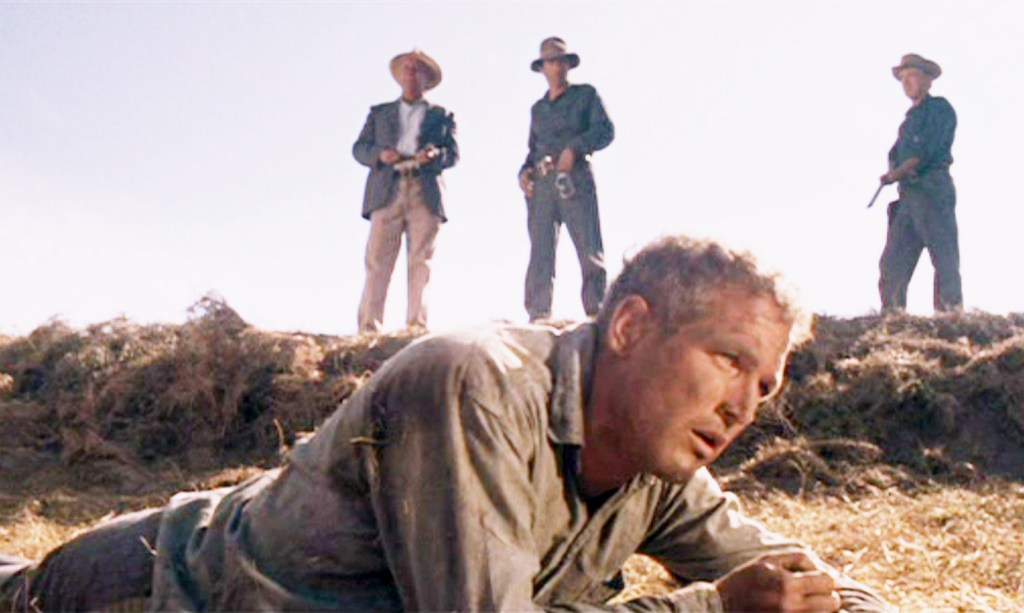
They didn’t come much cooler than Paul Newman, as evidenced by his iconic turn in Cool Hand Luke as Luke Jackson. After drunkenly decapitating the heads off parking meters, he is sentenced to two years in a Florida chain gang alongside fellow inmates played by Dennis Hopper, Harry Dean Stanton, and a scenery-chewing (and Oscar-winning) George Kennedy. Ever the rebel, Luke pushes back against confinement, even when it means the chain-gang captain, a superb Strother Martin, repeatedly tosses him into solitary. “What we have here is … failure to communicate,” the captain says in one of the most-quoted lines in all of American cinema. The punishments only strengthen Luke’s resistance to the system’s savagery, even if it means accepting a dare that he can’t eat 50 hardboiled eggs—a scene that might just make you swear off breakfast for a spell. Newman’s Oscar-nominated performance supplies the charisma needed to sell the film’s Christ-like view of Luke, but the entire production, from Conrad Hall’s cinematography to Lalo Schifrin’s wistful score, showcases the best of early New Hollywood mythmaking.
Honorable mention: The Big House (1930, dir. George W. Hill), The Birdman of Alcatraz (1962, dir. John Frankenheimer), Brawl in Cell Block 99 (2017, dir. S. Craig Zahler), Brute Force (1947, dir. Jules Dassin), Caged (1950, dir. John Cromwell), Hunger (2008, dir. Steve McQueen), Kiss of the Spider Woman (1985, dir. Héctor Babenco), Le Trou (1960, dir. Jacques Becker), Midnight Express (1978, dir. Alan Parker), Riot in Cell Block 11 (1954, dir. Don Siegel)

