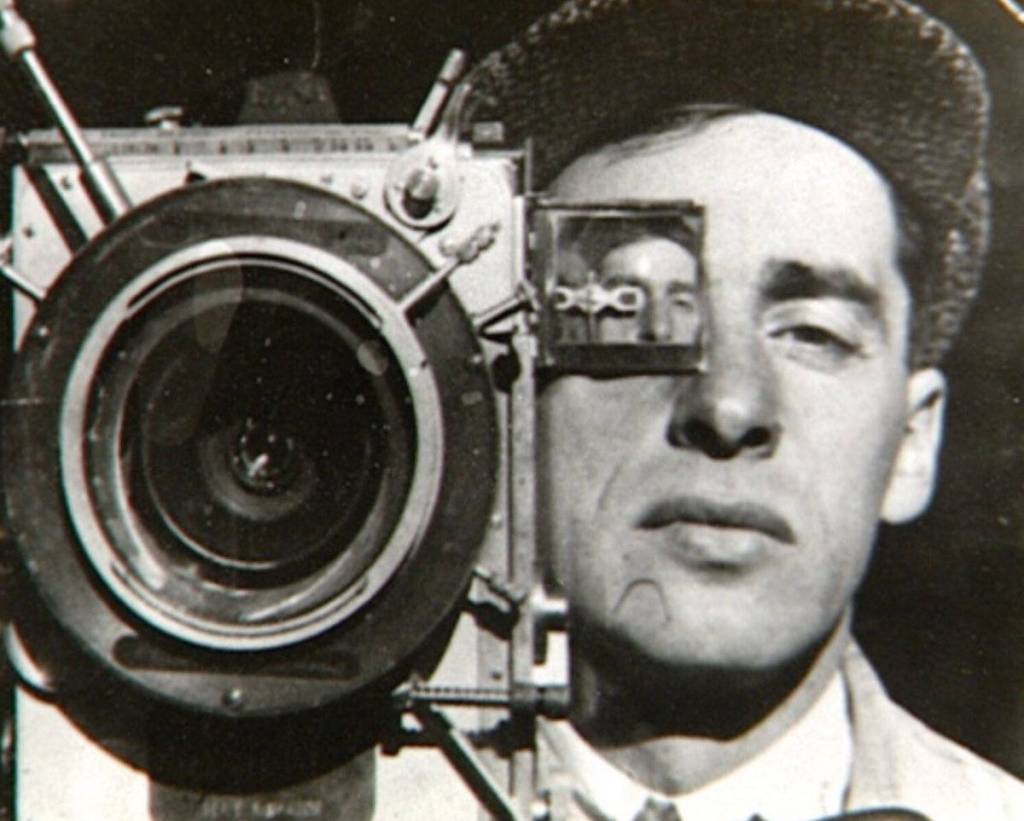
It’s hardly surprising that an industry devoted to mythmaking has long been fascinated with its own self-image. Movies about moviemaking are nearly as old as the medium itself, with “behind the scenes” comedies about Hollywood appearing as early as the 1910s. Viewpoints vary widely, however, ranging from valentines like Singin’ in the Rain and Day for Night to the lacerating wit of Sunset Boulevard and The Player.
10. Living in Oblivion (1995, dir. Tom DiCillo)
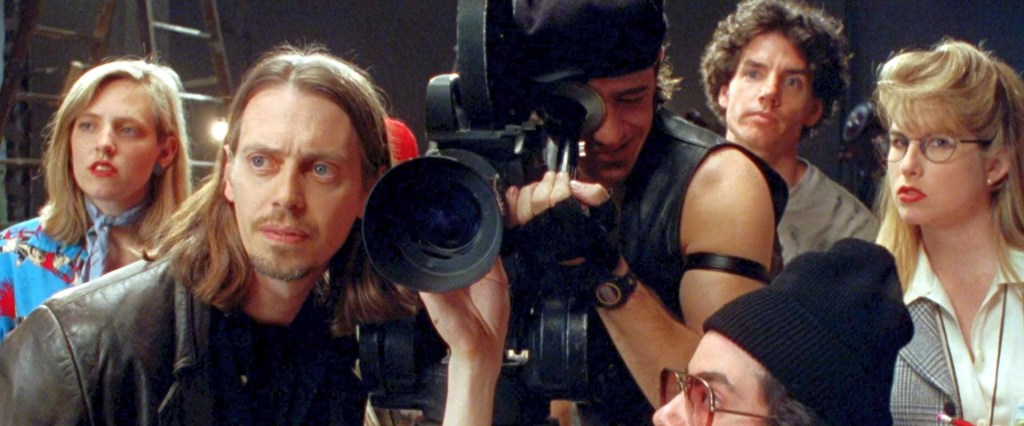
Indie filmmaker Tom DiCillo’s dismal experience with his first feature, Johnny Suede (1991), inspired this wry comedy where everything goes wrong in a low-budget movie shoot. Steve Buscemi plays director Nick Reve, suffering through a beleaguered production—a boom mic intrudes into a shot, a light explodes, actors flub lines—of film-within-a-film Living in Oblivion. “It’s all just one compromise and disappointment after another,” Nick ruefully tells a crew member by way of explaining what a director does. Catherine Keener and James LeGros are terrific as stars Nicole Springer and Chad Palomino, with the latter having great fun goofing on a specific breed of narcissistic heartthrob. Because Brad Pitt had starred in Johnny Suede, there was speculation that he was the basis for the character, rumors that DiCillo has long denied. In fact, Pitt was initially set to play Palomino, but had other commitments. Living in Oblivion is an underseen and affectionate look at chaos among creatives.
9. Irma Vep (1996, dir. Olivier Assayas)
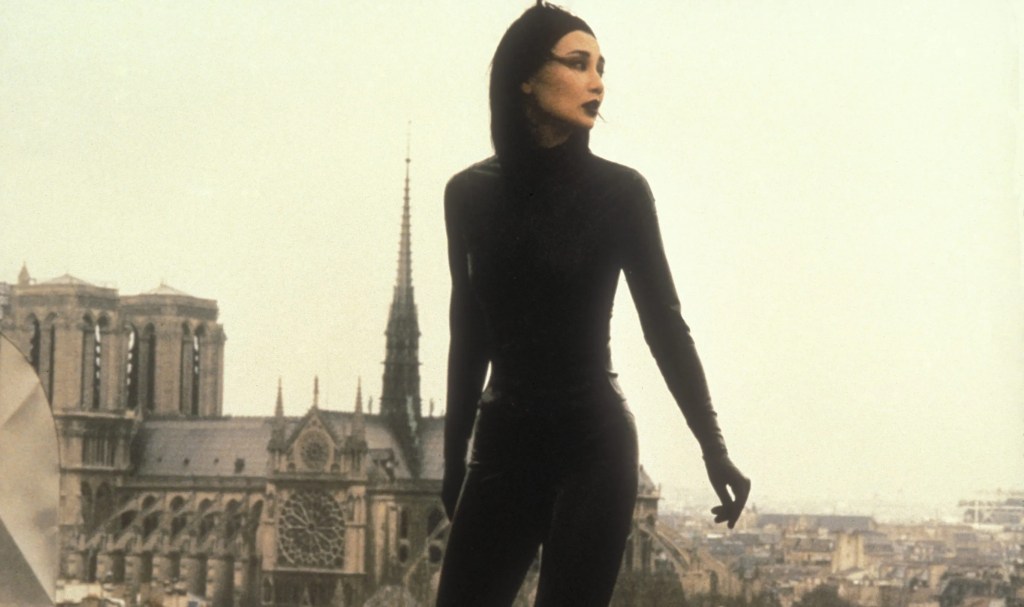
Irma Vep is Olivier Assayas’ gentle riff on French cinema and the agreeable bustle of moviemaking. Maggie Cheung, one of Hong Kong cinema’s biggest international superstars, plays herself. Past-his-prime director René Vidal (Jean-Pierre Léaud, see #7) has hired Cheung to play Irma Vep, the eponymous jewel thief in a remake of Louis Feuillade’s silent-era crime serial Les Vampires. René receives considerable pushback that a Chinese actress who doesn’t speak the language is portraying a French film icon, but the director contends Cheung is ideal for the part. “You are mysterious like Irma Vep,” he tells her. “You are beautiful like Irma Vep, and also you’re magic like her.” Ultimately, René adds, he was convinced by Cheung’s experience in action pictures. She sheepishly admits that she relied on stunt doubles in those pictures. The debate over Cheung’s casting reflects a weightier anxiety running throughout Irma Vep: whether French cinema can honor its traditions without becoming trapped by them. Away from the fictitious movie shoot, Cheung dons Irma Vep’s skintight, black latex costume to prowl around her Parisian hotel in search of expensive jewels. Assayas, who married Cheung—the real-life version—two years after Irma Vep, gives the proceedings a freewheeling, improvisational feel that enhances the self-reflexiveness of the exercise.
8. The Bad and the Beautiful (1952, dir. Vincente Minnelli)
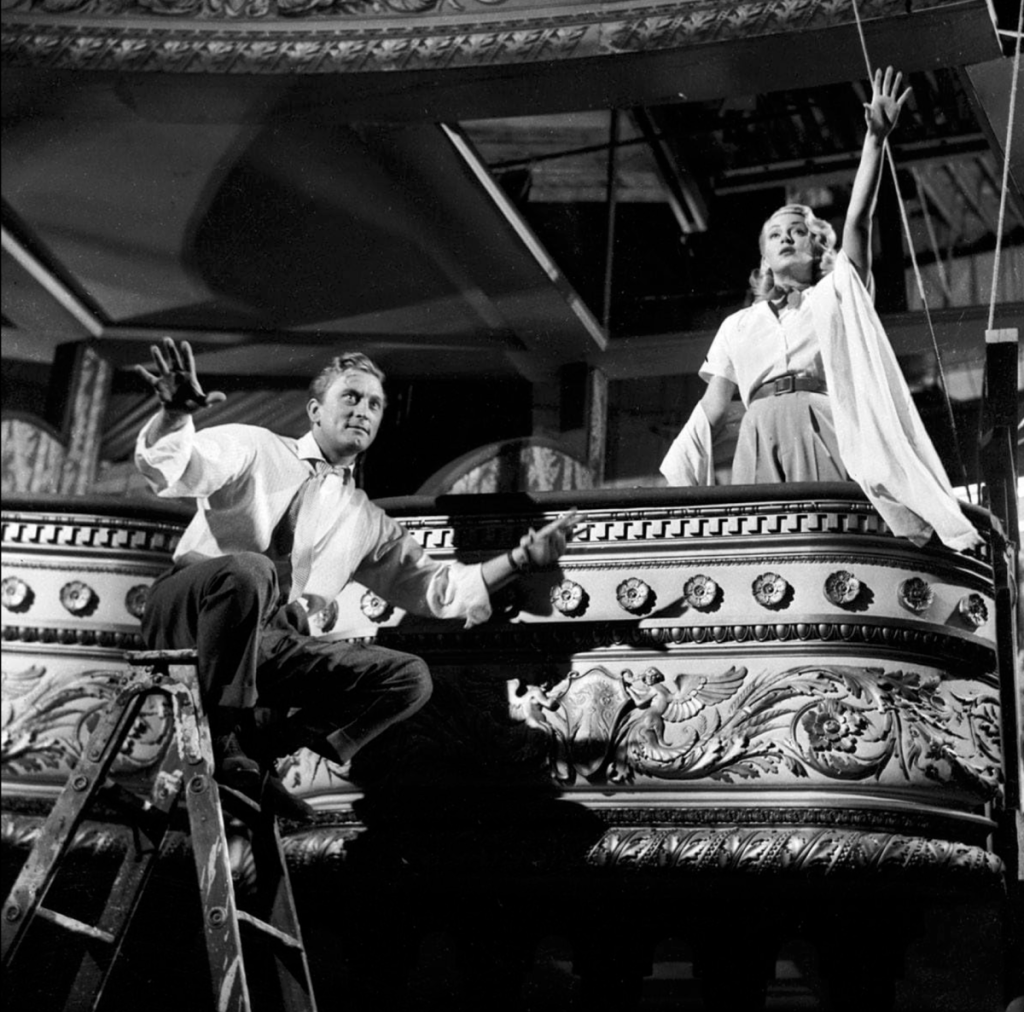
Since Vincente Minnelli knew the studio system well, his melodrama about Hollywood backstabbing and double-dealing naturally led to speculation about the inspiration for Kirk Douglas’ diabolical producer, Jonathan Shields. Some theorized it was David O. Selznick, but who’s to say? What is certain: The Bad and the Beautiful boasts a memorably charismatic monster in Jonathan, whose success hinges on betraying colleagues and, in the case of alcoholic starlet Georgia (Lana Turner), a lover. It’s the kind of role in which Douglas excelled. He and Turner are phenomenal, as are Barry Sullivan as a double-crossed director and Dick Powell as an exploited writer. It was Gloria Grahame, however, appearing briefly as Powell’s Southern-belle wife, who took home an Academy Award. Other Oscars went to Robert Surtees for his shimmering black-and-white cinematography and Charles Schnee for his venom-dripping script. The film is purportedly an insider’s view of Hollywood corruption, but, as Douglas Brode puts it in The Films of the Fifties, “The Bad and the Beautiful is as simplistic and garish as its title, and what it actually offers is an amalgam of fact and fantasy in which bits of truth and incredible distortions are inseparably welded into an elaborate cinematic artifice.”
7. Day for Night (1973, dir. François Truffaut)
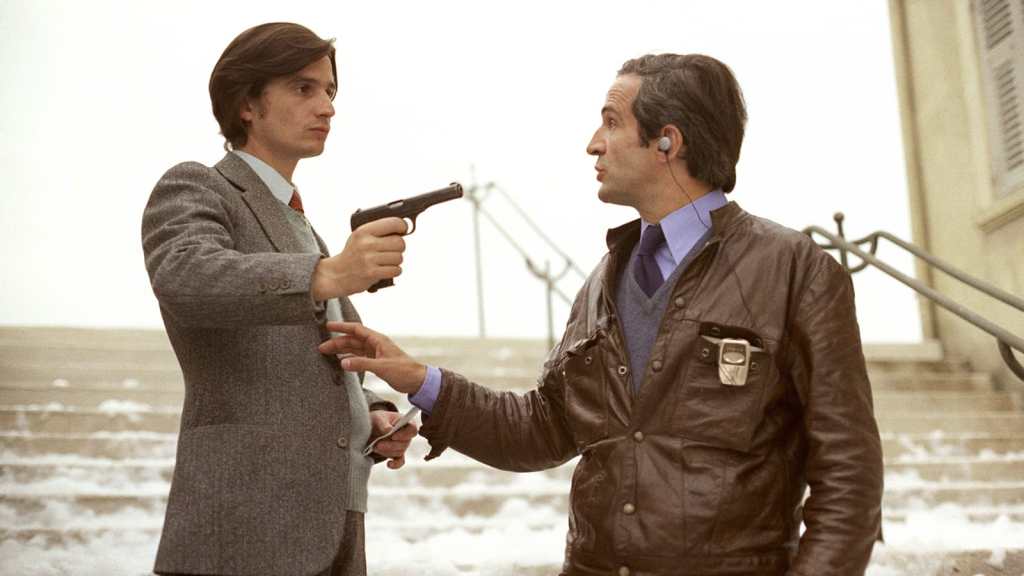
Day for Night’s scrappy celebration of moviemaking is catnip for film buffs, sure, but even casual fans might find the enthusiasm to be infectious. French New Wave stalwart François Truffaut takes on the role of director both behind and in front of the camera as Ferrand, a fictional filmmaker in the midst of shooting Je vous présente Paméla, or Meet Pamela, about a man falling in love with his son’s fiancée. “Movies are more harmonious than life,” says Ferrand, summarizing what might just be the thesis of Day for Night, where the offscreen romances, affairs, and grievances of Je vous présente Paméla’s cast and crew mirror the melodramatic complications onscreen. Truffaut’s strong cast includes terrific turns by Jacqueline Bisset and his longtime collaborator, Jean-Pierre Léaud (see #9). Winner of the Oscar for Best Foreign-Language Film, the picture embraces the simultaneous magic and absurdity of the medium. Although lauded by critics, it drew the ire of Truffaut’s fellow director Jean-Luc Godard, who fired off a letter accusing his longtime friend of being a sellout. The broadside prompted Truffaut to write back that “I feel it’s finally time to tell you, at length, that in my opinion you’re behaving like a shit.”
6. Hail, Caesar! (2016, dir. Joel Coen and Ethan Coen)
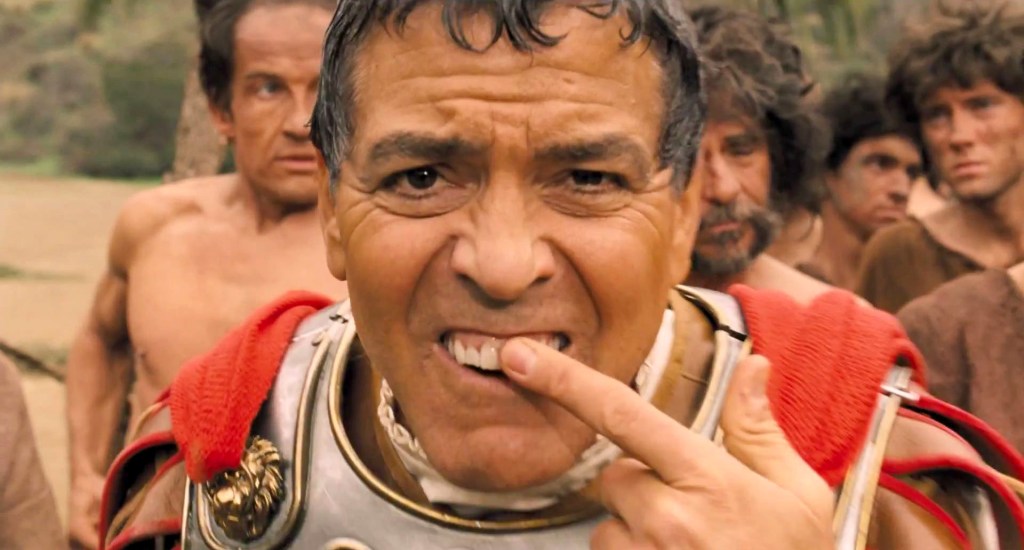
The films of Joel and Ethan Coen earned the brothers a well-deserved reputation as misanthropes (think Fargo, Barton Fink, or Burn After Reading), but they lighten up in this delightful mash note to 1950s Hollywood. The plot concerns Josh Brolin as Eddie Mannix, a studio “fixer” tasked with ensuring Capitol Pictures’ matinee idols are kept out of the scandal sheets. His latest challenge is tracking down Baird Whitlock (George Clooney), the lunkhead lead of a bible epic, Hail, Caesar! A Tale of the Christ, who has been kidnapped by blacklisted Communist screenwriters. What makes the Coens’ film such a blast are its pitch-perfect spoofs of genre pictures. Scarlett Johansson and Channing Tatum shine in respective takeoffs of Esther Williams and Gene Kelly-styled musicals. Best of all is Alden Ehrenreich as Hobie Doyle, a babyfaced, singing cowboy doing his darndest to fit into a sophisticated comedy of manners in which he has been cast. Hobie’s tortured attempts to wrap his folksy mouth around dialogue like “Would that it were so simple” while being coached by snooty director Laurence Lawrentz (Ralph Fiennes) is among the funniest scenes the Coens ever cooked up. Hail, Caesar! isn’t exactly warmhearted, but the filmmakers’ affection for their art informs every frame of this must-see for cinephiles.
5. Ed Wood (1994, dir. Tim Burton)
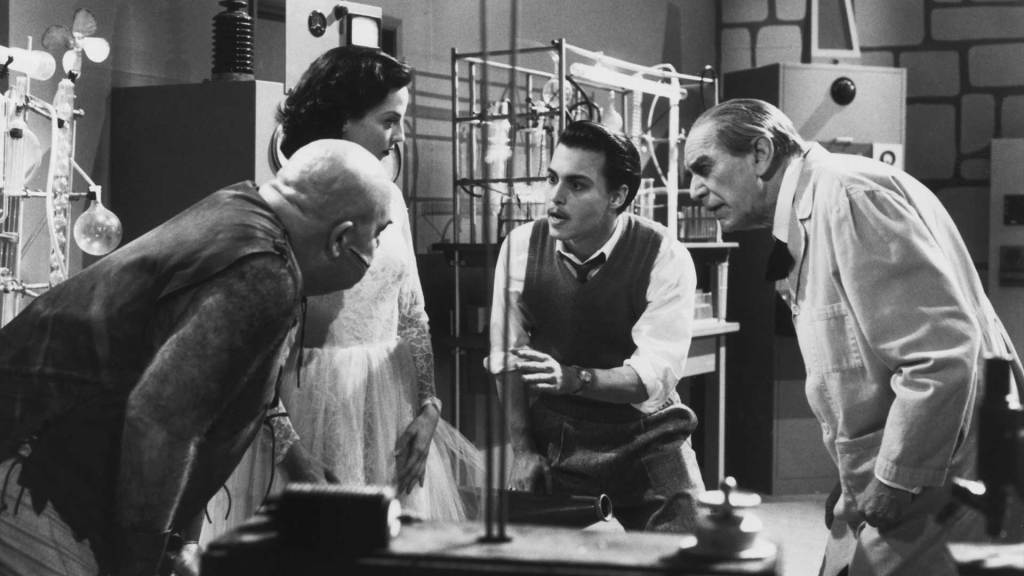
I have no idea if Edward D. Wood Jr., the man behind some of the most gloriously inept movies of the 1950s, was at all similar to how he is interpreted here by Johnny Depp. I hope he was, because this Ed Wood—maniacally optimistic, sweetly enthusiastic, and persevering in a way seemingly impervious to reality—is exactly how I would want him to be. Director Tim Burton and the screenwriting team of Scott Alexander and Larry Karaszewski capture the exuberance of chasing a dream, even when—or maybe especially when—it is beyond one’s abilities. In this case, that dream is making Grave Robbers from Outer Space, the original title of what became Plan 9 from Outer Space, a notoriously bad science-fiction clunker but nowhere close to the worst movie of all time, whatever some wags claim. Ed Wood covers much more than Ed’s 1959 magnum opus. His cross-dressing is played mainly for laughs, but the director’s friendship with Bela Lugosi (Martin Landau) is genuinely poignant. Landau rightly earned the Academy Award for Best Supporting Actor for his portrayal of Lugosi long after the Dracula star had devolved into morphine addiction. Sarah Jessica Parker, Patricia Arquette, and Bill Murray are also memorable in smaller roles. Filmed in lovely black and white by cinematographer Stefan Czapsky, Ed Wood somehow pokes fun at its subject without being cruel. A chance encounter between Ed and Orson Welles (Vincent D’Onofrio, see #4) at the Brown Derby, where they share their professional frustrations, could have been played as farce. Instead, the scene allows both filmmakers—one brilliant and disrespected, one not-so-brilliant and disrespected—their dignity, which is more than Hollywood ever did.
4. The Player (1992, dir. Robert Altman)
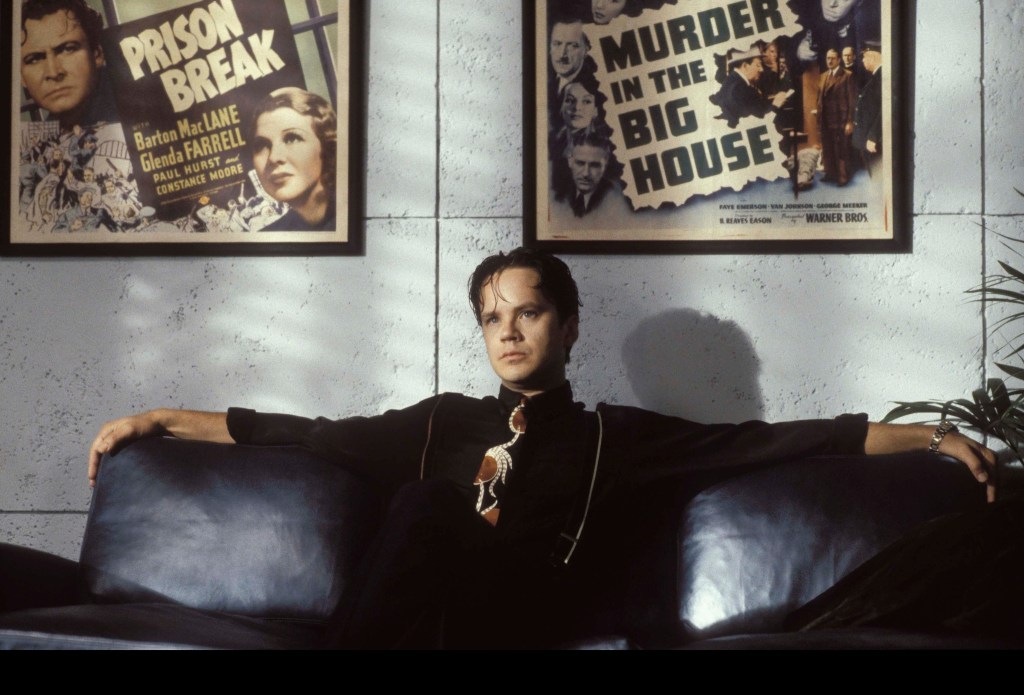
Robert Altman’s uneven commercial track record had made him a quasi-pariah with the big studios by the time he got hold of Michael Tolkin’s novel, The Player. The resulting film allowed Altman his revenge on Hollywood, painting most people in the movie business as craven, insecure, mean-spirited, disloyal, cutthroat, and woefully unimaginative—and those are just the positive traits. Tim Robbins plays Griffin Mill, a studio executive who accidentally kills a disgruntled screenwriter (Vincent D’Onofrio, see #5) whom he suspects of sending him death threats. It’s not a good time for Griffin, who is under suspicion from Pasadena homicide detectives—played by Whoopi Goldberg and Lyle Lovett, both clearly having a ball—while fending off rumors that he will be replaced by up-and-coming exec Larry Levy (Peter Gallagher). The storyline is secondary to the inside jokes, movie references, and Easter eggs that roast an industry where the bottom line is butts in seats. A parade of star cameos—Bruce Willis, Julia Roberts, Burt Reynolds, John Cusack, Anjelica Huston, and many more—heightens the picture’s sense of realism. The opening scene, a nearly 8-minute single shot that snakes through the studio lot, is a stunner that introduces the premise and key characters along with withering asides such as cliché-riddled movie pitches (“It’s Out of Africa meets Pretty Woman!”) and The Graduate screenwriter Buck Henry pitching a sequel where Mrs. Robinson has a stroke and must live with Benjamin and Elaine. The Player’s most wicked joke, however, is saved for its ultra-cynical ending.
3. Sunset Boulevard (1950, dir. Billy Wilder)
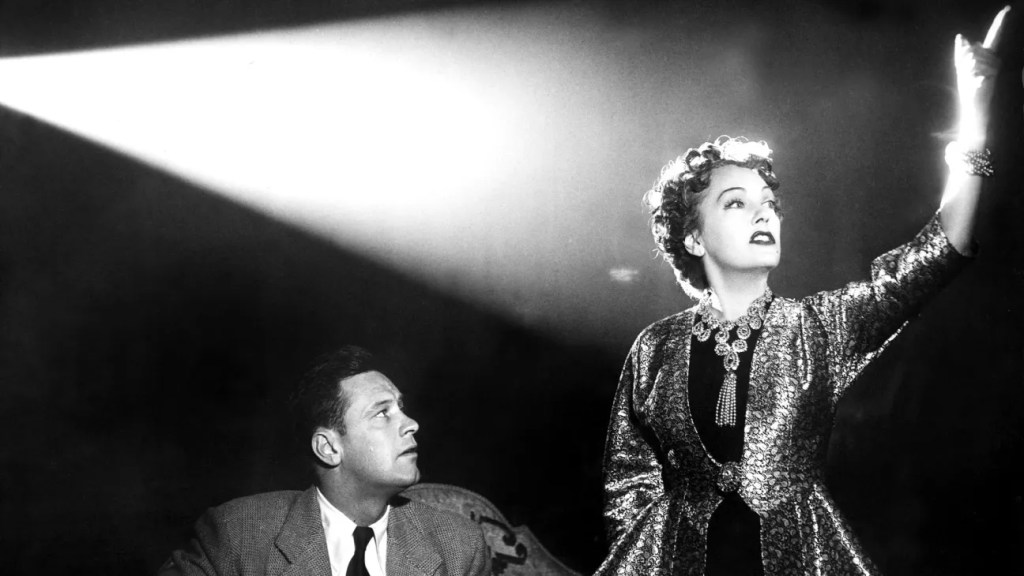
Billy Wilder’s idea for Sunset Boulevard stemmed from a single image: a dead body floating in a swimming pool. For Wilder and co-screenwriters Charles Brackett and D.M. Marshman Jr., the macabre visual encapsulated the movie business in all its California sun-drenched treachery. Silent-film star Gloria Swanson came out of retirement at age 49 to play Norma Desmond, a silent-film star but, unlike Swanson, one long forgotten by Hollywood. William Holden is Joe Gillis, a struggling young screenwriter who latches on to Norma shortly after he pulls onto her once-palatial estate while trying to dodge creditors. Rounding out the principal cast is the great silent-era director Erich von Stroheim, who had directed Swanson in 1929’s Queen Kelly, here playing silent-era filmmaker Max von Mayerling, once Norma’s husband and director, but now her dutiful butler shielding her fragile ego from a harsh reality. The meta-ness of it all is head-spinning—Norma, Joe and Max watch Queen Kelly in Norma’s private screening room—and that doesn’t even include Norma’s routine visits from silent-screen stars like Buster Keaton and Anna Q. Nilsson, whom Joe uncharitably labels “the waxworks.” At an early screening of Sunset Boulevard, MGM boss Louis B. Mayer told Wilder he should be run out of town for biting the hand that fed him. Wilder was unmoved. He reportedly answered with “fuck you” or “go shit in your hat”—accounts vary. The director and co-writer acquitted himself with 11 Oscar nominations, including wins for Screenplay, Art Direction, and Score. “In hindsight,” writes David Thomson in The Big Screen: The Story of the Movies, “Sunset Blvd. looks like the start of a new adulthood, or the peeling away of ‘Hollywood’ nonsense.”
(See more in The 15 best film noir.)
2. Singin’ in the Rain (1952, dir. Gene Kelly and Stanley Donen)
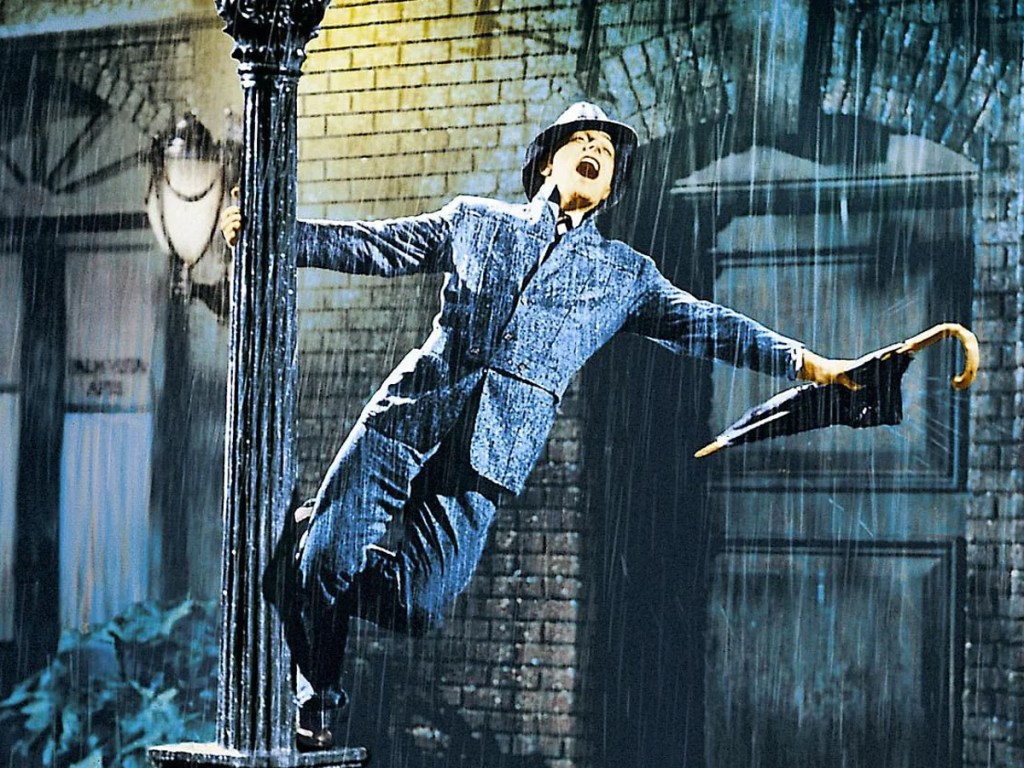
In addition to being arguably cinema’s greatest all-time musical, this ebullient MGM treasure is also a thoroughly enchanting satire of Hollywood’s bumpy transition from silent film to talkies. Gene Kelly gets many opportunities to flash his megawatt smile as 1920s matinee idol Don Lockwood, whose upcoming picture with starlet Lina Lamont (Jean Hagen) is hurriedly refitted to be a musical called The Dancing Cavalier after 1927’s The Jazz Singer launches the era of talkies. There’s only one hitch: Lina’s shrill, grating Brooklyn accent. Enter Kathy Selden, played by 19-year-old Debbie Reynolds, a budding actress who has captured Don’s heart. Don and his trusty sidekick Cosmo (Donald O’Connor) scheme for Kathy to surreptitiously dub in Lina’s voice (ironically, Betty Noyes dubbed vocals for Reynolds in two songs). Screenwriters Betty Comden and Adolph Green tweak the movie business from a loving (but knowing) place. Lina’s predicament is hardly far-fetched, as talkies ended the career of Clara Bow and other silent stars whose voices didn’t match their looks. But Singin’ in the Rain satirizes much more, from bruised egos to the tension between art and commerce. Kelly not only starred, but co-directed with Stanley Donen. “Gene was not afraid of ridiculing himself,” Green recalled. “He caught the spirit of the spoiled star and exploited it like mad.” Reynolds and O’Connor were likely less enamored, as Kelly’s exacting methods could be unkind. It is hard to argue with the results, though, with showstopper numbers like “Moses Supposes,” “Make ‘Em Laugh,” “Good Morning,” and, of course, that exhilarating, puddle-splashing title song.
1. 8½ (1963, dir. Federico Fellini)
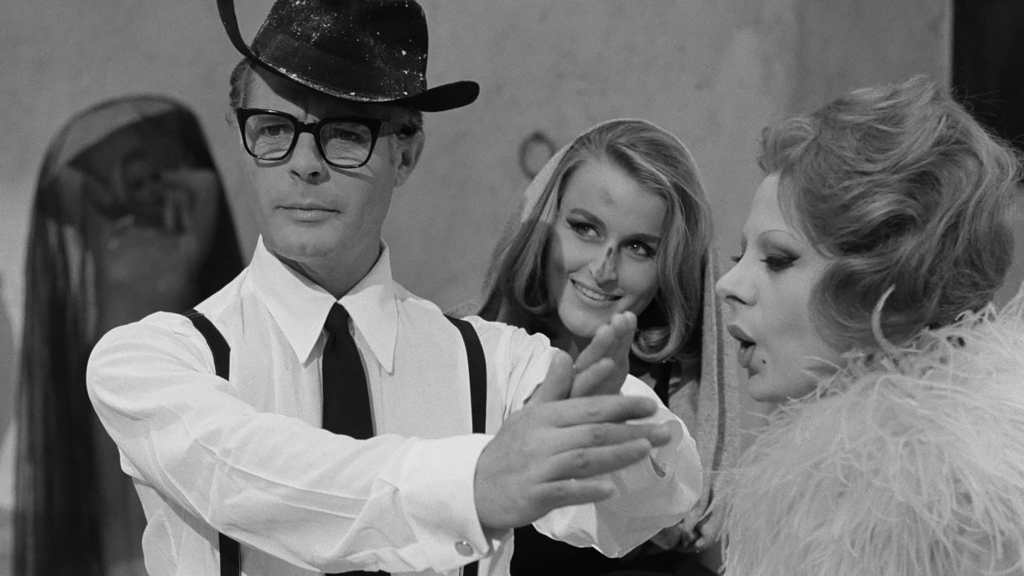
More about the mind of the artist than the artistic process per se, 8½ invites viewers into the playfully surreal headspace of its creator, Federico Fellini. Although he insisted the film was in no way autobiographical, its title alone suggests otherwise. By the time he made this masterpiece, Fellini had directed six features, co-directed one, and made two shorts—eight and a half works, for those keeping score. Marcello Mastroianni, Fellini’s spiritual doppelgänger, stars as Italian director Guido Anselmi. He is in the throes of a creative block while working on a picture he does not yet understand. Guido’s uncertainty is hardly alleviated by the producer, actors, crew, and various personalities who surround him at all hours. His bubbly mistress Carla (Sandra Milo) only frustrates him, as does his estranged wife Luisa (Anouk Aimée) and even his ideal woman (Claudia Cardinale) who flits in and out of his fertile fantasy life. Guido is a charmer—how could Mastroianni be otherwise?—but self-absorbed, sexist, and addicted to the chaos he cultivates. He is also unreasonably ambitious, trying to make a film that is about childhood, memory, religion, sex and fantasy—in short, everything. Fellini later explained that Guido lives simultaneously in three planes: the past, the present and the fantastical. “The blending of time and mental states continues throughout the film,” Hollis Alpert notes in Fellini: A Life. “The past intrudes into the present, the present into the past, imaginings into one or the other.” That approach imbues 8½ with something of a frenetic, carnival-like atmosphere, but not one that feels overstuffed. Fellini is an adept juggler; from Gianni Di Venanzo’s gorgeous black-and-white cinematography to Nino Rota’s intoxicating score, the production is impeccable. “It is not only a film about the cinema,” wrote French critic Christian Metz, “it is a film about a film that is presumably itself about the cinema.”
(See more in The 10 best films about memory and The 10 best films about dreams.)
Honorable mention: Adaptation. (2002, dir. Spike Jonze), Babylon (2022, dir. Damien Chazelle), Barton Fink (1991, dir. Joel Coen), The Big Knife (1955, dir. Robert Aldrich), Camera Buff (1979, dir. Krzysztof Kieślowski), Contempt (1963, dir. Jean-Luc Godard), The Disaster Artist (2017, dir. James Franco), The Fabelmans (2022, dir. Steven Spielberg), Gods and Monsters (1998, dir. Bill Condon), Hollywood Boulevard (1976, dir. Allan Arkush and Joe Dante), Hollywood Shuffle (1987, dir. Robert Townsend), State and Main (2000, dir. David Mamet), The Stunt Man (1980, dir. Richard Rush), Sullivan’s Travels (1941, dir. Preston Sturges), Tropic Thunder (2008, dir. Ben Stiller)
 Cutting to the Chase with Phil Bacharach
3 responses to “The 10 best films about filmmaking”
[…] When Billy Wilder and writing partner Charles Brackett first drafted what became Sunset Boulevard, among the first images they wanted was that of a dead body floating in a pool: death in paradise. But they took the concept further, making that corpse the narrator and, thus, the audience’s point of entry. The story of Hollywood narcissism and cruelty features former silent-screen star Gloria Swanson as—in a feat of meta casting—an aging silent-film queen. The similarities between the actress and her character ended there, although Swanson, whose performance earned an Oscar nomination, bemoaned afterward that audiences confused the two. As Norma Desmond, Swanson is a wild-eyed, nostril-flaring force of nature; her reclusive star is lost in a reverie of past glories that are kept alive by her faithful butler and ex-husband, Max von Meyerling (Erich von Stroheim). That hermetically sealed universe is upended when down-on-his-luck screenwriter Joe Gillis (William Holden) stumbles onto Norma’s decaying mansion while outrunning creditors. In the darkly comic Sunset Boulevard, Wilder, Brackett, and co-writer D.M. Marshman Jr. give the movie business itself the most withering of close-ups. Hollywood is the film’s ultimate femme fatale. (See more in The 10 best films about filmmaking.) […]
LikeLike
[…] It wasn’t a leap for one of the leading directors of the silent screen to play a leading director of the silent screen, but Erich von Stroheim is better than superb as Sunset Boulevard’s Max von Meyerling. He plays the current butler/ex-husband/ex-director of faded silents star Norma Desmond, portrayed by Gloria Swanson. Billy Wilder had already directed Stroheim once before—as Field Marshal Rommel in Five Graves to Cairo (1943)—but this inspired meta-casting resonates on multiple levels. Like Norma, Stroheim (Greed, Foolish Wives) was a casualty of Tinseltown’s transition away from silent cinema, his career derailed by battles with studios over artistic control and elephantine budgets. That shared history lends Stroheim’s every glance toward Swanson the melancholy of lived experience. Wilder also layers in additional irony. Stroheim had directed Swanson in the unfinished Queen Kelly (1929), footage from which appears here as one of Norma’s old films that she screens for her young gigolo (William Holden). Swanson ultimately fired Stroheim on that project. He held a grudge against her for years, but Sunset Boulevard transformed that unhappy history into one of Hollywood’s most ingenious casting choices.(See more in The 15 best film noir and The 10 best films about filmmaking.) […]
LikeLike
[…] Few openings announce a film’s fatalism more elegantly.(See more in The 15 best film noir, The 10 best films about filmmaking and The 10 best performances by film […]
LikeLike