
Ethan Hawke somehow seems a natural fit for any time period. In The Weight, set in 1933, the actor’s face—lean and angular, his eyes conveying perpetual anguish—could belong to someone in one of Dorothea Lange’s celebrated photographs from the Great Depression. It’s a somber face, well suited to a role that is something of a departure. Hawke has specialized in characters known for their verbal dexterity (see Richard Linklater’s Before trilogy or the actor’s Oscar-nominated performance in Linklater’s Blue Moon), but The Weight demonstrates that he also excels as the strong, largely silent type.
Hawke plays Samuel Murphy, a widower doing his best to raise his small daughter, Penny (Avy Berry), while the fates seem to conspire against him. First, Murphy and Penny are evicted from their apartment while they are at Sunday church service. They are searching for new lodging when Murphy is jumped by a sketchy group of men. He defends himself but learns the hard way that the men on the business end of his fists are undercover police officers. Murphy is imprisoned and sent to an Oregon labor camp. Penny is shipped off to a home for wayward children, where she will become eligible for adoption before her father’s sentence is up.
At the camp, Murphy catches the attention of the quietly menacing Warden Clancy (Russell Crowe), who recognizes the man’s innate intelligence and leadership potential. Prison-movie tropes being what they are, we brace for Clancy to take the inmate down a few pegs. Instead, he offers Murphy an intriguing deal. President Franklin D. Roosevelt has ordered Americans to surrender most privately held gold to the Federal Reserve in an effort to move the country away from the gold standard. Clancy says a mining operation in the region needs to move its gold before it is seized by thieves trying to beat federal agents to the punch.
The warden and a mining supervisor named Taggart (Alec Newman) want Murphy and three other prisoners of his choosing to smuggle gold bars through the Oregon wilderness to make a drop in six days. If Murphy completes the mission, Clancy promises him an early release in time to get Penny back before he loses custody.
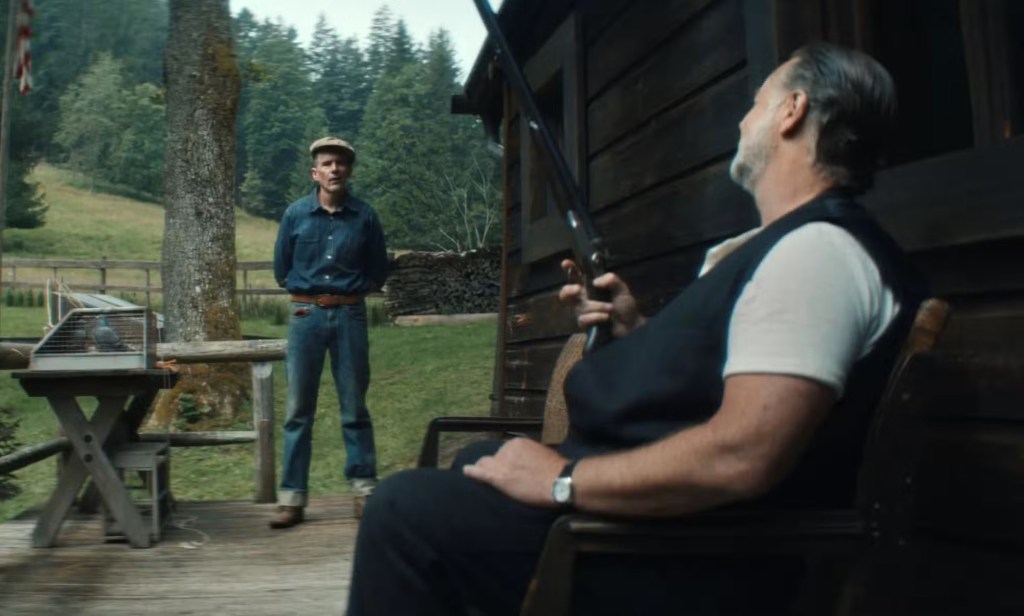
The proposal sounds fishy to Murphy, but he has little choice. “I want my daughter,” he tells Clancy in a raspy growl. He selects his crew: a socialist (Avi Nash), a Scandinavian immigrant (Lucas Lynggaard Tønnesen) and a racist loudmouth (Austin Amelio). Accompanied by two armed goons from the mining company, the group is soon joined by an Indigenous woman, Anna (Julia Jones), who is determined to find a better life for herself.
Their 100-mile trek is a grueling ordeal, from raging rivers to an encounter with a twitchy stranger (Cameron Brady) who wants to know what the crew has in their heavy backpacks. The setting may be the 1930s, but The Weight is clearly summoning the bare-knuckled tension of 1970s thrillers such as Sorcerer and Deliverance. In one excruciatingly suspenseful scene, the group must cross a crumbling rope bridge by tossing the bars, one by one, to Murphy, who is precariously stationed at the bridge’s midpoint.
The Weight is a remarkable feature directorial debut for Padraic McKinley, a veteran film editor and producer who has crafted a muscular, earthy and often riveting movie. Cinematographer Matteo Cocco captures the beautiful but treacherous landscapes (Bavaria substituting for the Pacific Northwest), while the score by Shelby Gaines—who co-wrote the screenplay—and his brother Latham is effectively discordant.
The cast is uniformly strong. Crowe continues to shine in a new chapter as a character actor, while Jones has a fierce presence in a comparatively underwritten role. Much of the film rests on Hawke’s shoulders. If the character is a bit too capable—engineering, automotive repair, survival skills, you name it—Hawke imbues Murphy with a solemn desperation that keeps him grounded. That seems fitting for a film titled The Weight.
Check out the trailer here.

