The directorial collaboration between documentary filmmaker Lance Oppenheim (Some Kind of Heaven) and television’s reigning provocateur, Nathan Fielder, is ostensibly a movie about Elizabeth Holmes, the disgraced former tech mogul who built Theranos into a multibillion-dollar company. And You Can See Everything is about Holmes—at least in part—albeit without rehashing the fraud that made her a paper billionaire, cost investors hundreds of millions of dollars, and landed her a 2022 conviction.
But the film wrestles with a helluva lot more than Holmes and her life partner, Billy Evans. Over its nearly three-hour (but never less than riveting) runtime, You Can See Everything raises questions about documentary filmmaking, celebrity culture, voyeurism, codependency, the nature of truth and the slipperiness of language. It might just be the most intellectually stimulating and wildly entertaining documentary I’ve seen since—well, I don’t know when.
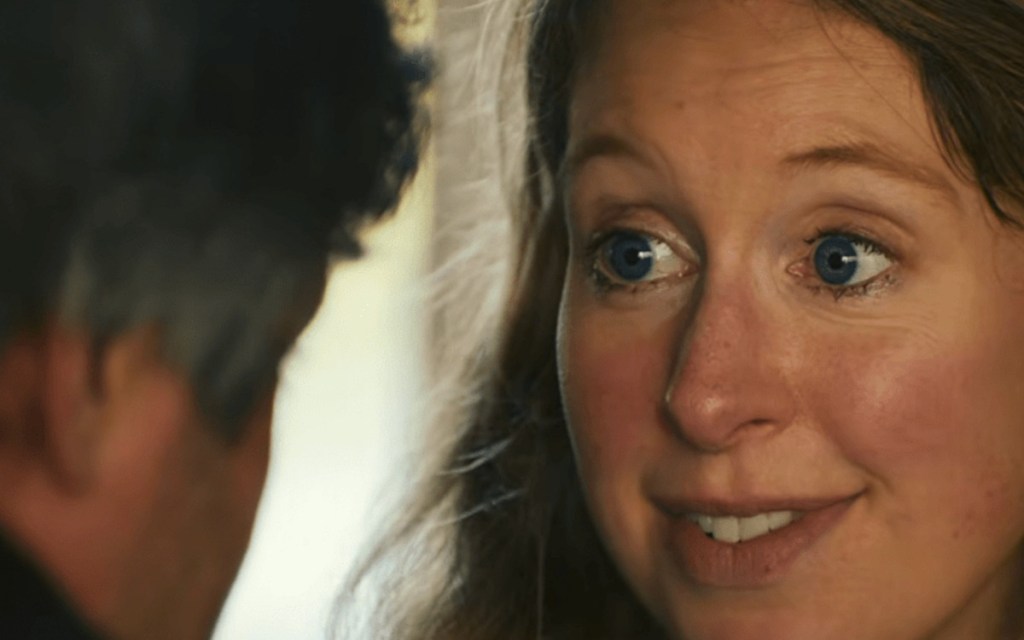
Holmes and Evans gave the filmmakers unprecedented access to their lives in the 34 days before Holmes began serving an 11-year prison sentence. Employing the extreme closeups that are a staple of Oppenheim’s style, the movie observes the couple hanging out in a rented beachfront home in San Diego. Holmes and Evans play with their two small children, frolic in the Pacific Ocean and, of all things, work to raise capital for a Theranos 2.0. They are routinely joined by Fielder, who eventually moves into a guest bedroom. In one of numerous memorable moments, he shows them snippets of the Hulu series The Dropout, which earned actress Amanda Seyfried an Emmy for her portrayal of Holmes.
Fielder’s genius goes well beyond his mastery of cringe comedy. He turns Abbott and Costello’s “Who’s on First?” routine and an anecdote about magician David Blaine into piercing instruments of revelation. He also continually peppers Holmes and Evans with questions—often skeptical if not hostile—that aim to strip away the psychological armor we all wear. Early in the film, they are all in the kitchen when Evans quietly takes over the eggs Holmes is whisking. Fielder calls him on it. Later, Evans and Fielder are having a conversation when Evans stops himself mid-sentence and admits his mind wandered. Fielder wants to know what the man was thinking about. He doesn’t let up.
Among Holmes’ more breathtaking claims is her insistence to Fielder that she has never intentionally told a lie. He is understandably dubious. “Liz, really?” Fielder asks, pressing her on whether she has ever told even a white lie.

Then the 34 days run out. Holmes enters federal prison in Texas, where the family relocates to be near her. It’s the end of her freedom but not the end of the story.
Cut to two years later, and You Can See Everything veers into some splendidly mind-bending realms. Anyone who wants to tell you about it beforehand is an asshat.
Lies and truth, memory and documentation, fiction and reality—these distinctions continually collide throughout You Can See Everything, which makes seeing anything but believing. It’s a theme that has obsessed Fielder since his childhood fascination with magic tricks. His television work on The Rehearsal and Nathan for You poked at the notion of objective truth, but here Fielder and Oppenheim take a bat to that piñata.

Another newly released documentary, Alex Gibney’s Musk, takes a more conventional path. If anyone warrants a nearly four-hour documentary, it’s probably the world’s first trillionaire, whose influence spans many of the 21st century’s defining conflicts in technology, economics and politics. Elon Musk is a mighty big subject, and covering the key chapters of his life—taking over Tesla, founding SpaceX, turning Twitter into X, and becoming a key ally of President Trump in his second term—requires some time.
Musk is a wide-ranging profile of the man who has been revered as a world-class innovator and reviled as a supervillain. While compelling and brisk throughout, it offers little new information and only limited insight into its subject’s inner life. Gibney’s use of an AI-created Musk avatar to spout things the mogul has previously stated publicly is more annoying than edifying.
Musk himself declined an interview with the Oscar-winning documentarian whose résumé includes Enron: The Smartest Guys in the Room, Taxi to the Dark Side and Going Clear: Scientology and the Prison of Belief. Instead, he took to X to call Gibney “a douche.”
It’s fair to say Gibney holds Musk in similar esteem.
The film’s second half (there is an intermission) shifts from Musk’s entrepreneurial conquests to his ascent as a political power. Gibney examines how Musk’s leadership of Trump’s DOGE initiative not only dismantled USAID but also weakened federal oversight of Musk’s business interests.
“What are his motivations, and do we even know this man at all?” asks Ashley St. Clair, a former girlfriend and the mother of one of Musk’s many children. “Elon is a nuke.” Musk may remain as elusive at the picture’s end as at the beginning, but the film makes a clear case that his concentrated power poses a serious danger.

