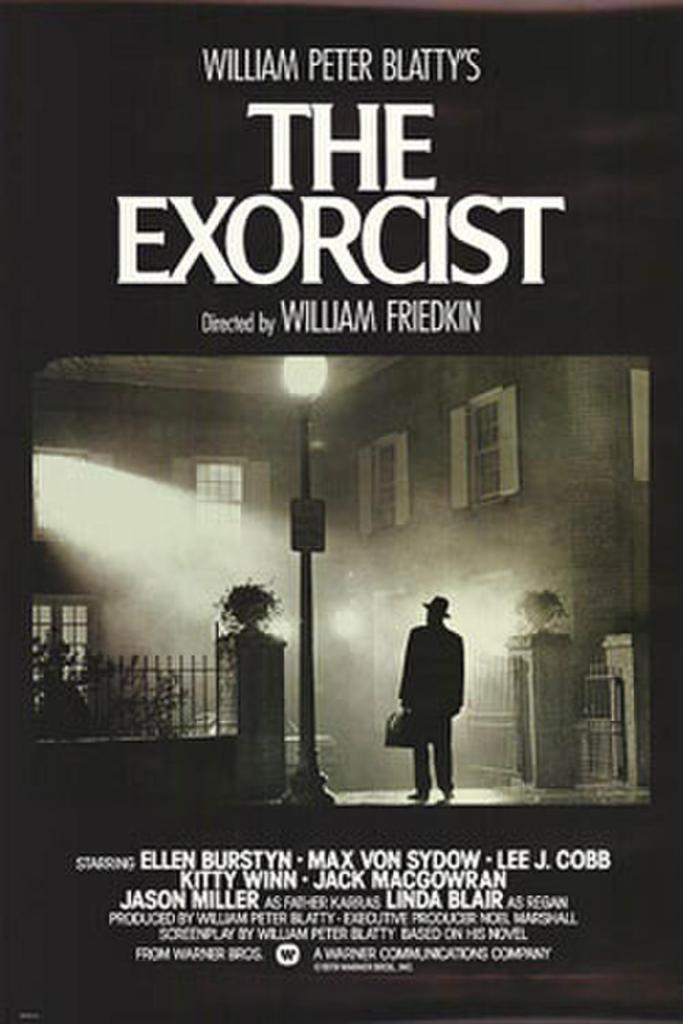
Even 50 years after audiences got the holy bejesus scared outta them in packed movie theaters, The Exorcist remains, in my estimation, one of the most frightening films ever made. Released the day after Christmas in 1973, it almost immediately leapt from blockbuster to cultural phenomenon, fueled by reports at the time of some moviegoers throwing up and even fainting as a result of the grotesqueries onscreen. When the hype finally cleared, what remained was a meticulously crafted horror film about demonic possession, but a story malleable enough to be an all-purpose allegory.
Based on a 1971 novel by William Peter Blatty, who also penned the screenplay, The Exorcist poses a nastily straightforward premise: Sweet 12-year-old Regan MacNeil (Linda Blair) becomes possessed by the Devil. The girl’s increasingly erratic behavior understandably alarms her single mother, movie actress Chris MacNeil (Ellen Burstyn), but the breaking point arrives when Regan masturbates with a crucifix and smacks mom clear across a bedroom.
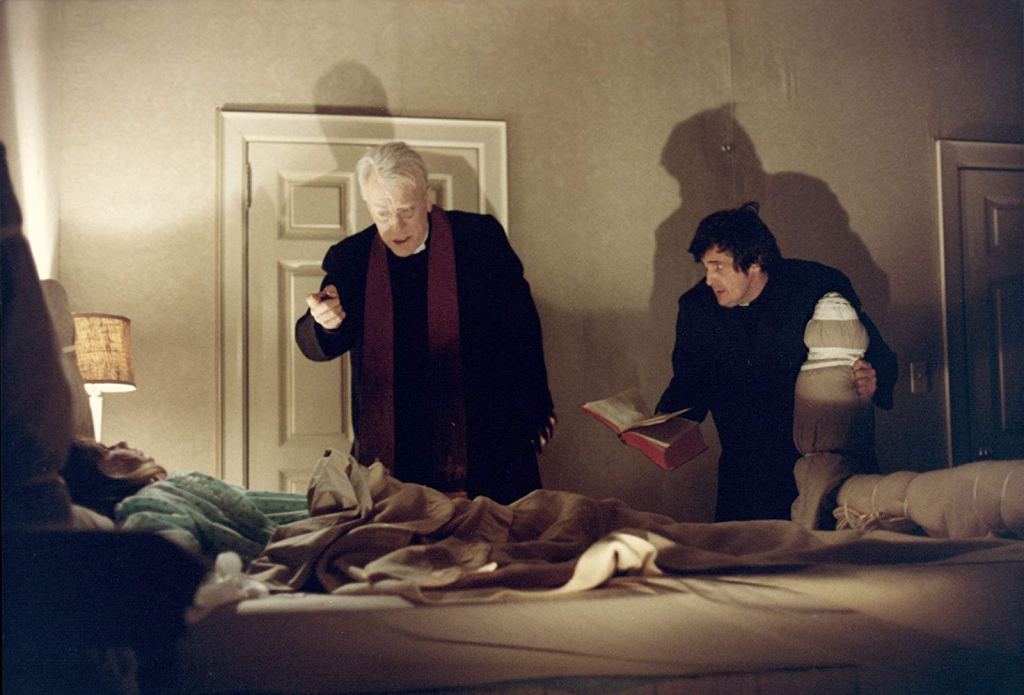
After a battery of medical tests fails to find anything wrong with Regan, Chris wonders if her daughter is suffering from a psychotic delusion that she has been taken over by demons. Desperate for any sort of explanation, mom enlists the help of a brooding neighborhood priest, Father Damien Karras (Jason Miller). In turn, Karras summons a veteran exorcist, Father Lankester Merrin (Max von Sydow), to rid the evil spirit from the child’s body.

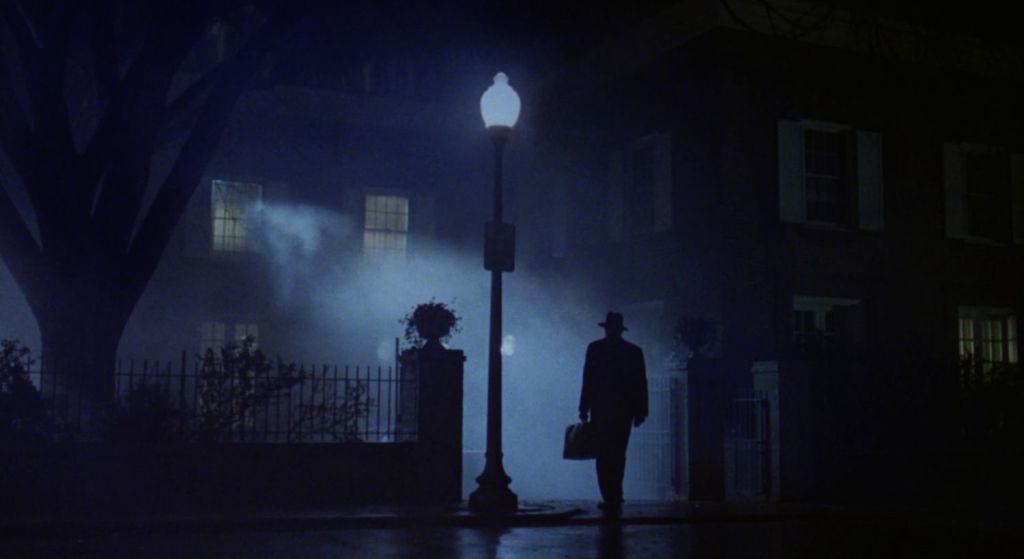
What emerges is a horror masterpiece. Director William Friedkin fashions a relentlessly threatening atmosphere by treating the subject with documentary-styled seriousness. All the elements integrate beautifully. Cinematographer Owen Roizman captures truly iconic images amid the Georgetown, Washington, D.C., locale, while Mike Oldfield‘s “Tubular Bells” is put to spellbinding use. The movie garnered 10 Oscar nominations, winning Best Screenplay Adaptation and Best Sound. Friedkin took home the Golden Globe for Best Director.
While the movie spawned a deluge of imitators, The Exorcist transcended its genre. Its elegant pace builds tension with scalpel-like precision. Granted, the wizardry of today’s special effects has rendered a few scenes (particularly Regan’s head-spinning trick) cheesy, but such moments do not dilute the creepiness.
The cast is uniformly excellent. Miller is particularly haunting in a role that had attracted interest from the likes of Paul Newman and Jack Nicholson. Friedkin had insisted on an unknown actor unfettered by audience expectations, and it was the right move.
Miller is not alone. The movie added considerably to Burstyn’s rising star, made Linda Blair a household name (a celebrity she squandered) and even provided a plum minor role for Lee J. Cobb as a cinehile police detective.
Catholic dogma permeates the good vs. evil struggle at the core of The Exorcist, but you don’t have to be Catholic to be genuinely spooked. The movie reaches past its theological underpinnings to poke any number of fears. Stephen King, in his 1981 treatise on horror, Danse Macabre, posited that the “foul-talking monster” that is Regan exploited the generational divide of the time. “Religious trappings aside, every adult American understood what the film’s powerful subtext was saying; they understood that the demon in Regan MacNeil would have responded enthusiastically to the Fish Cheer at Woodstock,” King wrote.
That read certainly makes sense, but I think The Exorcist taps other societal anxieties. In Easy Riders, Raging Bulls, for example, author Peter Biskind contends many women hated the movie because it depicted “a male nightmare of female puberty” that literally demonized female sexuality.
As for me, what works most effectively is The Exorcist‘s central notion of losing control of one’s self: physically, mentally and spiritually. What could be scarier than that?
 Cutting to the Chase with Phil Bacharach
3 responses to “The Exorcist (1973)”
Hands down the scariest film I’ve ever seen. THE POEER OF CHRIST COMPELS YOU!!!!
LikeLike
[…] Martin Scorsese4. Amarcord, director: Federico Fellini3. Charley Varrick, director: Don Siegel2. The Exorcist, director: William Friedkin1. American Graffiti, director: George […]
LikeLike
[…] the joke. Letts’ first stage play rolls around in the muck, and Friedkin, the director of The Exorcist and Cruising, isn’t one to shy away from pushing boundaries. Violent and gleefully depraved, […]
LikeLike