Long before the profession of journalism became a casualty of the culture wars, movies about reporters tended to depict them as stalwart crusaders for the people’s right to know or as doughy cynics in ill-fitting suits who chainsmoke, drink from flasks and wisecrack throughout the day.

Journalism flicks have evolved over the years as the public’s view of the profession has grown more ambivalent. These are my picks for the 10 best.
10. The Paper (1994, dir: Ron Howard)
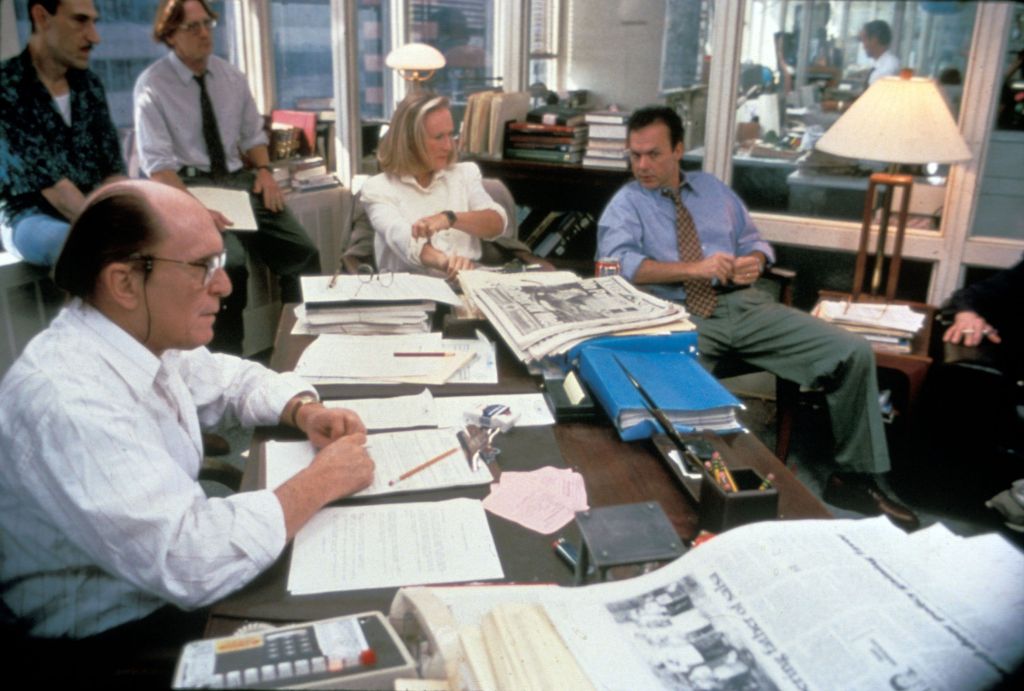
This loving ode to the newspaper business is among Ron Howard’s more finely calibrated crowd-pleasers. Michael Keaton is Henry Hackett, an editor for the fictitious New York Sentinel, on a pivotal day in his career. He must decide between remaining with his scrappy tabloid or accepting a job offer for better money from a highfalutin paper across town. His pregnant wife (Marisa Tomei) thinks the choice should be obvious, but Henry isn’t so sure. The Paper’s screenplay, by brothers David and Stephen Koepp, is a tidy balance of comedy and drama, and it offers plenty of room for its impressive cast—including Glenn Close, Robert Duvall and a pre-crazy Randy Quaid—to shine. The film is a wistful reminder of a time when newspapers thrived.
9. Medium Cool (1969, dir: Haskell Wexler)
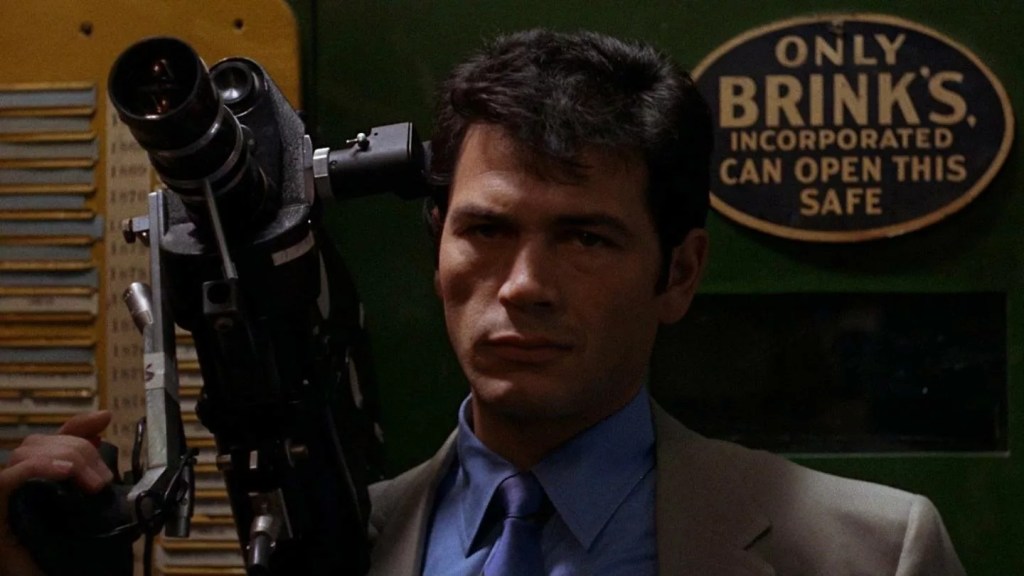
Cinematographer Haskell Wexler had lensed his share of landmark films by the time he tried his hand at directing. His first and only narrative feature, Medium Cool, is a bracingly experimental blurring of fact and fiction. It follows a television news cameraman, played by Robert Forster, as he drifts through the cataclysmic news events of 1968, most notably the chaos and bloodshed that erupted on the streets of Chicago at that year’s Democratic National Convention. Wexler fashion a fictional narrative around an aesthetic commitment to cinema vérité and commitment to capturing unfiltered reality. Our introduction to Forster’s character is pungent; he and his sound man (Peter Bonerz) are dutifully filming a grisly traffic accident before they bother to think about calling for an ambulance. The dichotomy between what we see and how we register it intellectually and emotionally is at the heart of Medium Cool.
8. Shattered Glass (2003, dir: Billy Ray)
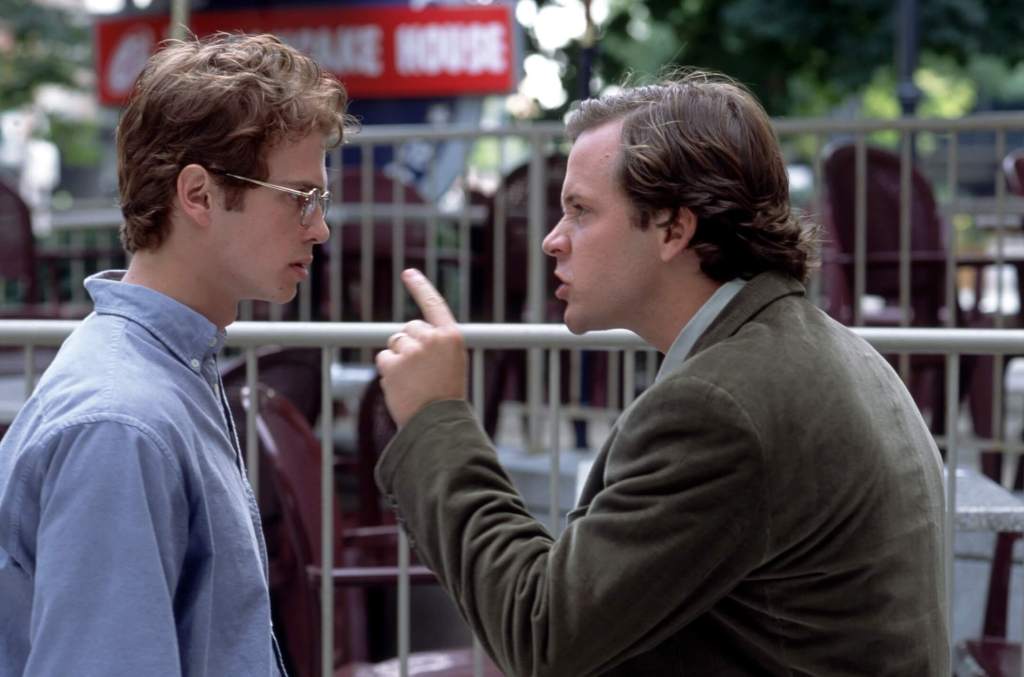
New Republic magazine star reporter Stephen Glass sniffed out the kind of wild human-interest stories that seemed too weird to be true, and for good reason. He made them up. A Forbes article in 1998 eventually exposed the hotshot reporter to be a pathological fabricator who had invented many of his pieces. Writer-director Billy Ray details that real-life scandal in this absorbing drama. Hayden Christensen, a dud as young Anakin Skywalker in the Star Wars prequels, is startlingly perfect as Glass, whose “are you mad at me?” mantra masks a shrewd manipulator. Peter Sarsgaard is equally strong as Charles Lane, the New Republic editor who weathered the storm. Shattered Glass predates a social media revolution that would make it easier for others like him to lie in plain sight.
7. Good Night, and Good Luck (2005, dir: George Clooney)
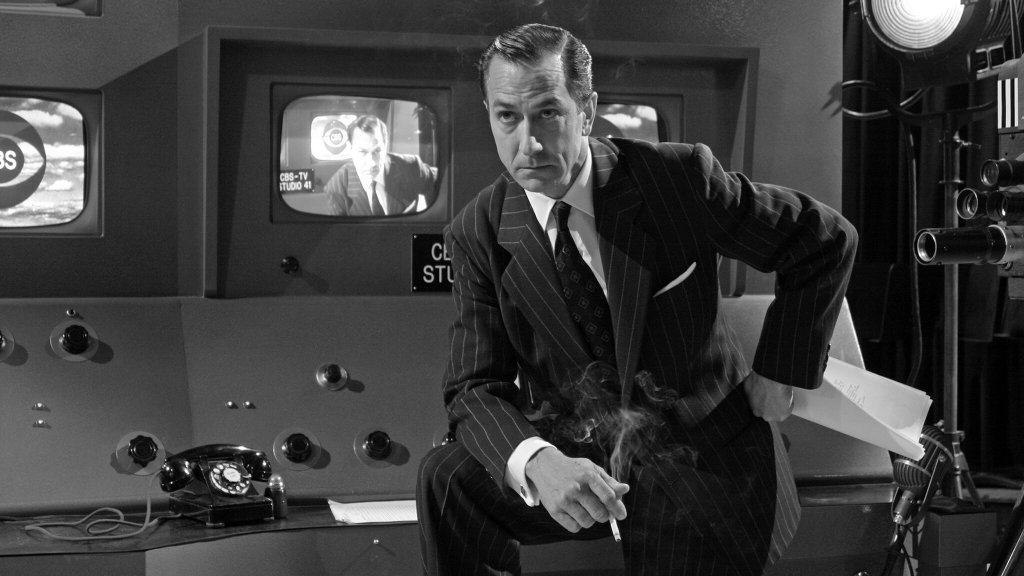
George Clooney’s sophomore outing as a director turned to the story of broadcast journalist Edward R. Murrow and his 1954 on-air takedown of Wisconsin Sen. Joseph McCarthy and his anti-communist witch hunts. Accomplished character actor David Strathairn was born for the role of Murrow, and he portrays the CBS News icon as a plainspoken beacon of Fourth Estate courage. Shot in crisp black and white and cleverly showing only archival footage of McCarthy, Good Night, and Good Luck (the title comes from Murrow’s signature sign-off) is steady and elegantly understated. Clooney and co-writer Grant Heslov modified their screenplay for the Broadway stage in 2024, with Clooney taking on the Murrow role. It is more than a little dispiriting that the film now feels like such a relic from a time when the press was both brave and influential.
6. The Insider (1999, dir: Michael Mann)
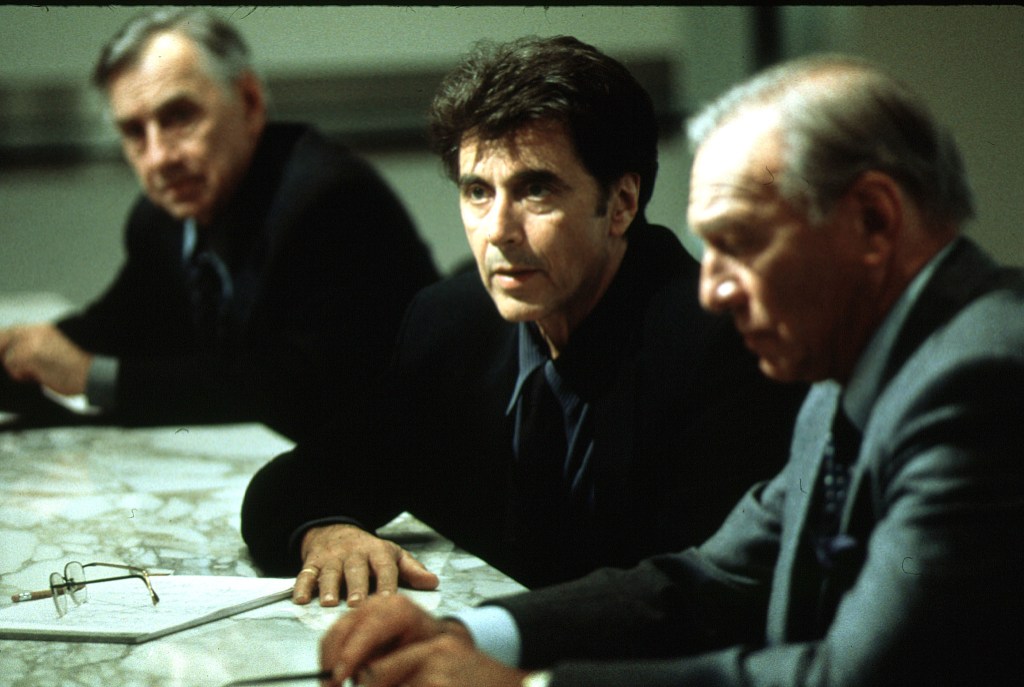
Michael Mann brings his muscular brand of storytelling to the real-life saga of Jeffrey Weigand, a Brown & Williamson research executive who in 1996 blew the whistle on how the industry manipulated its product to maximize addiction. The Insider is about more than the ethical and moral failings of Big Tobacco. Al Pacino plays 60 Minutes producer Lowell Bergman, who successfully persuades Weigand, portrayed by Russell Crowe, into an on-camera interview with the TV program’s Mike Wallace (Christopher Plummer). Mann and co-writer Eric Roth then shift focus from Big Tobacco to an equally compromised Big Media. Cowed by Brown & Williamson’s threat of litigation, CBS declines to air the interview. It is worth noting, however, that 60 Minutes eventually ran the Weigand piece. It would not be the first time the once-celebrated CBS News would be dogged by accusations of cowardice.
5. Spotlight (2015, dir: Tom McCarthy)
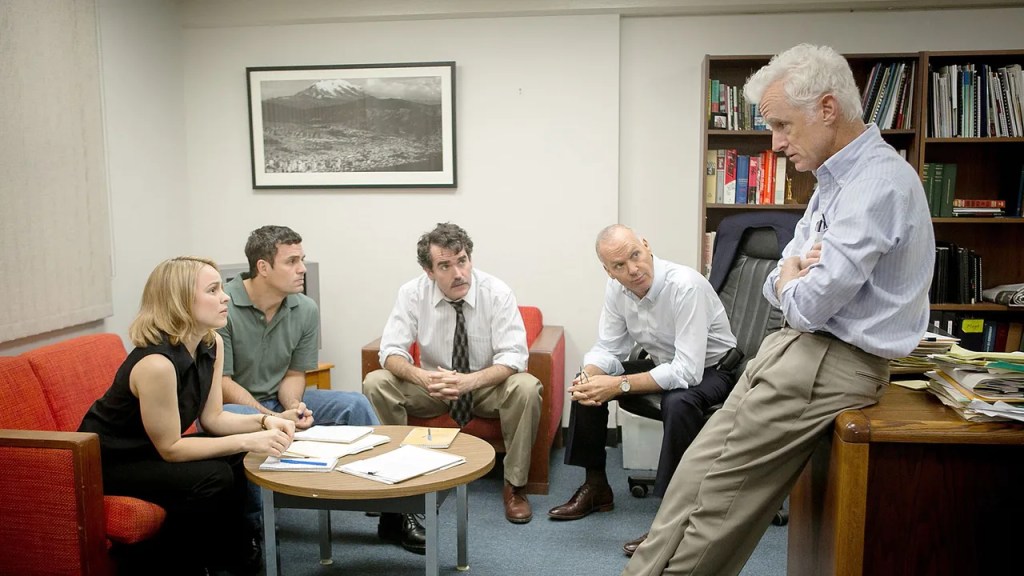
Like the four-person Boston Globe investigative team depicted in the film, Spotlight is lean, no-frills and devastatingly effective. Tom McCarthy’s ink-stained newspaper thriller is reminiscent of 1976’s All the President’s Men in that it concentrates on the methodical legwork of reporting. This time, however, the culprit isn’t a presidency but the Boston Catholic Church hierarchy that covered up decades of clerical sexual abuse. Also unlike All the President’s Men, Spotlight won the Academy Award for Best Picture. An ensemble cast that includes Michael Keaton, Mark Ruffalo, Rachel McAdams and Liev Schreiber does justice to McCarthy and Josh Singer’s riveting, Oscar-winning screenplay. “Journalists on film are usually portrayed as idealists or cynics, crusaders or parasites,” New York Times critic A.O. Scott wrote in his review. “The reality is much grayer, and more than just about any other film I can think of, ‘Spotlight’ gets it right.”.
4. Ace in the Hole (1951, dir: Billy Wilder)
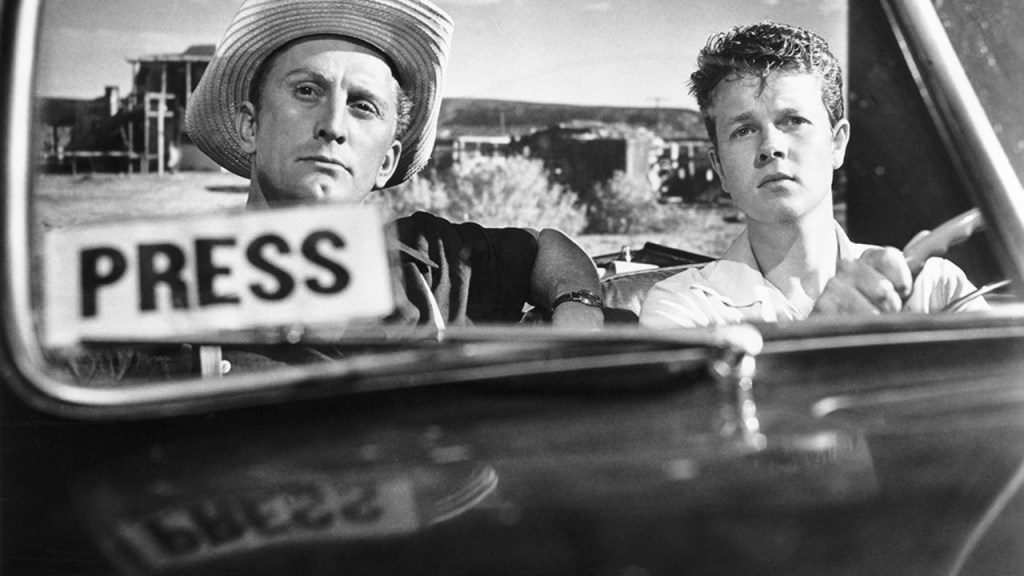
In Billy Wilder’s noir follow-up to 1950’s Sunset Boulevard, Kirk Douglas is at his cleft-chinned cockiest as Chuck Tatum, a one-time big-city newspaper reporter now wasting away in a sun-baked New Mexico town. Good fortune arrives for Chuck in the form of someone else’s misfortune. A poor lug named Leo (Richard Benedict) gets trapped in a cave; Chuck senses a story he can exploit to get himself back to the East Coast dailies. Loosely based on the 1925 plight of trapped cave explorer Floyd Collins, Wilder’s roasting of tabloid journalism is mercilessly dark and proved to be too bleak for 1951 audiences. It didn’t help that Paramount saddled the picture with the God-awful name The Big Carnival shortly before release. Wilder’s original title had been The Human Interest, and it is no small irony that Chuck engineers his human-interest scoop by being anything but humane.
3. Network (1976, dir: Sidney Lumet)
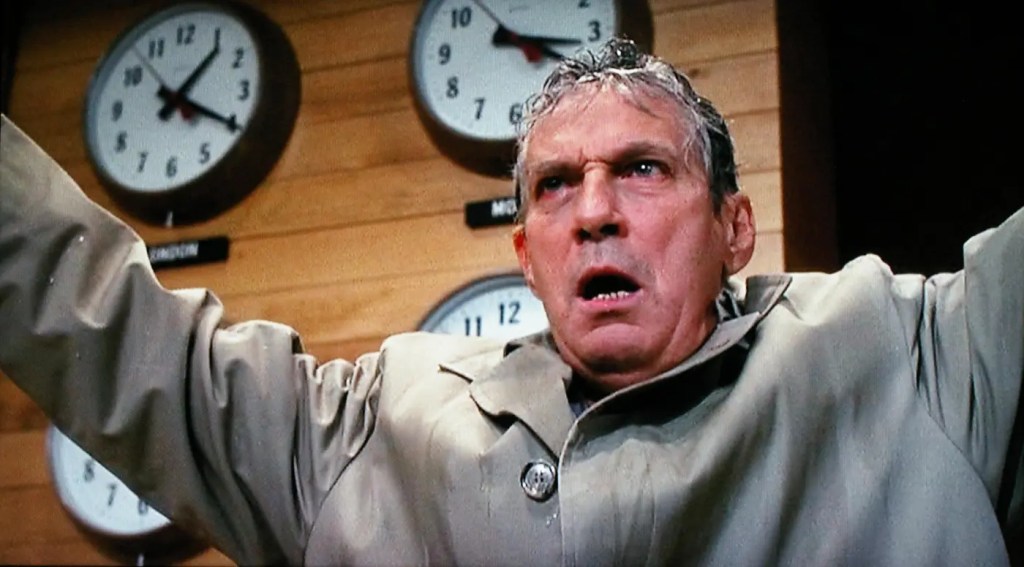
Paddy Chayefsky’s bitter, biting screenplay for Network anticipated the corporatization, diminution and eventual capitulation of broadcast news. Veteran network news anchor Howard Beale (Peter Finch, in an Oscar-winning performance), upon learning he will be forced into retirement, calmly tells viewers he will blow his brains out on next week’s broadcast. His boss and longtime friend (a craggy William Holden) is understandably concerned about Howard’s mental state, but the network’s vice president of programming (Faye Dunaway, also Oscar-winning and never better) senses a ratings bonanza in the making. The next broadcast proves her right. Howard doesn’t blow his brains out, but an angry rant about contemporary life culminates with his urging viewers to go to their windows and shout, “I’m mad as hell and I’m not going to take it anymore!” What was satire in 1976 now feels disturbingly close to reality.
2. Broadcast News (1987, dir: James L. Brooks)
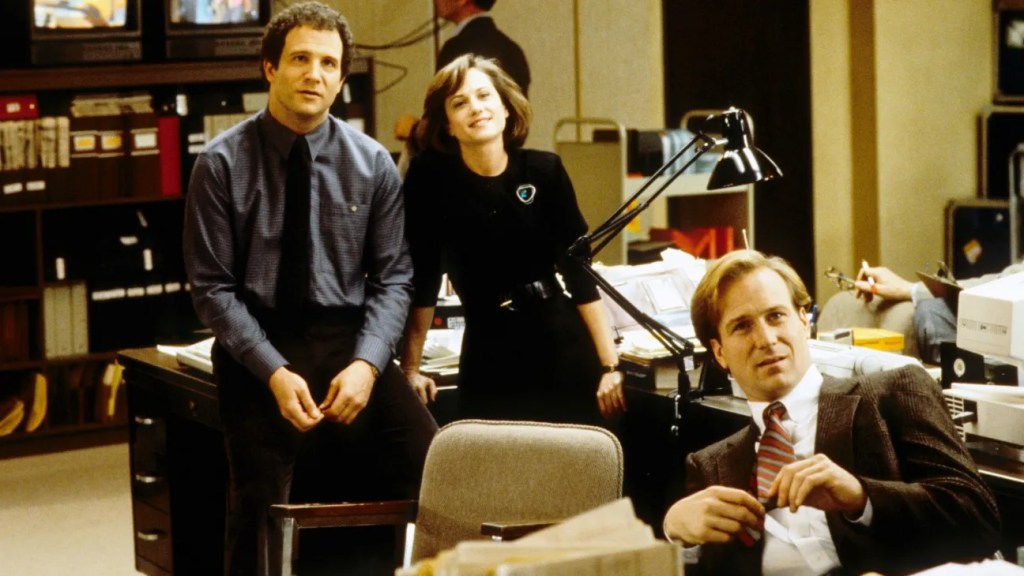
I never worked for a big broadcast network, but I toiled long enough at an Oklahoma CBS news affiliate to recognize that Broadcast News comes from a very knowing place. As news producer Jane Craig, Holly Hunter is a beautifully calibrated mix of workaholic doggedness and the sort of neurosis that can trigger uncontrollable sobbing. Pining for Jane is her coworker and friend, smart but nebbishy reporter Aaron Altman (Albert Brooks). Jane, however, finds herself drawn—against her better judgment—to Tom Grunick (William Hurt), a handsome new hire of dubious intellect being groomed by the network for bigger things. Tom stands for everything Jane abhors in TV news, and yet … she wants the dude. Broadcast News probes the tensions between hard-hitting investigative journalism and soft news, but always with terrific humor and always grounded in specificity of character. Hunter, Hurt and Brooks are all superb.
1. All the President’s Men (1976, dir: Alan J. Pakula)
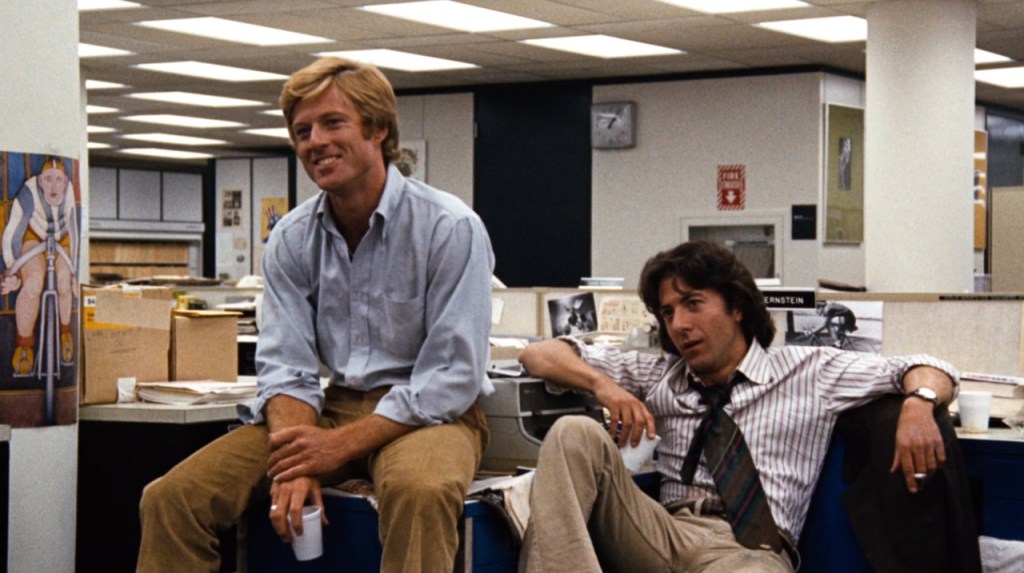
Alan J. Pakula’s expertly crafted dramatization of how two intrepid Washington Post reporters broke the Watergate scandal inspired a generation of young people to throw caution to the wind and become journalists. I was one of ‘em, and it’s no wonder. Scripted by the great screenwriter William Goldman, All the President’s Men is one of the finest procedurals ever committed to film. Miraculously, Pakula makes painstaking research look suspenseful, even as the story’s outcome is a matter of historical record (SPOILER ALERT: Tricky Dick had to resign the presidency). Robert Redford and Dustin Hoffman are idealized versions of Bob Woodward and Carl Bernstein, respectively, and they’re backed by a first-rate supporting cast including Jason Robards Jr. (who earned a Best Supporting Actor Oscar as Post editor Ben Bradlee), Jack Warden and Martin Balsam. Hal Holbrook is the anonymous source (many years later revealed to be then-FBI deputy director Mark Felt) whom Woodward dubbed “Deep Throat.” Oh, and playing himself is Frank Willis, the real Watergate security guard who discovered the burglary of Democratic National Committee offices.
Honorable mention: Anchorman: The Legend of Ron Burgundy (2004, dir: Adam McKay), Between the Lines (1977, dir: Joan Micklin Silver), Civil War (2024, dir: Alex Garland), His Girl Friday (1940, dir: Howard Hawks), Nightcrawler (2014, dir: Dan Gilroy), Page One: Inside the New York Times (2011, dir: Andrew Rossi), The Post (2017, dir: Steven Spielberg), Salvador (1986, dir: Oliver Stone), September 5 (2024, dir: Tim Fehlbaum), Zodiac (2007, dir: David Fincher)
 Cutting to the Chase with Phil Bacharach
One response to “The 10 best journalism movies”
[…] Watching All the President’s Men today, whether for the first time or the 30th, it is worth remembering that the Watergate break-in was only four years old at the time of the movie’s release. The greatest of journalism procedurals focuses on the conspiracy in which the Nixon White House tried covering up its involvement in the burglary of the Democratic National Committee. It is a matter of tugging on a metaphorical thread; in this case, it’s Washington Post reporter Bob Woodward (Robert Redford) at the burglars’ arraignment when he catches that one of the defendants worked for the CIA. Each bit of information uncovered by Woodward and Carl Bernstein (Dustin Hoffman) leads to another morsel. “In a conspiracy like this, you build from the outer edges and go step by step,” Woodward is told by “Deep Throat” (Hal Holbrook), his high-level anonymous source. “If you shoot too high and miss, everybody feels more secure.” For a nation whipsawed by assassinations and an unpopular war, Watergate seemed to solidify the belief that our government is corrupt. It outraged the country, but in hindsight, it also desensitized Americans to scores of scandals to follow. (See more in The 10 best journalism movies.) […]
LikeLike