
Political junkies love movies about politics, but the dirty little secret is that so do a lot of folks who claim to hate politics. The reason is simple. The best examples focus on who acquires power, how they wield it, and whose lives are changed as a result. From the rise of Willie Stark in All the King’s Men to the flawed presidential candidate of Primary Colors, cinema underscores that politics is both theater and battleground, and the line between hero and opportunist can be perilously thin. One note on the films below: titles that focus on the presidency get their own list).
10. All the King’s Men (1949, dir: Robert Rossen)
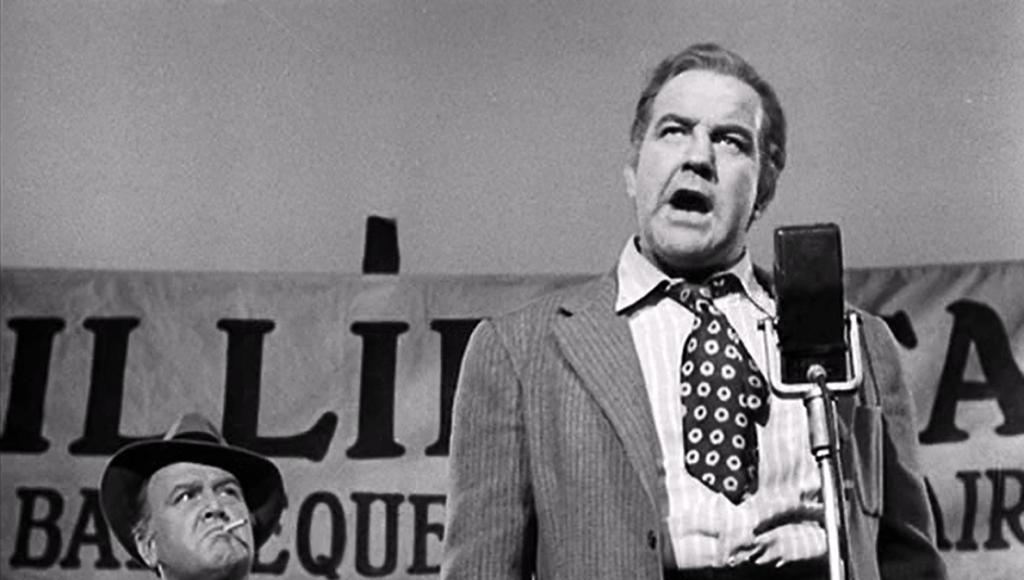
Broderick Crawford’s performance in All the King’s Men as fire-breathing politician Willie Stark earned a Best Actor Oscar and lifted him from character actor roles into stardom. Robert Rossen introduces us to Stark as a low-key, principled gubernatorial candidate—unwittingly being used by political operatives to split the “hick” vote in hopes it will throw the election to their preferred man. But Stark discovers their scheme, and it activates the enraged demagogue inside him. He whips up a crowd of voters by vowing to battle the power elite. Once elected, he becomes as vilified as he is glorified, his populism as genuine as his bottomless appetite for power. Robert Penn Warren’s Pulitzer Prize-winning novel, loosely inspired by Louisiana Depression-era political boss Huey Long, still feels relevant today—even if a 2006 remake mainly contributed a bad Southern accent by Sean Penn.
9. The Great McGinty (1940, dir. Preston Sturges)
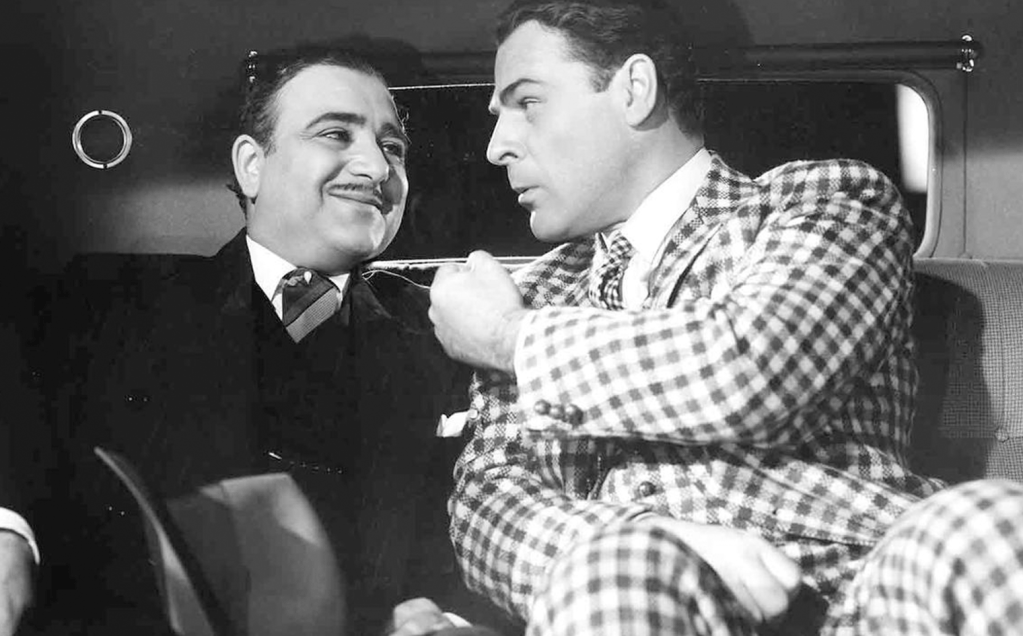
Preston Sturges was so adamant that he direct his own screenplay, he sold The Great McGinty script to Paramount Pictures for $10 on the condition that it be his directorial debut. Paramount got quite a bargain: the script went on to win the Oscar for Best Original Screenplay. Brian Donlevy stars as Daniel McGinty, a belligerent hobo who eventually becomes governor of an unnamed state. McGinty’s ascent begins when he’s taken under the wing of a crooked political boss, played by Akim Tamiroff. “We need a new face—clean, typical American, upright, dependable…someone they don’t know too much about,” says the boss when his previous candidate runs afoul of the law. McGinty is no less corrupt, but has a pang of conscience when his wife (Muriel Angelus), the result of a politically motivated marriage, urges him to do better. Donlevy, never an especially accomplished actor, is a thoroughly credible goon; he and Tamiroff reprised their roles in Sturges’ The Miracle of Morgan’s Creek (1943). The Great McGinty suggests that graft is part and parcel of how things work in government, but somehow makes it look halfway endearing.
8. Mr. Smith Goes to Washington (1939, dir: Frank Capra)
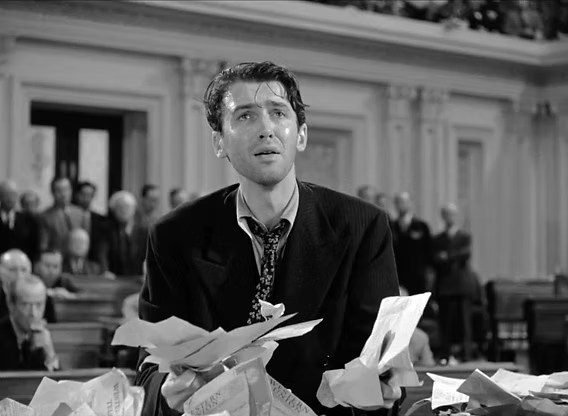
Frank Capra’s populist fables were considered corny even in 1939 (hence the “Capra-corn” tag from some critics), but he knew what stirred moviegoers. “What audiences respond to in Mr. Smith Goes to Washington is the humanity of a man who cares about something and is fighting for it,” the director said years later. “When they see somebody fight for an ideal, it will always get ‘em right here, in the stomach.” As idealistic Senator Jefferson “Jeff” Smith, James Stewart delivers a career-defining performance, but the entire cast––including Capra regulars Jean Arthur and Edward Arnold, as well as Claude Rains and Thomas Mitchell––is in top form. Moreover, you’ve got to love any picture that makes a filibuster a scene of rousing heroism. “You all think I’m licked. Well, I’m not licked … and I’m gonna stay right here and fight for this lost cause!” Jeff tells the Senate chamber, his voice cracking from exhaustion, in the picture’s most fabled scene. U.S. senators assailed the film for its depiction of corrupt Washington powerbrokers. Nowadays, Capra’s treatment of Congress feels like a whitewash.
(See more in The 10 best uses of manmade landmarks in film.)
7. Advise & Consent (1962, dir: Otto Preminger)
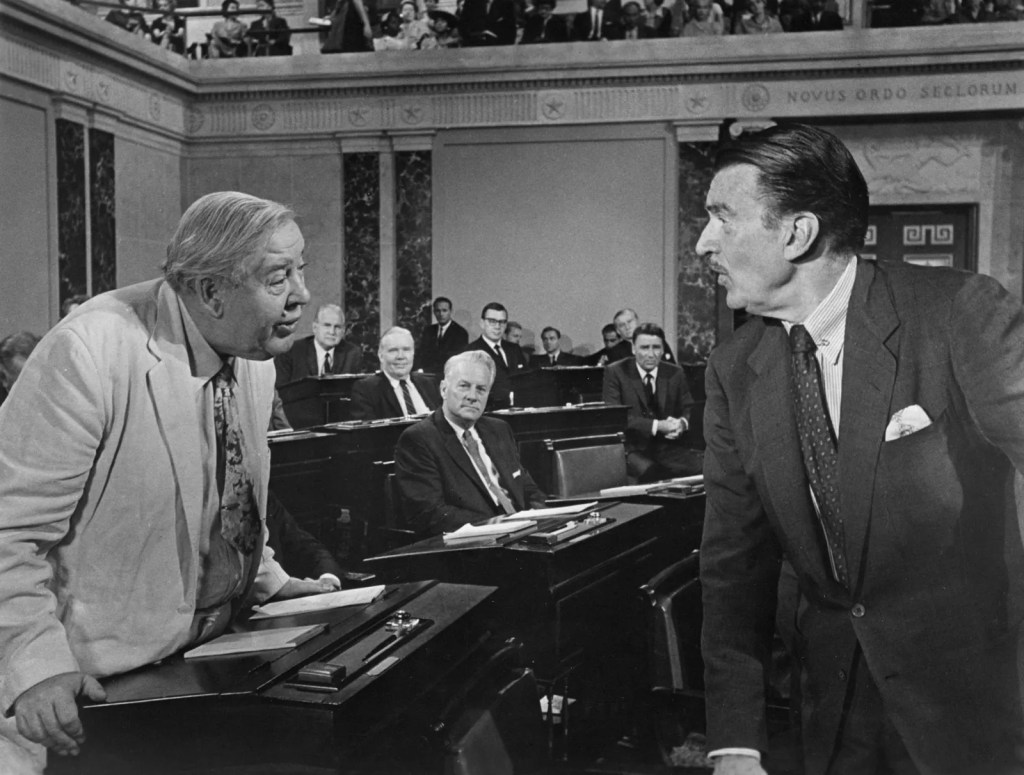
Movie historian David Thomson has called Otto Preminger’s take on Capitol Hill wheeling and dealing “the calm antidote to the rising hysteria in Frank Capra’s Washington films.” Adapted by Wendell Mayes from Allen Drury’s Pulitzer Prize-winning novel, Advise & Consent’s Beltway intrigue centers on a bruising confirmation battle over the president’s nominee for secretary of state, Robert Leffingwell (Henry Fonda, oozing integrity), who is accused of having been a communist. Subtlety wasn’t Preminger’s strong suit, and he doles out some unfortunate caricatures for a now-uncomfortable subplot concerning Don Murray as a senator desperate to conceal a gay past. If you can get past that, Advise & Consent benefits from a star-studded assemblage highlighted by Charles Laughton as an oily Southern senator, Franchot Tone as the president, Burgess Meredith as Leffingwell’s accuser, and Walter Pidgeon as the crafty Senate majority leader. Politics, it turns out, is a natural for melodrama.
6. Being There (1979, dir: Hal Ashby)

Peter Sellers is a marvel of restraint as a sheltered, childlike gardener whose limitations are mistaken for profundity. Being There opens with Sellers’ Chance the gardener, who inadvertently reinvents himself as Chauncey Gardiner, forced to leave his lifelong home in Washington, D.C., following the death of his employer and benefactor. Through circumstances befitting a screwball comedy, Chauncey is taken in by an über-wealthy industrialist played by Melvyn Douglas—in an Academy Award-winning performance—and somehow wanders into the forefront of national politics. Chauncey’s understanding of the world is limited to what he sees on television––”I like to watch,” he routinely lets people know––but it proves to be enough for his every inane utterance to be interpreted as brilliant. Sellers inexplicably lost the Best Actor Oscar (to Kramer vs. Kramer’s Dustin Hoffman), but the picture also has strong work from Shirley MacLaine, Richard Dysart, and Jack Warden. Adapted by Jerzy Kosinski from his novel and directed by Hal Ashby with admirable understatement, Being There can sever arteries with its satire.
(See more in The 10 most memorable masturbation scenes in film.)
5. The Candidate (1972, dir: Michael Ritchie)
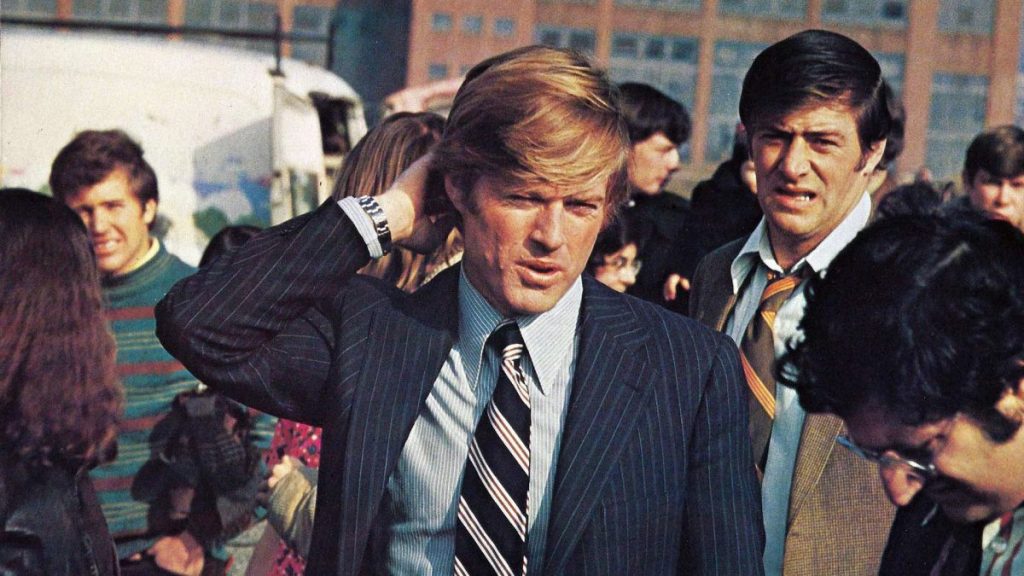
Robert Redford is in full movie star mode as Bill McKay, a handsome, idealistic California legal-aid attorney who embarks on a quixotic quest to unseat an incumbent California senator, the wonderfully named Crocker Jarmon (Don Porter). McKay jumps into the race at the coaxing of a campaign operative (Peter Boyle) with the assurance that he will lose, a luxury that McKay presumes will enable him to be totally honest with voters. The Candidate is unsentimental and unsparing on the corrupting nature of competition, a theme near and dear to director Michael Ritchie. The film examines politics at its most paradoxical. McKay’s progressive remarks on the campaign trail boost his popularity, but the improved polling numbers prompt his risk-averse handlers to protect McKay’s lead by not rocking the boat. But their subsequent strategy of having the candidate spout vague platitudes lessens his appeal among voters––and so the campaign corrects its correction. These reversals make the film both an artifact of its era and an enduring portrait of electoral politics. The Candidate also boasts one of the wittiest and most desperate endings in movie history. It helped earn an Oscar for screenwriter Jeremy Larner, who had been a speechwriter for 1968 presidential candidate Eugene McCarthy.
4. Z (1969, dir: Costa-Gavras)
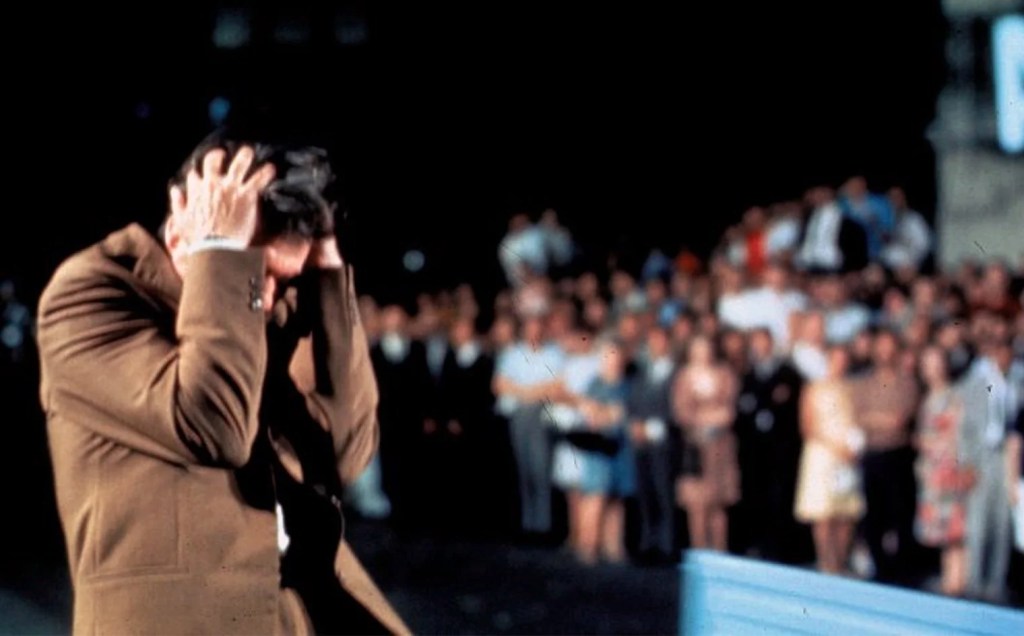
This incendiary masterpiece doesn’t mess around. “Any similarities to real persons and events is not coincidental. It is intentional,” announces an opening title card. Z is a barely disguised account of the assassination of Grigoris Lambrakis, a leftist leader in Greece beaten to death by right-wing extremists in 1963. The subsequent investigation exposed links between the attackers and state security forces, further destabilizing the government. Because any discussion of the Lambrakis affair had effectively been banned in Greece under the military junta, Z became a French-Algerian production. It dramatizes the murder and its aftermath, but this is no dry history lesson. Yves Montand is the Lambrakis-inspired character, Jean-Louis Trintignant the crusading prosecutor whose scruples frustrate the powers that be. “As if it’s not enough that our country has been invaded by long-haired thugs, atheists, and junkies of unclear sex,” the prosecutor is lectured by the nation’s attorney general, “now you want to disparage our armed forces and courts, the only elements not corrupted by parliamentarianism.” Sweeping in scope and crackling with energy, Z is great, propulsive filmmaking from Costa-Gavras. He turns political procedure into action, making every deposition and disclosure feel like another blow against the state.
(See more in The 10 best conspiracy films.)
3. In the Loop (2009, dir: Armando Iannucci)
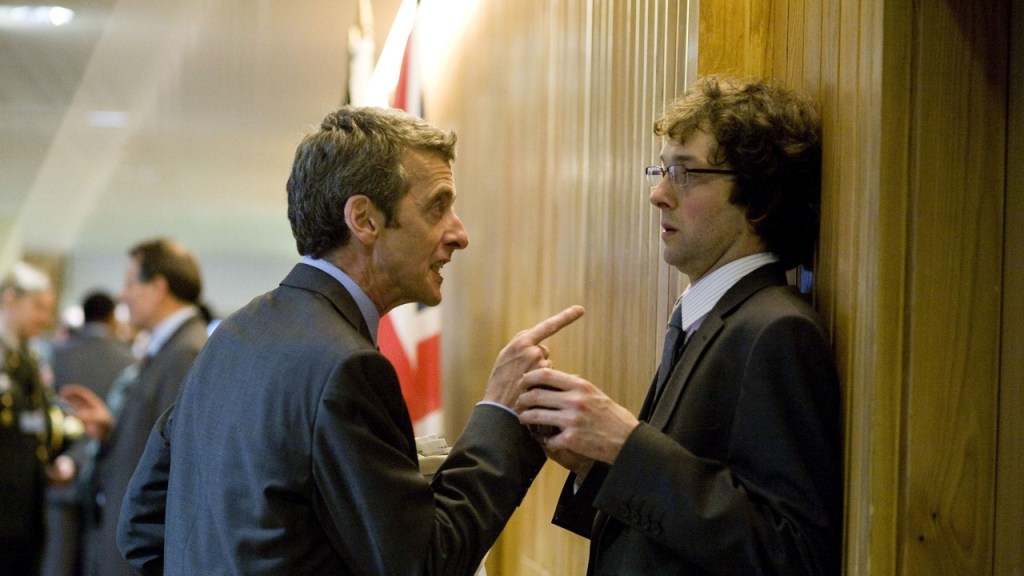
Having worked in government and political communications for more than 30 years, I can attest to the unnerving verisimilitude of In the Loop, Armando Iannucci’s spin-off of his BBC series, The Thick of It. This lacerating comedy nominally concerns an impending United Nations vote on whether the U.K. and the U.S. will support military intervention in the Middle East. But the threadbare plot is just pretext. The script by Iannucci and co-writers Jesse Armstrong, Simon Blackwell, and Tony Roche dishes out cutthroat deals and jockeying for position, all of which allows for one-liners, insults, and ripostes––most of them expletive-laden––delivered at breakneck speed. An ensemble cast that includes Peter Capaldi, Tom Hollander, Mimi Kennedy, James Gandolfini, David Rasche, and Anna Chlumsky gets to wrap its collective mouth around the barbed dialogue. Trying to savor each verbal dagger is like trying to slake your thirst from a firehose. Sample 1: “I will marshal all the forces of darkness to hound you into an assisted suicide.” Sample 2: “You know they’re all kids in Washington? It’s like Bugsy Malone, but with real guns.” Sample 3: “This is the problem with civilians wanting to go to war. Once you’ve been there, once you’ve seen it, you never want to go again unless you absolutely fucking have to. It’s like France.”
2. A Face in the Crowd (1957, dir: Elia Kazan)
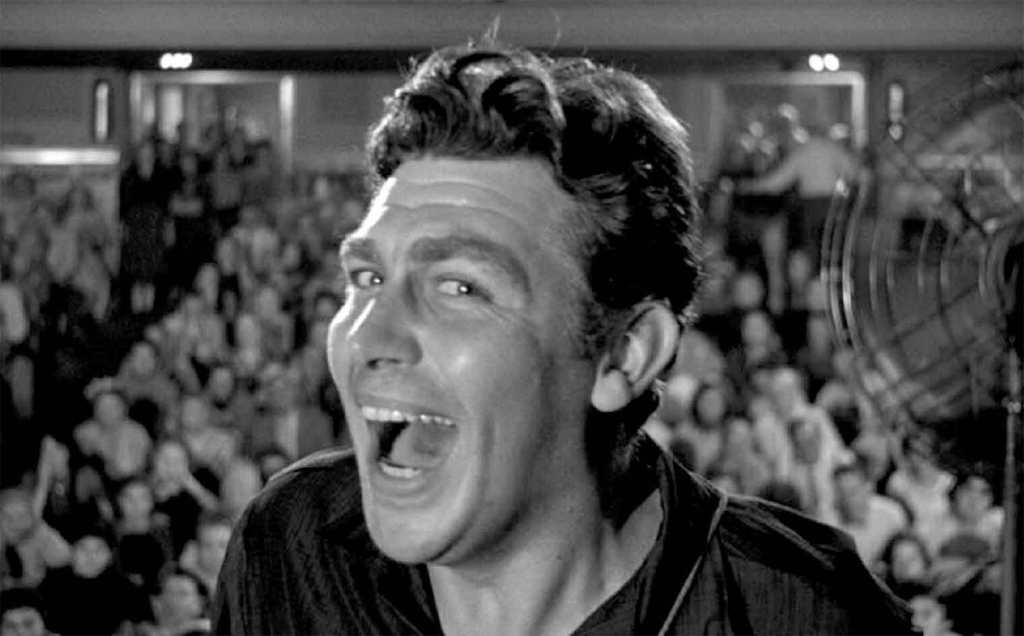
In this age of sham-populist podcasters, on-the-take influencers, and prevaricating demagogues, Elia Kazan’s masterpiece is so prescient as to be spooky. In the 1950s, A Face in the Crowd screenwriter Budd Schulberg had plenty of false prophets of the airwaves for inspiration––from Father Coughlin to Walter Winchell––but he and Kazan went further by foretelling the soul-crushing power of mass media for charlatans willing to exploit it. If you know Andy Griffith only from his aw-shucks television persona, buckle up. Griffith disliked the shoot (“I like to laugh when I’m working,” Ron Howard, who played Griffith’s son on television, recalled the actor telling him) but is a tornado of volatility and manic charisma as “Lonesome” Rhodes, a drunken drifter catapulted to fame after being “discovered” by a small-town radio reporter (Patricia Neal). A man whose ambition is matched by his viciousness, Lonesome employs a down-home huckster charm that takes him from radio personality to TV star to political kingmaker. “I’m not just an entertainer. I’m an influence, a wielder of opinion… a force!” he boasts after a stodgy senator begs his support for a presidential bid. “This whole country’s just like my flock of sheep––rednecks, crackers, hillbillies, hausfraus, shut-ins, pea pickers!” A Face in the Crowd peels back the sunny veneer of American can-do optimism to expose the rot beneath it.
1. The Battle of Algiers (1966, dir: Gillo Pontecorvo)
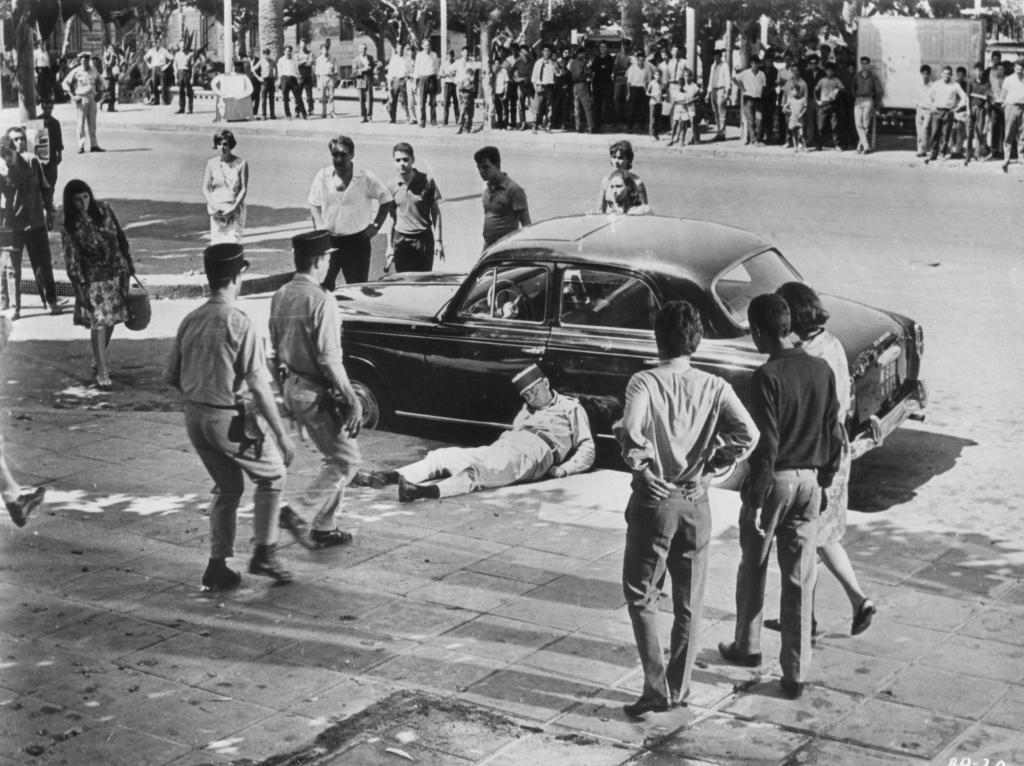
This raw, documentary-like reconstruction of Algeria’s fight for freedom from French colonial rule carries an urgency that makes events feel like they’re unfolding in real time. Perhaps that immediacy is why The Battle of Algiers was studied by radical organizations ranging from the Irish Republican Army to the Black Panthers. Italian writer-director Gillo Pontecorvo set out to capture as accurately as possible the period from 1954 through 1957, when the revolutionary National Liberation Front, or FLN, launched a war against authorities in French Algeria’s capital city. Shot in grainy black and white and drawing on Italian neorealism and cinéma vérité, the film is an unblinking look at guerrilla warfare. Pontecorvo cast nonprofessional actors for their resemblance to the real-life figures. The one exception is Jean Martin as French Col. Mathieu, who embodies the French military perspective. There is no mistaking that the sympathies of Pontecorvo and co-writer Franco Solinas lie with the Algerian rebels, but the filmmakers remain clear-eyed about the violence committed by both sides. The picture details the FLN’s terrorist atrocities, as well as the French military’s reliance on torture and propaganda. The Battle of Algiers rings as a powerful indictment of colonialism. “It has a firebrand’s fervor; it carries you with it, and doesn’t give you time to think,” wrote The New Yorker’s Pauline Kael upon the picture’s U.S. release. “Pontecorvo’s inflammatory passion works directly on your feelings. He’s the most dangerous kind of Marxist, a Marxist poet.” The fight for liberation culminated with Algeria’s independence in July 1962.
Honorable mention: All the President’s Men (1976, dir. Alan J. Pakula), The Best Man (1964, dir. Franklin J. Schaffner), Bob Roberts (1992, dir. Tim Robbins), Bulworth (1998, dir. Warren Beatty), Citizen Kane (1941, dir. Orson Welles), City of Hope (1991, dir. John Sayles), The Death of Stalin (2017, dir. Armando Iannucci), Election (1999, dir. Alexander Payne), The Last Hurrah (1958, dir. John Ford), The Manchurian Candidate (1962, dir. John Frankenheimer)


5 responses to “The 10 best political films”
[…] There’s no way to exclude Z, which the estimable New Yorker critic Pauline Kael hailed as “one of the fastest, most exciting melodramas ever made,” in a roundup of the all-time greatest conspiracy-minded films. Costa-Gavras’ masterpiece is a thinly veiled account of the 1963 assassination of Grigoris Lambrakis, a leader of Greece’s pacifist movement, by right-wing extremists. A subsequent investigation shed light on a labyrinthine cover-up that ensnared the highest echelons of government. The scandal even briefly empowered the opposition party, but the victory was short-lived; a military junta took over four years later. Jean-Louis Trintignant plays the intrepid prosecutor who discovers a far-reaching plot to downplay the killing and protect the perpetrators. The political realities of Greece meant Z had to be a French-Algerian production. Even its music score by Mikis Theodorakis had to be smuggled to the filmmakers while he was in Greek custody. (See more in The 10 best political films.) […]
LikeLike
[…] Alan J. Pakula’s expertly crafted dramatization of how two intrepid Washington Post reporters broke the Watergate scandal inspired a generation of young people to throw caution to the wind and become journalists. I was one of ‘em, and it’s no wonder. Scripted by the great screenwriter William Goldman, All the President’s Men is one of the finest procedurals ever committed to film. Miraculously, Pakula makes painstaking research look suspenseful, even as the story’s outcome is a matter of historical record (SPOILER ALERT: Tricky Dick had to resign the presidency). Robert Redford and Dustin Hoffman are idealized versions of Bob Woodward and Carl Bernstein, respectively, and they’re backed by a first-rate supporting cast including Jason Robards Jr. (who earned a Best Supporting Actor Oscar as Post editor Ben Bradlee), Jack Warden and Martin Balsam. Hal Holbrook is the anonymous source (many years later revealed to be then-FBI deputy director Mark Felt) whom Woodward dubbed “Deep Throat.” Oh, and playing himself is Frank Willis, the real Watergate security guard who discovered the burglary of Democratic National Committee offices.(See more in The 10 best conspiracy films and The 10 best political films.) […]
LikeLike
[…] In this deadpan satire of media and politics, Eve (Shirley MacLaine) throws herself at Peter Sellers’ television-obsessed Chauncey Gardner. At first he responds with passionate kissing, mimicking what he is watching on the TV behind her. When the scene on TV ends, Chauncey goes cold. Startled, Eve asks what would make him happy. “I like to watch, Eve,” he says blankly. The misunderstanding prompts her to take matters into her own hands, literally, writhing on a bearskin rug while the oblivious Chauncey, glued to a yoga demonstration on the tube, does a headstand on his bed. Under the direction of Hal Ashby, the moment is absurd and faintly heartbreaking. On set, MacLaine said Laurence Olivier told her he had turned down the role in Being There of Eve’s elderly husband because “he didn’t like the idea of being in a movie with me masturbating.”(See more in The 10 best political films.) […]
LikeLike
[…] month hasn’t gone by since that I haven’t thought of that girl,” he says.(See more in The 10 best political films and The 10 best journalism […]
LikeLike
[…] When American movies need a potent symbol of the nation’s better angels, the Lincoln Memorial is hard to top. It makes an especially appropriate backdrop in Mr. Smith Goes to Washington. Early on, freshman Senator Jefferson “Jeff” Smith (James Stewart) visits the memorial to marvel at its grandeur. Recreating a sight that director Frank Capra had seen himself, Jeff watches a young boy read aloud the Gettysburg Address carved into the memorial wall. When Jeff next visits it, he has been beaten down by a smear campaign. His wisecracking assistant (Jean Arthur) confronts him there to deliver a pep talk. “Remember what you said about Mr. Lincoln?” she says. “You said he was sitting up there for someone to come along. I think he was waiting for you, Jeff.” Rejuvenated, the senator takes one last admiring glance at Honest Abe’s statue before departing for his dramatic filibuster.(See more in The 10 best political films.) […]
LikeLike