
Few issues in the political arena are as polarizing as immigration. Its divisiveness, particularly the never-ending debate over illegal immigration, can obscure the real hardships—the physical journey, prejudice, assimilation to a new country while maintaining one’s cultural identity—that typically define the immigrant experience. Regardless of where one comes down on the subject, there is no disputing the cinematic power of such stories, which date as far back as Reginald Barker’s The Italian (1915) and Charlie Chaplin’s The Immigrant (1917).
For me, an immigrant’s odyssey is best exemplified by the following 10 titles.
10. America, America (1963, dir. Elia Kazan)
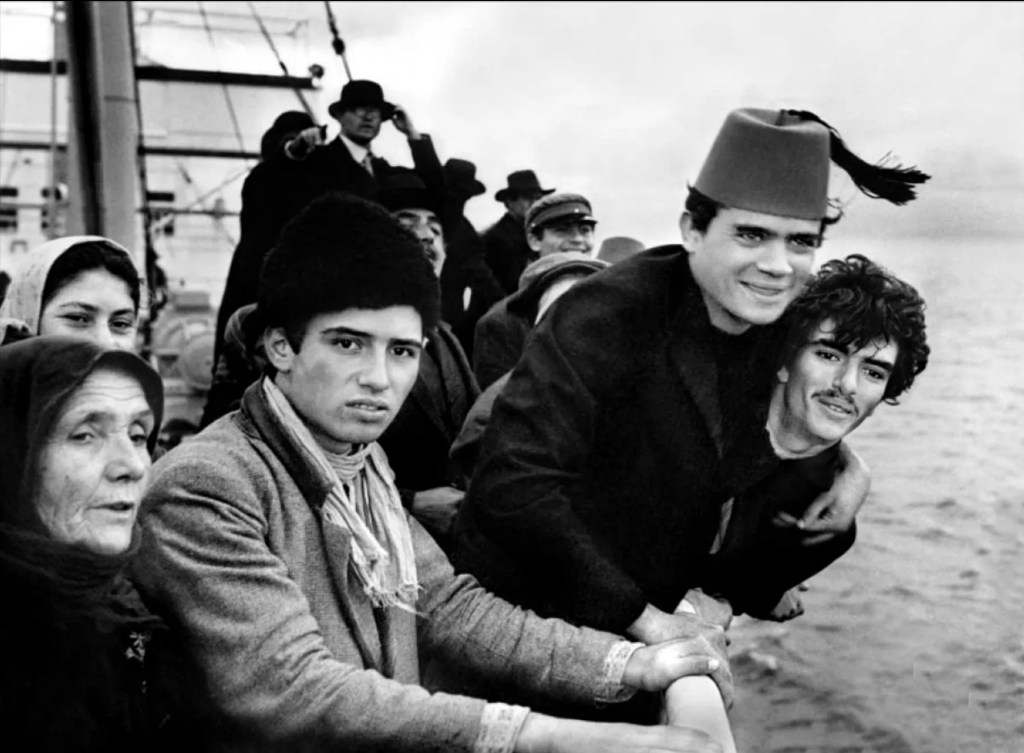
Writer-director Elia Kazan drew on the story of his uncle, Joe Kazantzoglou, in this tale of a young Greek’s journey in the 1890s to the United States. A Kazan discovery, Stathis Giallelis, stars as Stavros Topouzoglou, who withstands a host of obstacles thrown his way from Anatolia to Constantinople. He is robbed, pressured into an arranged marriage, kills a man, and has an affair with a rich wife, among other adventures. Throughout, Stavros is resolute that nothing will stop him from reaching a promised land that exists for him only as myth. The shoot itself was a slog. Kazan scurried for investors after losing his initial financing, a hostile reception from the Turkish government forced him to relocate late in production, and movie reviews were mixed. Clocking in at nearly three hours, America, America gets a little baggy but Kazan’s ambition and vision are compelling in what he said was the favorite of his films.
9. Sin Nombre (2009, dir. Cary Joji Fukunaga)
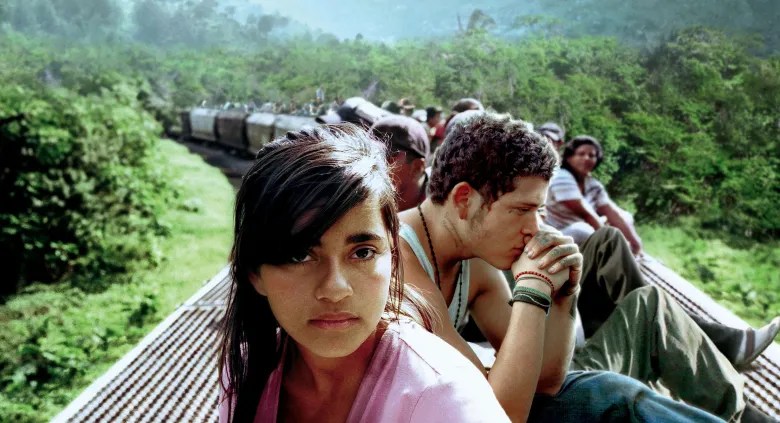
Casper (Edgar Flores) is an atypical hoodlum in Chiapas, Mexico—a quiet, sensitive soul—whose girlfriend (Karla Cecilia Alvarado) is raped and killed by one of the top-dog gangsters, Lil’ Mago (Tenoch Huerta Mejía). Fear keeps Casper from retaliating, but things reach a breaking point when he joins Lil’ Mago to rob immigrants on a train heading from Central America to the U.S.-Mexico border. Lil’ Mago accosts a 14-year-old Honduran, Sayra (Paulina Gaitan). Casper intercedes to save the girl, but makes himself a target in the process. A riveting mix of grittiness and visual splendor, Sin Nombre does not whitewash its milieu of poverty and despair, though Cary Joji Fukunaga’s stylishness lends it a haunting, almost romantic, sheen. A number of scenes—the ghostly images of railway lines at night, an afternoon rain shower—have a mournful beauty. Sin Nombre presents the struggle to hang on to one’s humanity when the world is doing its best to snuff it out.
8. The Brutalist (2024, dir. Brady Corbet)

This epic but intimate tale begins with László Tóth (Adrien Brody), a brilliant Hungarian-Jewish architect and Holocaust survivor newly arrived in New York. As László’s boat docks in New York harbor, director Brady Corbet makes sure our first glimpse of the Statue of Liberty is upside down—which succinctly foretells how The Brutalist turns the American myth, especially capitalism’s promise, on its head. László is hired by Harrison Lee Van Buren (Guy Pearce), a smug industrialist, to design an audacious community center. László’s benefactor gradually bends the immigrant to his will. Corbet’s stunning production, shot on a budget of less than $10 million, is lifted by Lol Crawley’s lush VistaVision cinematography and Daniel Blumberg’s innovative music score. Crawley and Blumberg both took home Oscars for their work, as did Brody. The Brutalist has a lot on its mind—the immigrant experience, capitalism, the compromise of artistic vision—but never loses sight of the personal saga at its center.
7. The Visitor (2007, dir. Tom McCarthy)

Character actor extraordinaire Richard Jenkins, who earned an Oscar nomination for his work here, disappears into the role of Walter Vale. A disaffected college professor in Connecticut, Walter bristles when forced by his dean to attend an academic conference in New York City. He is surprised to find an immigrant couple has mistakenly been allowed to sublet the New York apartment he has used for decades. Grudgingly, Walter allows Tarek (Haaz Sleiman), who is Syrian, and Senegalese Zainab (Danai Gurira) to stay until they can find other accommodations. Just as grudgingly, he warms up to the undocumented immigrants. Then Tarek is arrested at a subway terminal and sent to a U.S. Immigration and Customs Enforcement detention center. Tom McCarthy poses some provocative, politically charged questions, but his storytelling has no fat. What remains for the viewer—aside from a poignant final image—is the understated connection between people separated by borders both literal and emotional.
6. The Namesake (2006, dir. Mira Nair)
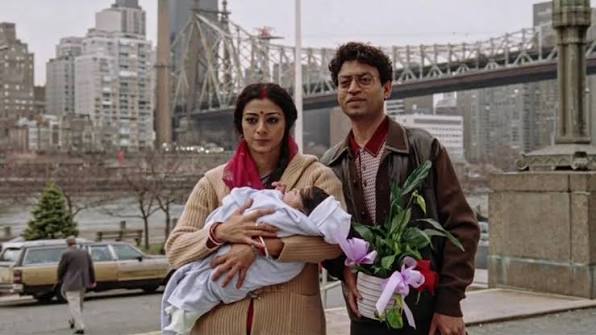
Mira Nair looks at two generations of a fictional Indian-American family to explore the divide between cultural identity and assimilation. But The Namesake is no polemic. Based on a Jhumpa Lahiri novel, it begins with newlyweds Ashoke Ganguli (Irfran Khan) and Ashima (Tabu) immigrating from Calcutta to New York City in the late 1970s. Ashima gives birth to a boy whom Ashoke names Gogol in deference to a life-changing experience that involved a story by 19th-century Russian writer Nikolai Gogol. The namesake grows up to be a thoroughly Americanized young man, played by Kal Penn, who loathes the name given him but chalks it up as another indignity foisted upon him by his old-fashioned parents. Nair and screenwriter Sooni Taraporevala let their characters breathe, and occasionally stumble, without judgment. Early on, Ashima slips on the shoes of her husband-to-be, a sweetly revealing moment that is later repeated by another character. That desire to see the world from a different perspective gives The Namesake lasting resonance.
5. Maria Full of Grace (2004, dir. Joshua Marston)

Maria Alvarez is as complicated as any 17-year-old. She is smart but prone to rash decisions; generous to her friends but quick to pick fights with her family. Maria’s contradictions make her journey from a Colombian village to international drug-trafficking all the more riveting. Upon learning she is pregnant, Maria quits her job after being berated by a supervisor. She drifts to a job that promises her more money than she could ever hope to make otherwise. She becomes a human “mule,” swallowing tiny packages of cocaine to smuggle past U.S. Customs officials into New York. Between Joshua Marston’s quasi-documentary approach and Catalina Sandino Moreno’s gripping performance as the title character—she earned an Oscar nomination—Maria Full of Grace presents a heroine who is sympathetic without being likeable. We find ourselves empathizing with her even as she carries a bellyful of drugs that could threaten the life of her unborn child. That ambivalence is part of what makes the film extraordinary.
4. El Norte (1983, dir. Gregory Nava)
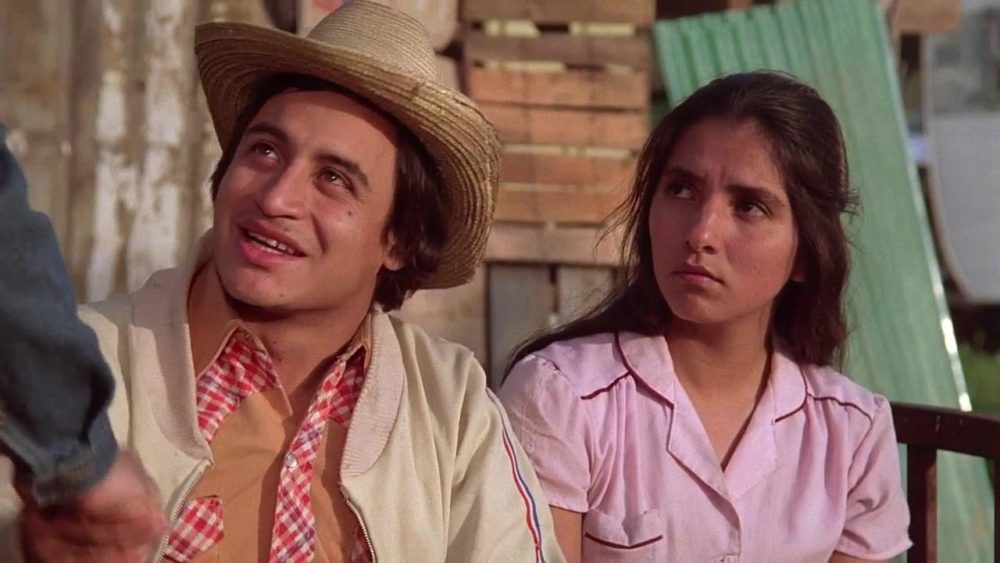
With El Norte, the husband-and-wife team of director Gregory Nava and screenwriter Anna Thomas present the tumultuous journey of siblings Rosa (Zaide Silvia Gutiérrez) and Enrique (David Villalpando) as they flee war-torn Guatemala after government soldiers kill their father and imprison their mother. The brother and sister resolve to get to the United States, where they hear that even poor people have electric lights and toilets that flush. “You need big balls and the protection of God and the saints,” Enrique is cautioned about their plan. Indeed, the film is at its most harrowing when the pair is directed by a “coyote” to crawl through miles of an abandoned sewer tunnel originating in Tijuana. They endure attacks by swarming rats, eventually reaching Los Angeles, where they learn to dodge periodic raids by immigration officers. Largely funded by PBS’ American Playhouse, the movie is not without flaws. With the notable exception of Gutiérrez and Villalpando, both making their debut, the acting is spotty. It is occasionally painfully earnest, particularly in the first of its three chapters. But El Norte is also a tale that extracts a heavy emotional toll.
3. Minari (2020, dir. Lee Isaac Chung)

In the midst of the COVID-19 pandemic, a modest, humane drama about a multigenerational family of immigrants arrived as a kind of healing balm. Writer-director Lee Isaac Chung’s lightly autobiographical film highlights the cultural gulf and language barriers facing a South Korean family in 1980s rural Arkansas, but Minari embodies a faith, unsentimental and unfussy, in the innate kindness of people. Steven Yeun and Han Ye-ri are Jacob and Monica Yi, living in a cramped trailer home with their two children (Alan Kim and Noel Kate Cho) and Monica’s mother (Youn Yuh-jung) while scraping by, working in a chicken hatchery. Youn won an Oscar for Best Supporting Actress—the movie racked up four other nominations, including Best Picture, Director, and Original Screenplay—but all the performances are strong. Minari unfolds through life’s vicissitudes large and small, some of it heartbreaking, and yet Chung does not wallow in sadness. Like the Yi family, Minari is ultimately about resilience.
2. Hester Street (1975, dir. Joan Micklin Silver)

For millions of East European Jewish immigrants in the late 19th and early 20th centuries, the United States was the fulfillment of a dream promising freedom and opportunity. Hester Street, set in New York’s Lower East Side circa 1896, explores the built-in tensions in balancing assimilation to the new country and the preservation of one’s cultural and ethnic identity. Jake (Steven Keats) has been in America long enough to declare himself a Yankee and disavow his Russian Jewish roots, which makes the arrival of his wife and son all the more vexing for him. Giti (Carol Kane in an Oscar-nominated performance) is a “greeny” who dresses simply and speaks Yiddish. Jake reacts to his wife with embarrassment and revulsion, preferring the westernized ways of his mistress (Dorrie Kavanaugh). Giti finds kindness and understanding from a boarder, a Talmudic scholar named Mr. Bernstein (Mel Howard). Joan Micklin Silver’s debut, shot in grainy black and white, captures the time period on a shoestring budget. More impressively, Hester Street focuses on a modest story of one strained marriage as a microcosm for universal challenges that immigrants routinely face.
1. Ali: Fear Eats the Soul (1974, dir. Rainer Werner Fassbinder)
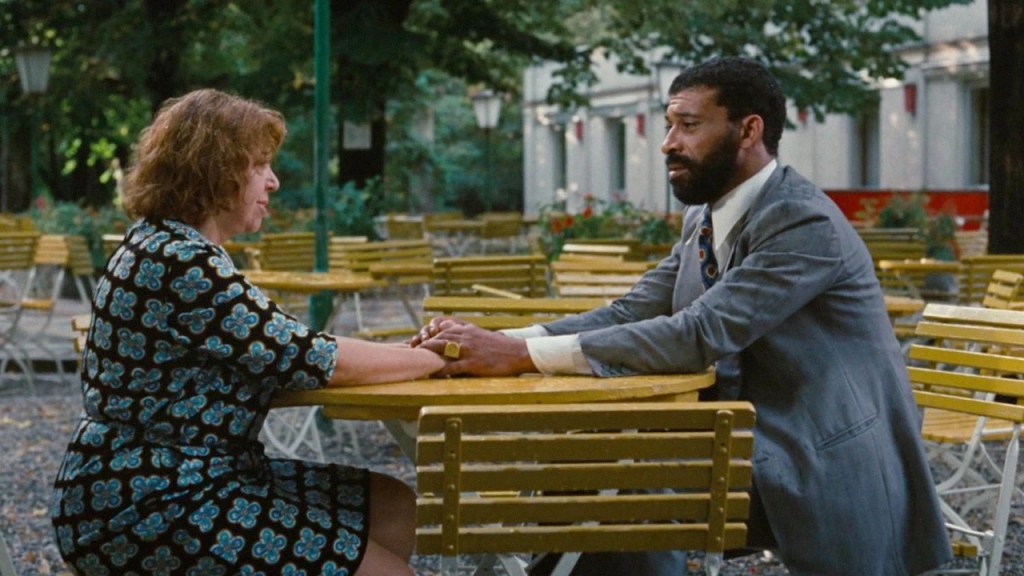
The DNA of 1950s Hollywood melodramas, particularly Douglas Sirk’s All That Heaven Allows (1955), is evident in Ali: Fear Eats the Soul. Rainer Werner Fassbinder uses the love story of a 60-year-old cleaning woman and a much younger Arab man in postwar West Germany to explore the xenophobia endured by many immigrants. Brigitte Mira plays Emmi, a widow whose chance meeting in a bar with Ali (El Hedi ben Salem), a strapping Moroccan mechanic, leads to an unlikely romance. They marry, but the union is fraught with tension, and not merely because of the marked age difference between them. “Germans with Arabs, not good,” Ali tells Emmi. “Arabs not human in Germany.” Emmi is soon ostracized by her adult children, neighbors, and coworkers. Feebly, she tries to excuse the racism that surrounds her, but also succumbs to it. It is noteworthy that Emmi, a onetime member of the Nazi party, drags Ali to a restaurant that had been a favorite of Adolf Hitler’s. Shot in two weeks on a tight budget, Ali: Fear Eats the Soul underscores the complexities of humanity’s need for acceptance and penchant for tribalism. In a strange epilogue to the filming, Salem fled West Germany after stabbing three people two years after the picture’s release. He was arrested in France, but took his own life while in custody in 1977. Fassbinder dedicated his final movie to Salem, who had been an ex-lover.
(See more in The 15 best films that explore class divides.)
Honorable mention: Avalon (1990, dir. Barry Levinson), Border Incident (1949, dir. Anthony Mann), Brooklyn (2015, dir. John Crowley), Dirty Pretty Things (2002, dir. Stephen Frears), The Farewell (2019, dir. Lulu Wang), Fremont (2023, dir. Babak Jalali), Green Border (2023, dir. Agnieszka Holland), The Immigrant (2013, dir. James Gray), In America (2002, dir. Jim Sheridan), R.M.N. (2022, dir. Cristian Mungiu)

