In cinema, where we watch characters who don’t know they are being watched, voyeurism is a feature and not a bug. It isn’t surprising, then, that movies often explore the implications of being a voyeur.
Some filmmakers, particularly Alfred Hitchcock and Brian De Palma, made it a cornerstone of their works. “When you’re watching something voyeuristically, you can watch the most inane things,” De Palma was quoted in Michael Pye and Linda Myles’ The Movie Brats. “You can watch a woman ironing across the street and the key question is: will she go to the refrigerator and take out a sandwich?” Outside a movie theater, of course, the voyeur has decidedly problematic connotations. Here are 10 movies that look—and look and look—into voyeurism.
10. One Hour Photo (2002, dir. Mark Romanek)
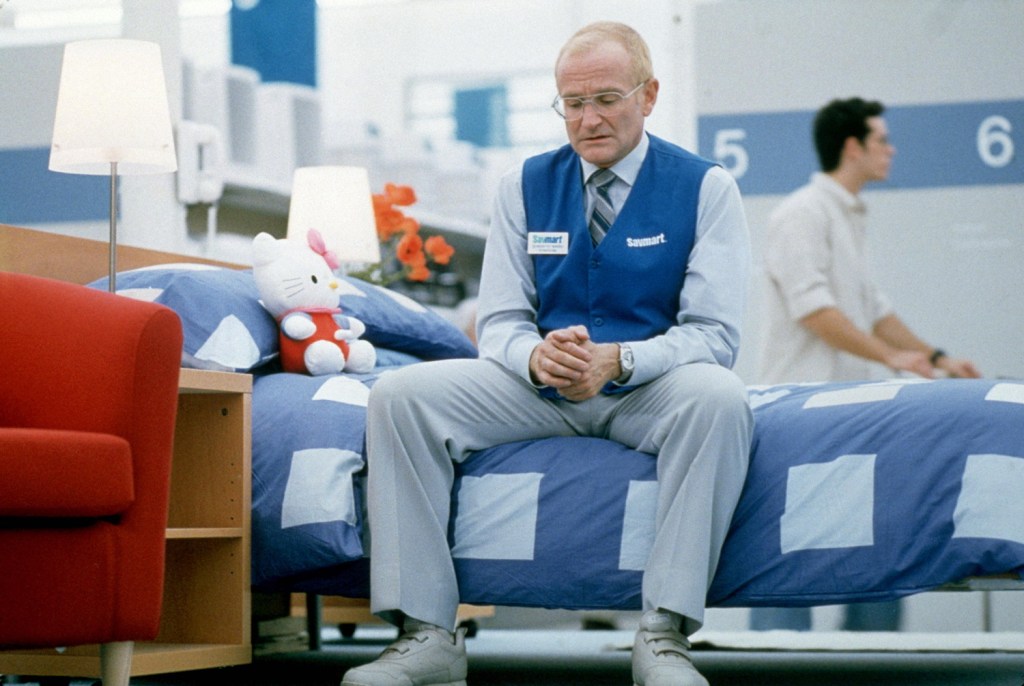
As a photo technician in a photo-processing lab, Sy Parrish (Robin Williams) has the unique vantage point to share, albeit vicariously, the special moments of strangers’ lives. For Sy, however, a man without family or friends, such access can lead to terror for a family like the Yorkins. He is obsessed with the attractive, seemingly all-American household, even maintaining a sort of shrine to them in his apartment. Sy learns that Mr. Yorkin (Michael Vartan) is cheating on his wife (Connie Nielsen)—a discovery made through developing photos, of course—and his disillusionment spirals into derangement. Williams relished the opportunity to play against type, preparing for the role by immersing himself in interviews with serial killers. If the age of smartphones has rendered One Hour Photo a bit dated, fear not: there’s always social media to feed the Sy Parrishes among us. Creepiness is forever..
9. Body Double (1984, dir. Brian De Palma)
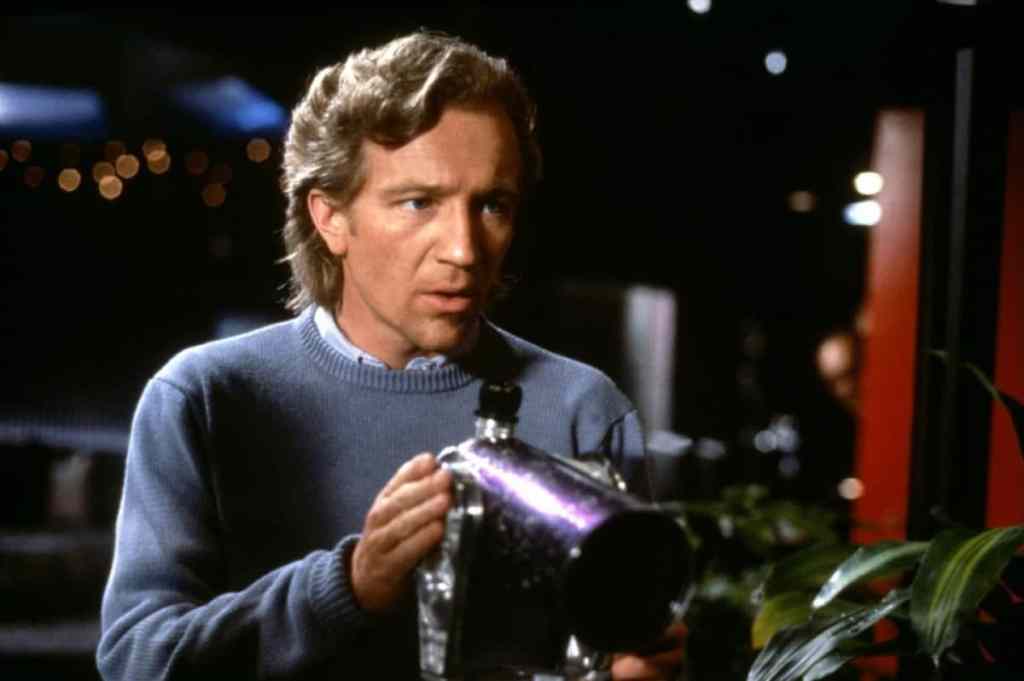
Struggling actor Jake Scully (Craig Wasson), needing a new place to stay after he catches his girlfriend mid-coitus, is only too happy when a friend offers to let him housesit in a posh Los Angeles apartment. He takes advantage of the apartment’s telescope and begins routinely spying on a neighbor who dances erotically in front of her window at the same time each evening. During one such nightly peeping session, he watches in horror as she is murdered by an intruder. Jake calls the police and rushes to save the woman, but he is too late. This being a Brian De Palma film, Jake nurses his grief by watching pornography, only to notice that one of the performers, Holly Body (Melanie Griffith), is doing the exact same erotic routine. Body Double is ludicrous but sordid fun—sexy, knowingly campy and packed with visual punch. As always with De Palma, the line between watching and participating is not just blurred—it’s erased.
8. Red Rooms (2023, dir. Pascal Plante)
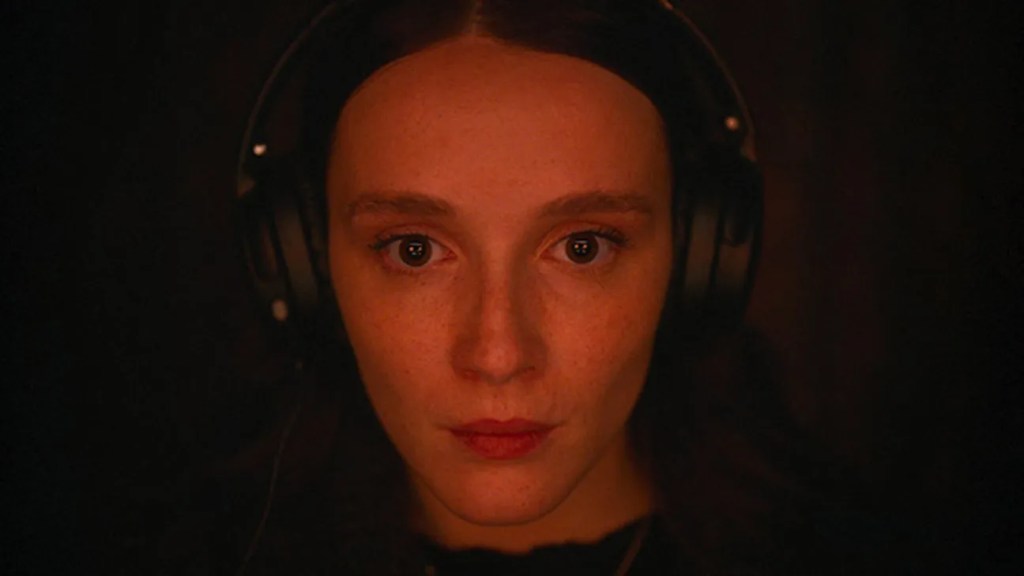
This coldly menacing, French-Canadian thriller probes the darkest recesses of voyeurism. It concerns a man (Maxwell McCabe-Lokos) on trial in Montreal for the abduction, torture and murder of three teenaged girls, a crime he is accused of recording and uploading to the “dark web.” The high-profile case attracts a small but unsettling coterie of admirers of the defendant, particularly Juliette Gariépy as Kelly-Anne, a fashion model who is fixated on the proceedings. She strikes up a friendship with one of the accused’s more ardent groupies (Laurie Babin), who insists he is too gentle and dreamy to be guilty. Kelly-Anne is more circumspect in her views, but harbors her own unusual obsessions. Red Rooms can be a challenging watch, but it’s also hard to turn away. Writer-director Pascal Plante understands that the most disturbing thing about true crime fascination isn’t the criminals. It’s us.
7. Blue Velvet (1986, dir. David Lynch)
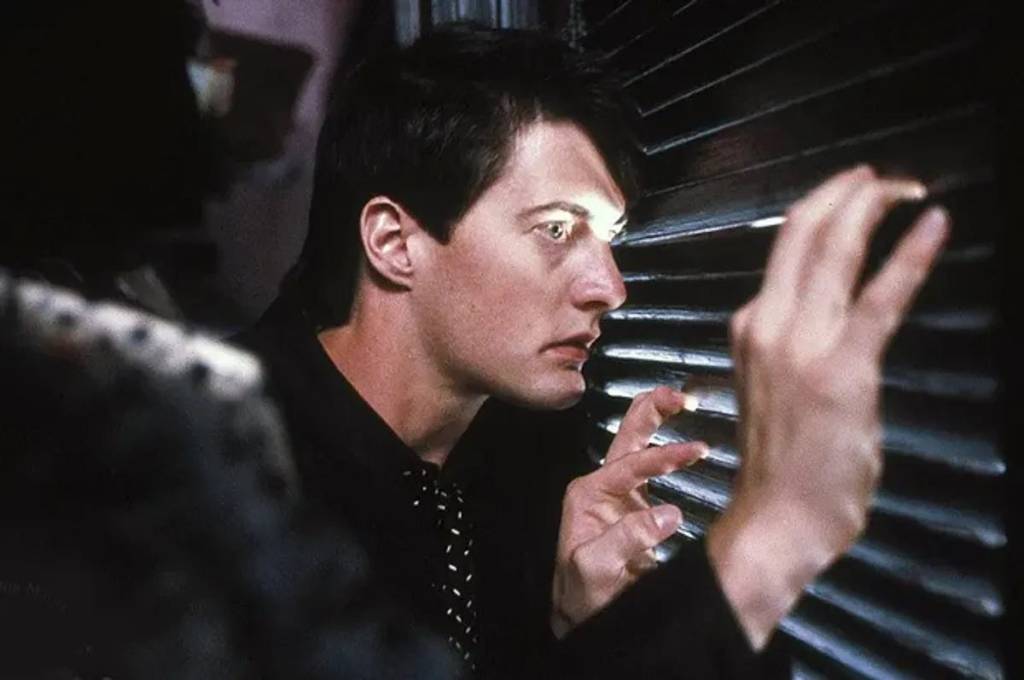
Blue Velvet’s Jeffrey Beaumont (Kyle MacLachlan) just wants to solve the mystery surrounding a severed human ear he found. Surely, it’s not his fault that unraveling the mystery entails hiding in the apartment of lounge singer Dorothy Vallens (Isabella Rossellini) to spy on her. Watching through the slats of a closet door, he eventually sees Dorothy raped and beaten by the supremely scary Frank Booth (Dennis Hopper). But the encounter and Dorothy’s incomprehensible relationship with Frank pulls Jeffrey further into the dark underbelly of life in small-town Lumberton. “I don’t know if you’re a detective or a pervert,” Jeffrey is told by his friend, Sandy (Laura Dern). His act of watching is ultimately not about learning Dorothy’s secrets, but about exposing his own. In Blue Velvet, David Lynch suggests that the whole “detective or pervert” question is a distinction without a difference.
(See more in The 20 best needle drops in film and The 15 best neo-noir films.)
6. Peeping Tom (1960, dir. Michael Powell)
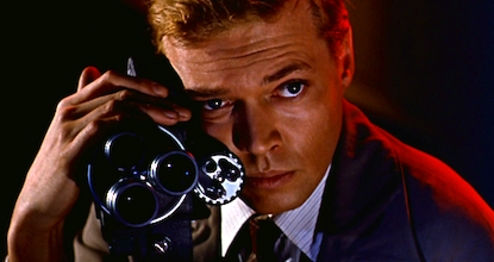
Michael Powell and Emeric Pressburger had turned out a string of beloved British films under the name “The Archers,” but Powell’s first solo outing since the dissolution of that partnership was jarring: the story of a London serial killer who films his female victims at the moment he fatally impales them with the sharpened end of a tripod leg. As murderers go, Mark Lewis (Karlheinz Böhm) cuts a particularly pathetic figure, enslaved by his psychotic compulsions. But we discover that he is also a victim—the son of a renowned psychologist who had bizarre ideas about how best to research the effects of fear on his child. Moviegoing Brits in 1960 were not much intrigued by the psychological underpinnings of Peeping Tom. Instead, they were mainly repulsed, a reaction that seems awfully quaint and short-sighted decades later. Powell’s movie is certainly unsavory, but its sinister implications of voyeurism—especially for those of us watching it unfold on screen—is chilling.
(See more in The 15 best slasher movies.)
5. The Lives of Others (2006, dir. Florian Henckel von Donnersmarck)
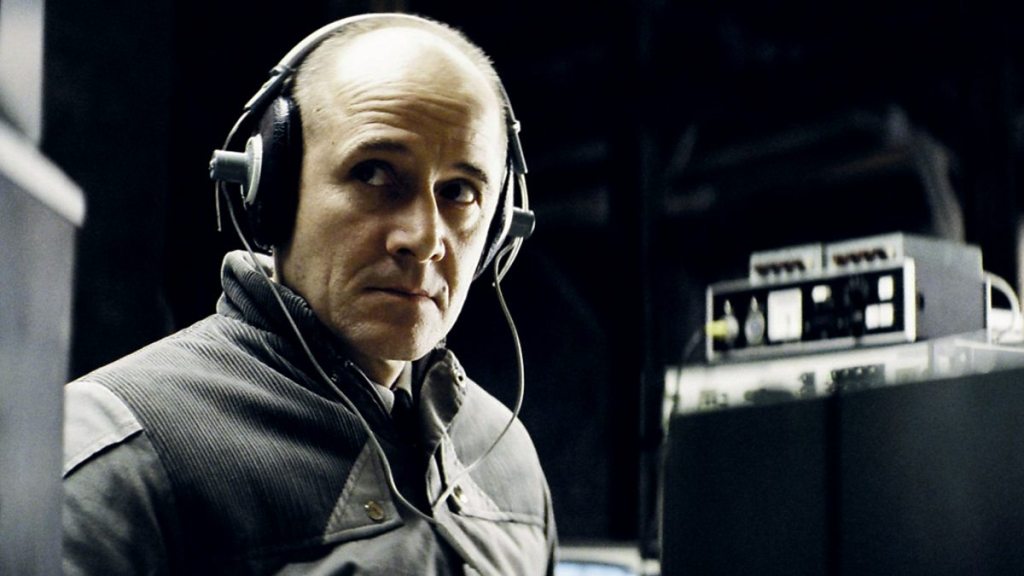
The Lives of Others recounts the world before the Nov. 9, 1989, fall of the Berlin Wall, when East Germans lived in constant fear. By weaponizing the acts of watching and listening to the citizenry, the Stasi secret police force ensured strict obedience to the authoritarian Communist regime. In this state of paranoia, Stasi captain Gerd Wiesler (Ulrich Mühe) is a consummate spy renowned for his powers of interrogation. He is excited to bug the home of Georg Dreyman (Sebastian Koch), a celebrated playwright who has been targeted by a government minister (Thomas Thieme) with designs on Georg’s actress-girlfriend, Christa-Maria Sieland (Martina Gedeck). Wiesler’s surveillance of Georg and Christa-Maria affords him glimpses of a heretofore stifled humanity. While the performances are uniformly excellent, Mühe is especially superb; his metamorphosis is credible and poignant. The directorial debut of Florian Henckel von Donnersmarck took the Academy Award for Best Foreign-Language Picture. Mühe attended the ceremony. Five months later, he died of stomach cancer.
4. The Truman Show (1998, dir. Peter Weir)
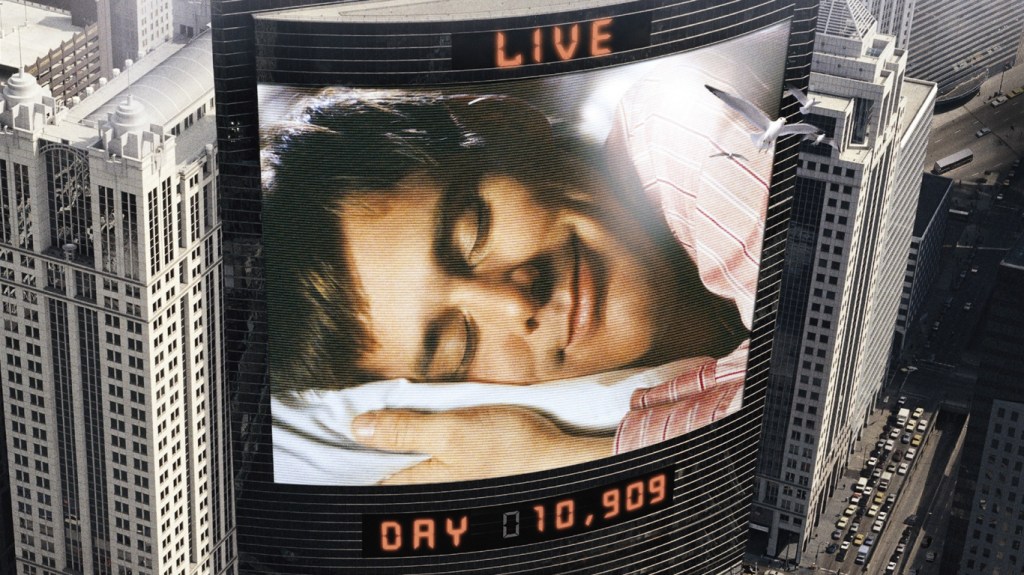
Jim Carrey is the title character wholly unaware that his entire life has been the subject of a long-running television series. When The Truman Show (the movie, not the ersatz TV program) hit theaters in 1998, the national zeitgeist was just beginning to embrace the reality TV phenomenon and social media wasn’t yet a glimmer. The comedy-drama from director Peter Weir and screenwriter Andrew Niccol is ingenious entertainment that also happened to have been clairvoyant. Truman Burbank discovers that every moment of his existence has been recorded and shared worldwide. Moreover, his own world is an enormous and elaborate soundstage. These revelations lead to an existential dilemma. What is free will? What is life, for that matter? Carrey is dynamite and (mostly) restrained in his first dramatic role, and he receives strong support from the likes of Laura Linney, Noah Emmerich and—best of all—Ed Harris as the reality show’s godlike creator, Christof. Truman may be the one on display, but the film makes clear that we are the ones doing the watching.
3. Caché (2005, dir. Michael Haneke)
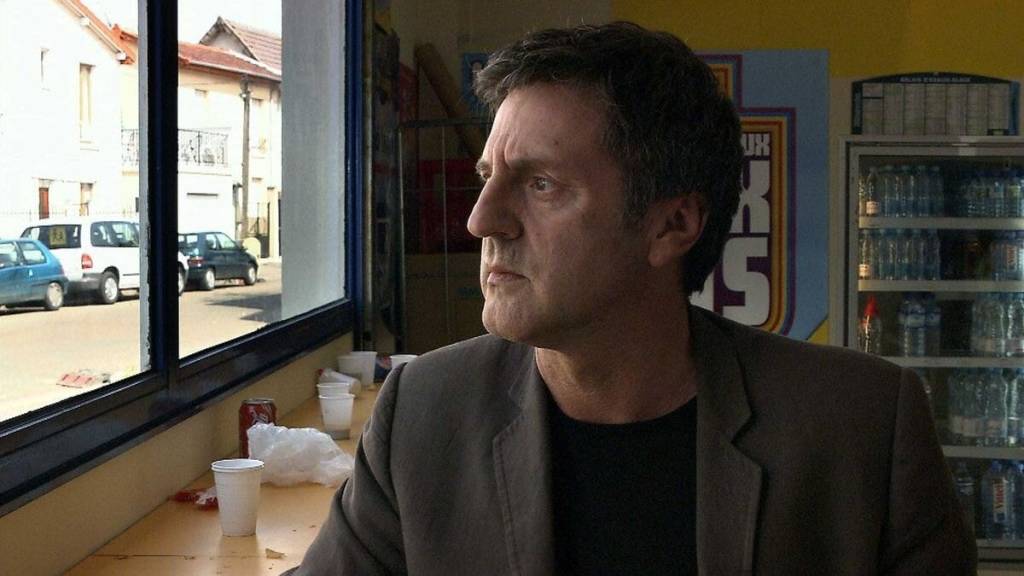
You see the street-level view of a well-kept Paris home. The camera is stationary and we’re not sure what we are meant to see. Then we hear the voice of someone obviously seeing the same picture, and the static shot fast-forwards briefly. We are watching a videotape of a house apparently under surveillance, we realize along with the bourgeois couple who has received the anonymous video. Georges and Anne (Daniel Auteuil and Juliette Binoche) are understandably shaken. More tapes arrive over successive days, along with what looks to be the crude, ominous drawing of a child. Georges wonders if the videos and pictures have something to do with a childhood incident that he had all but swept from his memory. Caché manifests the psychological terror of being watched against one’s will, but it delves further, linking the voyeurism to a country’s collective shame of colonialism. Austrian filmmaker Michael Haneke, one of cinema’s great provocateurs, makes the moviegoer complicit by continually forcing us into the eyes of the voyeur as well as the couple being watched—sometimes we are not even sure whose point of view we have. In the end, Caché surveils the viewer.
2. Blow-Up (1966, dir. Michelangelo Antonioni)
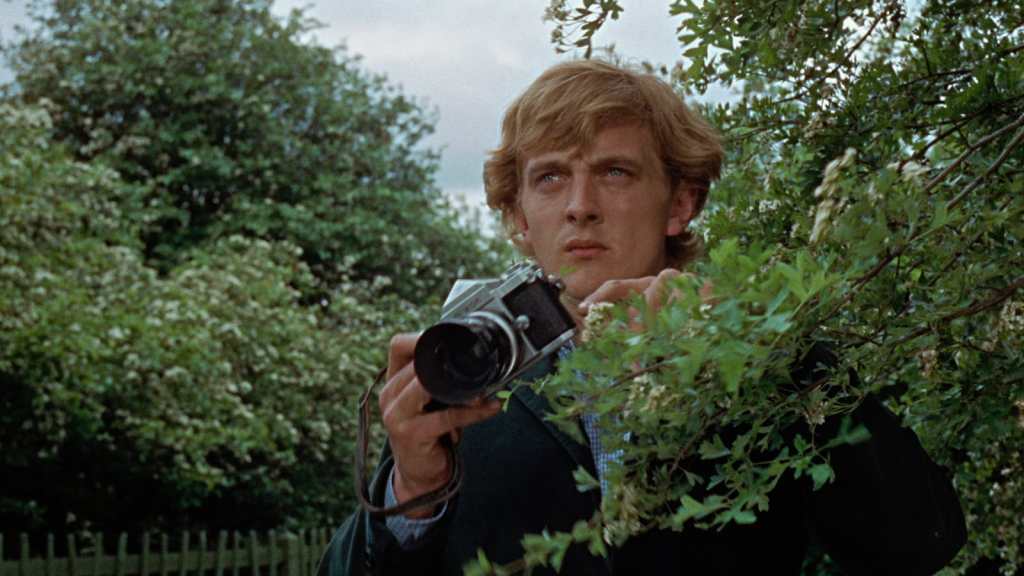
Michelangelo Antonioni’s first English-language film was an international arthouse sensation upon its release. David Hemmings is Thomas, a fashion photographer in 1960s Swinging London. Even as a time capsule of that singular moment—the glamour, the sex, the music, the posh digs—Blow-Up would be essential viewing. But Antonioni, who shared writing credit with Tonino Guerra, scratches beneath the mod artifice to ponder our perceptions of reality. Thomas is shooting photos in a park one afternoon when he snaps pictures of a woman (Vanessa Redgrave) with a man in what might be a tryst. She tries to get the film, but her persistence only makes Thomas more curious about what he has. Later, having blown up the negatives, he realizes he might have unwittingly documented a murder. “Death … makes its grand entrance in a photographer’s studio through the eyes of a camera that sees truth whereas the eyes of the photographer only see reality,” wrote renowned critic Andrew Sarris in the Village Voice. “This then is the paradox of Antonioni’s vision of art. The further we draw away from reality, the closer we get to the truth.” The movie’s DNA is evident in Francis Ford Coppola’s The Conversation (1974) and Brian De Palma’s Blow Out (1981). Blow-Up also boasts one of the all-time great movie endings—which is saying a lot, since it involves mimes.
1. Rear Window (1954, dir. Alfred Hitchcock)
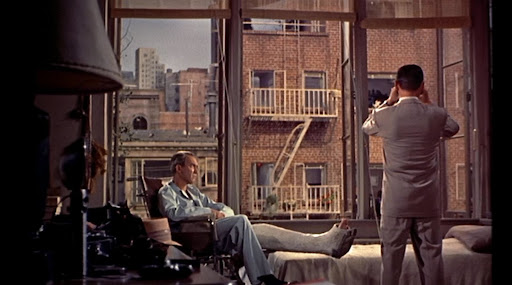
Voyeurism is central to the artistry and vision of Alfred Hitchcock, but the implications of what it means to watch are the very engine of Rear Window. As a globe-trotting photographer temporarily confined to a wheelchair, L.B. “Jeff” Jeffries (Jimmy Stewart) has nothing to do but spy on his neighbors. Newlyweds move in. An attractive single woman fends off suitors. A composer agonizes over his current work. A lonely single woman pretends she has a dinner date. Stella (Thelma Ritter), the nurse providing care to Jeff, disapproves. “We’ve become a race of Peeping Toms,” she laments. “What people ought to do is get outside their own house and look in for a change.” The stakes ratchet up considerably when Jeff suspects the unhappily married traveling salesman across the courtyard, portrayed by Raymond Burr, has killed his wife. Jeff’s suspicions eventually draw in his girlfriend, Lisa Fremont (Grace Kelly, at her most dazzling), who until now has dismissed Jeff’s neighbor-watching as unhealthy. “The film examines the dangerous potential of voyeurism,” writes Donald Spoto in The Art of Alfred Hitchcock. “And because of a constant identification between Jeffries and the viewer, it is our own potential we are seeing.” Rear Window is one of those rarefied films I consider perfect. There is no deadweight here; Hitchcock’s talent for visual storytelling has never been better.
Honorable mention: American Beauty (1999, dir. Sam Mendes), The Anderson Tapes (1971, dir. Sidney Lumet), Being John Malkovich (1999, dir. Spike Jonze), Blow Out (1981, dir. Brian De Palma), The Conversation (1974, dir. Francis Ford Coppola), Following (1998, dir. Christopher Nolan), Kimi (2022, dir. Steven Soderbergh), Three Colors: Red (1994, dir. Krzysztof Kieślowski), Vertigo (1958, dir. Alfred Hitchcock), Wings of Desire (1987, dir. Wim Wenders)
 Cutting to the Chase with Phil Bacharach
6 responses to “The 10 best films about voyeurism ”
[…] British reviewers and moviegoers assailed Peeping Tom upon its release as grotesque trash, and it essentially ended the career of its director, Michael Powell. Critics couldn’t understand how such perverse rubbish could have come from Powell, whose collaboration with Emeric Pressburger yielded some of the UK’s greatest pictures, including The Red Shoes, Black Narcissus and The Life and Death of Colonel Blimp. As with so many great movies, Peeping Tom was simply ahead of its time. Its portrait of a psychologically damaged serial killer is disturbing stuff, but hardly scandalous. “It is a film in which you cannot tell disgust from exhilaration,” writes film scholar David Thomson, “because it is gripped by the real sadism of a serial killer.” Karlheinz Böhm is effectively creepy as Mark Lewis, a photographer with a compulsion to film women at the moment of their impalement on the sharpened leg of his tripod. Mark’s solicitous demeanor and awkwardness around women echoes that of Psycho’s Norman Bates (see #3), who was also scaring audiences that same year.(See more in The 10 best films about voyeurism.) […]
LikeLike
[…] A suburban dad has a heart attack while watering his lawn. He topples to the ground and the camera burrows into the subterranean layers of earth until we land in a frenzied insect world, chaotic and cacophonous. That dichotomy between respectable suburbia and monstrosity simmering below the surface is the central metaphor of this David Lynch masterpiece. Blue Velvet then shifts to the stricken man’s son, guileless Jeffrey Beaumont (Kyle MacLachlan), who is home from college to help take care of his father. On a stroll through the neighborhood, Jeffrey comes across a human ear, and the mystery it promises is something that he and his equally sweet-as-pie neighbor (Laura Dern) cannot resist investigating. If you have seen Blue Velvet, you know the sinister rabbit hole that follows, from Isabella Rossellini as a sultry torch singer to Dennis Hopper as the evilest sumbitch to ever don an oxygen mask. Lynch loves the dance between innocence and corruption. Blue Velvet might just be the cinematic apex of that thematic obsession, as vivid as a severed ear in a nice neighborhood.(See more in The 10 best films about voyeurism.) […]
LikeLike
[…] Scotty Ferguson (James Stewart), the detective in this dreamlike trance of a movie, becomes obsessed with recreating an illusion. But then again, Vertigo itself is fascinated by how easily a person can be remade into the image of another. He is hired to trail a client’s wife, Madeleine Elster (Kim Novak), a beautiful blonde obsessed with the belief she is possessed by a ghost. And yet Madeleine is herself a ruse manufactured by the client as part of a scheme to lure Scotty. It works. Scotty falls for faux Madeleine, only to watch helplessly as she hurls herself from the top of a tower. Months later, a grieving Scotty comes across a shopgirl, Judy (also Novak), who bears a striking resemblance to the deceased woman. Scotty courts the red-haired Judy, albeit with some unsettling demands. Put on this blonde wig, wear this gray dress, change your posture: erase yourself and become someone else. The situation is particularly knotty for Judy, who actually had pretended to be Madeleine, but she submits to Scotty’s creepy makeover in a desperate effort to make him like her. For Alfred Hitchcock, who created the icy-blonde archetype in movie after movie, this narrative had special resonance. In Vertigo, the self is alarmingly pliable—the putty of obsession.(See more in The 10 best films about voyeurism.) […]
LikeLike
[…] Set in Berlin, this Wim Wenders stunner stars Bruno Ganz as Damiel, one of the masses of ubiquitous angels who monitor the messy lives of human beings as they go about their day-to-day lives. The existence of Damiel and his colleagues, meanwhile, is a state of removed observations. They watch, listen and document, but they cannot interfere with the mortals. Wings of Desire “creates a mood of sadness and isolation, of yearning, of the transience of earthly things,” wrote Roger Ebert in The Great Movies. “If man is the only animal that knows it lives in time, the movie is about that knowledge.” Damiel grows enamored with a troubled trapeze artist, played by Soloveig Dommartin, whom he sees in a traveling circus. The celestial crush is enough for this lovelorn angel to trade in his wings for flesh and blood. Henri Alekan’s black-and-white cinematography is achingly beautiful. Look for a wonderful cameo from Peter Falk as himself.(See more in The 10 best films about voyeurism.) […]
LikeLike
[…] “Look at me, jerking off in the shower,” Lester Burnham (Kevin Spacey) tells us in voice-over. And sure enough, there he is onscreen, masturbating through tears, partly obscured (thankfully) by the shower stall door. It is a provocative opening for American Beauty, the apex of white, male, middle-class, suburban despair. “This will be the high point of my day,” Lester continues. “It’s all downhill from here.” Considering he is a dead man narrating, it’s fair to say Lester is correct.(See more in The 10 best films about voyeurism.) […]
LikeLike
[…] until Frank abruptly ends the show. “All right! Let’s hit the fuckin’ road!”(See more in The 10 best films about voyeurism and The 15 best neo-noir […]
LikeLike