Crime doesn’t pay? Try telling that to filmmakers. The gangster movie is among cinema’s most enduring genres, offering audiences the vicarious thrill of being bad. Its golden age came in the 1930s, when hard-edged, Pre-Code pictures such as Little Caesar, The Public Enemy, and Scarface: The Shame of a Nation introduced a rogue’s gallery of Prohibition-era antiheroes.
In the decades since, the gangster saga has proved versatile enough to encompass everything from Japan’s yakuza films (Battles without Honor and Humanity, The Yakuza) to 1976’s Bugsy Malone, an all-kid musical comedy in which pint-sized mobsters guzzle speakeasy sarsaparilla and fire Tommy guns that spray whipped cream. At their best, gangster flicks are not simply crime stories but examinations of ambition, power, and greed.
Here are 10 of the best you can’t refuse.
10. White Heat (1949, dir. Raoul Walsh)
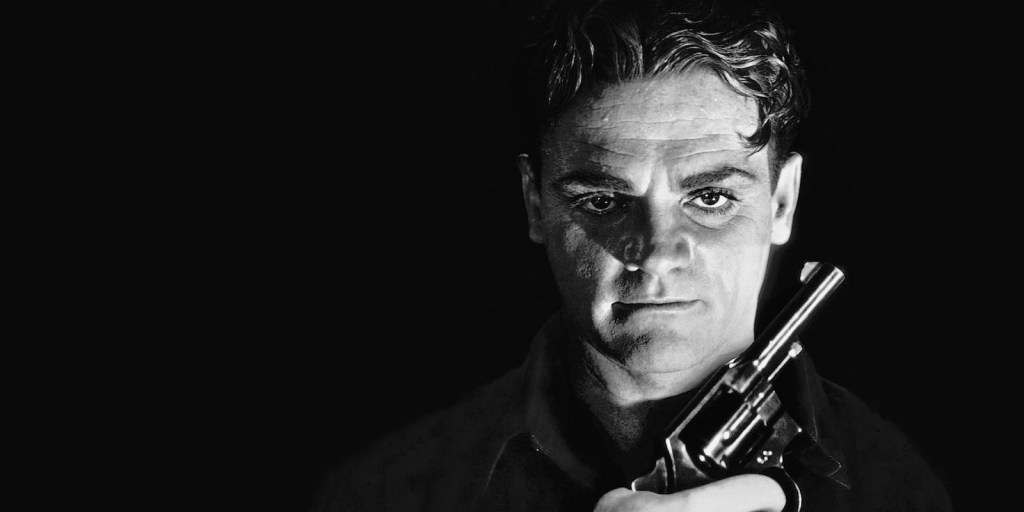
Gangster movies are rife with bad guys who have a soft spot for their mothers, but White Heat’s Cody Jarrett is in a class by himself. As portrayed by James Cagney, Cody is to mama’s boys what Picasso was to cubism. He loves Ma Jarrett (Margaret Wycherly) with near-Oedipal fervor. She is the brains of his criminal gang, sure, but Cody treats Ma like royalty while he barks orders at his hot-but-trashy wife (Virginia Mayo) as if she were an indentured servant. White Heat is a whirling dervish of a film. Raoul Walsh, who had previously directed Cagney in The Roaring Twenties, keeps the pace brisk and the vibe brutal, but most of the energy derives from the star; billed as his comeback, Cagney is fury incarnate. The man contorts his face into a fist. While the movie’s climax is rightly ensconced in pop culture (“Made it, Ma! Top of the world!”), few moments can rival the prison mess-hall scene when Cody learns of his mother’s death. He erupts in guttural howls that reportedly shocked the room of extras playing inmates.
(See more in The 15 best film noir and 10 memorable movie mothers.)
9. Once Upon a Time in America (1984, dir. Sergio Leone)
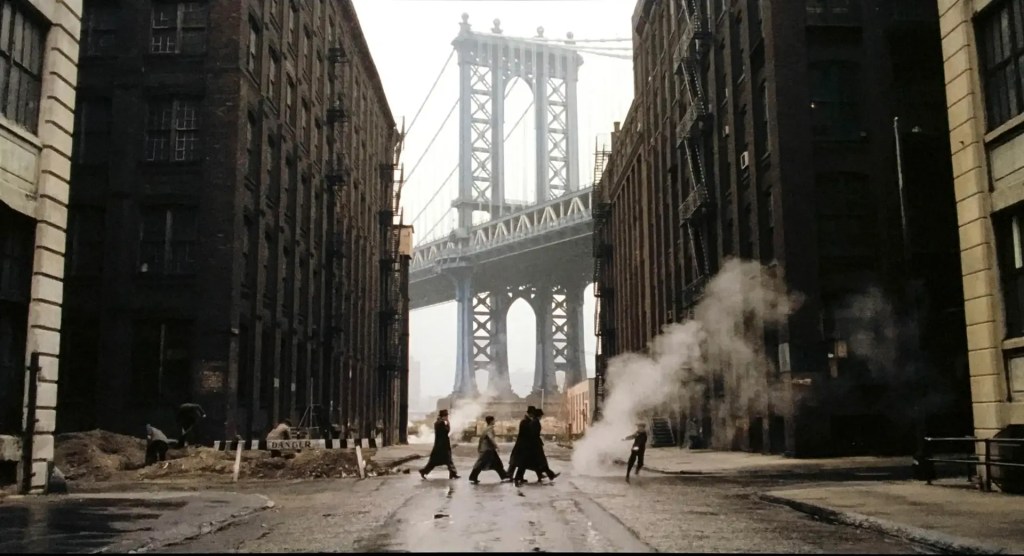
For his final film, Sergio Leone brought to the gangster genre the same mixture of mythmaking and deconstruction he had applied to the western. Spanning 1922 through 1968, Once Upon a Time in America follows Robert De Niro and James Woods as two Jewish kids from New York’s Lower East Side who grow from petty hoods to crime kingpins. It is epic in scope and elegiac in tone (thanks largely to Ennio Morricone’s haunting score), rich in period detail and boasting a strong ensemble cast—but it is also emotionally distant. There are bizarre shifts in tone, and, as evident in a brutal rape that De Niro’s “Noodles” Aaronson commits, it is sometimes difficult to tell when a character’s misogyny ends and Leone’s begins. Some cinephiles contend that much of the story is an opium-induced hallucination experienced by Noodles. I’m not sure I buy that. The picture was doomed to have some problems with flow. The distributor chopped 90 minutes from the American release after Leone’s version clocked in just shy of four hours (its most comprehensive restoration came in 2012). However flawed, this saga remains a fascinating and ambitious inquiry into guilt, self-deception, and the unreliability of nostalgia.
8. The Roaring Twenties (1939, dir. Raoul Walsh)
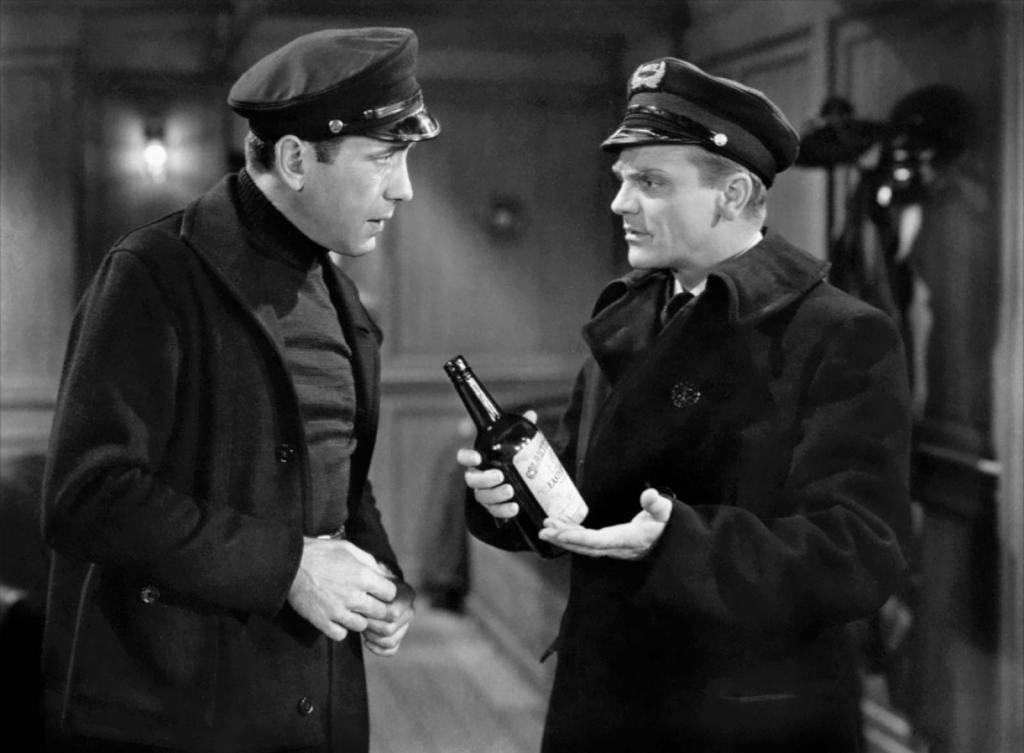
When the studio system was thrumming along in the 1930s and ‘40s like the efficient machine it was, Hollywood cranked out fast-paced stories that did what they needed to do and got out before you started to check the time. Raoul Walsh’s The Roaring Twenties exemplifies that craftsmanship. Based on a story by producer Mark Hellinger, it follows three American soldiers who meet in a foxhole during the First World War—Eddie (James Cagney), George (Humphrey Bogart), and Lloyd (Jeffrey Lynn)—and cross paths later during Prohibition when Eddie has become a top bootlegger. Cagney’s Eddie Bartlett is several shades more interesting than Warner Bros.’ run-of-the-mill movie gangster. He’s tough, certainly, but also a lovesick sap over Jean, the lounge singer played by Priscilla Lane, whose career he bankrolls only to lose her to do-gooder Lloyd. Cagney’s commanding screen presence sometimes obscured what a skilled actor he was. The Roaring Twenties is a reminder that he could also dig into a character’s vulnerability.
7. Scarface (1983, dir. Brian De Palma)
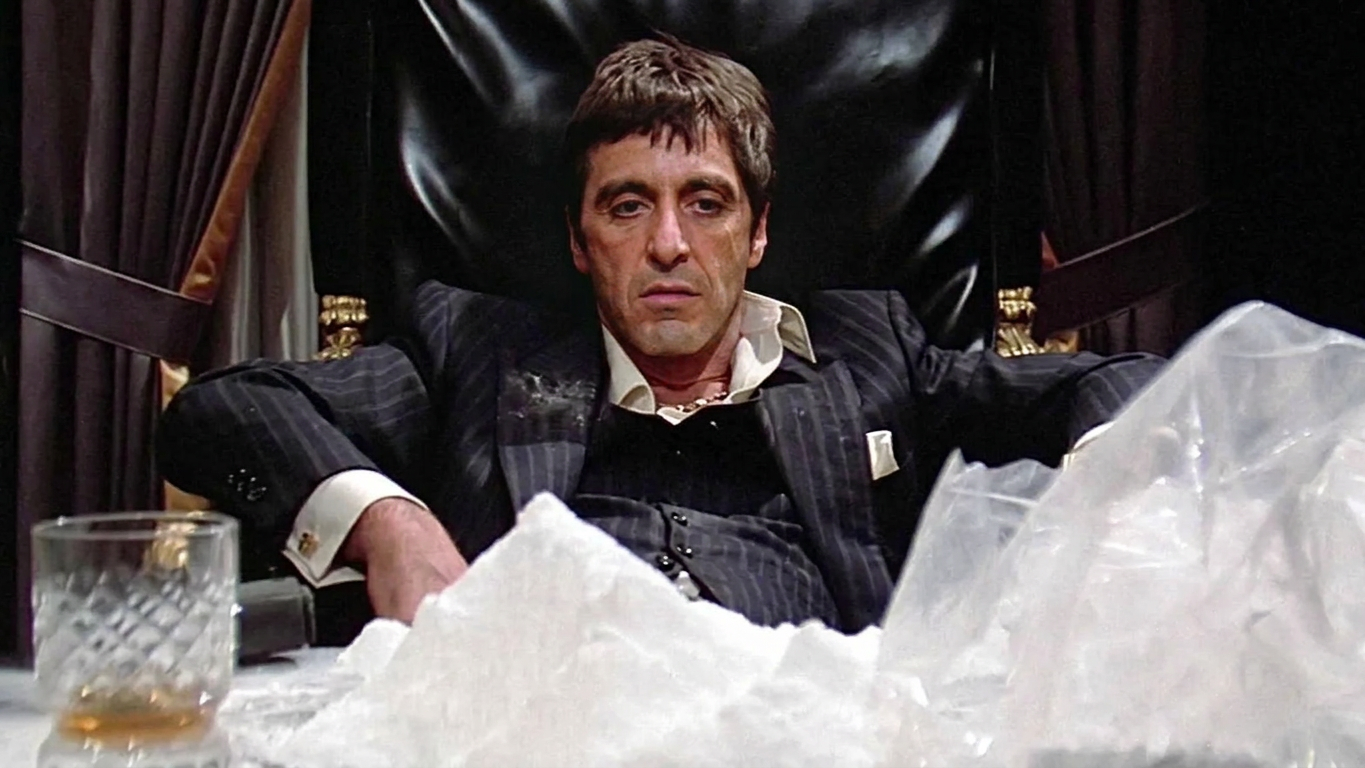
“Say hello to my little friend!” This blood-soaked remake of Howard Hawks’ 1932 crime picture long ago graduated from movie to meme, but Scarface is a pop-culture touchstone for a reason. This is pulp fiction writ large from director Brian De Palma, screenwriter Oliver Stone, and lead Al Pacino—creatives not exactly known for timidity. Tensions ran high on set. Pacino, by the climax toting an M16 fitted with a grenade launcher, is deliriously over-the-top as Tony Montana, a Cuban refugee who arrives via the 1980 Mariel boatlift and becomes Miami’s drug kingpin. Supporting players Michelle Pfeiffer and Steven Bauer fight for attention whenever Pacino isn’t snorting up all the oxygen—and cocaine—on screen. De Palma being De Palma, there are suspense sequences so meticulously crafted that they belong in a museum. A critical punching bag upon release, its stature has only grown in the ensuing decades. No less a fan than Saddam Hussein slapped the name Montana Management on a corporation he had set up for money-laundering.
6. The Long Good Friday (1980, dir. John Mackenzie)
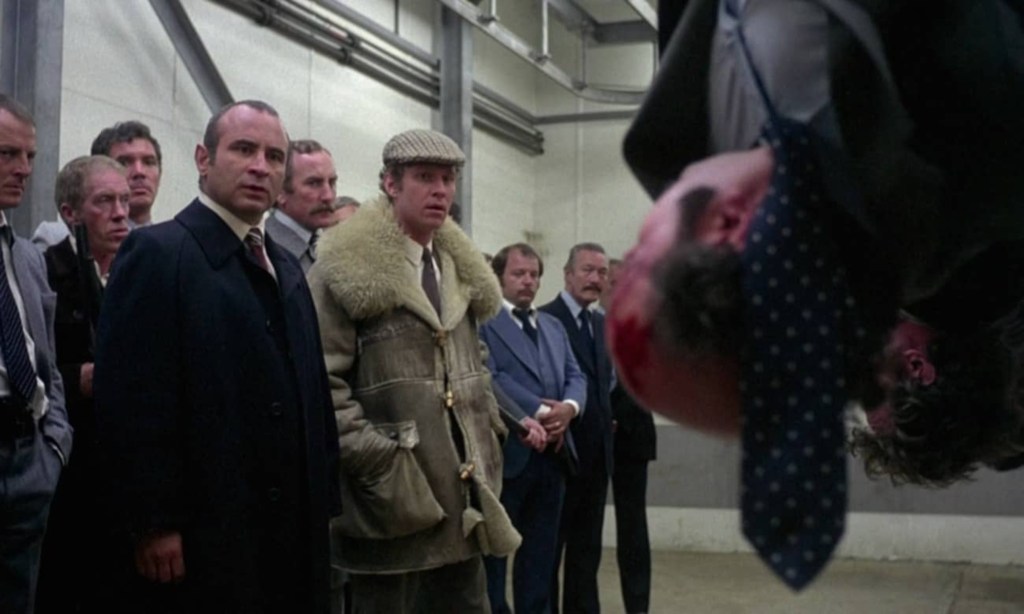
An alternate title for The Long Good Friday, the last great British crime thriller of the 1970s (completed in 1979 and first screened the following year) could be Bob Hoskins and the Terrible, Horrible, No Good, Very Bad Day. Hoskins is a barely contained reactor of nuclear rage as East London crime lord Harold Shand. A vicious hoodlum hoping to reinvent himself as a respectable businessman, he is in the midst of trying to close a real-estate deal with the American Mafia on a particularly difficult Good Friday (duh). The timing isn’t ideal. For reasons eventually explained, the Irish Republican Army has chosen this day to bomb Harold’s businesses and murder his closest associates, including a car bombing outside a church where Harold’s mother is attending services. “You don’t go crucifying people outside a church on a Good Friday!” barks the exasperated mob boss. Director John Mackenzie and screenwriter Barrie Keeffe go for a methodical slow burn as Harold, his partner Victoria (Helen Mirren), and his minions struggle to save their criminal empire. The picture made Hoskins a star, and rightly so. His wordless final close-up is a masterclass in acting.
5. Carlito’s Way (1993, dir. Brian De Palma)
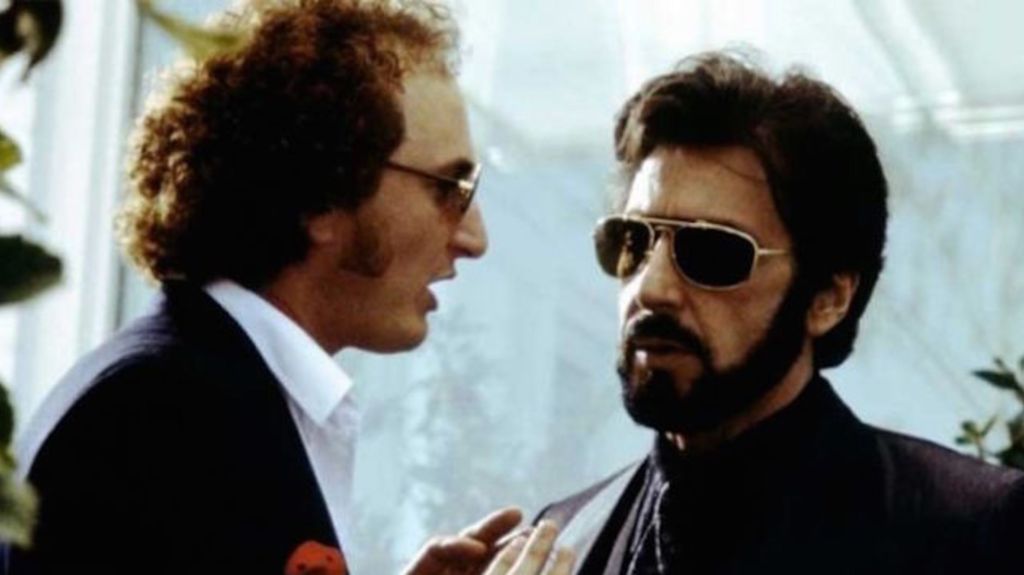
Leaving the gangster life ain’t easy. Just ask Al Pacino, whose Michael Corleone had already traveled that road in The Godfather saga (“Just when I thought I was out, they pull me back in!” he snaps in The Godfather Part III). In Carlito’s Way, he is Carlito Brigante, a muckety-muck in New York’s Puerto Rican underworld newly released from prison. He wants to go straight but discovers that is easier said than done. Carlito is barely out of the joint before he finds himself in a pool-hall shootout defending his cousin Guajiro from other hoods. Brian De Palma’s post-Scarface reunion with Pacino is solid genre entertainment anchored by David Koepp’s muscular script and a centerpiece scene at Grand Central Terminal that ranks among De Palma’s best work. Sean Penn has more fun than anyone as Carlito’s coke-snorting slimeball defense attorney, David Kleinfeld. Pacino is less volcanic here than in Scarface—we actually have a rooting interest in Carlito—but his Puerto Rican accent is only marginally more persuasive than his Cuban one in Scarface.
4. City of God (2002, dir. Fernando Meirelles and Kátia Lund)
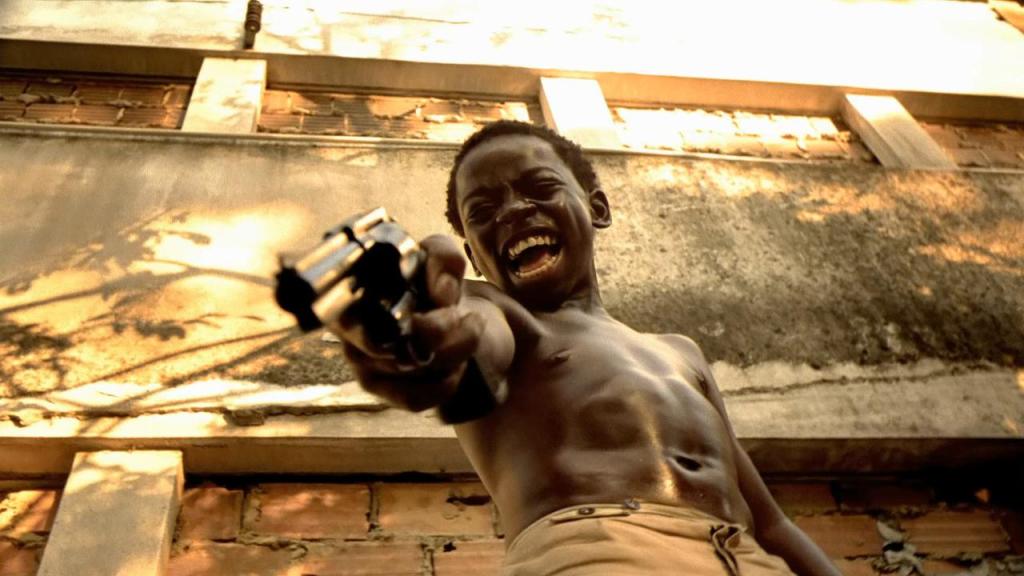
Set in a housing project on the outskirts of Rio de Janeiro, City of God is a maelstrom of warring gangs, roving bands of gun-wielding prepubescents, and the ubiquitous threat of death. This is thug life in the favela. An international sensation upon release, the Portuguese-language adaptation of Paulo Lins’ 1997 novel spans more than 20 years in the infamous ghetto. Rocket (Alexandre Rodrigues), who longs to escape, dreams of becoming a professional photographer. Benny (Phellipe Haagensen) is an affable drug lord who would rather party than kill. On the other end of the spectrum is Benny’s close friend and partner, Li’l Zé (Leandro Firmino), a crime boss with fearsome bloodlust; he isn’t even a teenager before he has committed mass murder. The visceral propulsion created by directors Fernando Meirelles and Kátia Lund is reminiscent of Martin Scorsese, but City of God is its own singular beast, its rawness and energy driven by fast edits, split screens, vibrant colors, docudrama techniques, handheld camerawork, and a quicksilver soundtrack of funk and samba. The picture inspired a Brazilian television series and helped bring renewed international attention to Brazil’s cinematic resurgence.
3. The Godfather (1972, dir. Francis Ford Coppola)
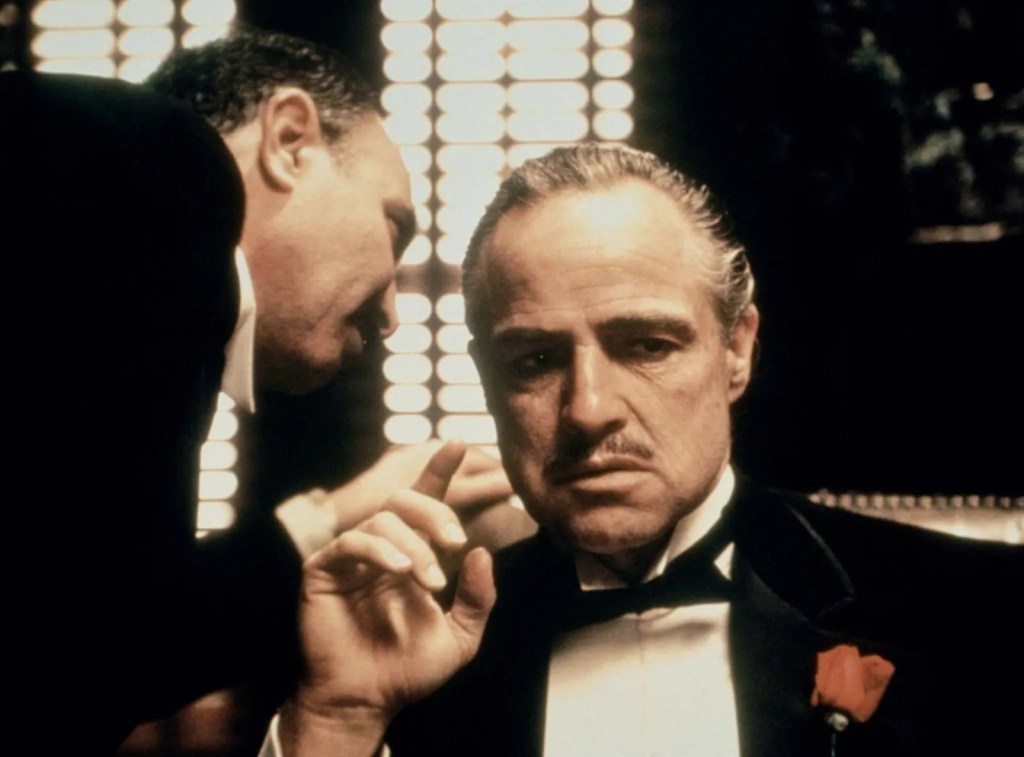
A box-office smash, cultural phenomenon, and winner of three Academy Awards, The Godfather redefined the gangster movie. Paramount Pictures took a considerable chance entrusting the adaptation of Mario Puzo’s bestseller to Francis Ford Coppola. Little in the 32-year-old director’s résumé suggested he was ready to shoulder a production on which the studio’s fortunes appeared to depend. Coppola’s vision was crucial in having the film transcend genre. In Mark Seal’s Leave the Gun, Take the Cannoli: The Epic Story of the Making of The Godfather, Coppola said he realized there was “the core of a profound story, one of a classic succession concerning a great king with three sons, each of whom had a single element of what made the king great.” Its production is the stuff of legend. Casting auditions seemingly included every actor with a SAG card; the studio considered Ryan O’Neal, Jack Nicholson, or Warren Beatty to play Michael Corleone. Once filming was underway, a New York Mafia family boss named Joe Colombo founded a sketchy Italian-American civil rights organization that successfully pressured Paramount to quash any overt reference in the picture to the Mafia. Marlon Brando won the Best Actor Oscar for the role of Vito Corleone, but boycotted the ceremony and declined the award in protest of Hollywood’s treatment of Native Americans and the federal response at Wounded Knee. Al Pacino and James Caan are every bit his equals as Corleone sons Michael and Sonny, with John Cazale quietly devastating as weak-willed second-son Fredo. The Godfather didn’t merely make the gangster genre respectable. It treated organized crime as a parallel American institution, complete with rituals, corporate strategy, and family mythology. From Gordon Willis’ innovative low-light, high-contrast cinematography and Nino Rota’s haunting music score to pitch-perfect casting, The Godfather deserves its reputation as not only one of the greatest gangster stories, but one of cinema’s best-ever films.
(See more in The 10 best bathroom scenes in film and 10 memorable movie fathers.)
2. Goodfellas (1990, dir. Martin Scorsese)
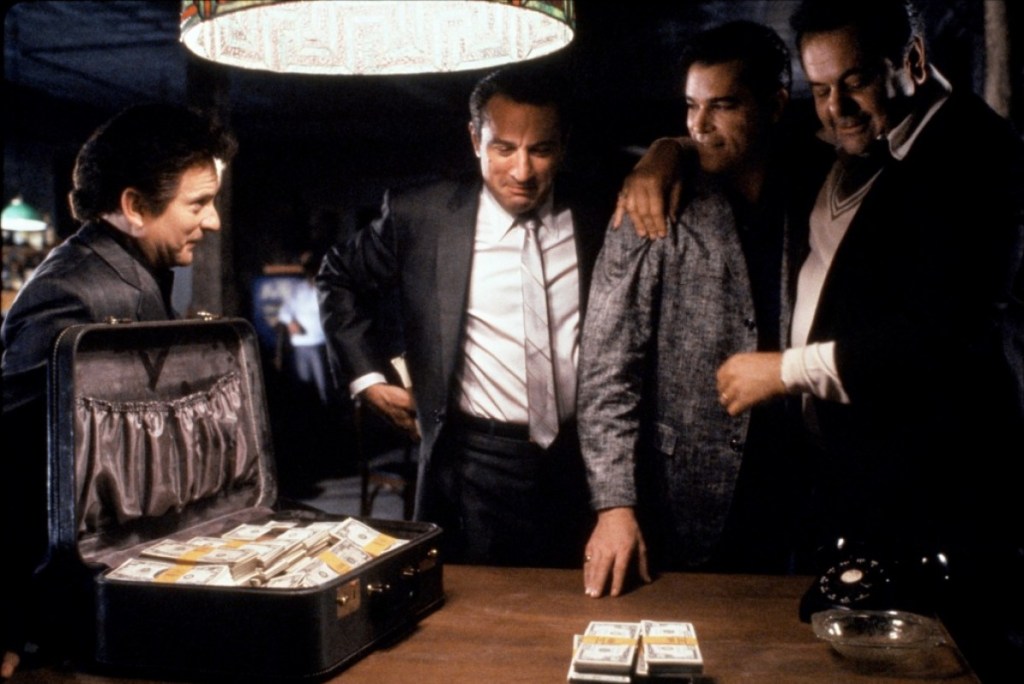
Martin Scorsese had long since kicked his cocaine habit by the time he made Goodfellas. You might not know it from this hyperkinetic roller coaster, which feels fueled by a three-hour coke binge. Like the devil’s powder, Goodfellas is enthralling, seductive, and potentially addictive. Unlike cocaine, repeated exposure isn’t bad for you. The picture, based on Nicholas Pileggi’s nonfiction Wiseguy: Life in a Mafia Family, chronicles the life of gangster-turned-federal informant Henry Hill. As a child growing up in Brooklyn, he is enamored of the big-shot hoodlums in his neighborhood flashing wads of cash. He winds up working for one, Paul Cicero (Paul Sorvino), and becomes fast friends with fellow mobsters Jimmy Conway (Robert De Niro) and Tommy DeVito (Joe Pesci). “The movie took gangsters off the wobbly pedestal popular culture erected in honor of The Godfather movies and made them into something like ‘regular’ guys again,” Glenn Kenny writes in Made Men: The Story of Goodfellas. The cast is extraordinary across the board, though Pesci’s portrayal of the unhinged Tommy steals his every scene and earned a Best Supporting Actor Oscar. The episodic structure allows Scorsese to flex in several knockout set pieces. Henry and his future wife Karen (Lorraine Bracco) visit the legendary Copacabana in a virtuoso unbroken tracking shot that immerses us in the excitement of the moment. The extended montage of the day leading to Henry’s arrest is a dazzler punctuated by rock ‘n’ roll needle drops and Thelma Schoonmaker’s breakneck editing. In illustrating both the evil of organized crime and its undeniable appeal, Goodfellas is the most daring—and perhaps most honest—of morality tales.
(See more in The 20 best needle drops in film.)
1. The Godfather Part II (1974, dir. Francis Ford Coppola)
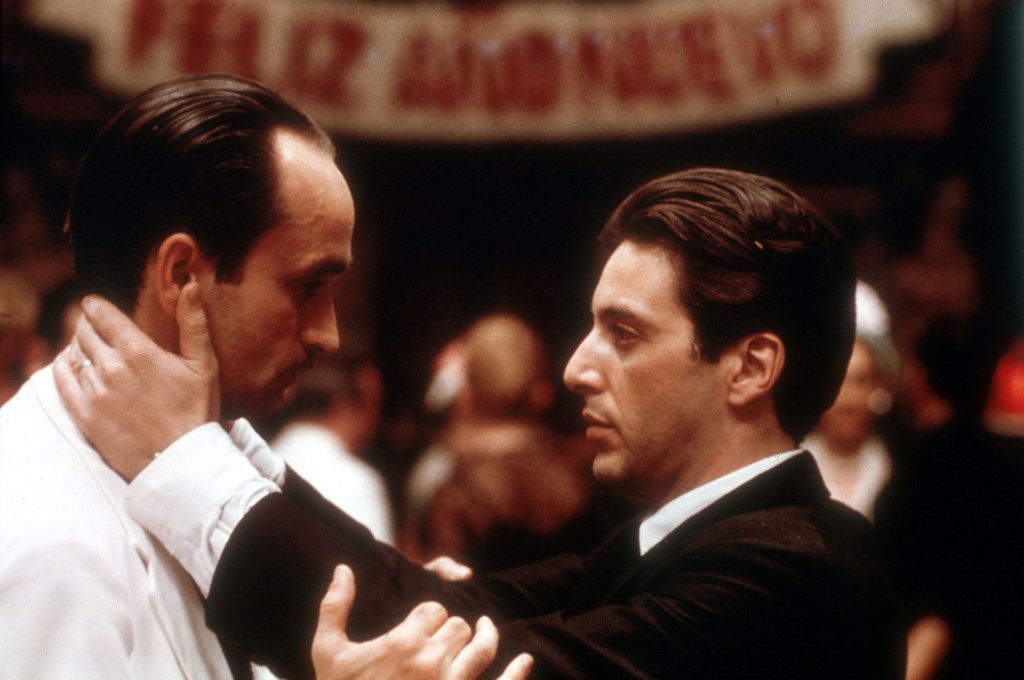
This ranking does not weigh in on the neverending debate among cinephiles over which Godfather is better. Both the first and second films are masterpieces (and III, for that matter, is better than its reputation). But as a full-throated gangster saga reflecting the expansion of organized crime in the 1950s and early ’60s, The Godfather Part II is superior. The screenplay by Francis Ford Coppola and Mario Puzo examines the roles of Las Vegas and pre-Castro Cuba in the Mafia’s transformation into a national and international enterprise, as well as the congressional probes that exposed organized crime to public scrutiny, particularly the 1963 hearings built around mob informant Joe Valachi. Lee Strasberg is particularly terrific as Hyman Roth, a thinly veiled version of Meyer Lansky, among the architects of modern organized crime. Part II is both sequel and prequel. Robert De Niro portrays Vito Corleone as a young immigrant in the Little Italy of early-20th-century New York, a part for which the actor learned to speak Sicilian. As Vito gains power and builds a family, Michael consolidates power and destroys one. A key cast change is the addition of Michael V. Gazzo as Corleone family capo Frankie “Five Angels” Pentangeli. Essentially, the character replaces Part I’s Clemenza, who disappeared from the script after actor Richard Castellano sought outside control over Clemenza’s dialogue. Coppola wasn’t messing around with compromises this time. Unlike with the first film, Paramount now ceded him far greater control. Building on its predecessor, The Godfather Part II lays bare the corruption of American institutions, from business to government and beyond. Although it cleaned up at the Academy Awards with six wins, including Picture, Director, Adapted Screenplay, and Best Supporting Actor (De Niro), not all critics were smitten. The New York Times’ Vincent Canby groused that the most notable thing about Coppola’s movie was that “it recalls how much better his original film was.” C’est la vie—I’m not sure what the Sicilian translation is.
(See more in The 20 best kisses in film.)
Honorable mention: Animal Kingdom (2010, dir. David Michôd), Battles without Honor and Humanity (1973, dir. Kinji Fukasaku), A Better Tomorrow (1986, dir. John Woo), The Departed (2006, dir. Martin Scorsese), Donnie Brasco (1997, dir. Mike Newell), Eastern Promises (2007, dir. David Cronenberg), The Friends of Eddie Coyle (1973, dir. Peter Yates), King of New York (1990, dir. Abel Ferrara), Miller’s Crossing (1990, dir. Joel Coen), Scarface: The Shame of a Nation (1932, dir. Howard Hawks)


4 responses to “The 10 best gangster films”
[…] blasts away at Sollozzo and the captain—the trajectory of his life forever changed.(See more in The 10 best gangster pictures and 10 memorable movie […]
LikeLike
[…] Few filmmakers use music as inventively as Martin Scorsese does. From the strident drums of the Ronettes’ “Be My Baby” that open Mean Streets (1973) to Badfinger’s “Baby Blue” that closes The Departed (2006), there is an abundance of legitimate candidates for this list. But Goodfellas’ use of “Layla” by Derek and the Dominos (essentially Eric Clapton and Duane Allman) is the intersection of cinema and music at its most dynamic. The number’s soaring slide guitar is the perfect soundtrack for the montage surveying the carnage that Jimmy Conway (Robert De Niro) has left in the wake of the Lufthansa armored-car robbery.(See more in The 10 best gangster films.) […]
LikeLike
[…] Serial killers and organized crime are excluded here; those subgenres are fertile enough to warrant their own lists. […]
LikeLike
[…] Things go from comic to dire with lightning speed in this acclaimed Brazilian crime drama. City of God begins with one very nervous chicken fleeing for its life from what appears to be a kill-and-grill party. A band of youths gives chase through city streets until they stop dead in their tracks, guns suddenly drawn—not at the chicken now, but at a young man, Rocket (Alexandre Rodrigues), who has wandered in their path. The leader of the gang, a bloodthirsty psychopath we will soon know as Li’l Zé (Leandro Firmino), orders Rocket to catch the bird himself. The opening also signals the film’s restless chronology. Rocket’s narration abruptly rewinds the story two decades to explain how everyone arrived at this consequential moment. Directors Fernando Meirelles and Kátia Lund’s fast edits, disorienting camera movement, and mercurial shift in tone announce the visual pyrotechnics that will propel City of God.(See more in The 10 best gangster films.) […]
LikeLike