It’s easy to gin up an audience by tossing in a recognizable site. Science fiction and action movies, in particular, have turned the destruction of famous places into cliché (“There goes the White House! There goes the Golden Gate!”) That stuff is just too easy. Real creativity comes when a familiar landmark is used so imaginatively that audiences never see it quite the same way again. It is virtually impossible to think about the Empire State Building without picturing a ginormous primate climbing up it. What North by Northwest fan could visit Mount Rushmore without imagining Cary Grant hanging on to the face of Abe Lincoln? The better films turn the recognizable into something transformative and enduring.
For the list below, I’m not counting the White House, U.S. Capitol or Pentagon; those buildings routinely appear in movies involving the federal government. Likewise, I excluded sports stadiums and suspension bridges because they appear far too often. With those ground rules established, let’s go sightseeing.
10. Louvre in Band of Outsiders (1964, dir. Jean-Luc Godard)
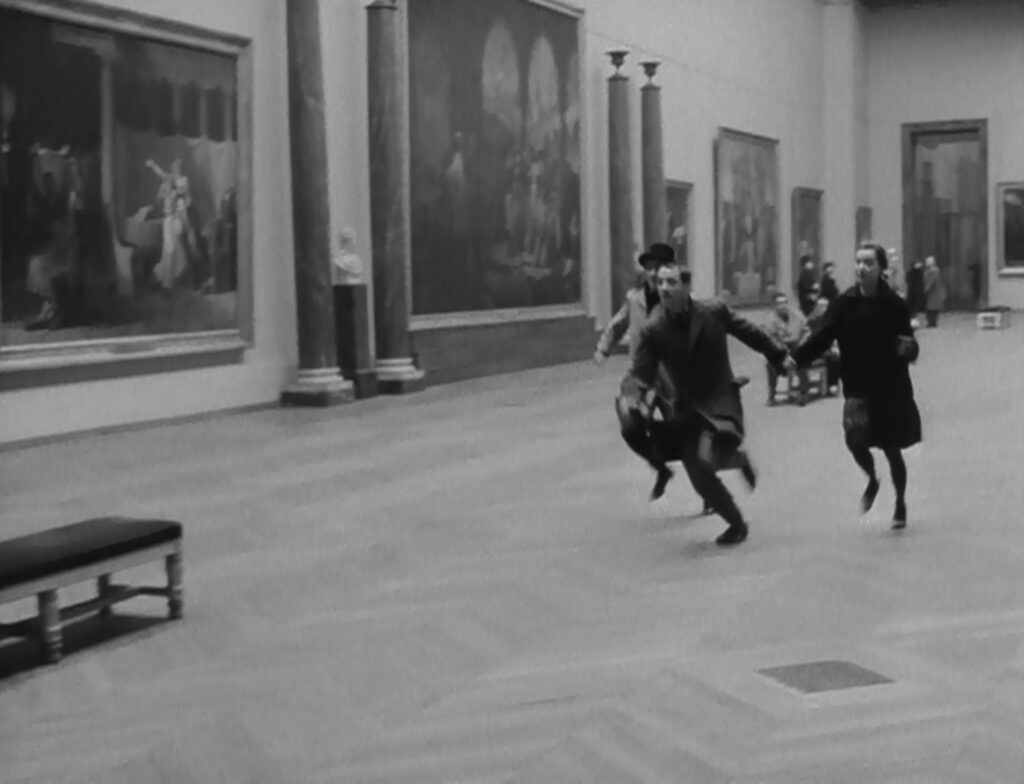
In this treasure of the French New Wave, the three young protagonists—played by Sami Frey, Claude Brasseur, and Anna Karina—learn that an American holds the record for touring Paris’ world-famous Louvre in nine minutes and 45 seconds. The trio sets out to break that record, racing through its halls past hallowed paintings and startled guards. Jean-Luc Godard didn’t get permission to film in the art museum. He simply directed his actors to run; once museum guards finally realized what was happening, the scene was in the can. Band of Outsiders’ voiceover narrator reports that the three beat the record by two seconds. The scene is blink-and-you’ll miss it, but unforgettable; Bernardo Bertolucci recreated it lovingly in The Dreamers (2003).
9. Burj Khalifa in Mission: Impossible—Ghost Protocol (2011, dir. Brad Bird)
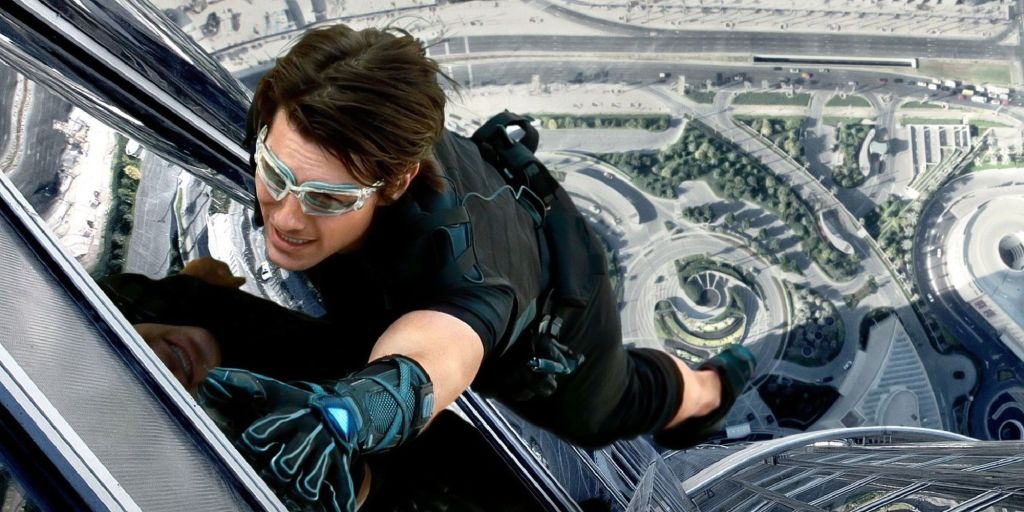
Tom Cruise famously executed most of his own stunts throughout the blockbuster M:I franchise, even when it came to climbing the world’s tallest building. In Mission: Impossible—Ghost Protocol, the Impossible Mission Force team must break into a database server on the 130th floor of the Burj Khalifa in Dubai. The hitch: Cruise’s Ethan Hunt can only enter from the exterior of the 2,717-foot skyscraper using suction gloves—one of which falls halfway through—to scale it. Director Brad Bird, making his live-action feature debut, nicely balances breathtaking suspense and a welcome respite of humor. The production used IMAX cameras that had to be flown back to Los Angeles for film development, meaning nobody on set knew if a shot worked until days after they’d finished shooting.
8. Alamo in Pee-wee’s Big Adventure (1985, dir. Tim Burton)
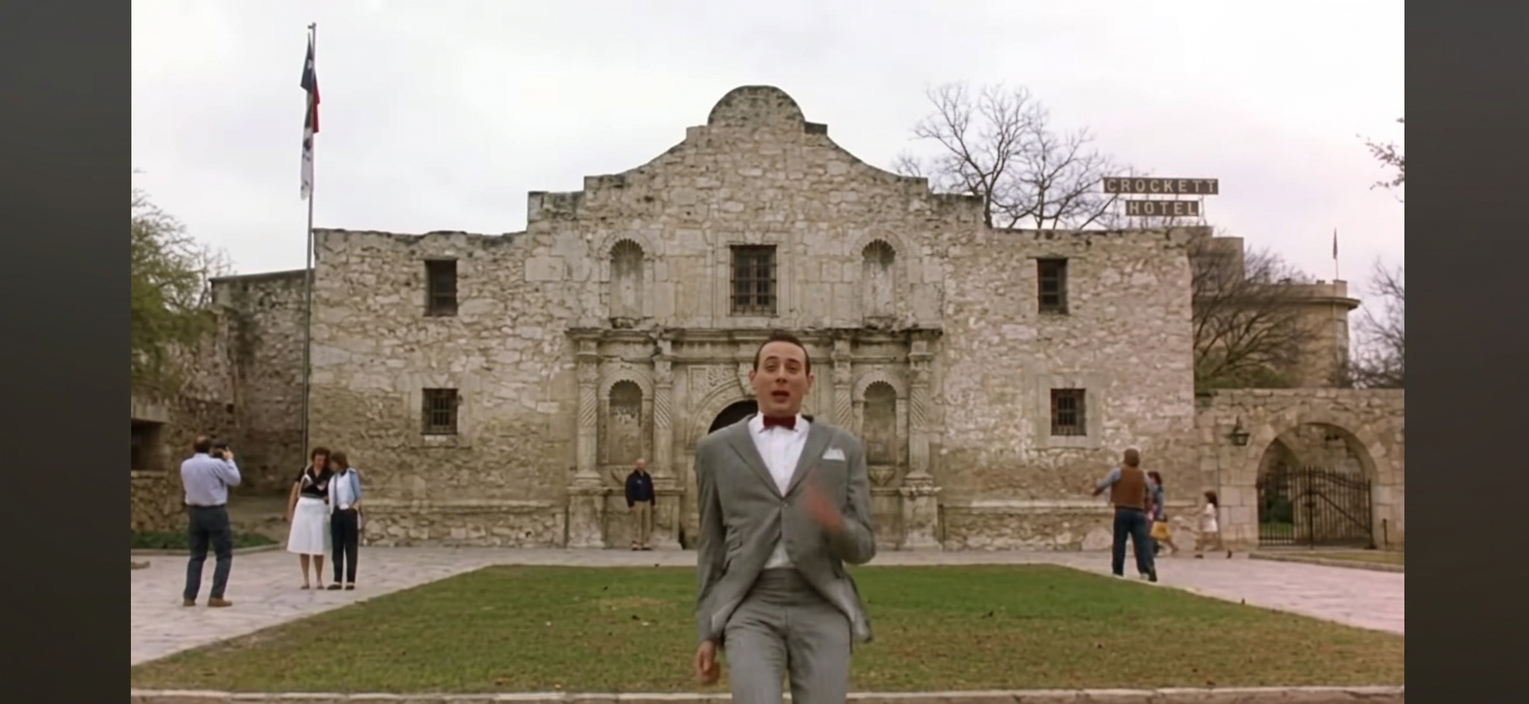
While Hollywood has made several movies about the Battle of the Alamo, my favorite has the titular hero of Pee-Wee’s Big Adventure hitchhiking to San Antonio after a psychic tells him that his super-loaded stolen bicycle is stashed in the basement of the Alamo. But an Alamo tour guide (Jan Hooks) scoffs when he asks to see the basement. “There’s no basement at the Alamo!” she laughs, prompting others on the tour to do the same. That guide was correct in 1985, but not anymore; the Alamo has since added two basements, although neither is open to the public. Tour guides, for their part, are still fielding basement questions from Pee-wee Herman devotees. Moreover, that awesome Schwinn is now at the Alamo—if not the basement—having been purchased by the museum in 2025.
(See more in The 10 best road-trip films.)
7. Lincoln Memorial in Mr. Smith Goes to Washington (1939, dir. Frank Capra)
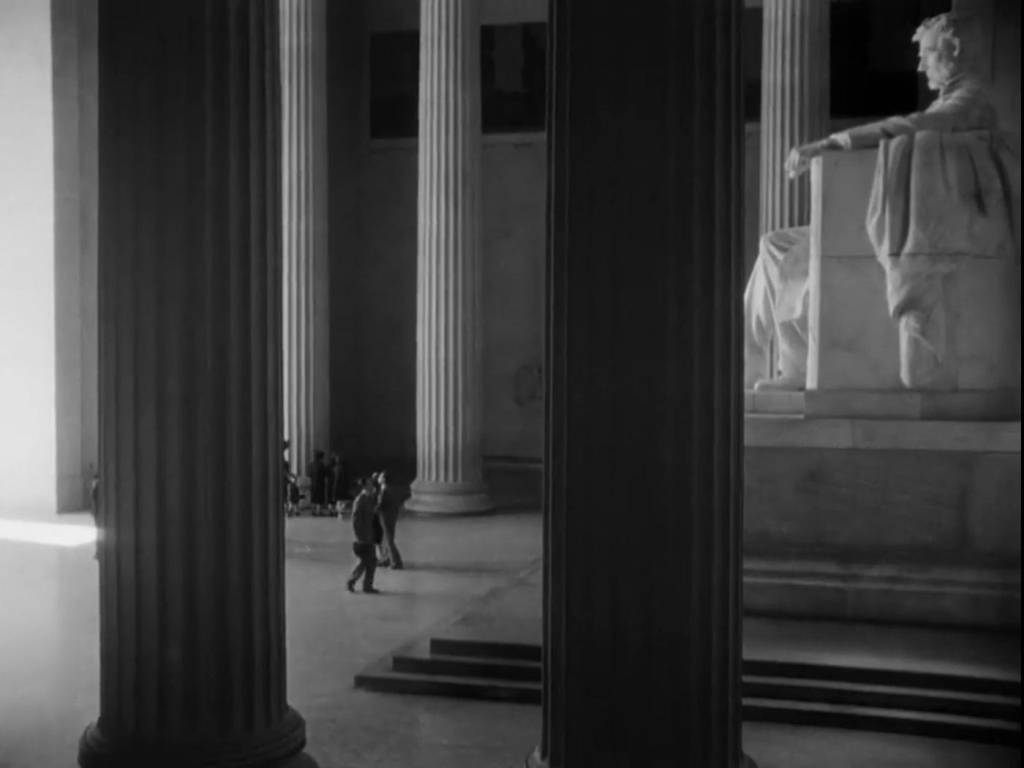
When American movies need a potent symbol of the nation’s better angels, the Lincoln Memorial is hard to top. It makes an especially appropriate backdrop in Mr. Smith Goes to Washington. Early on, freshman Senator Jefferson “Jeff” Smith (James Stewart) visits the memorial to marvel at its grandeur. Recreating a sight that director Frank Capra had seen himself, Jeff watches a young boy read aloud the Gettysburg Address carved into the memorial wall. When Jeff next visits it, he has been beaten down by a smear campaign. His wisecracking assistant (Jean Arthur) confronts him there to deliver a pep talk. “Remember what you said about Mr. Lincoln?” she says. “You said he was sitting up there for someone to come along. I think he was waiting for you, Jeff.” Rejuvenated, the senator takes one last admiring glance at Honest Abe’s statue before departing for his dramatic filibuster.
(See more in The 10 best political films.)
6. Metropolitan Museum of Art in Dressed to Kill (1980, dir. Brian De Palma)
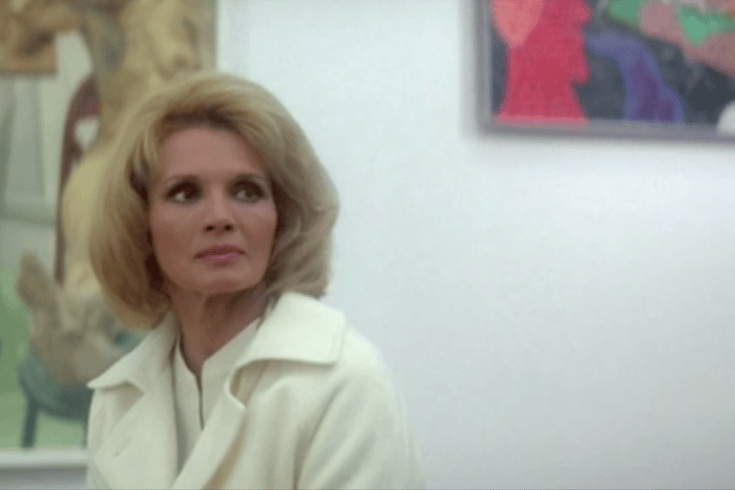
The Metropolitan Museum of Art is quite the meat market in Dressed to Kill. At least, it looks that way for Kate Miller, a bored, sexually unsatisfied housewife played by Angie Dickinson. Kate is at the Met, taking in the paintings and jotting down a grocery list when a handsome stranger (Ken Baker) sits beside her on a bench. His sunglasses are a tipoff that he’s not there to check out the Picassos. The wordless nine-minute scene that follows is vintage Brian De Palma, an exquisite cat-and-mouse flirtation accompanied by Pino Donaggio’s lush score. Kate and the stranger trade off the role of the pursuer and the pursued, the camera gliding along with them through the galleries until things, ahem, climax in the back of a taxicab. The Met didn’t allow De Palma to film inside, deeming the scene too racy. Instead, he shot the interiors at Philadelphia’s art museum. Only the exterior steps belong to the real Met.
5. Trevi Fountain in La Dolce Vita (1960, dir. Federico Fellini)
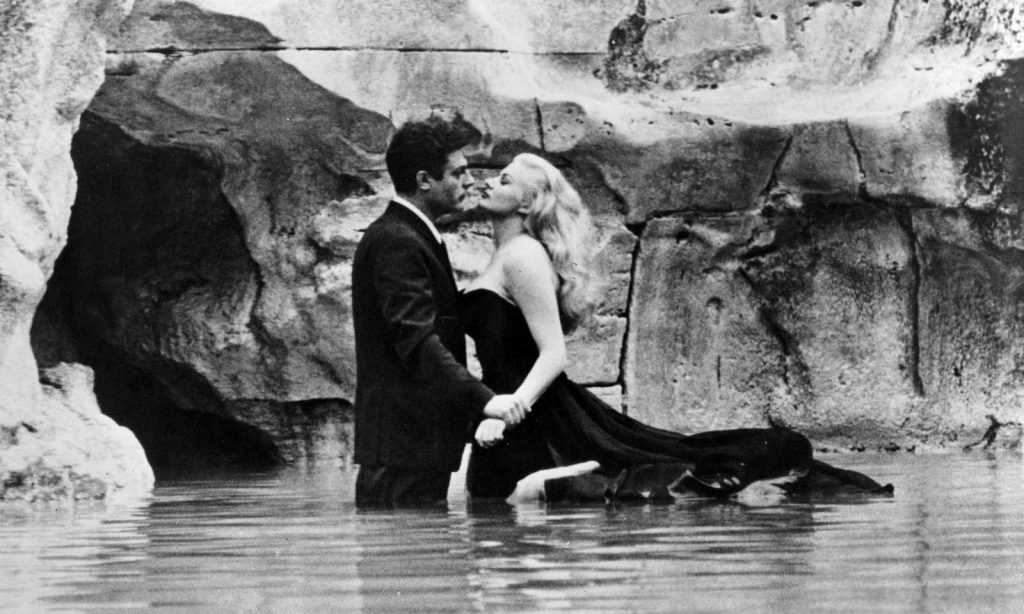
The empty “sweet life” of La Dolce Vita is at its most rapturous when Marcello Mastroianni and Anita Ekberg, as tabloid reporter Marcello and American movie star Sylvia, wander the streets of Rome as night creeps toward dawn. The pair end up at the Trevi Fountain. Sylvia wades in; the smitten Marcello follows her—two beautiful people who almost, but don’t, kiss. The image epitomizes the desire that pervades La Dolce Vita, but the filming itself was far from cozy. It took a week in March of 1959, with both actors spending hours standing in frigid water. Federico Fellini later claimed Ekberg scarcely noticed the cold, whereas Mastroianni wore a wetsuit beneath his clothes and fortified himself with vodka between takes. The days of moseying into the fountain are long gone. Rome now fines wading tourists up to €500 and has banned more than one Fellini enthusiast from the fountain for life
(See more in The 20 best opening scenes in film and The 15 best films exploring class divides.)
4. Mount Rushmore in North by Northwest (1959, dir. Alfred Hitchcock)
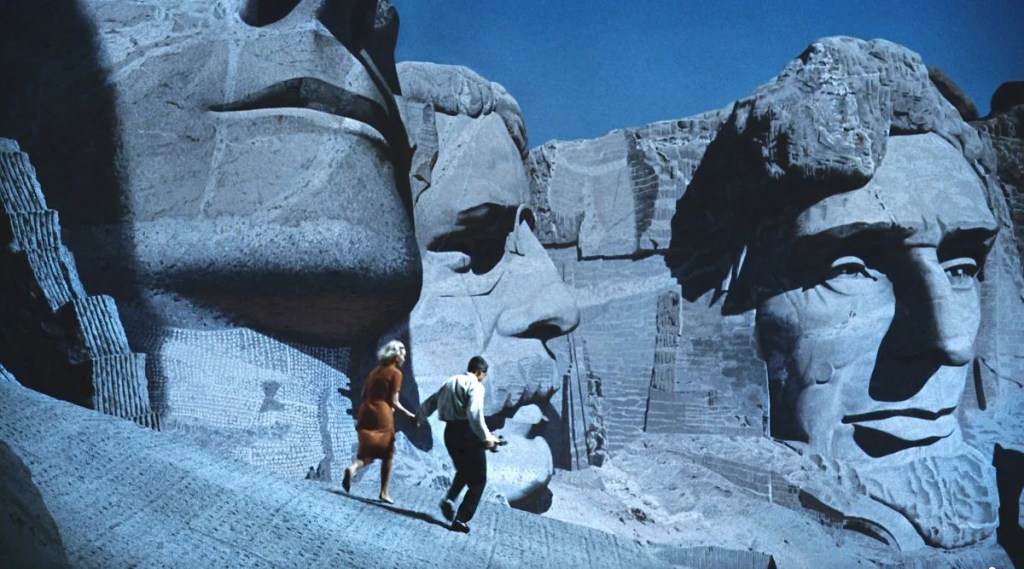
Alfred Hitchcock loved set pieces that feature universally known landmarks, from the Nazi spy in Saboteur plunging from the Statue of Liberty to the assassination attempt at the Royal Albert Hall in The Man Who Knew Too Much. But none is more iconic than advertising executive Roger Thornhill (Cary Grant) scrambling across Mount Rushmore while being pursued by bad guys who mistakenly think he’s a secret agent. It’s the capstone of North by Northwest’s cross-country chase that ends, absurdly and thrillingly, with a life-or-death struggle playing out across the presidential faces. National Park Service officials rejected Hitch’s request to shoot on location, worried that a movie with people clinging to the monument could be interpreted as disrespectful. They might have had a point. Hitchcock had considered filming a bit with Grant sneezing while hiding in Lincoln’s nostril. The director quipped that he originally wanted to title the movie The Man in Lincoln’s Nose.
3. Statue of Liberty in Planet of the Apes (1968, dir. Franklin J. Schaffner)
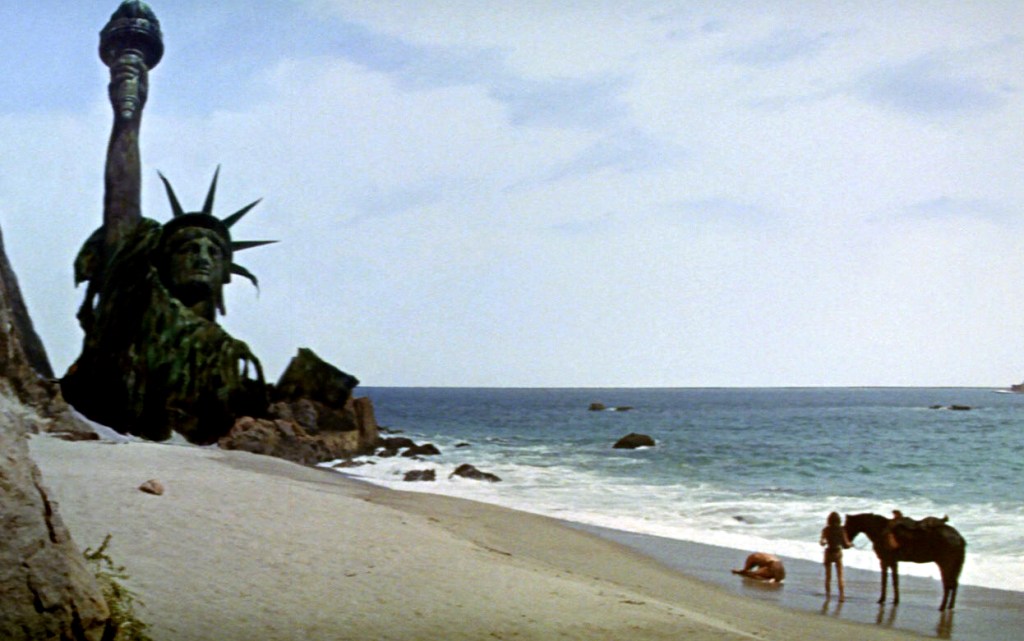
“You maniacs! You blew it up! Ah, damn you! God damn you all to hell!” bellows astronaut George Taylor (Charlton Heston) as he drops to his knees and beats his fist on the ground. Taylor and his squeeze (Linda Harrison) are on a deserted beach when he spies the vestiges of the Statue of Liberty. At that moment, Taylor—and moviegoers—realize that the planet they’d crash-landed on was Earth all along. The image is perhaps the cleverest WTF ending in American cinema, not surprising given that one of the two credited screenwriters (the other being Michael Wilson) was Rod Serling, whose The Twilight Zone specialized in such twists. You don’t need to have seen Planet of the Apes to recognize that half-buried torch—it’s been spoofed everywhere from The Simpsons‘ “Stop the Planet of the Apes! I Want to Get Off!” musical number to decades of editorial cartoons. Tim Burton’s unfortunate 2001 remake opts for a slightly different twist that invokes the Lincoln Memorial, but pales beside the gut punch of Franklin J. Schaffner’s original.
2. Griffith Observatory in Rebel without a Cause (1955, dir. Nicholas Ray)
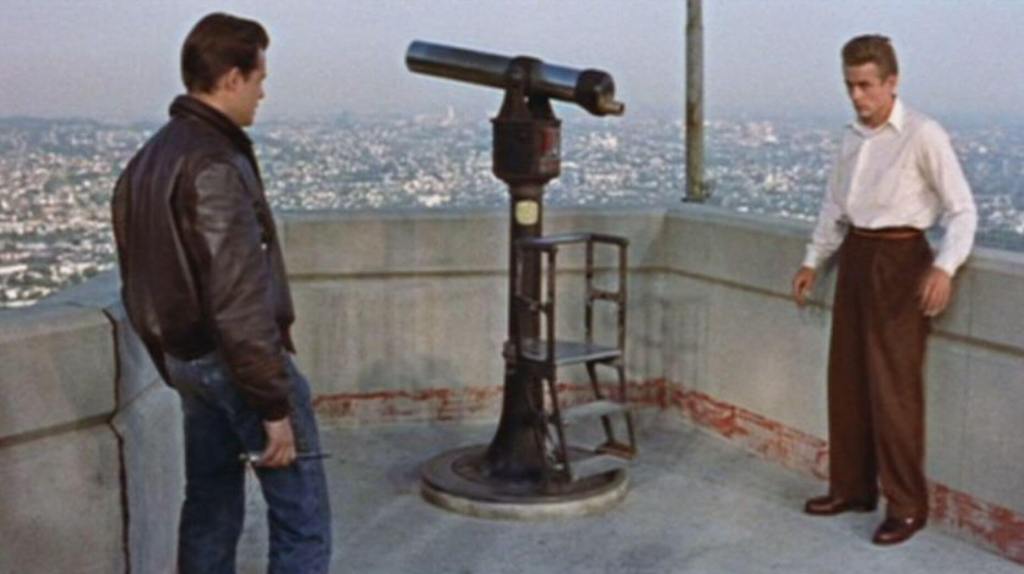
During a high school field trip to Los Angeles’ historic Griffith Observatory, Rebel Without a Cause’s angst-ridden Jim Stark (James Dean) has the misfortune of drawing the ire of the popular clique for the transgression of trying to fit in. This is no trivial conflict for Jim, whose chief tormenter, Buzz Gunderson (Corey Allen), wields a switchblade. But in a haunting juxtaposition, director Nicholas Ray uses the sequence to contrast the unfolding teen drama against a planetarium show that imagines the inevitable demise of civilization. “In all the immensity of our universe and the galaxies beyond, our Earth will not be missed,” intones the planetarium guide. “Through the infinite reaches of space, the problems of man seem trivial and naive, indeed, and man existing alone seems himself an episode of little consequence.” The sobering moment is recalled when the film’s tragic third act returns us to the observatory.
(See more in The 15 best coming-of-age films.)
1. Empire State Building in King Kong (1933, dir. Merian C. Cooper and Ernest B. Schoedsack)
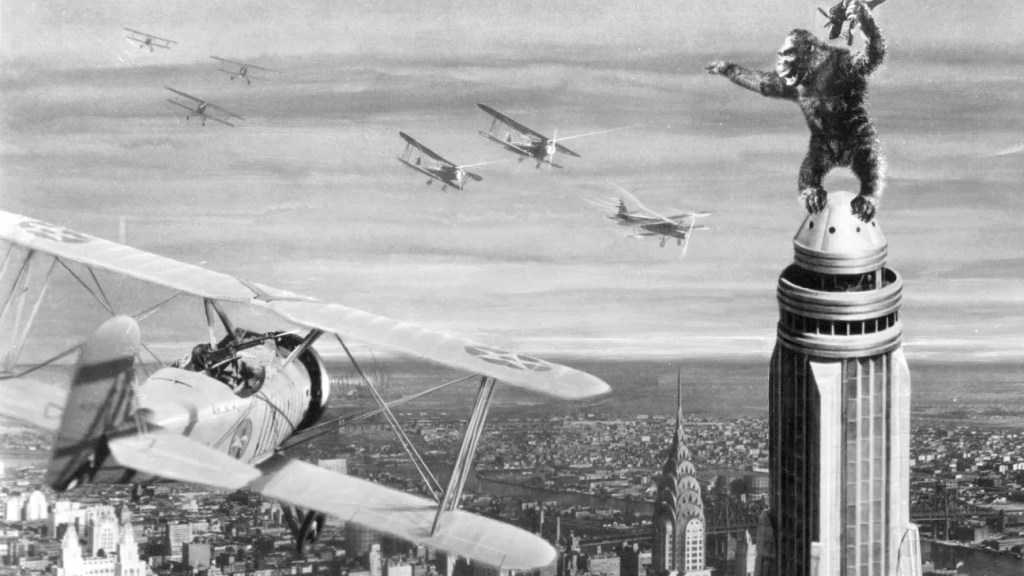
New York City’s most famous building will forever be linked with the fictitious gorilla who climbed it. Even people who have never seen the original King Kong or one of its remakes (do such people exist?) surely know it concludes with the big galoot climbing the Empire State Building while clutching blonde heroine Ann Darrow (Fay Wray), reaching the spire, and tumbling to his death after swatting pesky biplanes. That ending was the first image conceived by adventurer-turned-filmmaker Merian C. Cooper. While the actual Empire State is 1,250-feet tall, what awestruck moviegoers saw in 1933 was a miniature to accommodate an 18-inch puppet. The make-believe ape and the real-life skyscraper are so permanently fused in popular culture, in fact, that the Empire State Building has embraced Kong as part of its own history through exhibits and anniversary celebrations. The Dino De Laurentiis-produced remake in 1976 opted for Kong to scale the World Trade Center, but the scene didn’t pack the same resonance—and, of course, 25 years later it would carry an emotional pain that the filmmakers could not have imagined.
Honorable mention: Arc de Triomphe in John Wick: Chapter 4 (2023, dir. Chad Stahelski), Belfry of Bruges in In Bruges (2008, dir. Martin McDonagh), Eiffel Tower in The Lavender Hill Mob (1951, dir. Charles Crichton), Notre Dame in The Hunchback of Notre Dame (1939, dir. William Dieterle), Petra in Indiana Jones and the Last Crusade (1989, dir. Steven Spielberg), Philadelphia Museum of Art in Rocky (1976, dir. John G. Avildsen), Royal Albert Hall in The Man Who Knew Too Much (1956, dir. Alfred Hitchcock), Spanish Steps in Roman Holiday (1953, dir. William Wyler), The Statue of Liberty in Saboteur (1942, dir. Alfred Hitchcock), Vienna Ferris Wheel in The Third Man (1949, dir. Carol Reed)


4 responses to “The 10 best uses of manmade landmarks in film”
[…] substance and vacuity, virtue and sin—all established in that arresting opening.(See more in The 10 best uses of manmade landmarks in film and The 15 best films that explore class […]
LikeLike
[…] Jim Stark (James Dean) is being torn apart. His mom is on his case, his dad doesn’t have his back, and the popular kids at his new school are horrific bullies. Jim’s problems mount tenfold when he is involved in a dangerous game of car chicken that ends with a classmate’s death. In a tragic irony, Dean died in a car crash roughly a month before the picture’s release. He might not be a terribly convincing high schooler (Dean died at age 24), but his angst rings with authenticity. Co-stars Natalie Wood and Sal Mineo really were teens, and both give heartbreaking performances. Alienated and from dysfunctional homes, the three create their own fantasy family, however briefly. If Nicholas Ray didn’t quite blow the lid off why kids from good homes turn to delinquency, the picture was still provocative enough for Tennessee Senator Estes Kefauver to accuse it of corrupting America’s youth—an admonishment he made before seeing it. (See more in The 10 best uses of manmade landmarks in film.) […]
LikeLike
[…] This British noir from director Carol Reed and writer Graham Greene is lean, compact, and smart—in short, great storytelling. Set in postwar Vienna, The Third Man conveys the moral vacuity of a city gripped by black-market profiteers. Every camera movement, shot composition, and edit feels designed to accentuate the locale’s claustrophobia and sense of peril. You can tell this is a movie that has been fussed over, but in a good way. Its biggest gamble, it seems to me, is the zither-centric score by Anton Karas, whom the filmmakers discovered performing in a Vienna café during production. The music is strangely evocative and, somehow, perfect. Joseph Cotten stars as Holly Martins, who comes to Vienna for a job promised by his childhood friend, Harry Lime (Orson Welles). Damn the luck—Holly arrives just in time to learn that Harry was struck down by a motorist and is about to be buried. But Holly can tell something doesn’t add up, and his suspicions are only heightened at Harry’s funeral by mourners who practically have the word “disreputable” flashing in neon signs above their heads. Sure enough, Harry is very much alive. Holly spies his friend standing in a darkened doorway that is suddenly illuminated by a shaft of light from a nearby window. It is one of cinema’s most remarkable entrances. But cinematographer Robert Krasker makes every black-and-white frame of The Third Man a work of art. Cotten is excellent, but Trevor Howard nearly steals the picture as a flinty British lawman determined to nab Harry for stealing penicillin from military hospitals. The scam has killed children, but Harry is untroubled. “The dead are happy dead,” he tells Holly. “They don’t miss much, poor devils.” The sentiment encapsulates the Vienna of The Third Man.(See more in The 10 best uses of manmade landmarks in film.) […]
LikeLike
[…] Frank Capra’s populist fables were considered corny even in 1939 (hence the “Capra-corn” tag from some critics), but he knew what stirred moviegoers. “What audiences respond to in Mr. Smith Goes to Washington is the humanity of a man who cares about something and is fighting for it,” the director said years later. “When they see somebody fight for an ideal, it will always get ‘em right here, in the stomach.” As idealistic Senator Jefferson “Jeff” Smith, James Stewart delivers a career-defining performance, but the entire cast––including Capra regulars Jean Arthur and Edward Arnold, as well as Claude Rains and Thomas Mitchell––is in top form. Moreover, you’ve got to love any picture that makes a filibuster a scene of rousing heroism. “You all think I’m licked. Well, I’m not licked … and I’m gonna stay right here and fight for this lost cause!” Jeff tells the Senate chamber, his voice cracking from exhaustion, in the picture’s most fabled scene. U.S. senators assailed the film for its depiction of corrupt Washington powerbrokers. Nowadays, Capra’s treatment of Congress feels like a whitewash.(See more in The 10 best uses of manmade landmarks in film.) […]
LikeLike