The label of “mindfuck films” didn’t really come around until the late 1990s, but moviemakers were producing mindfucks as far back as 1929, when surrealists like Luis Buñuel and Salvador Dalí were slicing a calf’s eyeball in Un Chien Andalou. But one doesn’t have to resort to such extremes to make a mindfuck. For purposes of this list, think of films that airdrop you onto an unstable faultline and proceed to drill the earth beneath your feet. These are pictures that embrace ambiguity, explore the fracturing of identity, and scoff at traditional narrative. They’re cinematic puzzles without a firm answer.
Some entries here, like 2001: A Space Odyssey, aren’t unstable so much as unyielding—withholding meaning rather than obscuring it. In modern cinema, perhaps there was no greater master of the mindfuck than David Lynch, hence his prevalence below—but directors such as Ari Aster, Robert Eggers, and Spike Jonze will no doubt keep us happily confused.
10. Enemy (2013, dir. Denis Villeneuve)

Picture in your mind Disney’s The Parent Trap. Now picture that movie on acid, and you have a good idea of how Enemy plays. Jake Gyllenhaal does double duty as Adam Bell and Anthony Claire, full-fledged doppelgängers—even down to the same voice, the same beard, the same scar on the chest. Adam is a mild-mannered college professor committed to his girlfriend (Mélanie Laurent). Anthony is a struggling actor who cheats on his wife (Sarah Gadon). When Adam discovers the existence of Anthony, he forces a meeting that will shatter both their worlds. Denis Villeneuve and screenwriter Javier Gullón offer no reason for the identical physicality; there are hints that Adam and Anthony might be the manifestations of a single, fractured psyche. Gyllenhaal deftly creates two distinct characters who look exactly alike, yet moviegoers can distinguish between the two simply by how the actor carries himself. An atmosphere of dread is palpable throughout Enemy, with cinematographer Nicolas Bolduc effectively capitalizing on the film’s chilly Canadian setting. Then there’s the ending—a freakish bit of lunacy that resists easy explanation.
9. Holy Motors (2012, dir. Leos Carax)

Let’s get the obvious out of the way: Holy Motors does not make sense. At the center of this exercise in surrealism is Monsieur Oscar, played by Denis Lavant in, it must be said, one of the most gonzo film performances of all time. Oscar awakens in a strange room and proceeds through a passageway into what appears to be a movie theater. Shortly thereafter, this mysterious thespian climbs into a stretch limousine to be shuttled around Paris for a string of presumed acting jobs. He is an elderly woman. He is a feral, one-eyed dwarf who kidnaps a model (Eva Mendes) from a photo shoot. He is a hitman. Holy Motors writer-director Leos Carax plunges into the murky waters of dreams. Why is Oscar cycling through identities? Who is the vaguely referenced agency booking these gigs? How does the limo speak to other limos in its Holy Motors garage? Beneath the absurdity, the film poses a troubling question. If every social interaction of Oscar’s is a performance, is he ever not acting? Are we? Is there even a “real” Oscar? Enjoy the trip.
8. Videodrome (1983, dir. David Cronenberg)
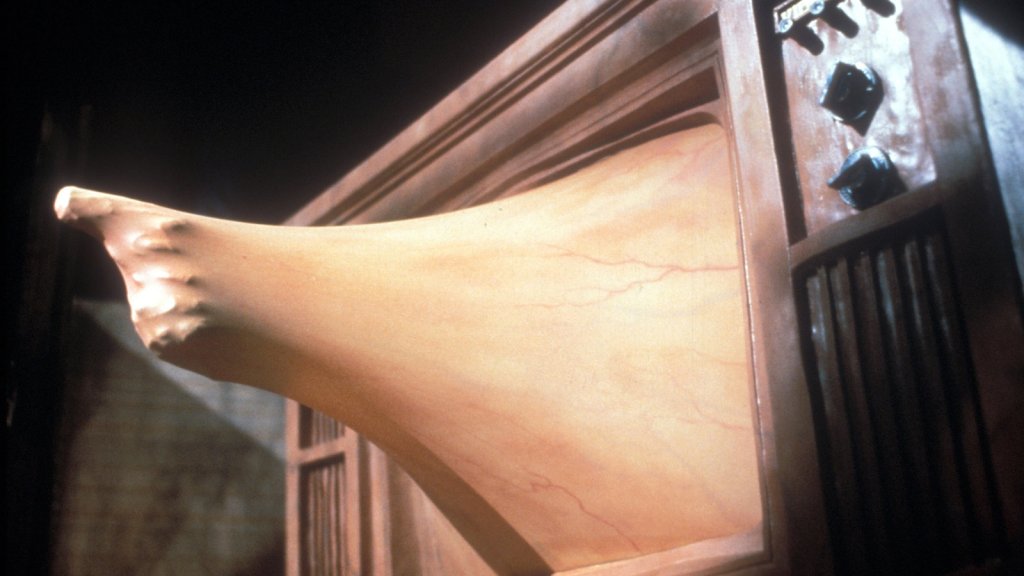
“Long live the new flesh.” In David Cronenberg’s disturbing body-horror Videodrome, that new flesh is a sort of synthesis of human and television. While Cronenberg didn’t anticipate that videocassettes would become archaic one day, he was definitely on to something in his vision of an evolutionary merging of human and technology, namely our addiction to—and the ubiquity of—screens. But this is no philosophical treatise. James Woods plays Max Renn, the slimeball owner of a Toronto cable TV station who grows obsessed with transmission signals of snuff films being intercepted on his satellite feed. The grainy images, purportedly from an underground station called Videodrome, appear to depict torture and murder—and Max, ambitious smut peddler that he is, can’t get enough of it. Neither can his BDSM-centric sex buddy, nicely played by Debbie Harry (of the band Blondie), who promptly disappears after heading off to try being on the program. Just what is Videodrome? The answers arrive as hallucinations, conspiracies, and biological impossibilities. The more Max digs into the broadcasts, the more bizarre the explanations, and the more tenuous his grip on reality. This gory, gnarly, and proudly perverse movie bats around a lot of gibberish about media theory, but don’t be fooled; this is about Max getting it on with a throbbing TV set and a vagina sprouting from his stomach.
7. House (1977, dir. Nobuhiko Obayashi)

One shudders to consider what notions were rolling around in the noggin of young Chigumi Obayashi, who suggested to her dad, Japanese filmmaker Nobuhiko Obayashi, that he make a movie about a house that eats unmarried girls. Fortunately, the elder Obayashi and screenwriter Chiho Katsura took her idea, and others, for this batshit-crazy motion picture. Honestly, I can’t think of a more apt description for House without making up words. Fortunately for that ravenous mansion, a group of giggly teenage schoolgirls—sporting nicknames like Fantasy, Kung Fu, and Mac, no less—visit the dear old auntie of their pal, Gorgeous (Kimiko Ikegami). That vacation quickly erupts into an orgiastic symphony of decapitated heads flying around, disembodied fingers playing a piano and, naturally, rivers of blood. But House is more deliriously comic than scary. Its deliberately artificial visual effects, cartoonish editing, and painted backdrops deliver Grand Guignol horrors with the lipsmacking sweetness of a cotton candy binge, its dream-logic storytelling feeling as though a sick child is recounting a nightmare moments after the fever breaks. As Mac, the girl who loves to eat, says when she is a disembodied head biting into the butt of a friend, “Tasty!”
(See more in The 10 best haunted-house films.)
6. Last Year at Marienbad (1961, dir. Alain Resnais)
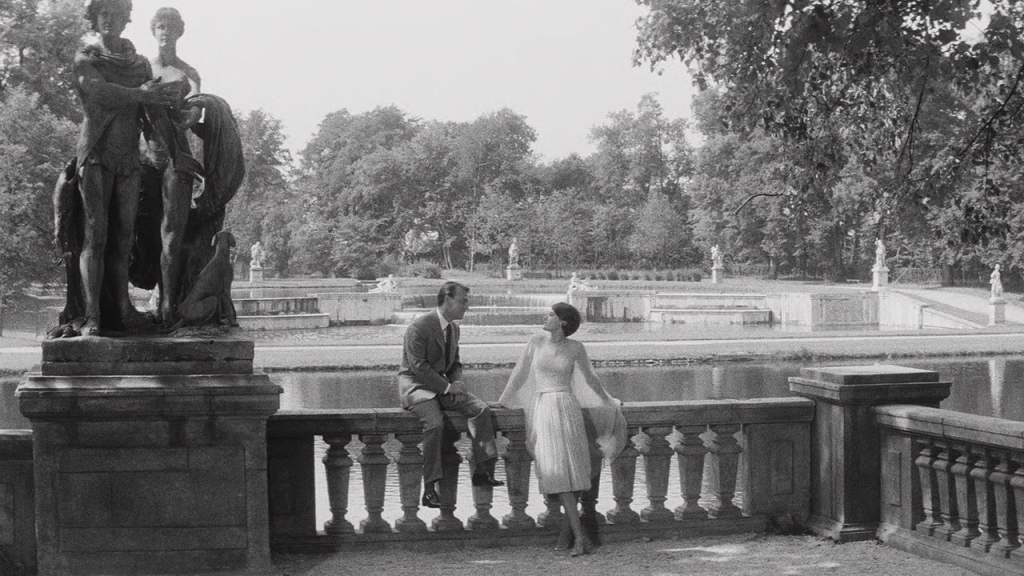
Alain Resnais was amused by his reputation for inscrutable films. One French joke he liked went like this: an accused killer tells police that he was at the cinema when the murder occurred. “What did you see?” asks a detective. “Last Year at Marienbad,” answers the accused. “Oh. What was it about?” he is asked. But the suspect cannot explain the movie—at all—and so he is condemned and sent to prison. Trying to decipher Last Year at Marienbad is a fool’s errand, but it hasn’t stopped cinephiles from trying to do so. In a labyrinthine resort hotel, a man (Giorgio Albertazzi) tries to convince a woman (Delphine Seyrig) that they met there the year before, had a sexual relationship, and that she promised to run away with him. But the woman says she recalls nothing of the sort. Is she being gaslighted? Are they all ghosts? Is this a convoluted metaphor for the Algerian war? Theories abound in a movie that verges on self-parody of the prototypical French art film. It is beautifully photographed by Sacha Vierny, its hypnotic feel enhanced by Resnais and screenwriter Alain Robbe-Grillet’s aversion to anything smacking of a linear narrative. Entrancing tracking shots allow viewers to soak in the baroque environs and ponder the overriding obliqueness. Characters stand frozen in time. Scenes and dialogue are repeated with slight variances in sound and image. Flashbacks contradict previous flashbacks. This is not passive viewing.
(See more in The 10 best films about memory.)
5. Persona (1966, dir. Ingmar Bergman)

Persona proclaims its mindfuckery early on with its infamous prologue. Ingmar Bergman immerses the viewer in a montage of unsettling imagery that eventually settles on a child reaching out to the blurred faces of the film’s principal characters. Liv Ullmann is Elisabeth Vogler, a celebrated stage actress who is no longer able to speak, much to the bafflement of her doctors. Alma (Bibi Andersson) is the nurse sent to care for the mute woman. Alma talks and Elisabeth listens, particularly when the nurse recounts an episode of group sex she once had on a beach. The actress shares that confession in a letter that Alma finds—on purpose? While it is unknown whether Elisabeth meant to reveal her betrayal, it sets in motion a transferral of memories and identities, a merging underscored by the famed composite face framed by the director’s longtime cinematographer Sven Nykvist. Ultimately, the movie refuses to say whether the women have formed a single identity, exchanged identities, or were even two people to begin with. Bergman later said Persona was the product of feelings of rage. “Since he was not sure himself what the film meant, he left his audience free to make of it what they would,” Barbara Young writes in The Persona of Ingmar Bergman. “Perhaps more than any other of his films, Persona poured forth from an amalgam of unconscious and semiconscious issues in Bergman’s past and present life.”
(See more in The 10 best films about identity crises.)
4. Eraserhead (1978, dir. David Lynch)

The Philadelphia chamber of commerce probably wasn’t thrilled that its city was the inspiration for Eraserhead. Before becoming a filmmaker, David Lynch spent five years studying art in the City of Brotherly Love, an experience that was far from loving. “I saw horrible things pretty much every day,” he later recalled, quipping that Eraserhead was “the real Philadelphia Story.” He shot his debut movie on and off over several years as financing ebbed and flowed. Eraserhead taps into our collective nightmares. It is nominally about Henry Spencer (Jack Nance), a factory printer with a perpetual glower and a ramrod-straight pompadour. At dinner with his girlfriend Mary (Charlotte Stewart) and her parents, Mary’s mother reveals that Henry is about to become a father. “Mom!” Mary sobs, mortified. “They’re still not sure it is a baby!” It’s already been an uncomfortable meal, to be sure, what with roasted manmade chickens that undulate suggestively, a catatonic grandmother, and puppies nursing loudly in a corner. When we finally see Henry and Mary’s child, a wheezing cross between a lizard and E.T., we understand why there was some uncertainty about its species. A chipmunk-cheeked Lady in the Radiator (Laurel Near)—perhaps part of Henry’s dreamworld?—stomps her heels on small, wriggling creatures that resemble spermatozoa. Lynch, who was a young father at the time of Eraserhead, might have been working through some parenting issues. What’s less debatable is that the film’s phantasmagoric visuals, dark humor, and industrial-noise sound design made it ideal for the midnight-movie circuit. Funnyman Mel Brooks saw this hallucinatory work and knew its maker was the right person to direct a movie he was producing called The Elephant Man.
(See more in 10 memorable movie fathers.)
3. 2001: A Space Odyssey (1968, dir. Stanley Kubrick)
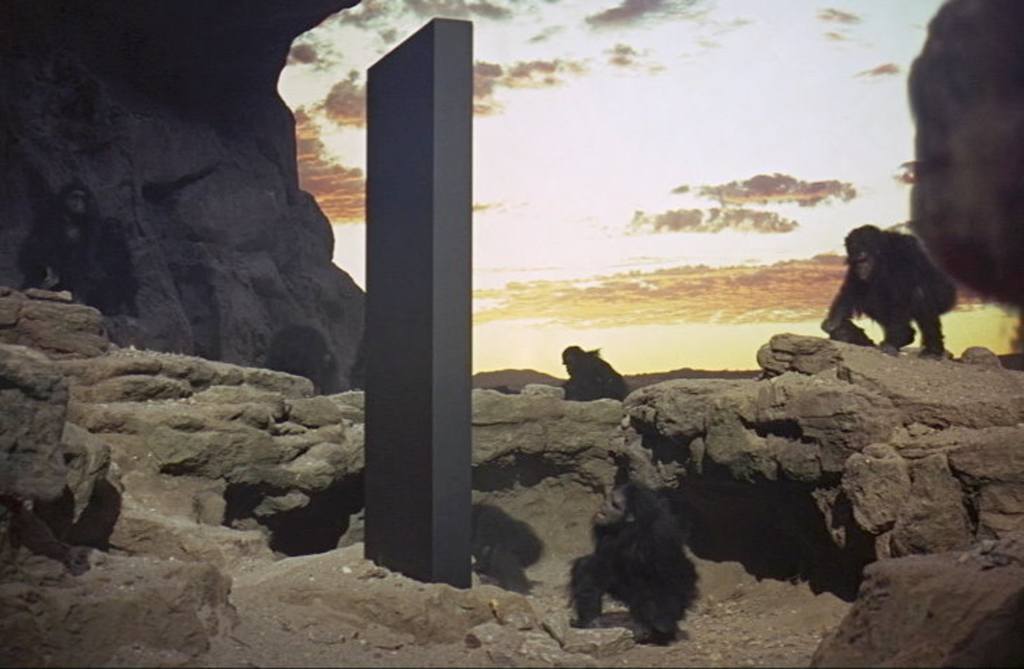
2001: A Space Odyssey is a cinematic Rorschach test. You can analyze it frame by frame and argue over its meaning, or you can sit back and just take in the spectacle. From its “Dawn of Man” opening sequence to its head-scratcher of an ending, Stanley Kubrick’s magnum opus invites all manner of interpretation. Some themes are more obvious. Scripted by Kubrick and science-fiction giant Arthur C. Clarke, the movie explores humanity’s relationship with technology, whether it is an animal bone for clobbering foes or a massive spacecraft sailing through space—images forever linked through perhaps the most famous match cut in cinema history. The special effects by Douglas Trumbull remain impressive even in today’s world of CGI wizardry. The penultimate scene, in which the astronaut David Bowman (Keir Dullea) is pulled into a new dimension near Jupiter, is a dazzling collage of color, light, and sound—right up until he enigmatically winds up in an elegantly furnished bedroom suite fit for Louis XVI. “The connections of this passage with narcotic experience has won it a cult following, but its effects hold good in the realm of allegory, too,” write Alexander Walker, Sybil Taylor, and Ulrich Ruchti in Stanley Kubrick, Director: A Visual Analysis. “Bowman becomes a part of all he experiences.” Wrestling with allegorical implications is well and good, of course, but, as many a moviegoer in 1968 could attest, the film could be just as enlightening on hallucinogens.
(See more in The 10 best films about artificial intelligence and The 20 best needle drops in film.)
2. Mulholland Drive (2001, dir. David Lynch)

David Lynch again. Mulholland Drive bridges seemingly desultory dreams in its Hollywood-centric fable of obsession, desire, and mystery. A lot of mystery. Is the unfolding narrative a deathbed nightmare? A looking-glass version of Tinseltown? Being from the mind of Lynch, the neo-noir encourages audiences to welcome the bewilderment. In a breakthrough performance, Naomi Watts is Betty Elms, an ingénue fresh off the plane from Canada and ready, by golly, to make it as an actress. Shortly after settling in, Betty meets Rita (Laura Harring), a raven-haired beauty who has survived a car wreck from the night before but now has amnesia. Who is Rita? Betty digs into the quest like a wannabe Nancy Drew, but still taking time out for a preternaturally sexy performance at a movie audition—a scene of such an incongruently erotic charge from Betty, it’s the audience’s first clue that there’s more to the apple-cheeked innocent she appears to be. Additional storylines, ostensibly unrelated, are stitched into the narrative. A movie director (Justin Theroux) is forced by some sinister mob types to cast a specific woman in his movie; a very sloppy hitman (Mark Pellegrino) accidentally kills multiple people; two men at a diner check to see what might be lurking behind the restaurant. Originally conceived as a television series for ABC, much of Mulholland Drive had been shot when the network nixed the project. Lynch retooled it as a standalone film, rethinking what he already had in the can and injecting it with new ideas, a process he likened to “the surrealists throwing words in the air and letting random acts dictate something.” Whatever that means. Sometimes the most slapdash decisions can make for the most haunting art.
(See more in The 10 best neo-noir films.)
1. Synecdoche, New York (2008, dir. Charlie Kaufman)
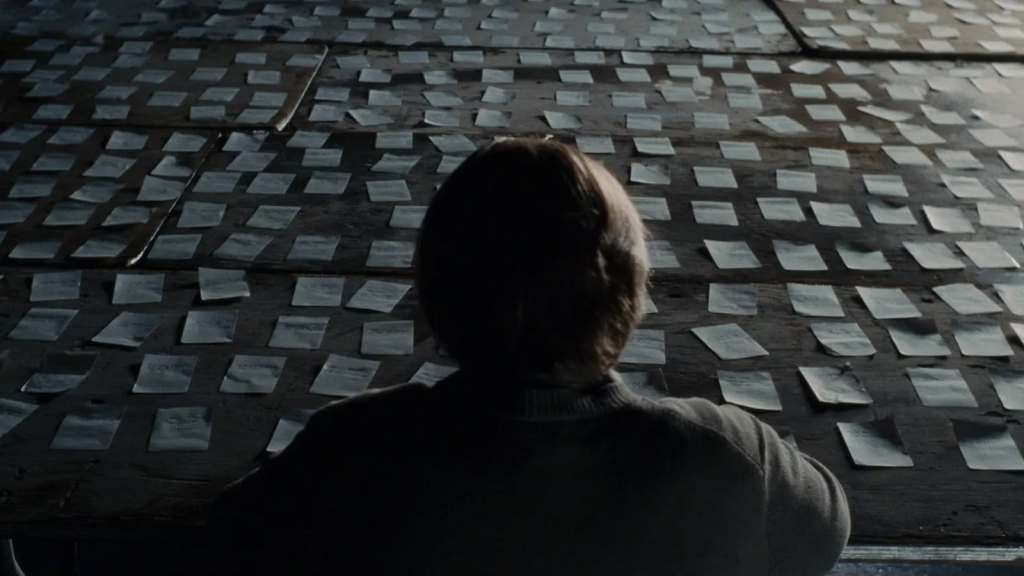
No amount of therapy or pharmaceuticals can sufficiently prepare one for the directorial debut of meta screenwriter Charlie Kaufman (Being John Malkovich, Adaptation). His scripts are the literary equivalent of an M.C. Escher drawing, but his preoccupations transcend mind puzzles. Synecdoche, New York contemplates life and death and everything sandwiched between. Philip Seymour Hoffman is Caden Cotard, a neurotic, fledgling theater director whose personal life is in shambles. He has a flurry of ailments (real or imagined, we’re never sure) ranging from pustules to seizures. His wife (Catherine Keener), who paints portraits so small that they can only be viewed with jeweler’s glasses, flees the country with their daughter. But then Caden is awarded a MacArthur Foundation “genius” grant, and he uses the money for a stage production of epic proportions. He spends years in a vast Manhattan warehouse meticulously creating a full-scale replica of the world that surrounds him. The exercise is self-reflexive to the point of derangement. He makes himself a character in the play, casting a man named Sammy (Tom Noonan) who has stalked him for years. It then becomes necessary for another actor to play Sammy playing Caden. And so on. The passage of years forces a constant expansion of his production. Is Caden dreaming? Deceased? Notably, Caden’s surname is borrowed from Cotard’s Syndrome, a mental disorder in which a person believes they are dead. Kaufman provides no concrete answers, but what he does offer is an avalanche of ideas, mysteries, and paradoxes. At the film’s heart is the ever-widening gulf between Caden’s life and his desire to make sense of it. Sinking deeper into his artistic obsession, Caden is unable to distinguish fantasy from reality, unwilling to live in the moment. The movie is baffling and oblique, tedious and indulgent, strange and revelatory—and a true mindfuck.
(See more in The 10 best films about the theater.)
Honorable mention: Beau Is Afraid (2023, dir. Ari Aster), Being John Malkovich (1999, dir. Spike Jonze), Donnie Darko (2001, dir. Richard Kelly), Everything Everywhere All at Once (2022, dir. Daniel Scheinert and Daniel Kwan), The Holy Mountain (1973, dir. Alejandro Jodorowsky), Inland Empire (2006, dir. David Lynch), Jacob’s Ladder (1990, dir. Adrian Lyne), Lost Highway (1997, dir. David Lynch), Perfect Blue (1997, dir. Satoshi Kon), Pi (1998, dir. Darren Aronofsky), Possession (1981, dir. Andrzej Żuławski), Primer (2004, dir. Shane Carruth), Triangle (2009, dir. Christopher Smith), Un Chien Andalou (1929, dir. Luis Buñuel), Upstream Color (2013, dir. Shane Carruth)


4 responses to “The 10 best mindfuck films”
[…] yet this narrative, weird as it is, barely captures its inexhaustible inventiveness.(See more in The 10 best mindfuck films and The 10 best films about […]
LikeLike
[…] The humans in 2001: A Space Odyssey often come off as emotionally remote (cavemen excluded). It is no coincidence, then, that the most interesting entity in Stanley Kubrick’s opus is the HAL-9000 (voiced by Douglas Rain), the artificial-intelligence system of the Discovery One spaceship headed to Jupiter. HAL, as it is better known, is stuck with the company of two of the most wooden astronauts in the universe, Dave Bowman and Frank Poole (Keir Dullea and Gary Lockwood, respectively). When they spot what appears to be a malfunction by HAL, the pair confer privately in a soundproof pod—or so they think—on how to dismantle it. But HAL discovers their plan and strikes first, killing Poole before attempting to do the same to Bowman. Christiane Kubrick, the director’s widow, told Space Odyssey author Michael Benson that her husband was adamant HAL’s eventual shutdown be depicted as a death. “It was very important to him that the computer suffers when he (Bowman) takes these bits of the brain,” she said, As HAL’s voice slows to a crawl, it warbles “Daisy Bell (Bicycle Build for Two)”—a song learned in its infancy—in an accelerated state of decay. HAL’s demise, incidentally, is the last stop before humankind’s next evolutionary metamorphosis.(See also The 10 best mindfuck films.) […]
LikeLike
[…] into the final cut. The composer must have been gobsmacked, but it was the right call.(See more in The 10 best mindfuck films and The 10 best films about artificial […]
LikeLike
[…] identities. Or maybe they don’t. Bergman famously refuses to settle the question.(See more in The 10 best mindfuck films and The 10 best films about identity […]
LikeLike