Although “needle drop” initially referred to lowering a phonograph needle onto a vinyl record, the term has since expanded to describe the use of preexisting music in place of an original film score.
Because we come to the movie theater with our own cultural baggage regarding certain tunes, a preexisting song can do a lot of work quickly and effectively, whether that is establishing a mood, defining a character, or offering a wry commentary on whatever action is unfolding onscreen.
One of the earliest and most influential needle drops in a mainstream flick came in 1955, with Bill Haley and the Comets’ “Rock Around the Clock” playing over the opening credits of The Blackboard Jungle, a cautionary tale of juvenile delinquency.
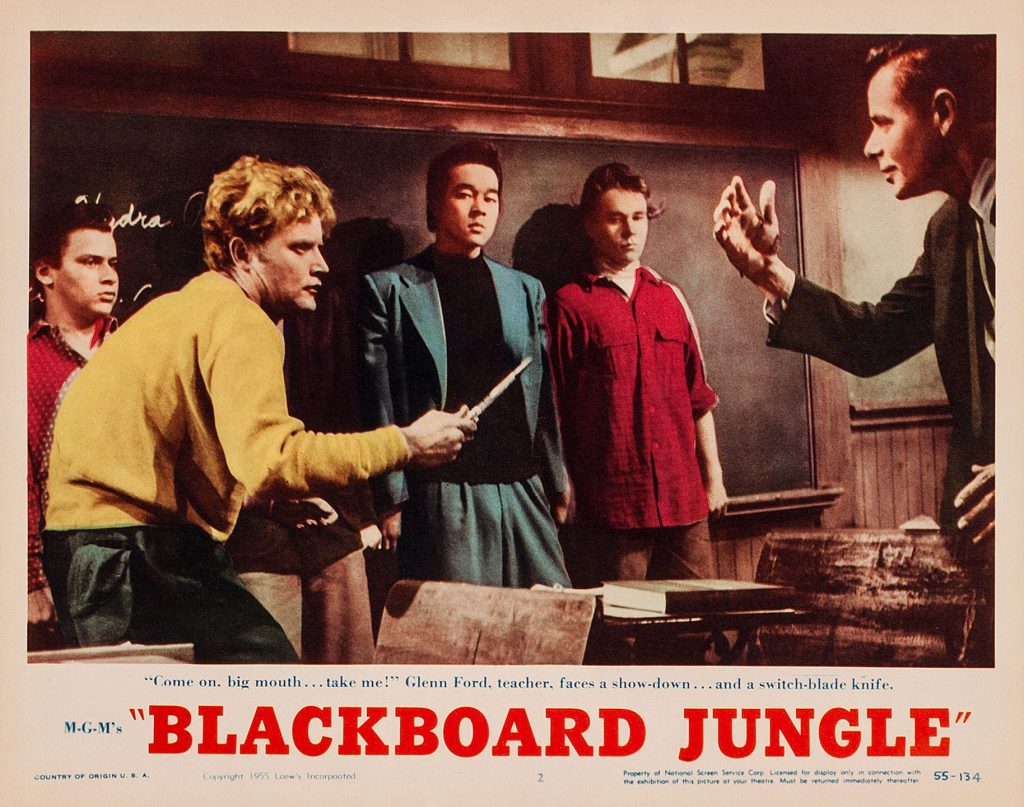
Nearly 20 years later, the tune resurfaced in George Lucas’ American Graffiti, a movie of nearly wall-to-wall needle drops from the early days of rock ‘n’ roll. In the years since, a growing cadre of moviemakers—Martin Scorsese, Quentin Tarantino, Paul Thomas Anderson, and Sofia Coppola, to name a few—have made the strategically deployed popular song a hallmark of their style.
For purposes of this exercise, the list excludes songs used over opening credits. Such needle drops can be remarkably evocative, of course, but primarily in setting the table for what will follow. They have a different function than a needle-drop that occurs mid-narrative—or, in one case, a sequence so fully dramatized that the credits feel incidental to it. For that reason, you won’t find numbers like Steppenwolf’s “Born to Be Wild” from Easy Rider (1969), Harry Nilsson’s “Everybody’s Talkin’” from Midnight Cowboy (1969), Isaac Hayes’ “Theme from Shaft” (1971), the Bee Gees’ “Stayin’ Alive” from Saturday Night Fever (1977), Public Enemy’s “Fight the Power” from Do the Right Thing (1989), and Redbone’s “Come and Get Your Love” from Guardians of the Galaxy (2014).
OK, got that? Good. Let’s go.
20. “Foggy Mountain Breakdown”—Flatt & Scruggs and the Foggy Mountain Boys, from Bonnie and Clyde (1967, dir. Arthur Penn)
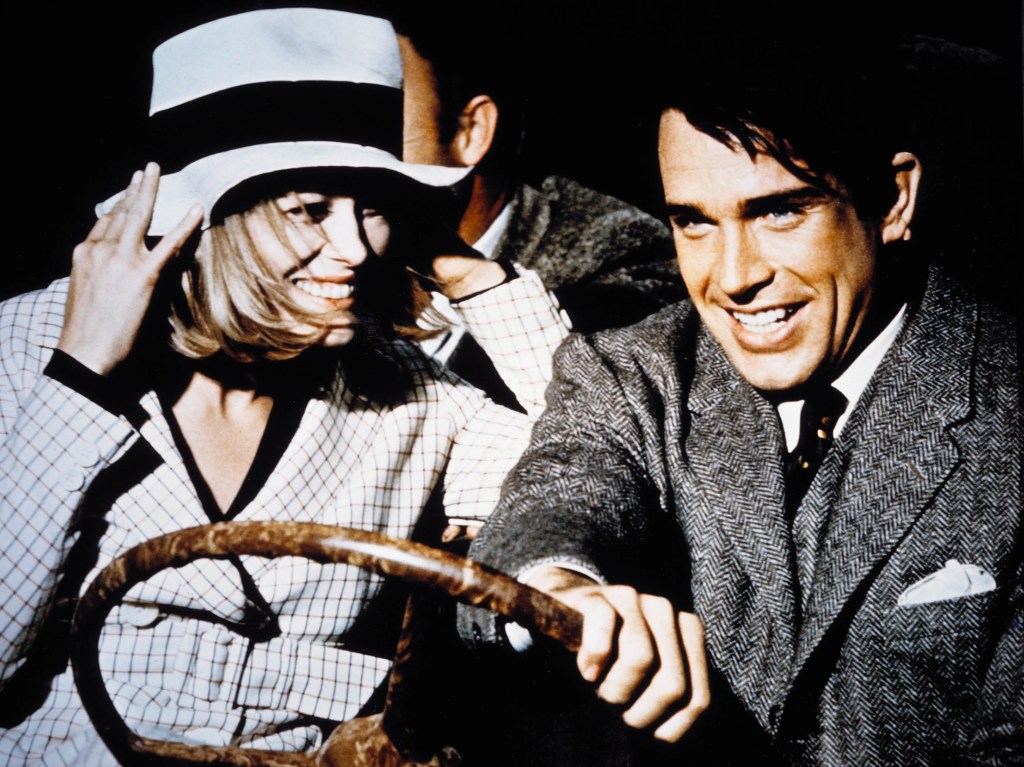
Flatt & Scruggs’ bluegrass classic kicks up when the police give chase after the Barrow gang—Warren Beatty, Faye Dunaway, Michael J. Pollard, Gene Hackman, and Estelle Parsons—robs a bank. One of cinema’s earliest iconic action-movie needle-drops, the rollicking instrumental helps establish the film’s seriocomic tone that would flummox early reviewers but ultimately spur many imitators.
19. “Needle in the Hay”—Elliott Smith, from The Royal Tenenbaums (2001, dir. Wes Anderson)
The tragic specter of singer-songwriter Elliott Smith, who died by apparent suicide in 2003 at age 34, marks a retroactively jarring change in tone for Wes Anderson’s comedy about a supremely overachieving but dysfunctional family. Richie Tenenbaum (Luke Wilson), a professional tennis player despairing that the adopted sister he loves is getting married, calmly shaves, cuts off his hair, and slashes his wrists.
(See more in 10 memorable movie fathers.)
18. “Adagio for Strings”—Samuel Barber (composer), from Platoon (1986, dir. Oliver Stone)
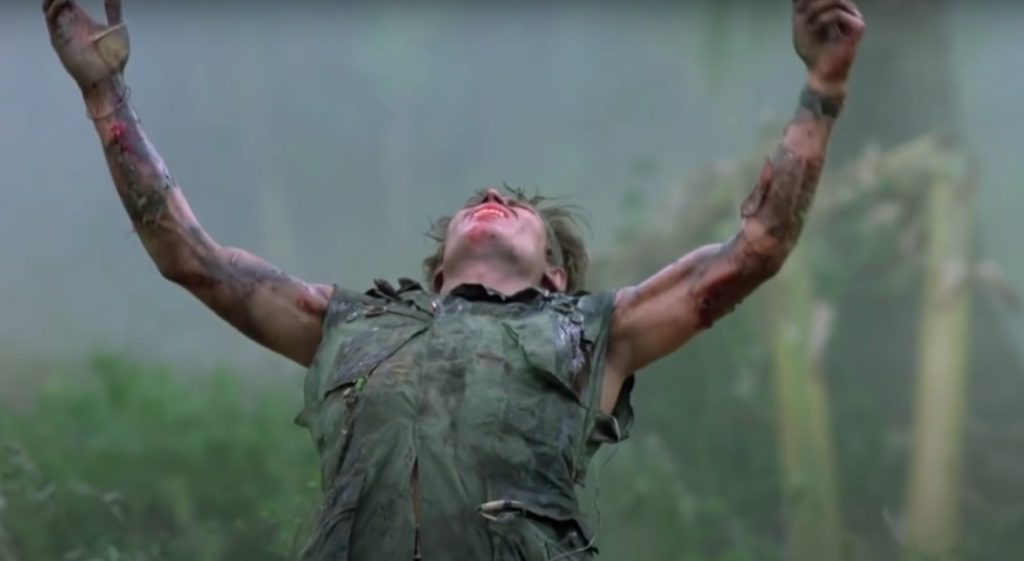
Samuel Barber’s 1936 composition had already become America’s unofficial music of public mourning long before Oliver Stone got hold of it, but the director makes it downright heart-wrenching in his semi-autobiographical account of his Vietnam War experience. “Adagio for Strings” swells when the saintly Sgt. Elias, played by Willem Dafoe, is riddled with gunfire, his arms raised to the sky in an unmistakably Christlike posture. The image became the film’s poster art.
17. “Old Time Rock & Roll”—Bob Seger, from Risky Business (1983, dir. Paul Brickman)
As a teenager in suburban Chicago whose parents have left him alone for a week, Tom Cruise’s Joel Goodsen is ready to celebrate. First, he helps himself to a tall glass of his folks’ Chivas Regal scotch to wash down a frozen dinner. Then, as the coup de grâce, Joel, clad only in briefs and a shirt, cranks up the Bob Seger rock standard for a lip-synching performance in the privacy of his living room. He struts, sings into a candlestick, and gyrates while face-down on a couch. A star is born.
16. “Hurdy Gurdy Man”—Donovan, from Zodiac (2007, dir. David Fincher)
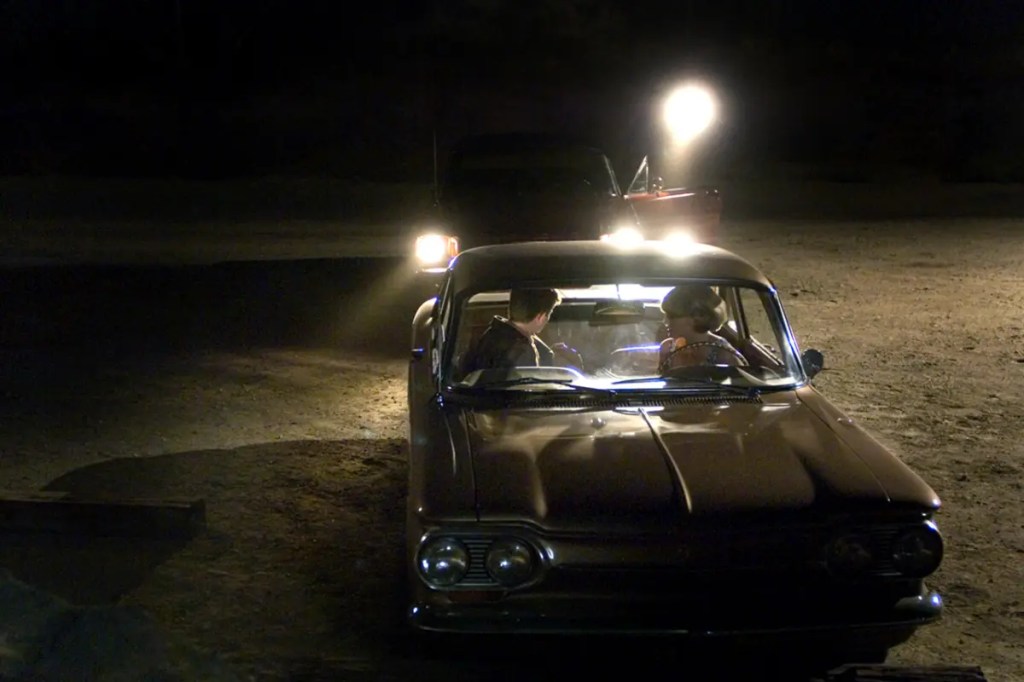
On the night of July 4, 1969, Mike Mageau and Darlene Ferrin (Lee Norris and Ciara Hughes) have just parked at Blue Rock Springs Park in Vallejo, California. Before they can get comfortable, a brown Corvair pulls up behind them, leaves, and then circles back again. Mike senses that something isn’t right. The viewer can, too, since the arrival of the strange car coincides with the spooky, flower-child psychedelia of Donovan’s “Hurdy Gurdy Man.” Soon the couple will become two of Zodiac’s victims, although Mageau survived the attack.
(See more in The 10 best serial-killer films, The 15 best neo-noir films and The 10 best journalism films.)
15. “In Dreams”—Roy Orbison, from Blue Velvet (1986, dir. David Lynch)
David Lynch nails the creepiness inherent to Roy Orbison’s overwrought tearjerker when Ben (Dean Stockwell), heavily rouged and wearing a satin smoking jacket, treats psychotic Frank Booth (Dennis Hopper), his goons, and the captive Jeffrey (Kyle MacLachlan) to a shiver-inducing performance. Ben’s miming appears to both soothe and disturb his criminal confederate, Frank—at least until Frank abruptly ends the show. “All right! Let’s hit the fuckin’ road!”
(See more in The 10 best films about voyeurism and The 15 best neo-noir films.)
14. “Goodbye Horses”—Q Lazzarus, from The Silence of the Lambs (1991, dir. Jonathan Demme)
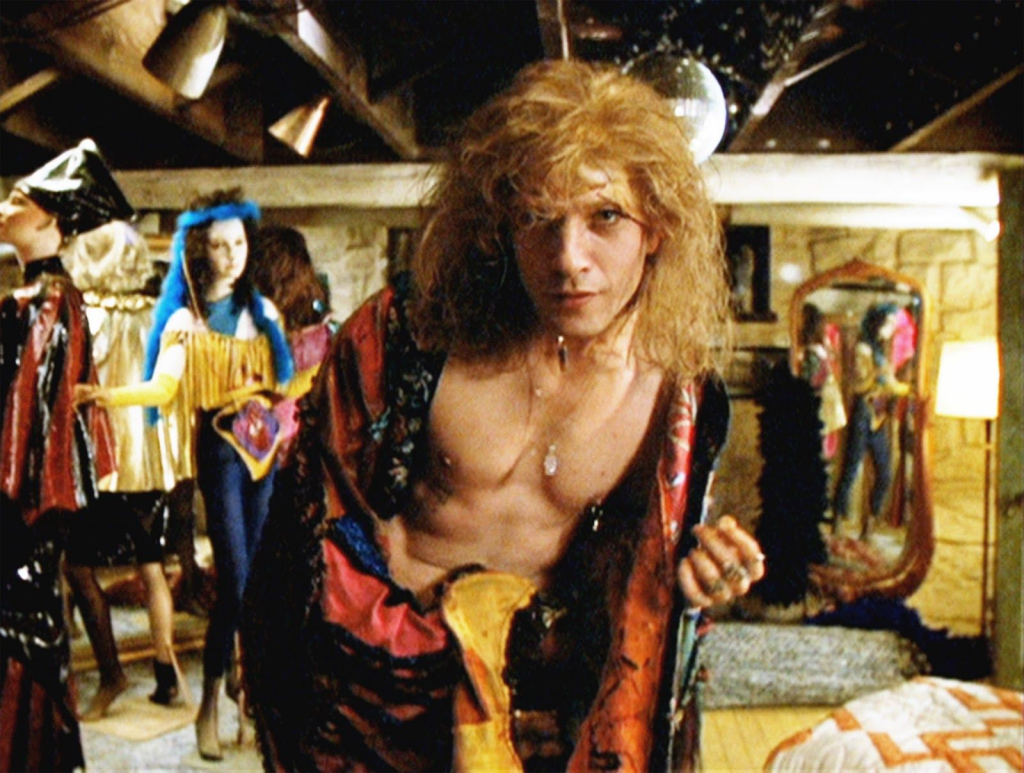
Listen to this Q Lazzarus song on its own, and the sound is dreamy, romantic, almost evanescent. Director Jonathan Demme had already used it in Married to the Mob (1988), but evidently he wasn’t going to be satisfied until this obscure synth-pop could be permanently contaminated by linking in with fictional serial killer Buffalo Bill (Ted Levine). In The Silence of the Lambs’ most notorious scene, Bill dances to “Goodbye Horses” in front of a mirror while he applies lipstick and makeup. All the while, his kidnap victim (Brooke Smith) desperately tries to lure Bill’s beloved lapdog into the pit where she is being held captive.
(See more in The 10 best serial-killer films.)
13. “September”—Earth, Wind & Fire, from Robot Dreams (2023, dir. Pablo Berger)
Pablo Berger’s animated tale of a dog and his mail-order robot friend transforms the Earth, Wind & Fire classic into a pathos-packed evocation of joy, loneliness, and longing. Based on a 2007 graphic novel, the woefully little-known Robot Dreams uses the tune throughout the film, each instance signifying a different stage in the lives of its anthropomorphized canine and his bot buddy. Its first appearance is the sweetest: the two friends rollerskating through Central Park, grooving in wonderfully dorky unison—a snapshot of happiness that informs the events to follow.
12. “Lust for Life”—Iggy Pop, from Trainspotting (1996, dir. Danny Boyle)
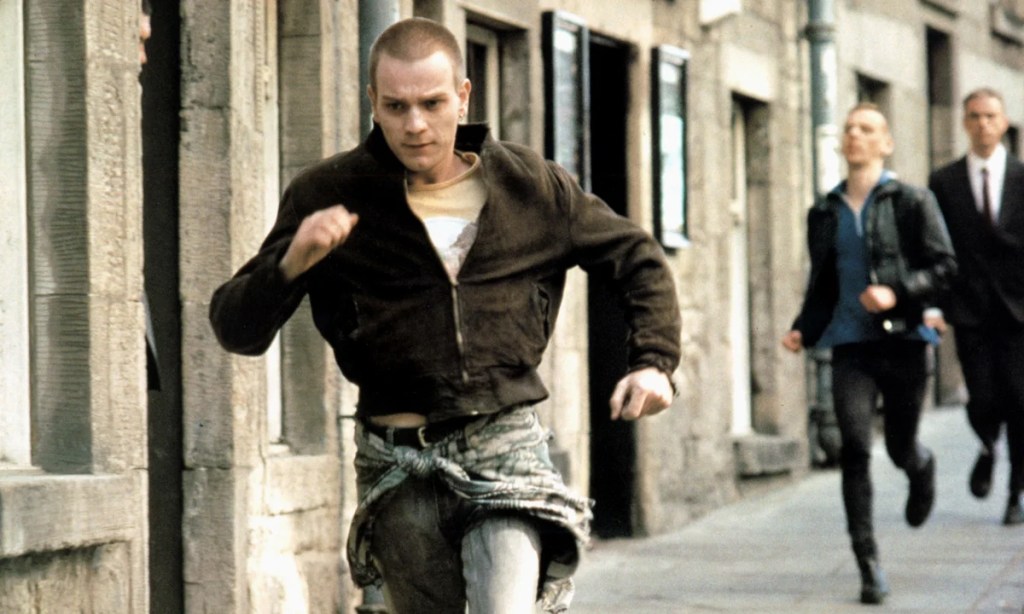
The manic desperation of Trainspotting’s heroin addiction roars off the screen early on as Ewan McGregor’s smack-addled Renton and company sprint through the streets of Edinburgh, running from police. As the drums of Iggy Pop’s ferocious anthem kick in, Renton launches into a voiceover that encapsulates the smirking rebellion of him and his mates. “Choose life. Choose a job. Choose a career,” Renton says derisively. “Choose washing machines, cars, compact disc players, and electrical tin openers.” But Renton chooses nothing of the kind: “Who needs reasons when you’ve got heroin?”
(See more in The 10 best bathroom scenes in film.)
11. “Raindrops Keep Falling on My Head”—B.J. Thomas, from Butch Cassidy and the Sundance Kid (1969, dir. George Roy Hill)
The musical anachronism of B.J. Thomas’ pop hit in Butch Cassidy and the Sundance Kid, a Western set in the 1890s, caused some eye-rolling at the time. As it turns out, the picture helped pave the way for the sort of anachronistic soundtrack choices routinely used by filmmakers like Quentin Tarantino—and for good reason. The friendly shuffle of “Raindrops Keep Falling on My Head” proves an ideal accompaniment for Butch (Paul Newman) and Etta (Katharine Ross) to enjoy a bicycle ride. The tune earned a Best Original Song Oscar for writers Burt Bacharach and Hal David.
(See more in The 10 best male buddy films.)
10. “California Dreamin’”—The Mamas & the Papas, from Chungking Express (1994, dir. Wong Kar-wai)
Music is a big part of Chungking Express’ fizzy charm, but it’s the Mamas & the Papas’ “California Dreamin’” that makes the most indelible impression. Hong Kong filmmaker Wong Kar-wai makes the 1965 hit single the theme song for Faye (Faye Wong), the eccentric waif who works at the Midnight Express food stand, where she blares it constantly while bopping around behind the counter. “You like noisy music?” asks Cop 663 (Tony Leung), the police officer who soon becomes the subject of Faye’s obsession. “Yes!” she shouts. “The louder, the better—stops me from thinking!”
(See more in The 20 best hangout films.)
9. “Layla”—Derek and the Dominos, from Goodfellas (1990, dir. Martin Scorsese)
Few filmmakers use rock ‘n’ roll as inventively as Martin Scorsese does. From the strident drums of the Ronettes’ “Be My Baby” that open Mean Streets (1973) to Badfinger’s “Baby Blue” that closes The Departed (2006), there is an abundance of legitimate candidates for this list. But Goodfellas’ use of “Layla” by Derek and the Dominos (essentially Eric Clapton and Duane Allman) is the intersection of cinema and music at its most dynamic. The number’s soaring slide guitar is the perfect soundtrack for a montage surveying the carnage that Jimmy Conway (Robert De Niro) has left in the wake of the Lufthansa armored-car robbery.
(See more in The 10 best gangster films.)
8. “Rhapsody in Blue”—George Gershwin (composer), from Manhattan (1979, dir. Woody Allen)
The black-and-white cinematography of Gordon Willis showcases Manhattan at its most scenic—the Empire State Building, the Guggenheim, the Queensboro Bridge, etc.—a stunning visual accompaniment to Woody Allen’s narration as Isaac Davis, a writer who is monologuing a proposed opening to a book. Delivered in voiceover, his prose seeks to wring from the Big Apple every drop of metaphorical power he can muster. And the music? Why, it is the perfect aural representation of New York City: George Gershwin’s jazz-era epic, “Rhapsody in Blue.”
7. “Sister Christian”—Night Ranger, from Boogie Nights (1997, dir. Paul Thomas Anderson)
Nothing can stoke anxiety quite like a 1980s power ballad, especially when you happen to be in a strange house trying to sell cocaine to an unhinged, bathrobe-clad dude named Rahad (Alfred Molina) while his houseboy periodically lobs firecrackers just for the hell of it. Music blasts from Rahad’s personal mixtape—Night Ranger’s “Sister Christian” giving way to Rick Springfield’s “Jessie’s Girl”—so that every abrupt cut between tracks ratchets up the tension. Paul Thomas Anderson employs it all for a masterclass in humor-laden suspense. You’ll be motoring.
(See more in The 10 best films about sex workers.)
6. “Ride of the Valkyries”—Richard Wagner (composer), from Apocalypse Now (1979, dir. Francis Ford Coppola)
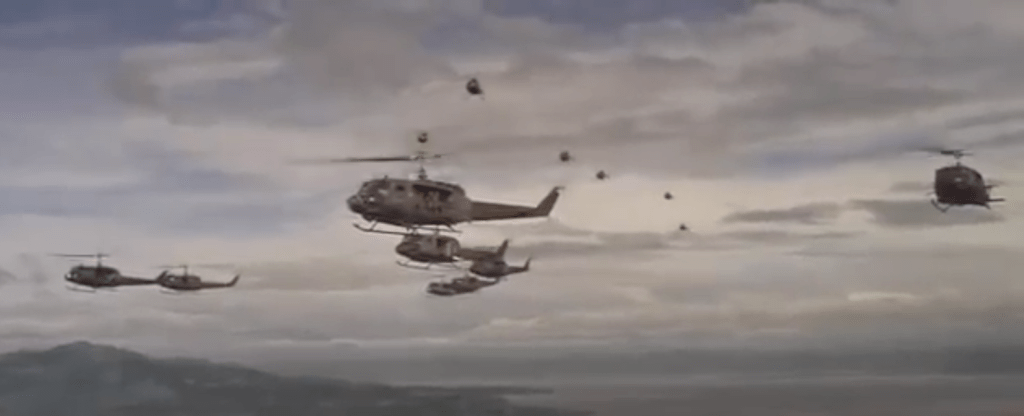
Francis Ford Coppola’s Vietnam War epic boasts several immortal needle drops, including a mesmerizing opening montage of jungleland erupting into flames while the Doors sing of “The End.” It speaks to Coppola’s artistry that I find the scene to be the picture’s second most memorable needle drop. Richard Wagner’s thunderous opening of Act III of Die Walküre (1870), the second opera in his Ring cycle, will forever be tied to Apocalypse Now and its gung-ho air cavalry commander, Lt. Col. Bill Kilgore (Robert Duvall). As Kilgore’s squadron begins its assault on a sleepy Vietnamese village, he directs “Ride of the Valkyries” to be blared from helicopters. “My boys love it!” he says, the music underscoring the intoxicating power-trip that comes from wanton destruction. Wagner is effectively weaponized.
5. “Stuck in the Middle with You”—Stealers Wheel, from Reservoir Dogs (1992, dir. Quentin Tarantino)
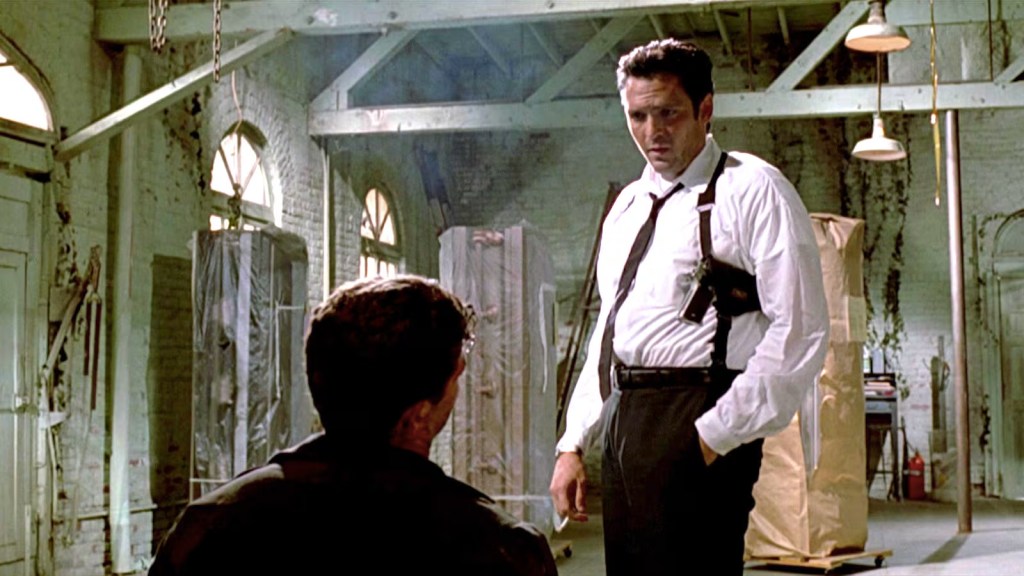
“You listen to K-Billy’s Super Sounds of the ‘70s?” Reservoir Dogs’ Mr. Blonde (Michael Madsen) asks Marvin Nash (Kirk Baltz), the police officer whom Blonde is torturing after having taken him captive amid a botched robbery. “It’s my personal favorite.” And with that, Blonde switches on a radio in time to strut around a bit to the folk-rock amble of “Stuck in the Middle with You.” Quentin Tarantino expertly uses the track as a counterpoint to the violence on screen, forever infecting the Stealers Wheel single with Mr. Blonde using a straight razor to slice off Nash’s ear.
4. “Bohemian Rhapsody”—Queen, from Wayne’s World (1992, dir. Penelope Spheeris)
Five heads banging in unison in a blue AMC Pacer: has any needle-drop ever delivered such nonsensical joy? Or is it joyful nonsense? Let’s not quibble. As Wayne (Mike Myers), Garth (Dana Carvey), and company mouth every operatic curlicue of Queen’s six-minute opus before going bonkers at the (air) guitar break, they enact what we all secretly believe our own car singalongs to be. Myers reportedly fought hard for the studio to green-light the song—execs wanted something contemporary—but history vindicated him. “Bohemian Rhapsody” raced back up the U.S. charts, and Freddie Mercury, who was shown the scene shortly before his death in 1991, gave it his delighted blessing. Party on.
3. “Tiny Dancer”—Elton John, from Almost Famous (2000, dir. Cameron Crowe)
In Cameron Crowe’s valentine to 1970s rock, the band Stillwater appears to be coming apart—bruised egos, growing resentments—in the midst of a grueling tour. But Almost Famous understands the healing powers of a good singalong. The strains of Elton John’s “Tiny Dancer” drift over a radio. One by one, the band, its roadies, and the hangers-on join in until eventually the entire bus is belting out the 1971 song. “I have to go home,” says William (Patrick Fugit), the teen journalist who is covering the group for Rolling Stone magazine. He is corrected by Penny Lane (Kate Hudson), Stillwater’s reigning groupie and the object of William’s crush. “You are home,” she assures him. Case closed.
2. “The Sound of Silence” / “April Come She Will”—Simon & Garfunkel, from The Graduate (1967, dir. Mike Nichols)
Mike Nichols had been listening to Simon & Garfunkel throughout the shoot of The Graduate when it suddenly hit him: this should be the soundtrack for a movie about a disaffected young man. For a montage depicting Benjamin Braddock’s (Dustin Hoffman) summer of sex and aimless swimming-pool drifting, The Graduate uses the duo’s melancholic “The Sound of Silence” and “April Come She Will.” Nichols and editor Sam O’Steen had used them as placeholders for editing purposes, but Nichols eventually realized the songs needed to stay. “It was the only thing to do,” he later told writer Mark Harris. “‘Hello, darkness, my old friend’ was what was happening in Benjamin’s head.”
(See more in The 10 best coming-of-age films and The 20 best kiss scenes in film.)
1. “Thus Spoke Zarathustra”—Richard Strauss (composer), from 2001: A Space Odyssey (1968, dir. Stanley Kubrick)
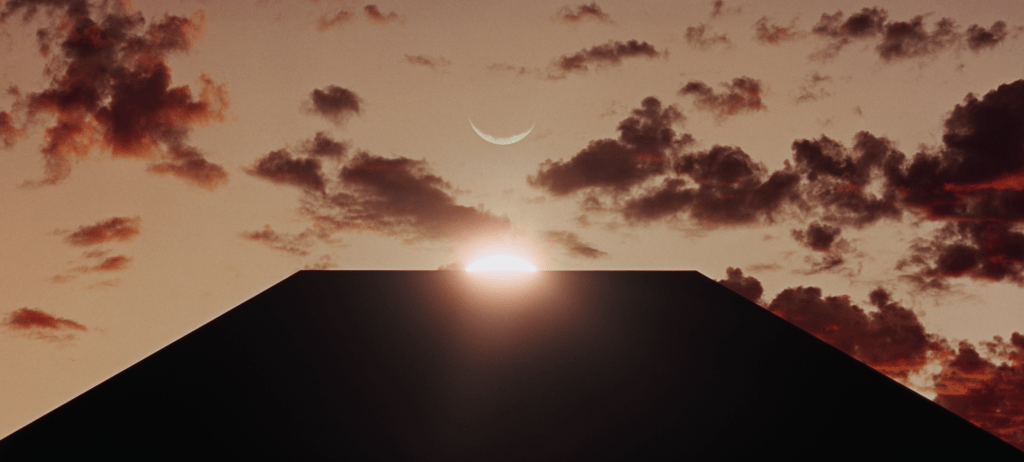
It is nearly impossible to separate 2001: A Space Odyssey‘s use of “Thus Spoke Zarathustra” from its entrenchment in popular culture. From The Simpsons to Barbie, the 19th-century tone poem by Richard Strauss has been lampooned in movies, television, music—even sporting events. Stanley Kubrick employs its roaring fanfare three times in 2001 to mark the evolutionary leaps that are triggered by the monolith. Kubrick initially intended “Zarathustra,” like all of the classical music in the film, to be a temp track until it would be substituted by Alex North’s original score. At an early preview of the picture, however, North discovered that none of his music made it into the final cut. The composer must have been gobsmacked, but it was the right call.
(See more in The 10 best mindfuck films and The 10 best films about artificial intelligence.)
Honorable mentions: “American Girl”—Tom Petty, from One Battle After Another (2025, dir. Paul Thomas Anderson); “Blue Moon”—Sam Cooke, from An American Werewolf in London (1981, dir. John Landis); “A Change Is Gonna Come”—Sam Cooke, from Malcolm X (1992, dir. Spike Lee); “Cat People (Putting Out Fire)”—David Bowie, from Inglourious Basterds (2009, dir. Quentin Tarantino); “Day-O (The Banana Boat Song)”—Harry Belafonte, from Beetlejuice (1988, dir. Tim Burton); “Diamonds”—Rihanna, from Girlhood (2014, dir. Céline Sciamma); “(Don’t You) Forget About Me”—Simple Minds, from The Breakfast Club (1985, dir. John Hughes); “Dry the Rain”—The Beta Band, from High Fidelity (2000, dir. Stephen Frears); “Fire and Rain”—James Taylor, from Running on Empty (1988, dir. Sidney Lumet); “In Your Eyes”—Peter Gabriel, from Say Anything… (1989, dir. Cameron Crowe); “Love My Way”—Psychedelic Furs, from Call Me by Your Name (2017, dir. Luca Guadagnino); “Midnight, the Stars and You”—Ray Noble & His Orchestra featuring Al Bowlly, from The Shining (1980, dir. Stanley Kubrick); “Riki-Tiki-Tavi”—Donovan, from Barbarian (2022, dir. Zach Cregger); “Shitlist”—L7, from Natural Born Killers (1994, dir. Oliver Stone); “Still”—Geto Boys, from Office Space (1999, dir. Mike Judge); “Tubular Bells, Part I”—Mike Oldfield, from The Exorcist (1973, dir. William Friedkin); “Unchained Melody”—The Righteous Brothers, from Ghost (1990, dir. Jerry Zucker); “Wake Up”—Rage Against the Machine, from The Matrix (1999, dir. Lana Wachowski and Lilly Wachowski); “We’ll Meet Again”—Vera Lynn, from Dr. Strangelove or: How I Learned to Stop Worrying and Love the Bomb (1964, dir. Stanley Kubrick); “Where Is My Mind?”—The Pixies, from Fight Club (1999, dir. David Fincher)


13 responses to “The 20 best needle drops in film”
[…] Royal Tenenbaum (Gene Hackman) is a scoundrel. A disbarred attorney and ex-convict, he is crooked, tactless, and can’t think beyond his own self-interest. As a parent, Royal is neglectful when not outright belittling to his brilliant adult children (Gwyneth Paltrow, Ben Stiller, and Luke Wilson). Despite having deserted his family long ago, he reevaluates things when he finds himself homeless. He returns to his estranged family’s New York City townhouse and schemes to scuttle the planned marriage of his ex-wife (Angelica Huston) to a kindly widower (Danny Glover). Hackman resented that Wes Anderson had specifically written the part for him, considering it presumptuous for the filmmaker to think he knew the actor’s range. Hackman was miserable during the making of The Royal Tenenbaums and made sure everyone else was, too, bullying Anderson throughout and grumbling that the movie would wreck his career. Perhaps his on-set irascibility worked to the film’s benefit. Hackman’s comic performance is magnificent; his Royal is a self-serving louse, but still open to redemption.(See more in The 20 best needle drops in film) […]
LikeLike
[…] the investigators become victims of the Zodiac, too—only they live to tell the tale.(See more in The 20 best needle drops in film, The 15 best neo-noir films and The 10 best journalism […]
LikeLike
[…] the whole “detective or pervert” question is a distinction without a difference.(See more in The 20 best needle drops in film and The 15 best neo-noir […]
LikeLike
[…] Trainspotting burrows deeply into the hopeless desperation of life as a junkie. No scene in this searing comedy-drama from director Danny Boyle and screenwriter John Hodge better illustrates the depraved lengths an addict will go to than when Ewan McGregor’s Renton, weathering the effects of heroin withdrawal, must rush to the closest bathroom stall. Not just any stall, mind you, but––as a handwritten sign on the door indicates–– “the worst toilet in Scotland.” Without a seat, the toilet is overflowing with what appears to be months of unflushed shit. An undeterred Renton plops himself down and plops out his contribution to the retch-inducing sight, realizing too late he has accidentally evacuated opium-filled suppositories. And so he drops to his knees to fish for the lost contraband, his head eventually submerging into the toilet before the rest of his body follows suit. Fortunately for McGregor, varieties of chocolate served as the brown sludge. Boyle reminisced years later that the set smelled of chocolate, “kind of like a confectionery.”(See more in The 20 best needle drops in film.) […]
LikeLike
[…] While 19th century outlaws Robert LeRoy Parker (aka Butch Cassidy) and Harry Alonzo Longabaugh (aka the Sundance Kid) likely didn’t elicit swoons from those they robbed, Hollywood wisely chose to transform the real-life criminals into perfect specimens of masculine beauty. Directed by George Roy Hill from William Goldman’s Oscar-winning screenplay, Butch Cassidy and the Sundance Kid mainly showcases the ineffable magic that comes from being Paul Newman and Robert Redford. The movie is laidback, funny and wistfully elegiac—traits not typically associated with Westerns. Nevertheless, the camaraderie of the rogues (they even share a lover in the comely form of Katherine Ross) is squarely in keeping with the genre. (See more in The 20 best needle drops in film.) […]
LikeLike
[…] Martin Scorsese had long kicked a cocaine habit by the time he made Goodfellas. That’s worth noting because otherwise one might think this hyper-kinetic rollercoaster is the product of a coke binge. Like the devil’s powder, Goodfellas is enthralling, seductive, and potentially addictive. Unlike cocaine, repeated exposure isn’t bad for you. The picture, based on Nicholas Pileggi’s nonfiction Wiseguy, chronicles the life of gangster-turned-federal informant Henry Hill. As a child growing up in Brooklyn, he is enamored of the bigshot hoodlums in his neighborhood flashing wads of cash. He winds up working for one, Paul Cicero (Paul Sorvino), and becomes fast friends with fellow mobsters Jimmy Conway (Robert De Niro) and Tommy DeVito (Joe Pesci). “The movie took gangsters off the wobbly pedestal popular culture erected in honor of The Godfather movies and made them into something like ‘regular’ guys again,” Glenn Kenny writes in Made Men: The Story of Goodfellas. The cast is extraordinary across the board, though Pesci’s portrayal of the unhinged Tommy steals every scene and earned a Best Supporting Actor Oscar. The big and bombastic envelops itself in the obscene extravagance of the gangster lifestyle. Its episodic structure allows Scorsese to flex in several bravura set pieces. Henry and his future wife Karen (Lorraine Bracco) visit the legendary Copacabana in an impressive, unbroken traveling shot immersing us in the excitement of the moment. A lengthy montage of the day that led to Henry’s arrest is a dazzler punctuated by rock ‘n’ roll needle-drops and Thelma Schoonmaker’s breakneck editing. In illustrating both the evil of organized crime and its undeniable appeal, Goodfellas is the most daring—and perhaps most honest—of morality tales.(See more in The 20 best needle drops in film.) […]
LikeLike
[…] For his second film, Paul Thomas Anderson turned to a topic that had intrigued him ever since he found his father’s secret pornography stash as a kid. Boogie Nights, a sprawling journey through the porn industry of the 1970s and ‘80s, chronicles the rise and fall of Dirk Diggler (Mark Wahlberg), an unusually well-endowed busboy languishing in the San Fernando Valley until his discovery by adult-movie impresario Jack Horner (Burt Reynolds). Loosely based on porn star John Holmes, the character of Diggler had rattled around in Anderson’s head since his teen years. “I love pornography just as much as it completely disgusts and completely depresses me,” the director said shortly after the movie’s release. “The back half of the movie is a sort of punishment for those fun and games. It’s my own guilty feelings about pornography.” Taken in its entirety, however, Boogie Nights is exhilarating: sexy, funny, operatic and drenched in nostalgia (the fashions! the music! the drugs!). The terrific cast includes several actors Anderson would work with again, including Julianne Moore, John C. Reilly, Philip Seymour Hoffman and William H. Macy. Also memorable: real-life porn star Nina Hartley as Macy’s sexually unfettered wife. Reynolds, for his part, hated the picture and fought with Anderson on set, but still wound up earning an Oscar nomination for Best Supporting Actor. From its bravura opening tracking shot onward, Boogie Nights heralds the arrival of a major filmmaker in Anderson. Peel away the virtuosic camerawork and assortment of oddball characters, however, and at the movie’s core are broken people from broken homes creating their own family.(See more in The 20 best needle drops in film.) […]
LikeLike
[…] how he handled being rejected by a woman. Redford didn’t understand the concept.(See more in The 20 best needle drops in film and The 20 best kiss scenes in […]
LikeLike
[…] 2001: A Space Odyssey is a cinematic Rorschach test. You can analyze it frame by frame and argue over its meaning, or you can sit back and just take in the spectacle. From its “Dawn of Man” opening sequence to its head-scratcher of an ending, Stanley Kubrick’s magnum opus invites all manner of interpretation. Some themes are more obvious. Scripted by Kubrick and science-fiction giant Arthur C. Clarke, the movie explores humanity’s relationship with technology, whether it is an animal bone for clobbering foes or a massive spacecraft sailing through space—images forever linked through perhaps the most famous match cut in cinema history. The special effects by Douglas Trumbull remain impressive even in today’s world of CGI wizardry. The penultimate scene, in which the astronaut David Bowman (Keir Dullea) is pulled into a new dimension near Jupiter, is a dazzling collage of color, light, and sound—right up until he enigmatically winds up in an elegantly furnished bedroom suite fit for Louis XVI. “The connections of this passage with narcotic experience has won it a cult following, but its effects hold good in the realm of allegory, too,” write Alexander Walker, Sybil Taylor, and Ulrich Ruchti in Stanley Kubrick, Director: A Visual Analysis. “Bowman becomes a part of all he experiences.” Wrestling with allegorical implications is well and good, of course, but, as many a moviegoer in 1968 could attest, the film could be just as enlightening on hallucinogens. (See more in The 10 best films about artificial intelligence and The 20 best needle drops in film.) […]
LikeLike
[…] The humans in 2001: A Space Odyssey often come off as emotionally remote (cavemen excluded). It is no coincidence, then, that the most interesting entity in Stanley Kubrick’s opus is the HAL-9000 (voiced by Douglas Rain), the artificial-intelligence system of the Discovery One spaceship headed to Jupiter. HAL, as it is better known, is stuck with the company of two of the most wooden astronauts in the universe, Dave Bowman and Frank Poole (Keir Dullea and Gary Lockwood, respectively). When they spot what appears to be a malfunction by HAL, the pair confer privately in a soundproof pod—or so they think—on how to dismantle it. But HAL discovers their plan and strikes first, killing Poole before attempting to do the same to Bowman. Christiane Kubrick, the director’s widow, told Space Odyssey author Michael Benson that her husband was adamant HAL’s eventual shutdown be depicted as a death. “It was very important to him that the computer suffers when he (Bowman) takes these bits of the brain,” she said, As HAL’s voice slows to a crawl, it warbles “Daisy Bell (Bicycle Build for Two)”—a song learned in its infancy—in an accelerated state of decay. HAL’s demise, incidentally, is the last stop before humankind’s next evolutionary metamorphosis.(See also The 10 best mindfuck films and The 20 best needle drops in film.) […]
LikeLike
[…] “I wanted Goodfellas to move as fast as a trailer, or the opening of [Truffaut’s] Jules et Jim, and to go on like that for two hours,” Martin Scorsese said of his approach to his 1990 masterpiece, as quoted in Mary Pat Kelly’s Martin Scorsese: A Journey. He opens his crime epic of mobster-turned-informant Henry Hill (Ray Liotta) with the force of a baseball bat to the knees. Three men in a Pontiac are driving a remote stretch of New York highway late at night when they hear a clattering from the rear of the car. Henry, driving, asks the others if he hit a deer. They pull over to inspect. The commotion is coming from the trunk. They open it: it’s a guy they thought they’d already killed—viewers will later learn about Billy Batts (Frank Vincent) and his big fucking mouth—and he’s still alive. Henry’s passengers, Jimmy and Tommy (Robert De Niro and Joe Pesci, respectively), finish the job. As Henry shuts the trunk, he tells us in voiceover one of the most instantly recognizable opening lines in moviedom: “As far back as I can remember, I always wanted to be a gangster.” Tony Bennett’s booming “Rags to Riches” kicks in, and Goodfellas charges straight ahead, a mob movie with a rock ‘n’ roll pulse(See more in The 10 best gangster films and The 20 best needle drops in film.) […]
LikeLike
[…] A suburban dad has a heart attack while watering his lawn. He topples to the ground and the camera burrows into the subterranean layers of earth until we land in a frenzied insect world, chaotic and cacophonous. That dichotomy between placidly respectable suburbia and monstrosity simmering beneath the surface is the key metaphor of David Lynch’s masterpiece. Blue Velvet then shifts to the stricken man’s son, guileless Jeffrey Beaumont (Kyle MacLachlan), who is home from college to care for his father. On a walk through the neighborhood, Jeffrey comes across a human ear, and the mystery it promises is something that he and his equally sweet-as-pie neighbor (Laura Dern) are compelled to investigate. If you have seen Blue Velvet, you know the sinister rabbit hole that follows, from Isabella Rossellini as a sultry torch singer to Dennis Hopper as the evilest sumbitch to ever wear an oxygen mask. Lynch loves the dance between innocence and evil. Blue Velvet might just be the cinematic apex of that thematic obsession, as vivid as a severed ear in a nice neighborhood.(See more in The 10 best films about voyeurism, The 20 best opening scenes in film, and The 20 best needle drops in film.) […]
LikeLike
[…] Sometimes revisionist history is just too irresistible. No one understands that better than Quentin Tarantino, whose reimagining of World War II would later lead him to perform a similar rescue of Sharon Tate. Inglourious Basterds unfolds as a parade of extraordinary set pieces detailing a secret squad of badass Jewish-American soldiers whose mission is to scalp Nazis. “You know somethin’?” Brad Pitt’s Lt. Aldo Raine says as he admires the carved-up forehead of a particularly vile Nazi, SS Col. Hans Landa (Christoph Waltz, in an Oscar-winning performance). “I think this might just be my masterpiece.” The line also serves as Tarantino’s own boast for Inglourious Basterds, and it would be bluster if it didn’t also happen to be true. The film’s biggest jaw-dropper—the fabrication that stunned audiences at the time—has a vengeance-seeking Jewish theater owner, Shosanna Dreyfus (Mélanie Laurent), setting fire to a movie house packed with Nazi bigwigs while machine gun-wielding “basterds” fill the Führer with more holes than a sieve. A few years after the picture’s release, I was at a military museum exhibiting a number of Hitler’s personal items seized by U.S. troops. A man nearby pointed out the artifacts to his two young children. “You kids know what happened to Hitler, right?” he asked rhetorically before confidently answering his own question. “Military got him.” If only it were so. One of history’s most monstrous killers took his own life as Soviet forces closed in on his Berlin bunker. I couldn’t help but wonder if this mistaken dad had seen Inglourious Basterds.(See more in The 20 best opening scenes in film and The 20 best needle drops in film.) […]
LikeLike